Up next in 10



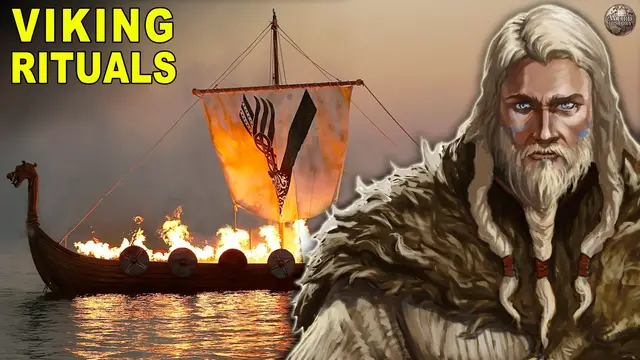
There were some pretty unusual Viking rituals practiced from the late 8th century into the late 11th century. It’s no secret that Vikings were fierce warriors with a reputation for raiding nations and brutalizing their inhabitants. These intense, seafaring Scandinavians would slaughter dozens and perform some pretty severe ritualistic executions. What’s known is that the Viking age is littered with some extreme rituals from the Norse religion but also a few oddball traditions that Vikings practiced exclusively.
Show More Show Less View Video Transcript
0:00
It's no secret that Vikings were fierce warriors with a reputation for raiding nations and
0:06
brutalizing their inhabitants. But these ruthless pirates had a superstitious side as well
0:12
They believed in omens, used good luck charms, and from the late 8th century into the late
0:17
11th century, they practiced some pretty unusual rituals. So today, we're going to take a look at some unusual Viking rituals that might surprise you
0:30
Like most people of their era, Viking warriors were pretty superstitious, and so they often
0:37
practiced magic battle rituals. These rituals entailed a number of practices. First, they would
0:43
look for and interpret any possible omens and respond appropriately to each one. Then, they would
0:49
be sure to mark every one of their weapons that would be taken into battle with enchanting symbols
0:54
The symbols represented strength, luck, and courage. Finally, they would make battle sacrifices
0:59
which had to be strong animals such as boars, stallions, or bulls
1:04
It's hard to say how much these steps actually helped in battle, but they probably couldn't have hurt
1:09
So it's easy to see why they bothered. Every culture has its own standard of beauty
1:19
and the Viking rulers of the sea were no different. What were their standards like
1:23
Well, remember when you saw the Marvel superhero movie Thor and the title character was portrayed as an Adonis
1:29
with flowing blonde hair. And you thought that was just a Hollywood movie star thing
1:34
Well, it wasn't. While the mythological Thor was traditionally thought of as having red hair, Viking men tended to favor blonde locks
1:43
In fact, Viking men preferred blonde hair so strongly that they'd use harsh soaps with a high-lie content
1:49
to strip the hair of its natural color, effectively bleaching it. They would also dye their beards to match
1:55
These soaps also killed off head lice, so they accomplished two different hair treatments
1:59
with one product, kind of like the OG head and shoulder shampoo and conditioner in one
2:09
Yule was a pagan winter festival that was traditionally observed by Germanic cultures
2:14
Modern academics believe it to be connected to the stories of the god Odin, the folkloric myth
2:19
of the wild hunt, and the Anglo-Saxon event known as Modranit. When the Germanic pagans became
2:25
Christians, the Yule celebration was Christianized as well. In fact, the Yule celebration included
2:31
many customs now widely recognizable as elements of Christmas celebrations, like the familiar Yule log wreaths mistletoe and the Yule tree which is a forerunner of the Christmas tree Another element of Yule which wasn adapted into a Christmas tradition was human sacrifice
2:48
Every ninth year during the Yule celebration, it was customary for Swedish kings to sacrifice
2:53
men at the Temple of Uppsala. Nine heads would be offered to the gods, with the bodies hanging
2:58
out in the temple's sacred grove. This would go on for nine days, totaling 81 sacrifices that
3:04
would be accompanied by feasts and Yule festivities. Hmm, that story would make an interesting Christmas carol
3:16
In Norse literature, the blood eagle is described as a ritualized form of execution
3:21
performed as a sacrifice to the god Odin. The ritual began with the restraint of the victim
3:27
who was face down as the shape of an eagle with its wings outstretched
3:31
was cut into his back. Each rib was then meticulously separated from the spine
3:36
with a sharp instrument. Once all the ribs were detached, they were pulled outward to create the illusion
3:41
of protruding wings. While still alive and in agony, the victim's lungs
3:46
were then pulled from the gaping hole and set over his wings. This gave the illusion that his wings fluttered
3:52
as he took his final breaths and died. Horrific sentences like the blood eagle
3:56
were typically reserved to punish individuals without honor or to exact vengeance on a mortal enemy
4:02
Well, maybe they were. The catch here is that historians aren't quite certain
4:05
whether this method was ever actually performed on anyone, or if it was just spread as a story to strike fear
4:11
into the hearts of enemies, which seems like it would be pretty effective at. On the one hand, scholars of the age
4:17
describe the ritual in such great detail that it's hard to believe it didn't happen
4:20
But on the other hand, there's no unambiguous historical evidence that anything like the Blood Eagle ever really happened
4:31
You might be thinking that Sex and Sacrifice is a Marcy Playground song that peaked at number
4:38
eight on the Billboard charts in 1997, but that was sex and candy. No, the sex and sacrifice we're
4:44
talking about here is far, far more disturbing than that song. See, after the death of a chief
4:51
one of his slave girls would volunteer to join him in the afterlife. Volunteer being a relative
4:56
term when slavery is involved. But regardless of how voluntary it really was, in order for her to
5:02
participate, a very, very disturbing ritual had to take place first. To begin with, the girl was
5:07
looked after and continuously intoxicated with various drinks, while cremation ceremony preparations were made. The girl would then partake in sexual rites, which is a euphemistic
5:17
way of saying that she would have sex with every man in the village We guessing this custom might have been invented by a Viking dude After that she would be strangled The village matriarch then stabbed her and her body was placed with that of the chief on a wooden ship
5:31
set on fire, and sent out to sea. This ensured that she would serve her master forever in the afterlife
5:37
As disturbing as that sounds to modern ears, the sexual rights embodied the Viking way
5:41
of transforming the chieftain's life force. For all intents and purposes, a Draug is North mythology's version of what we would call
5:55
a zombie. But it's not just any zombie. It's a big, brutal Viking zombie with fabulously
6:00
liedoc locks and a horrendous stench who likes to wreak havoc by murdering people
6:06
killing animals, and destroying property. It sounds pretty unstoppable, but there are
6:11
actually several practices to prevent this being from rising. Hiding twigs in the clothing of the
6:16
recently deceased is said to work. Placing an open pair of scissors on their chest or driving needles
6:21
through the bottom of their feet wore off draugs as well. There were also ways to try and disorient
6:26
the creature, which included lifting and lowering the coffin in three different directions and
6:31
making sure the body's big toes were tied together. Sounds like cheap insurance against giant zombies
6:41
The bloat was a blood sacrifice to the gods to show gratitude, which is why it was performed
6:48
publicly multiple times per year. The sacrifices were animals like horses and pigs, though they
6:53
could also sometimes include prisoners of war. Typically, they would be sliced over an altar of
6:58
stones. The meat would then be boiled in large cooking pits that could be indoors as well as
7:03
outdoors. The participants would then sprinkle the collected blood, which was thought to have
7:08
special powers, on walls, statues of gods, and sometimes even themselves. Some of that blood was
7:14
also collected in a bowl and then passed around and sipped while chanting ensued. Blood, however
7:19
was not the only beverage available. Beer and mead were also usually consumed. Next, they'd pass
7:25
around the carcass for more chanting before dossing it with its own blood. Naturally
7:29
the level of gratitude correlated with the size of the kill. Berserkers were warrior shamans who were said to fight in a trance-like fury, but they had to
7:44
undergo a symbolic death and rebirth to unlock their powers. To achieve this, they were put in
7:49
dangerous situations in the wild and were expected to live as their totem animal would in the
7:54
wilderness. Whether bear or wolf, they'd have to hunt and raid nearby towns as a beast would
7:59
They purposely stripped themselves of all humanity and morals to become barbaric on a physical and emotional level They went berserk as Beast did on the battlefield with no fear nor armor Reports hold that these warriors would foam at the mouth
8:14
howl like animals, and even gnaw at the edges of their iron shields. Some of the sagas even held that berserkers had shapeshifting power
8:21
that allowed them to literally change into bear form. One such shapeshifter is the legendary Bodvar Bialaki
8:28
a character from the saga of Hrov Krakki, which dates to at least the 14th century. According to the saga, men saw that a great
8:36
bear went before King Hroth's men, keeping always near the king. He slew more men with his forepaws
8:43
than any five of the king's champions. Interestingly, some scholars believe that
8:47
Bialki may be a cognate character to the English hero Beowulf, whose name means Beowulf, which may
8:54
be a kenning or poetic way of referring to a bear. That being said, Beowulf himself was not
9:00
a shapeshifter, and the relationship between the two is ultimately unclear. Although the origins
9:06
of the real-life berserkers, whose name means bear shirt and refers to the bearskins they would
9:11
wear as coats, aren't known with certainty, some evidence suggests they started out as a bear cult
9:16
that was once fairly common in northern regions. As viewers who saw our video on Viking hygiene
9:27
might recall, some recent findings suggest Vikings practiced decorative tooth modifications. About two dozen skeletal remains from the Viking era
9:35
have been discovered with horizontal grooves purposely filed into the surfaces of the front teeth
9:41
No one knows exactly what the purposes of those grooves were. One theory holds that they may have indicated victories
9:47
against opponents, like notches in a gun. An alternative theory suggests that the filings were meant
9:52
to intimidate their enemies. It just made the guy look scary as hell. Also unknown is what tools the Vikings used to make the cuts in their chompers
9:59
Slightly more certain is that the cutting was done by a skilled practitioner
10:03
and individuals then probably used various dyes to color in the grooves. It's not fun to think about the daily life of the guy whose job it was to find creative uses for
10:17
human urine. But someone did it. We know because Vikings discovered a way to turn their urine into fire
10:24
Yeah, you heard that right. This transmutation was accomplished by boiling a tree
10:28
bark fungus called touchwood in a pot of urine for days. It was then pounded into a strip of felt-like material
10:35
Because of the sodium nitrate in urine, these fungus bombs smoldered rather than burned
10:40
enabling Vikings to take fire with them wherever they went. It was actually pretty ingenious
10:45
And for the times, it was incredibly useful. That being said, I'm glad someone invented matches