Up next in 10



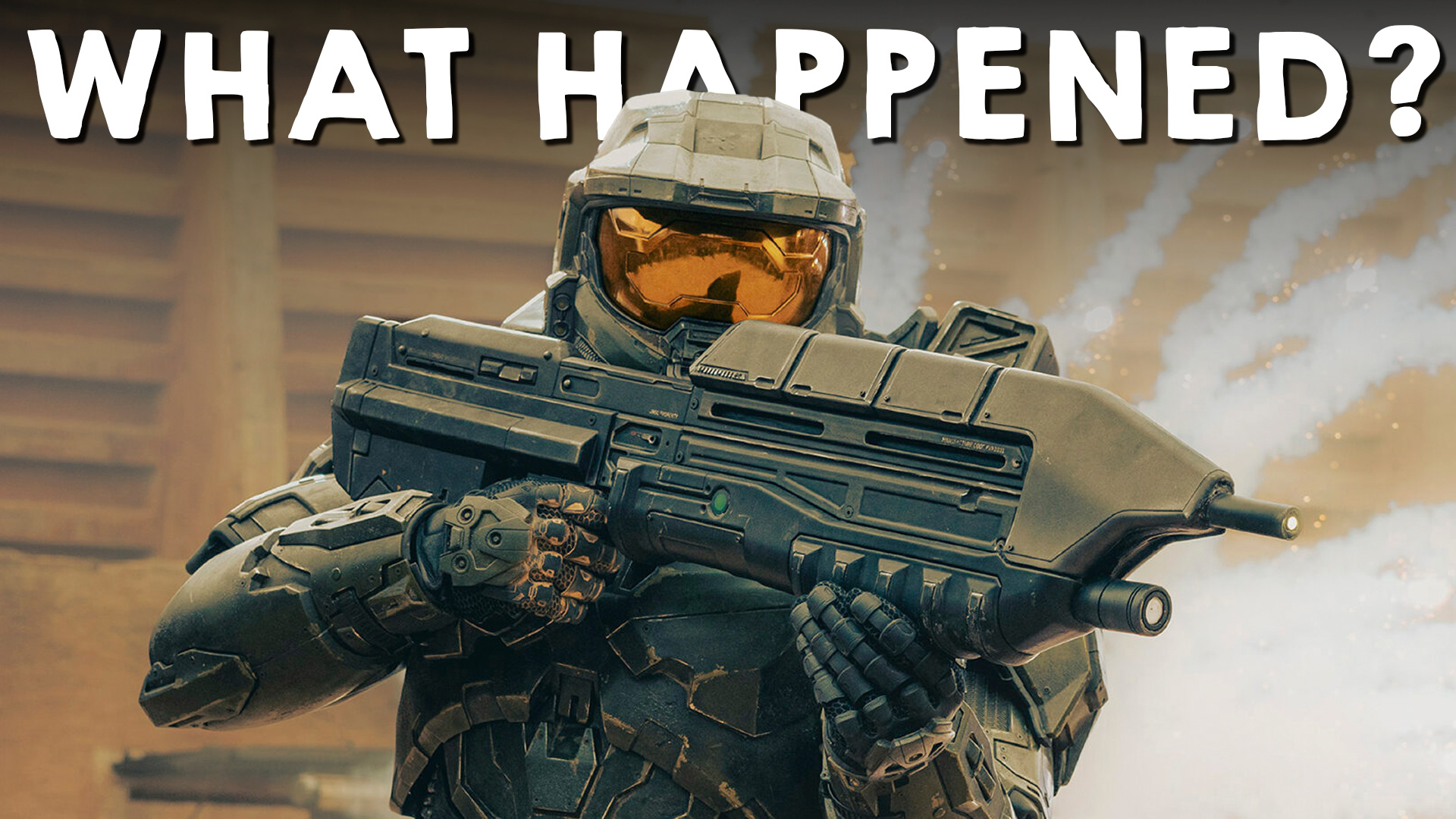
When Halo first dropped on the original Xbox, it changed gaming forever. Instantly becoming one of the most iconic sci-fi franchises of all time. For years, fans begged for a live-action Halo movie or TV show, with big names like Guillermo del Toro, Peter Jackson, and Neill Blomkamp once attached to make it happen. But after decades of hype, Halo: The Series on Paramount+ finally arrived… and completely missed the mark. So what went wrong?
Show More Show Less View Video Transcript
0:00
I will kill you
0:05
That guy is John117, better known as Master Chief. He's the protagonist of Halo, one of the biggest gaming franchises ever to exist
0:17
But you could be forgiven for not recognizing him, because outside of the 2022 Paramount Plus TV series
0:23
he's pretty much defined by the fact that audiences never see him take off his helmet
0:27
It's just one of the many changes the series made to the lore of the Halo universe
0:31
and just one of the many reasons that the Halo TV show completely failed
0:36
Captain Keys. Good to see you, Master Chief. Things aren't going well
0:41
Cortana did her best, but we never really had a chance. Released in November of 2001, Microsoft's militaristic sci-fi first-person shooter, Halo Combat Evolved, was met with overwhelming acclaim
0:53
The series followed the adventures of Master Chief and his AI companion, Cortana
0:57
and even as the first few installments were still coming out, fans were already clamoring for a big-budget movie or television adaptation of the story
1:05
As early as 2003, Rooster Teeth started producing the comedic web series Red vs. Blue
1:10
which was based on the first game. It became so popular. Its voice actors were invited to make cameos in Halo 3 and 4
1:16
and its story was referenced in subsequent games in the series, but it still wasn't exactly what fans had in mind
1:22
2005 saw studios flirt with a live-action movie written by Alex Garland, directed by Neil Blomkamp
1:28
and executive produced by Peter Jackson. But that fell apart after the principals
1:32
couldn't agree on a deal. Then a subsequent Guillermo del Toro-directed version
1:36
failed to make it out of development hell. Years then passed, and the Halo faithful
1:40
began to lose hope. But everything changed in 2013, when it was announced that not only was there
1:46
going to be a Halo TV series, but that it would be executive produced by Steven Spielberg
1:51
The show wouldn't actually be released until a decade later, but some things are worth waiting for
1:55
As it would turn out, the Halo TV series wouldn't be one of them. If you want me dead, you'll need to aim up here
2:03
The first sign something was amiss came in the months before it was released when interviews with the creative team made it clear that the show would reveal Master Chief face early in the run The logic was that in a video game the protagonist is often a blank
2:16
slate so the gamer can imagine themselves as the center of the action. But scripted drama requires
2:20
audiences to relate to the protagonist as a person. And while The Mandalorian proves it's
2:25
not impossible to pull off, it can be much more difficult to do that when the viewer can't see
2:30
the emotions on an actor's face. The announcement drew mixed reactions, but even those fans willing to keep an open mind
2:36
were surprised that the reveal occurred in the very first episode, and that Master Chief would go helmetless
2:42
for most of the first season. As if that wasn't bad enough, the character, as embodied by actor Pablo Schreiber
2:48
turned out to be extremely different from his video game counterpart. In the games, Master Chief is cool, calm, and collected
2:55
His stoicism is occasionally punctured by displays of dry wit, But overall, he's a classic, strong, silent type who always follows orders
3:03
Launch. A well-placed grenade, perhaps. But why? Okay, I'm coming with you
3:08
By contrast, the master chief in the show is emotionally volatile and in a near-constant state of rebellion against his superiors
3:15
It's suggested through exposition that prior to the events of the pilot
3:19
he was more like his video game self. But we never get to see it. Instead, he's been overlaid with an abrasive personality
3:25
that makes him less relatable and harder to like. The first half of the first season is then largely devoted to unpacking Master Chief's backstory
3:33
which is mostly revealed through visions he gets by touching a Forerunner artifact
3:37
with which he has a mysterious connection. He does nothing to earn the information, and the plot moves at a snail's pace
3:43
which isn't ideal for an audience accustomed to first-person shooters. But even if it went faster, it's hard to imagine Halo fans were hoping for a series
3:50
about a sad sack Master Chief coming to grips with his childhood trauma
3:54
and figuring out who he is as a person. It's natural. Memories get muddled, particularly where trauma's involved
4:02
You were so young when we met and so overwhelmed with grief. The Halo franchise isn't exactly known for its delicate exploration of intrapersonal conflict
4:11
or even interpersonal conflicts really It about humanity fight to survive against overwhelming odds and seemingly unstoppable threats But while that works great for a game scripted dramas usually thrive off intra and interpersonal character conflicts
4:24
And to that end, the producers of The Halo Show redesigned the whole universe to emphasize those qualities
4:30
For example, in the game, the United Nations Space Command, or UNSC, is a mostly noble organization
4:36
In the show, however, it's, at best, morally gray. Its leaders have a greater awareness of the ethical compromises that lay behind the Spartan program
4:44
and they're not above using the war as an excuse to occupy space colonies that don't want to join with them
4:49
or executing rebellious children who won't get with the program. This is partially accomplished through the original character Quan Ha
4:55
a teenage insurrectionist raised by the leader of an anti-UNSC rebellion. She joins forces with Master Chief after he spares her from execution
5:03
but otherwise seems to exist mainly to establish that, unlike in the games
5:07
humanity isn't united in its fight against the Covenant. The show also ratchets up the interpersonal conflict
5:12
by drastically reshaping the relationship between Master Chief and Cortana. In the games, she's his willing companion
5:19
and arguably the closest thing he has to a love interest. In the show, however, Cortana is forced on Master Chief by Dr. Halsey
5:26
to quell his suddenly rebellious tendencies. Her job is to spy on him and eventually take control of his body
5:32
Given this arrangement, Master Chief is fairly ambivalent, and occasionally even hostile, about being saddled with Cortana
5:38
Go disappear! And it's hard to blame them. Their relationship couldn't possibly be more different from what it is in the games
5:46
Other continuity-shattering changes include the original character, McKee, a human raised by and allied with the Covenant
5:53
In the games, the Covenant hate humanity with a religious fervor. They even consider Master Chief to be an actual demon
5:59
The inclusion of McKee among them serves no obvious point to the narrative
6:03
and as a result, comes off as a half-hearted attempt to save money on VFX and putting her
6:08
at the center of most Covenant-related action. The show attempts to justify the change by
6:13
establishing that McKee, like Master Chief, is a blessed one, with a special ability to interact
6:18
with Forerunner technology McKee also figures prominently into what is widely considered the low point a scene in Season 1 Episode 8 during which Master Chief has sex with her while she being held by the UNSC as a prisoner of war
6:32
The ethically uncomfortable sequence, which does nothing to advance the plot, is the first time in the entire Halo franchise we see Master Chief sexually interact with anyone
6:41
and fans overwhelmingly found it unearned and uncomfortable. Much like the moment we get a look at Master Chief's bare butt in Season 1, Episode 3
6:49
the sex scene suggests a desire on the producer's part to make the material more adult
6:53
But since the scene was totally unnecessary to the storyline, it just made the show feel more juvenile
6:58
And we're really just scratching the surface here. The show's dialogue was mostly terrible
7:03
I remember losing her. I just... What? I don't feel anything. Its action was flat, and thanks to an obviously insufficient budget
7:12
its special effects grew increasingly clunky as the series rolled on. Perhaps because all that was already apparent by the end of season one, season two was handed off to a new showrunner, David Wiener
7:23
Wiener attempted to course correct by making the series grittier, but it was too little too late, and fans tuned out
7:29
If you're wondering where it all went so very wrong, we refer you to the words of season one showrunner Stephen Cain
7:35
who told Variety, we didn't look at the game, we didn't talk about the game, we talked about the characters and the world
7:40
So I never felt limited by it being a game. In hindsight, maybe he should have
7:45
But instead of sticking to the source material, Kane and his team decided they would be better off drawing from it
7:51
to create a new story in much the same way the Marvel Cinematic Universe
7:54
drew from decades of comics to create its own unique continuity. And we understand that creative instinct
8:00
Video games and TV shows are different mediums with different needs. So adapting a property created for one into the other
8:06
will always entail changing it in some sense or another. But fundamentally, changing the personalities of Halo's main characters was going too far
8:15
Fans waited decades to see the world they love brought to life on film, and instead got a hollowed-out shell of that world
8:21
With the show's failure, it now seems unlikely that we'll ever get a faithful adaptation of Halo
8:26
And given there's nobody to blame for that failure other than humanity, it's starting to make us root for the Covenant