0:00
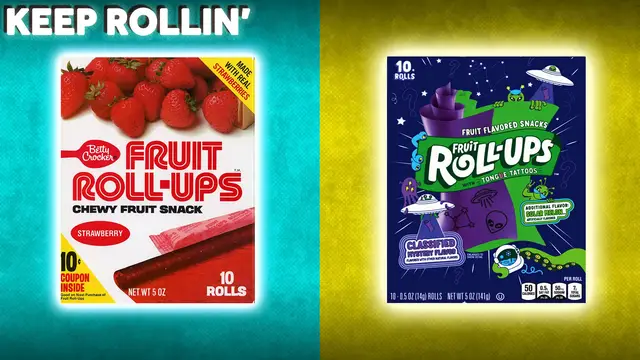
Today, we're rolling out the red carpet to figure out how much fruit is actually in a fruit roll-up
0:05
The fruit roll-ups rollout actually started at the beginning of the 20th century
0:09
In the Little Syria neighborhood of New York City, Syrian immigrant George Shalhoub began to sell apricot paste imported from his home country
0:16
But its real name was Amardine. Amardine continued to be a local favorite until the 1940s, when the entire neighborhood of Little Syria was demolished to make room for New York's Brooklyn Battery Tunnel
0:26
Many businesses, including Shalhoub's sweet shop, were forced to relocate to Brooklyn
0:31
A new location also meant a new name for George Shalhoub & Son. The titular son had grown up to be a man with a son of his own, and so the shop became Joseph Shalhoub & Son
0:40
The new son was Louis Shalhoub. Louis was tired of snipping apricot paste off giant sheets in his family store, and dreamed of selling Amberdine on a larger scale
0:48
He and his wife Madeline went about the arduous process of hand-cutting the paste into small circles
0:53
hanging them to dry, rolling them up, and packing them for sale in single servings
0:58
Lewis named the fledgling manufacturing business Joe Ray. In 1960, they sold their first individually wrapped fruit leather, which they called a fruit roll
1:06
And by the 1970s, the brand was spotlighted in a trade publication
1:10
and Lewis laid out the process of making his popular fruit rolls in surprising detail
1:14
This proved to be good news for fruit roll-up fans, but bad news for Joe Ray
1:18
Because after years of research and detailed production plans, General Mills was about to rock the world with its own version of Louis Shalhoub family recipes General Mills finally released its fruit roll in 1983 Rather than a simple apricot puree General Mills fruit roll were primarily made
1:35
from pear puree concentrate, maltodextrin, sugar, natural flavors, partially hydrogenated soybean oil, citric acid, sodium citrate, artificial colors, and pectin, which is a
1:45
naturally occurring gelling agent found in fruits. Like many supposedly healthy foods of the 80s and 90s, fruit roll-ups were eventually
1:52
found to be less than ideal when it came to their sugar content. In 2011, the Center for Science and
1:57
the Public Interest sued General Mills over its misleading marketing. CSPI claimed that General
2:05
Mills advertised fruit roll-ups as nutritious and healthy, when in reality, they contained about as
2:09
much nutritional value as a serving of gummy bears. CSPI argued that fruit roll-ups weren't so much
2:15
fruit snacks as they were fruit-inspired candy, and that argument ultimately proved to be completely
2:20
true. We know fruit roll-ups aren't great for you, but they've got fruit in their name. Just
2:24
how much real fruit is in one of those delicious plastic-wrapped sheets? The unfortunate answer is
2:30
not much. That same 2011 lawsuit, the Center for Science and the Public Interest pointed out that
2:35
there were actually no strawberries in the strawberry-flavored fruit roll-up. Zero. And so
2:40
General Mills is not allowed to print pictures of real strawberries on its fruit roll-ups
2:44
packaging. The ingredients in modern fruit roll-ups are surprisingly similar to the ones
2:48
found in the original rollout. They still contain around seven grams of sugar
2:52
and they're just as tasty as they were in 1983