Up next in 10



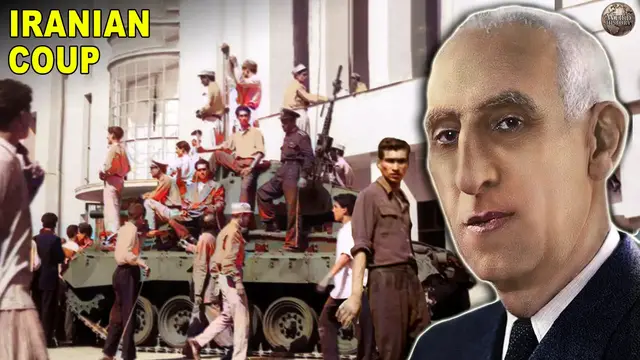
For decades, knowledge of America's role in the 1953 Iran coup, which led to the ejection of the country's democratically elected Prime Minister Mohammad Mossadegh and the installation of a despotic shah, was fragmented and vague. However, when CIA documents were declassified in 2000 about what it called Operation Ajax, it became clear American and British agents played a central role in the Iran coup d'état.
Show More Show Less View Video Transcript
0:00
In the year 2000, the CIA declassified documents that made it clear American and British agents
0:05
played a central role in the 1953 coup d'etat that led to the ejection of Iran's democratically
0:12
elected prime minister and the installation of a despotic shah. Iranian resentment over this
0:18
tampering culminated in the 1979 Islamic Revolution, and the rapport between the U.S
0:23
in Iran has never been the same. So today, we're going to take a look at the 1953 coup
0:30
that ruined the US-Iran relationship forever. By 1953, the CIA and British government had developed a plan to oust Iranian Prime Minister
0:46
Mossadegh. The success of that plan rested on convincing Iran's current Shah
0:51
Mohammed Reza Pallavi to seize power while a fake prime minister, Vazorloh Zahidi, was appointed
0:58
The CIA's Near East and Africa division chief, Kermit Roosevelt, wrote that his organization
1:03
wanted Pallavi to stand fast as the CIA stirred up popular unrest, and then as the country lurched
1:10
toward chaos to issue royal decrees dismissing Dr. Mossadegh and appointing General Zahidi
1:15
prime minister. The CIA wanted to produce such pressure on the Shah that it would be easier for
1:20
him to sign the papers required of him than it would be to refuse. Officials connected to the
1:25
agency held numerous meetings with both Pahlavi and conservative factions of the Iranian government
1:31
to exert their influence. It took all summer, but the Shah finally agreed to the plan on August 13th
1:37
The CIA may have needed the Shah's approval for their plan to work, but they weren't in the mood
1:41
to wait around for it before getting started. So along with the British government, the American
1:45
Intelligence Agency began unrolling a propaganda campaign all over Iran and the world to discredit
1:51
Mossadegh's party. In May of 1953, Kermit Roosevelt paid newspapers and journalists to
1:56
publish Grey Propaganda, which was the CIA's name for spreading lies and unflattering caricatures
2:02
of Mossadegh. One unnamed newspaper was paid $45,000 to aid in bringing the Shah to the side
2:08
of Western interests. As Roosevelt later wrote, the money was granted in the belief that this
2:12
would make the Shah's organ amenable to our purposes. You can pause the video now and put your Shah's organ jokes
2:18
in the comments below. Anyway, according to author Stephen Kinzer of All the Shah's Men
2:24
An American Coup and the Roots of Middle East Terror, the anti-Musadek messaging included claims
2:29
that he was a Jew, a homosexual, a British agent, anything they thought would outrage people
2:35
The demand for these stories was so high that CIA officers in Washington D were contracted to write new articles The CIA efforts paid off and the world braced for a revolution it believed to be brought on solely by Iranian citizens One Associated Press release stated
2:51
unofficial reports are current to the effect that leaders of the plot are armed with two
2:55
decrees of the Shah, one dismissing Mossadegh and the other appointing General Zahidi to replace him
3:00
As if all that wasn't cartoonishly evil enough, declassified documents later showed that the CIA
3:11
hired Iranians to pose as communists in the months leading up to the coup. These fake communists
3:17
threatened religious leaders and executed bombings, creating a further divide between Iran's Islamic factions and Mossadegh's government. Numerous leaders were targeted
3:25
One cleric's home was literally blown up. The reasoning behind this move was simple
3:29
At the time, the tension between the U.S. and Soviet Union was the biggest international conflict in the world
3:35
The CIA and British government wanted Mossadegh's nationalist agenda thwarted by fabricated connections to fanatical communists
3:43
The CIA worked every possible angle to ensure its plan would come to fruition, even digging deep into Iran's complicated political history to find support
3:51
The man chosen to serve as prime minister after Mossadegh, Major General Fazol Zahidi
3:56
was a royalist who pledged allegiance to the Iranian monarchy. Zahidi was a longtime minister whose affiliations with the royalist faction of the Iranian military
4:05
were used to the CIA's advantage. Again, it worked like a charm
4:09
When the coup eventually occurred on August 19th, much of the strong-arming and physical
4:14
acceleration was acted out by the royalist troops aligned with Zahidi and the Shah
4:18
As a bonus, the CIA also knew that Zahidi had a contentious relationship with Western powers
4:24
and they were able to use his reputation to distance themselves from the coup
4:28
In an article on August 20th, the New York Times predicted Zahidi's ascendancy will probably be met
4:33
with mixed feelings by the Western world. Views like this created plenty of room for
4:38
plausible deniability on the part of the agency. On April 16, 1953, the CIA's chief of the Iran branch for the Near East and Africa Division
4:53
wrote a memo to Kermit Roosevelt, which included a list of forces which will play a role in any
4:59
effort to replace Mossadegh and to establish a stable government and evaluation of their
5:03
attitudes. One of the forces listed is Samka, Iran's nationalist political party at the time
5:09
The officer, John Waller, described Sumka as small in size but capable of producing fanatical street fighters
5:15
Sumka, founded in 1951, worshipped and mimicked the Nazi Third Reich And its members were responsible for multiple street altercations all over Tehran By 1952 reports were circulating that both the US and Britain supported Sumca Even though the group had no more than 300 members at its height
5:34
it's possible the CIA backed its efforts financially. As the propaganda spread and mayhem escalated, it became obvious to Mossadegh that forces were
5:50
attempting to overthrow his government. On August 15th, with advance warning, Mossadegh was able to
5:56
prevent the coup from happening by convincing the Iranian military to remain loyal to him
6:00
The Shah fled to Baghdad, and Zahidi went into hiding while Mossadegh's forces detained dozens
6:06
of conspirators. On August 18th, Kermit Roosevelt received a wire from CIA Washington headquarters
6:11
telling him to call the coup off. It read, Operation has been tried and failed, and we
6:17
should not participate in any operation against Mossadegh, which could be traced back to US
6:22
Operations against Mossadegh should be discontinued. Roosevelt's answer was a short one
6:27
No, we're not done here. A rogue CIA agent toppling foreign governments even while being
6:32
ordered not to? Yikes. Despite the cold feet on the part of the CIA brass, the operation succeeded
6:40
The day after Roosevelt received the wire, August 19, Mossadegh was run out of Tehran
6:45
and headlines all over the world celebrated the return of Shah Pahlavi and the freshly
6:49
appointed Prime Minister Zahidi. The coup was a victory, courtesy of massive crowds
6:55
possibly placed in the city through CIA maneuvering. On August 20, CIA official Frank
7:00
Wisner released an internal memo congratulating those who worked on Operation Ajax for their efforts
7:06
I am sure that you are aware of the exceptionally heavy volume of traffic which this operation
7:10
has necessitated, he wrote. Two days after the coup succeeded, both the CIA and British Intelligence Agency sent $5
7:18
million to Zahidi's regime. From the beginning, securing an oil agreement with Zahidi and Shah Pahlavi was the prime aim
7:33
of the coup. And in that regard, the operation was a massive success. It was actually Britain
7:38
that first placed the seed for the Iran coup in 1952. They were worried about Iran's plans
7:43
to nationalize its oil industry. The British government reached out to America for help
7:48
planning and implementing the coup, which was designed to get rid of the nationalist figure
7:52
Mossadegh, who insisted that oil should be nationalized. In a declassified CIA document
7:58
operative John Waller made it clear the US and Britain felt their interests were more important than Iran A new proposal agreement must at least appear to be more generous than any previous one It must not insist upon compensation for years in which
8:11
concession would have covered, he wrote. By 1954, the year after the coup, the privately-owned
8:16
Anglo-Iranian oil company resumed operations without fear of nationalization. It would go
8:22
on to become British Petroleum, or BP, which still exists to this day. While Zahidi was promoted as
8:27
Mossadegh's replacement, it was really Shah Pahlavi who retained power over Iran. He ruled like a
8:32
dictator for the next 25 years. And, according to NPR's Ramtin Arablui, Western powers, including
8:39
the US, didn't really care because he gave them easy access to Iran's oil. Mossadegh was erased
8:44
from Iranian history, and the prime minister's legacy was tainted by disinformation campaigns
8:49
An autocratic ruler, matched with interference from other nations, led to a rise in religious
8:54
and political extremism in Iran. As author Stephen Kinzer told NPR, the 1979 Islamic
9:00
revolution brought to power a fanatically anti-American regime that has spent more
9:04
than 30 years working to undermine American interests all over the world
9:12
The U.S.-Soviet tension was the backdrop for this coup, and it fit into the ideological
9:17
struggles between the Soviet-influenced East and American-British-backed West. the American government knew that success with the Iran coup would give it an edge over the
9:25
Soviet Union. According to historian Mark Gasharovsky, the coup really reinforced the
9:30
Cold War polarization of the region. Of course, that's the reason the United States did it. They
9:35
did it because they were afraid of communist influence in Iran. However, the ultimate results
9:40
were a bit of a mixed bag. Not only did the coup lead to more escalated tension between the U.S
9:45
and the Soviet Union, but they also gave the Soviet Union ammunition against its Western nemesis
9:50
Moreover, as a major influence on the rest of the Middle East, Iran's political climate had a profound effect on other countries around it
9:57
Gasharovsky sees the 1953 coup as a step toward opening the region up to radicalization and
10:03
extremism. What the coup did was to take out the moderate, secular element of Iranian politics
10:08
and enabled radical Islamicists and radical leftists to emerge as key opposition factions
10:13
in place of it in the 1960s and 70s. Since the 1979 Islamic Revolution
10:19
the coup has been in vote by Iranian leaders when outside countries, particularly Western ones
10:24
attempt to interfere in the country's politics. Mossadegh has also become an anti-colonial icon
10:29
in Iran, viewed as a leader who was not afraid to stand against Western interests
10:34
Today, some experts believe that a failed coup may have led to a drastically different and far
10:39
less interventionist U.S. foreign policy in the 1950s and 60s. But it didn't fail. The CIA went
10:45
on to attempt coups in countries all over the world