0:08
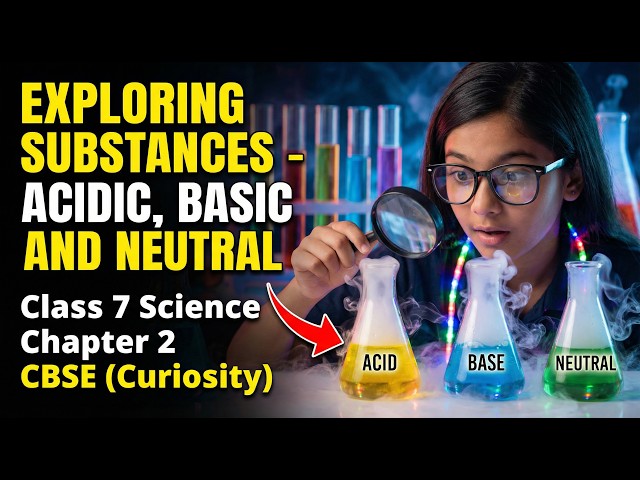
Welcome students. Today we are stepping
0:10
into the colorful world of chemistry to
0:12
explore the substances we use everyday.
0:14
Have you ever wondered why a lemon
0:16
tastes sour? Or why soap feels so
0:18
slippery? Let's begin our adventure by
0:20
learning how to classify the world
0:22
around us into three families: acidic,
0:30
journey starts at a school science fair
0:32
with siblings Ashwin and Kirthy. They
0:34
were given a blank white paper, but when
0:36
a volunteer sprayed it with a mystery
0:37
liquid, a secret message appeared. It
0:40
looked like magic, but it was actually a
0:42
clever chemical reaction involving
0:43
substances we are about to study.
0:50
In our naturebased laboratory, we sort
0:52
substances into three main groups based
0:54
on their chemical personalities. We have
0:56
acids, bases, and neutral substances.
0:59
Understanding these categories helps us
1:01
predict how different materials will
1:02
behave and interact with one another.
1:08
But how do we tell them apart without
1:10
tasting them? We use indicators. These
1:12
are special substances that show a
1:14
noticeable change, usually in color,
1:16
when they touch an acid or a base. They
1:18
are like chemical signals that reveal
1:20
the hidden nature of any solution.
1:26
Meet litmus, our most common acid base
1:29
indicator. It's a natural dye extracted
1:31
from composite organisms called lychans.
1:34
In the lab, we use it most often in the
1:36
form of these handy paper strips, which
1:38
come in two specific colors, blue and
1:45
Here is the litmus rule. Acidic
1:47
substances like lemon juice turn blue
1:50
litmus paper red. On the other hand,
1:52
basic substances like soap or baking
1:54
soda turn red litmus paper blue. It's a
1:57
simple but powerful test to identify the
1:59
chemicals in our kitchen and lab.
2:06
What if the paper doesn't change at all?
2:08
Substances like tap water, sugar
2:10
solution, or salt solution are neutral.
2:13
This means they are neither acidic nor
2:15
basic. Because they lack those reactive
2:17
properties, they don't affect the color
2:18
of either red or blue litmus paper.
2:25
We can often recognize acids by their
2:27
sour taste and bases, by their bitter
2:29
taste and slippery soapy feel. However,
2:31
we must be very careful. You should
2:33
never taste or touch unknown substances
2:35
in a laboratory as many chemicals can be
2:38
poisonous or harmful if handled
2:46
Nature is full of acids we can safely
2:48
eat. Lemons contain citric acid. Amla is
2:51
packed with ascorbic acid. And tamarind
2:53
gives us tartaric acid. Even the vinegar
2:56
in your pantry is acidic containing what
2:58
we call acetic acid. These acids give
3:00
our food its characteristic tang.
3:08
You can even make indicators at home. By
3:10
crushing red rose petals in hot water,
3:12
you create a natural extract. This
3:14
beautiful liquid turns a bright shade of
3:16
red when added to an acid, but it turns
3:18
green when it meets a base like soap.
3:20
Nature really is our science laboratory.
3:27
Turmeric or Haldi is another golden
3:30
indicator. It remains yellow in acidic
3:32
or neutral solutions, but turns reddish
3:34
brown the moment it touches a base. This
3:36
is why a yellow curry stain on your
3:38
shirt turns red when you try to wash it
3:45
Finally, let's use our sense of smell.
3:47
Some substances called olfactory
3:49
indicators change their odor in
3:51
different environments. For example, the
3:54
characteristic smell of an onion is
3:55
destroyed when it is mixed with a basic
3:57
solution like baking soda. It's a
3:59
completely different way to sniff out
4:00
the truth in chemistry.
4:04
Now that we can identify acids and
4:06
bases, it's time to see what happens
4:08
when these chemical opposites collide.
4:10
We are moving beyond identification to
4:12
explore the exciting process of
4:13
neutralization and its many uses in our
4:20
What happens when we mix an acidic
4:22
substance with a basic one? If we add
4:24
basic lime water to acidic lemon juice,
4:26
we see the properties of the acid begin
4:28
to vanish. They effectively cancel each
4:31
other out, leading us to a point where
4:32
the solution is no longer acidic.
4:39
This chemical handshake is called a
4:40
neutralization reaction. When an acid
4:43
and a base are mixed in the right
4:44
quantities, they neutralize each other's
4:46
properties. The resulting solution is
4:48
neither acidic nor basic. It has found a
4:51
perfect chemical balance.
4:56
Scientists represent this reaction with
4:58
a simple equation. Acid plus base
5:00
produces salt and water. But there's a
5:02
hidden guest in this reaction too. Heat.
5:04
Whenever this reaction occurs, energy is
5:07
released into the surroundings.
5:13
Neutralization reactions are exothermic,
5:15
which means they give off heat. Along
5:17
with water, the reaction produces a
5:19
compound called a salt. This salt can be
5:21
acidic, basic, or neutral. But the
5:24
process of creating it is one of the
5:25
most fundamental reactions in all of
5:32
Let's meet the father of modern Indian
5:34
chemistry, Achara Profula Chandra Ree.
5:37
He was a brilliant scientist and social
5:39
reformer who established India's first
5:41
pharmaceutical company in 1901. He
5:43
believed in the power of science to
5:45
advance society and championed learning
5:47
in one's own mother tongue.
5:54
Chemistry is a lifesaver. When a red ant
5:56
bites, it injects formic acid into your
5:58
skin, causing that sharp, stinging pain.
6:01
By applying a mild base like moist
6:03
baking soda, you neutralize the acid and
6:05
get instant relief. It's a laboratory
6:07
reaction happening right on your skin.
6:15
Farmers use chemistry to grow our food.
6:17
If soil becomes too acidic from
6:18
excessive fertilizers, plants struggle
6:21
to grow. To fix this, farmers add lime,
6:24
which is a base. This neutralizes the
6:26
excess acid and creates the perfect
6:28
environment for healthy crops to thrive.
6:34
What if the soil is too basic? In this
6:36
case, we add organic matter like manure
6:39
or compost. As this organic matter
6:41
decays, it releases natural acids. These
6:44
acids neutralize the basic nature of the
6:46
soil, proving that balance is the key to
6:55
Chemistry also protects our environment.
6:58
Many factories produce acidic waste that
7:00
can be deadly to fish and aquatic life
7:02
if poured directly into rivers. By
7:04
neutralizing this waste with basic
7:06
substances first, we prevent
7:08
environmental harm and keep our water
7:10
bodies healthy and safe.
7:16
We've learned so much. From identifying
7:19
substances with indicators like litmus
7:21
and turmeric to solving real world
7:22
problems through neutralization,
7:24
chemistry is everywhere. Next time you
7:26
see a colorful flower or feel soapy
7:28
water. Remember, you're seeing the
7:30
wonderful world of science in action.
7:32
For more stuff, visit our website given
7:34
in the description. Comment below your
7:36
queries and suggestions. Like, share,
7:38
and subscribe. Thanks for watching.