Up next in 10



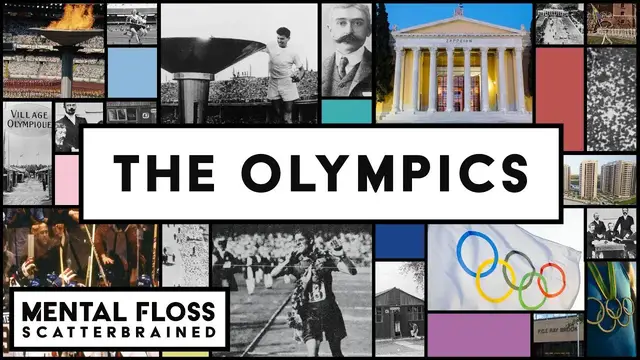
Scatterbrained is a new trivia show in which different hosts do a deep dive into one topic. Today, we're learning all about the Olympics - from the marathon to the Olympic Village to Cool Runnings.
Subscribe for new episodes of Scatterbrained every other Wednesday!
----
Don't miss a video! Subscribe NOW: https://www.youtube.com/@MentalFloss?sub_confirmation=1
About Mental Floss:
Mental Floss is where curious people come for trivia-tastic information. Mental Floss produces lists of fun facts, debunks common misconceptions, and tells untold stories from history, science, culture and more.
Website: http://www.mentalfloss.com
Twitter: http://www.twitter.com/mental_floss
Facebook: http://www.facebook.com/mentalflossmagazine
Store: http://store.mentalfloss.com/ (enter promo code: "YoutubeFlossers" for 15% off!)
Copyright Notice: This video and YouTube channel contain dialog, music, and images that are property of Mental Floss. You are authorized to share the video link and channel, and embed this video in your website or others as long as a link back to this YouTube Channel is provided.
2025 Mental Floss
The Olympics - Mental Floss Scatterbrained | Mental Floss
https://www.youtube.com/@MentalFloss
Show More Show Less View Video Transcript
0:00
Hello and welcome to Mental Floss video
0:02
Today we're going to talk about the Olympics, because the Winter Olympics are beginning soon
0:06
Before we get into the Olympics proper, interesting side note about the Winter Olympics
0:10
It's the only Olympics in which I cannot do any of the sports, even at an extremely amateur level
0:16
Like, I can do most of the summer sports. For instance, I can run 100 meters, but I cannot hockey
0:30
Okay, let's kick off this episode with some misconceptions about the Olympics, starting
0:36
with a really common one, that women couldn't watch the ancient games in Greece
0:41
This misconception is more of a generalization of something that actually is true, that married
0:45
women weren't allowed to watch the Olympics, and the punishment was a harsh one for women
0:50
who tried death. But unmarried women were allowed to watch the games, and the priestess of Demeter was
0:55
a VIP who got to watch from the stadium altar. Some women even participated, like Canisca, the daughter of King Archidemus of Sparta
1:02
owned a four-horse chariot that won two Olympic races. And there was also a very obscure companion to the ancient male Olympics called the Horaean Games
1:10
which was for women and also held at Olympia. One chronicler said that it involved a foot race
1:15
and the winner received an olive crown and some sacrificial cow meat
1:19
which is actually not that much different from contemporary Olympics. It's just now you get money, the main purpose of which, of course, is to purchase sacrificial cow meat
1:26
Moving on to our second Olympic misconception, commercialism is a modern phenomenon
1:31
Attendees of the ancient games bought souvenirs. They could get statues of the competitors or vases with images of their athletic feats
1:39
And of course, there was food and drink available for purchase as well. Misconception number three, the marathon race dates back to ancient Greece
1:47
Now, it is said that a runner ran the 25 miles from Marathon to Athens
1:51
to tell the people of Athens that the Persians had been defeated in the Battle of Marathon around 490 BCE
1:56
But that's not the definition of a marathon. A marathon is a 26.2 mile race that people finish not in order to deliver a message, but for no particular reason
2:07
Anyway, the first time the marathon was run was at the Olympic Games in 1896
2:10
French philologist Michel Brayal suggested the long distance race, and that 1896 marathon featured 17 runners who actually traveled 24.8 miles
2:21
It didn't become 26.2 miles until 1908. It's believed that it was extended to give the royals a better opportunity to view the race
2:29
Okay, let's move on to our final misconception, that modern Olympians are financially supported by their country and their sponsors
2:35
Nowadays, about 11,000 athletes compete in a given Summer Olympics, and almost 3,000 participate in the Winter Olympics
2:42
Obviously, they're not all earning the same amount as, say, Ali Raisman with her Ralph Lauren sponsorship
2:47
An American athlete does get a bonus for winning a medal. $25,000 for gold, $15,000 for silver, and $10,000 for bronze
2:56
And the U.S. Olympic Committee does provide some financing. But most Olympians need jobs
3:01
Emil Mulev, an American pistol shooter, taught physical education. Cyclist Mara Abbott works at a farmer's market
3:07
Curler Pete Fenson owns a pizza place. And, of course, I host Mental Floss Video
3:12
What's that? Oh, apparently I'm not going to the Olympics. By the way all those examples were Americans but the same is the case all over the world Most Olympians don do their sport for a living they do it because they love it And also because there is the ever dream of winning some sacrificial cow meat
3:32
Maybe there's something that makes all of that pizza-flipping work worth it, though
3:36
It's time to delve into a scientific study. My least favorite subject
3:41
The authors examined 15,174 Olympic athletes who won medals between 1896 and 2010
3:48
They included both male and female athletes from nine different country groups
3:52
There was also a mix of winter and summer games competitors. The researchers looked at an athlete 30 years after they had won a medal
4:00
That athlete was compared with a non-Olympian of the same age from the same country
4:04
The researchers found that Olympic medalists lived 2.8 years longer on average than the
4:10
general population. 30 years after winning at the games, 8% more medalists were alive than regular non-Olympians
4:17
And Olympic medalists lived longer regardless of country or sport. Long distance runners, soccer players, and wrestlers all got benefits
4:24
Medalists also lived longer regardless of whether they'd won gold, silver, or bronze
4:29
But some athletes did receive more benefits than others. Like endurance athletes and mixed athletes lived the longest
4:35
Power athletes had the least advantage. Sorry, CrossFit folks. Get your money back
4:43
Just kidding. Don't come after me. make assumptions based on these findings. So here's an important note from the
4:49
conclusion. This study was not designed to explain this effect, but possible
4:53
explanations include genetic factors, physical activity, healthy lifestyle, and the wealth and status that come with international sporting glory. In other
5:01
words, we don't know exactly why Olympic medalists live longer on average, but in
5:05
an article in the British Medical Journal about this study and another similar one, the author points out that people who spend 150 minutes per week
5:13
exercising have a survival advantage compared to non-exercisers. Oh, I need to go and pump some iron now
5:26
Athletes competing in the Olympics stay in a place called Olympic Village, but that wasn't
5:32
always the case. In 1874 CE, construction on the Zapion in Athens, Greece started
5:37
It housed the fencing events in 1896. Ten years later, the Zapion housed many athletes during the so-called Intercalated Games
5:45
a short-lived idea for a second set of Olympics. They were widely considered an Olympics at the time, but aren't really today
5:53
It is excessively complicated. Frenchman Pierre de Cobourta is considered the founder of the modern Olympic Games
5:59
In 1910, he gave a speech about the future of the Olympics, in which he said
6:03
we might open a camp or a military camp nearby the competition terrain
6:09
to provide housing for athletes during the competition. The 1912 Games were held in Sweden
6:15
There was housing for the Swedish athletes, with meals included for an entire month leading up to the Olympics
6:21
About a decade later, the executive board of the International Olympic Committee
6:25
announced that athletes had to be given housing. So, for the 1924 Olympics in Paris, cabins were built for the athletes
6:32
This is considered the first Olympic village. Then in 1932 the Los Angeles Olympics gave athletes slightly better
6:39
accommodations in Baldwin Hills There were 550 total bungalows but the female athletes didn stay there They lived at a hotel The first time male and female athletes lived in the same village was the 1956 Olympic Village in Heidelberg West Australia
6:55
The 1980 Winter Olympics were held in Lake Placid, New York, and Congress gave them $28 million for the construction of an Olympic Village
7:02
But there was a catch. After the Olympics, the village had to be converted into something else
7:08
Today, it's a federal prison. One stat that often gets reported is the number of condoms provided at the Olympic Village
7:14
At the 1988 Olympics in Seoul, that number was first reported. 8,500, for those of you wondering
7:20
And 18,000 athletes, coaches, and other officials lived in the Olympic Village at the 2016 Rio Games
7:27
It contained 31 buildings and cost $700 million. Today, most of it is totally abandoned
7:34
If you too want to stay in an Olympic village that may become a prison someday, you're going to need some help
7:44
So let's go straight to the sources and learn some athletic tips from Olympians
7:48
American swimmer and five-time gold medalist Katie Ledecky is a big fan of practicing at 100%
7:54
Her coach Bruce Gimmel once said, There are days she fails catastrophically
7:58
She'll start out like, This is the pace I need to swim in the race, so I need to replicate it in practice
8:03
And she'll go six repeats like that and the tank just goes empty and she falls off
8:08
But you know what? She'll come back the next day and try it again. And on the third day, she'll nail it
8:13
And that's my Bruce Gimel impression. But what do you do when you're not exercising? Canadian bobsledder Lyndon Rush is an advocate of visualization
8:20
In his words, I try to keep the track in my mind throughout the year. I'll be in the shower or brushing my teeth
8:26
It just takes a minute so I do the whole thing, or sometimes just the corners that are more technical
8:30
You try to keep it fresh in your head so when you do get there, you're not just starting at square one. It's amazing how much you can do in your mind
8:36
USA gold medalist swimmer Natalie Coughlin is all about recovery. In 2016 she cited four things that she does during her time off
8:44
Massage, compression, cupping, and a recovery smoothie. The smoothie recipe by the way is almond milk, almond butter
8:51
frozen dark cherries, and half a banana. Usain Bolt, who has eight Olympic gold medals for sprinting, agrees that downtime is important
8:59
He's a big fan of taking it easy between training. As he put it
9:03
The majority of the time I'm chilling. I'm always with friends and laughing, and if I'm not doing that, then I'm playing video games and still relaxing
9:10
The more relaxed you are, the smoother and faster you'll run. Your muscles get tight when you tense up
9:16
28 time medalist Michael Phelps made news in 2012 for his high altitude sleep chamber
9:21
He described it as a giant box in his apartment that mimicked the conditions of about 9,000 feet above sea level
9:27
High altitude is supposed to boost red blood cells and be good for recovery
9:33
Okay, so now you might be thinking that all you need to do to be an athlete is drink a
9:37
smoothie and chill and sleep. Not really the case. So let's move on to four-time gold medalist Simone Biles
9:43
In an interview she explained that in addition to all of the gymnastics specific training
9:48
the US women's gymnastic team incorporates cross training. In 2015 that included swimming almost a mile twice a week and running
9:57
The year before that required biking 10 miles outside every week. Julie Chu of the US women hockey team encouraged knowing the difference between injury and soreness As she put it if you feel discomfort during an exercise our strength coach Mike Boyle suggests asking yourself one question is it pain or soreness Work through soreness
10:17
but if it's pain, stop and pinpoint the cause. One of the most popular movies featuring the Olympics is the 1993 Disney film Cool Runnings
10:29
which tells the true story of the Jamaican bobsled team that went to the 1988 Winter Olympics
10:34
The film grossed $155 million worldwide, but popular doesn't necessarily mean accurate
10:41
For today's short story, let's learn a little more about the actual bobsled team
10:45
A man named George Fitch founded the team. He was one of the real-life people who inspired the character played by John Candy in the film
10:52
Fitch spent about $92,000 of his own money on the bobsled team
10:56
and he once said, I was personally offended by the film because I'm not a disgraced Olympic bobsledder who's a drunk
11:01
who's spending the rest of my life in some pool hall, But that's Hollywood. I can't argue with that
11:07
He also had a co-founder, William Maloney. They were both Americans, and they got the idea after talking to another friend
11:13
about how Jamaica wasn't a winter powerhouse, despite being great at the Summer Olympics
11:18
Then they stumbled upon a push-cart derby in Jamaica and thought that it kind of resembled bobsledding
11:24
perfect for the country's strong sprinters. In the film, the bobsled team is assembled of a group of sprinters
11:30
But in reality, Fitch did try to recruit some athletes who were already training for the Seoul Summer Olympics
11:36
But understandably, they didn't want to get hurt, so the team ended up being made up of members of the Jamaican Army
11:42
The team trained in Austria and Lake Placid, New York, and they had coaches from both Austria and the U.S
11:48
The movie doesn't tell you that they had to qualify in order to compete, which the real team did in Austria
11:53
But 10 days before the 1988 Olympics were supposed to begin, the International Olympic
11:58
Committee tried to stop Jamaica from competing. They were worried that the team would be an embarrassment
12:03
Prince Albert of Monaco, who's a winter Olympian himself, and a few others intervened, reminding
12:08
the IOC that they couldn't ban a team who'd qualified fair and square
12:12
As for what happened during the games, the team didn't embarrass themselves. They ranked 30th in the two-man bobsled, beating 11 other teams
12:20
They hadn't planned on competing after that, but they decided to go for the four-man sled
12:25
That four-man sled did crash, which brings me to the most accurate part of the film
12:30
The crew couldn't crash an actual sled. They were only able to film some close-ups
12:34
so there's actual footage from the real Olympics crash in cool runnings
12:39
As for how Jamaica's bobsledding is going now, despite the movie's inaccuracies, it made the team very popular
12:44
They needed money for equipment and other expenses in order to compete in Sochi in 2014
12:49
and they did with the $178,000 they'd raised. As for 2018, the plan is to compete again
13:19
Thank you
education