Up next in 10



A firsthand look at one of China’s most advanced autonomous vehicles.
Show More Show Less View Video Transcript
0:00
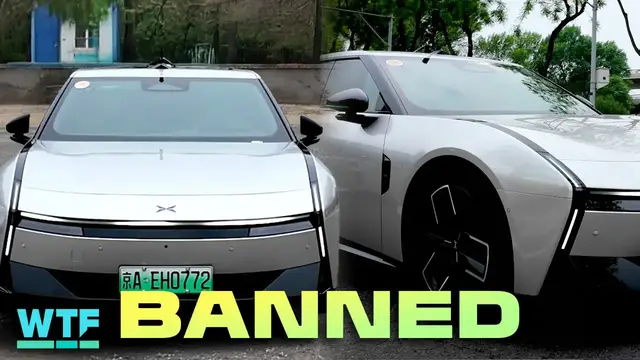
The United States government doesn't want you to be able to buy this car, but one of our reporters
0:04
went to China to test it out anyway and find out how its autonomous driving system handles parking
0:09
navigating in hectic environments, and what sort of situations still make the driver have to take
0:14
control. This is the P7 made by XPeng, a Chinese high-tech company that can be compared to Tesla
0:23
since both are developing humanoid robots, sci-fi-looking trucks, and self-driving electric vehicles. XPeng also has a flying car division, but more on that later. XPeng brought Mashable
0:33
reporter Amanda Yeo to China to experience its new self-driving system, called VLA 2.0
0:39
firsthand. The driver begins by activating the autonomous driving feature either by pulling down
0:44
on the right lever twice or via the touchscreen. A blue ring around the car on the display signals
0:49
to the driver that the vehicle is in autonomous driving mode. Chinese law says that the driver
0:53
has to keep their hands on the wheel at all times in case they need to intervene. If the driver
0:57
forgets and drops their hands, the car is able to remind them. China also requires cars with autonomous driving capabilities to emit blue light to signal to nearby drivers that they are in autonomous driving mode Drivers can speed up or slow down the autonomous driving by scrolling a wheel on the steering wheel And if the driver intervenes to make a small correction
1:21
the autonomous driving system will pick right back up as soon as the driver relinquishes control
1:25
When self-driving mode is on, the car will continue navigating to the destination
1:29
But what if there is no destination set? So if you activate VLA, well, there's no destination in mind
1:37
I imagine it would just follow the road that you're on. To really put the VLA 2.0 system to the test, the driver turned down a busy narrow road filled with pedestrians, obstacles, and scooters
1:54
The car slowed down for pedestrians who nearly walked in front of the car, but the driver did have to take control two different times
2:01
The first was during a tight squeeze. You can see just how close the car got to this parked car on the interior screen
2:07
When confronted with another tight squeeze, the driver had to take control again
2:14
The car came to a stop in front of a pole with the stopped car on the other side
2:18
Eventually, the stopped car moved and the driver navigated around the pole. In engineering and software development, extreme or unusual scenarios like these are called corner cases
2:27
and they one of the biggest challenges preventing fully autonomous vehicles The problem we are facing is not that we don have enough data to solve the car cases but we have too many car cases so we need to solve it
2:40
Anyone who spent hours of their life circling the block looking for parking will likely tell
2:44
you that self-parking is one of the biggest appeals of self-driving. And Amanda got to
2:48
see the P7 self-parking in action. The car can automatically help identify parking spaces
2:53
and you can select the exact one that you want. We even saw the car parked with nobody
2:57
inside. In addition to self-driving, the P7 Amanda tested also features a built-in heads-up display
3:03
which provides indicators for upcoming turns, as well as showing the rear camera view when backing
3:07
up. The heads-up display flickers on video, but that isn't visible to the naked eye. Amanda said
3:12
she found the car's interior screen easier to read and more useful, but said the heads-up display was
3:17
fun and interesting, and may become more intuitive as the technology evolves and people start to get
3:22
used to it. Speaking of evolving technology, XPeng also showed off a demo of its personal
3:27
flying machines. I got a chance to sit inside one at CES a couple years ago, but this is the first
3:31
time one of our reporters has seen one flying in person. These flying machines go in the back of
3:36
XPeng's Land Aircraft Carrier, a six-wheel hybrid vehicle that serves as both a transporter and a
3:41
charger for these personal flying machines The flyer itself is more for sightseeing than travel and due to Chinese regulations is currently limited to being flown in the approximately 200 parks in China where flying this type of vehicle is allowed
3:55
The demo we saw involved takeoff, hover, and landing, but the main event was the demo of the new Vision Language Action 2.0 self-driving model
4:03
We want to get rid of the driver from the car. The problem is you never know what is the problem
4:10
There's so much I know I know problems. You can never solve one by one. So you needed to change the paradigm and trying to change the system to be generalized enough and scalable enough to solve all the problems
4:22
The United States' 100% tariffs on Chinese vehicles, combined with bans on cars with Chinese-made software, have prevented these vehicles from being sold in the U.S. market
4:31
But foreign-made cars have been entering the U.S. market for decades, and China is shaping up to be a global automotive powerhouse, especially in the realm of electric vehicles
4:40
Would you like the option of buying Chinese EVs, or at least test driving one
4:43
Let us know down in the comments
Celebrities & Entertainment News