Up next in 10

The Magic of Akasha - The Space in Between
May 27, 2026

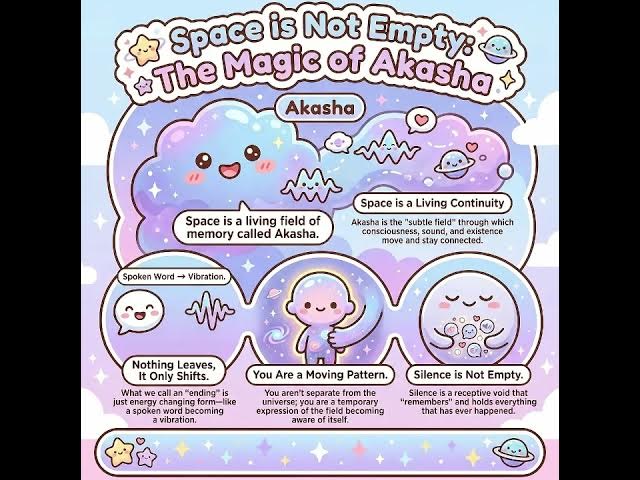
Explore the ancient Vedic concept of Akasha - not as empty space, but as a living field of memory, connection, and becoming.
This piece blends philosophy, poetry, and music to explore the idea that nothing truly disappears. Every thought, sound, emotion, and experience leaves a trace within the fabric of reality itself. Rather than being separate from the universe, we are expressions of it - participating in an interconnected field where silence is not empty, and loss is transformation.
"Space Is Not Empty, It Remembers" is a reflection on consciousness, continuity, and the illusion of separation between ourselves and the world around us.
Full song + article:
https://lancelhoff.com/akasha-space-is-not-empty-it-remembers/
#akasha #hallofrecords #memory
Show More Show Less View Video Transcript
0:00
So imagine you're just standing in a
0:01
room right after someone finishes
0:03
speaking. The conversation is totally
0:05
over. The audio stops, but is the
0:07
vibration of that voice actually gone?
0:12
Welcome to this custom deep dive. Today
0:14
we're unpacking a really fascinating
0:16
article about accasha.
0:17
>> Yeah, it's this ancient Vadic
0:19
philosophy. It basically asserts that
0:21
space is um not just some empty void but
0:24
a living field of continuity that
0:26
actually remembers,
0:27
>> right? It remembers. And our mission
0:29
today is to fundamentally shift how you
0:31
perceive the physical space around you
0:33
>> because the immediate instinct is to
0:34
think that you know when a sound stops
0:36
or an object is moved the space just
0:38
goes back to being empty.
0:39
>> Exactly.
0:40
>> But the concept of accasha suggests that
0:42
energy and information they just change
0:44
form. So a spoken word becomes a
0:46
vibration which then becomes a physical
0:49
movement
0:49
>> which turns into interaction. Right.
0:51
>> Right. And eventually it settles as a
0:53
memory.
0:53
>> The source text actually has this great
0:55
poetic line for this. I think it says
0:56
nothing leaves, it only shifts. But I
0:59
mean, mechanically, what does it
1:01
literally mean for a physical space to
1:03
like settle as memory?
1:04
>> Well, think about the physics of sound.
1:06
When someone speaks, they release
1:08
acoustic energy.
1:10
>> Mhm.
1:10
>> And that energy doesn't just vanish when
1:12
you stop hearing it. It travels outward.
1:15
It hits the walls and it physically
1:17
vibrates the atomic structure of the
1:19
room itself.
1:20
>> Wow. So, it actually alters the room.
1:22
>> Exactly. It generates these microscopic
1:24
amounts of heat. So the physical
1:26
environment is permanently altered on a
1:28
subatomic level by that exact soundwave.
1:31
>> That is wild.
1:32
>> The space has essentially memorized the
1:34
event just by absorbing its energy.
1:36
>> Which ties so perfectly into that
1:38
analogy the author uses the whole fish
1:40
and water thing. Yeah.
1:42
>> Like a fish doesn't realize it's
1:43
swimming in a medium because the water
1:45
is just a given.
1:46
>> Yeah. It's just always there,
1:47
>> right? And we look at an empty room and
1:48
we totally ignore the medium of space
1:50
because we're constantly swimming in it.
1:52
We just assume that because we don't see
1:54
a solid object, there's nothing there.
1:56
>> We treat space like it's just a
1:57
container rather than a connector. But
2:00
if space is actively holding and
2:02
transmitting all of these physical
2:03
interactions, it completely blurs the
2:06
lines of well individual isolation.
2:08
>> Wait, so if we pull on that thread a
2:10
bit, if I am constantly interacting with
2:12
this medium, you know, exchanging energy
2:15
and heat and vibration, where do I
2:17
actually stop and the room begins? like
2:19
does my physical boundary really just
2:21
end at my skin?
2:22
>> According to this philosophy, no, it
2:24
doesn't. There's this constant
2:25
reciprocity happening.
2:27
>> Okay.
2:27
>> The text describes this ongoing cycle of
2:30
inside out and outside in.
2:32
>> What does that mean exactly?
2:33
>> Basically, your internal thoughts shape
2:36
how you perceive the world. And that
2:38
perception drives your physical
2:40
behavior, which in turn reshapes the
2:43
environment around you.
2:44
>> Oh, I see. And then that newly altered
2:46
environment pushes back in.
2:47
>> Exactly. It influences your thoughts all
2:49
over again in this constant loop.
2:51
>> The article captures this with another
2:52
lyric that I loved that says, "You are
2:54
not separate from the air. You are the
2:57
way it knows you're there."
2:58
>> I really love that line. And translating
3:00
that poetry into practice just means we
3:02
aren't isolated observers trapped inside
3:04
these, you know, meat suits,
3:06
>> right? Totally.
3:07
>> We are actual expressions of the
3:09
universe interacting with itself. So the
3:11
air, the space, the environment, they
3:14
are defined by how we move through them,
3:16
>> just as we're defined by what we breathe
3:18
in. But okay, if space is holding
3:20
everything together like that, what
3:22
happens when those interactions are
3:23
permanently severed? The text brings up
3:26
silence and even physical loss.
3:28
>> Yeah, it frames silence not just as an
3:30
absence of noise, but as receptivity. It
3:33
is the canvas that allows sound to exist
3:35
in the first place.
3:36
>> And then it applies that exact same
3:38
logic to death, which is a heavy shift.
3:40
>> It is. Yeah,
3:41
>> it calls physical loss a transformation
3:43
rather than absolute erasure mainly
3:46
because influence continues through
3:48
memory, genetics, and our actions.
3:50
>> Because the energy shifts, it doesn't
3:52
just leave the system entirely.
3:54
>> I have to say, I struggle with this part
3:55
a little. Doesn't viewing loss as merely
3:57
a transformation risk minimizing human
4:00
grief?
4:00
>> How so? I mean, telling someone who is
4:03
actively mourning that their loved one
4:04
just shifted form, that feels incredibly
4:07
dismissive of the brutal pain of losing
4:09
someone's physical presence.
4:11
>> I mean, it definitely would be
4:12
dismissive if the philosophy used it to
4:15
bypass pain, but the text is very
4:18
careful here.
4:18
>> Okay. So, it acknowledges the pain.
4:20
>> Yes. It doesn't argue that understanding
4:22
accasha just magically removes grief.
4:24
Grief is the visceral human experience
4:28
of that massive shift in form.
4:30
>> Right. What this perspective does is it
4:32
just changes the frame holding that
4:35
grief
4:35
>> by suggesting that the person hasn't
4:37
vanished from the universe.
4:38
>> Exactly. The text actually notes that
4:41
every ending is a doorway. The structure
4:44
of a person's life, their actions, their
4:46
genetics, the memories they created,
4:48
those have already permanently altered
4:50
the atomic structure of the world.
4:52
>> Just like the soundwave altering the
4:53
room.
4:54
>> Precisely. They become a permanent part
4:56
of the ongoing structure of experience.
4:58
>> So it doesn't erase the void. It just
5:00
proves the void isn't entirely empty.
5:02
Which I guess brings us to what this
5:04
means for you listening right now,
5:05
>> right? Because you are an active
5:07
participant in what the text calls the
5:09
accasha breathing.
5:10
>> The accasha breathing. I love that.
5:12
>> Yeah. Every single thought, every
5:14
emotion and every action becomes a trace
5:17
in the turning of space. You know, you
5:19
are constantly imprinting on the world
5:22
around you. So if physical space truly
5:25
remembers everything we put into it,
5:27
what does that mean for the non-physical
5:29
spaces we spend so much of our time in
5:30
today?
5:31
>> Like the internet.
5:32
>> Exactly. Does the internet have an
5:34
accasha of its own? I mean to think
5:36
about that for a second. If every click,
5:39
every single comment and every digital
5:41
interaction leaves a permanent trace,
5:42
>> which we know they do,
5:44
>> right? What invisible lasting footprints
5:46
are your thoughts leaving in the digital
5:47
space right beside
#Jobs & Education
#Religion & Belief