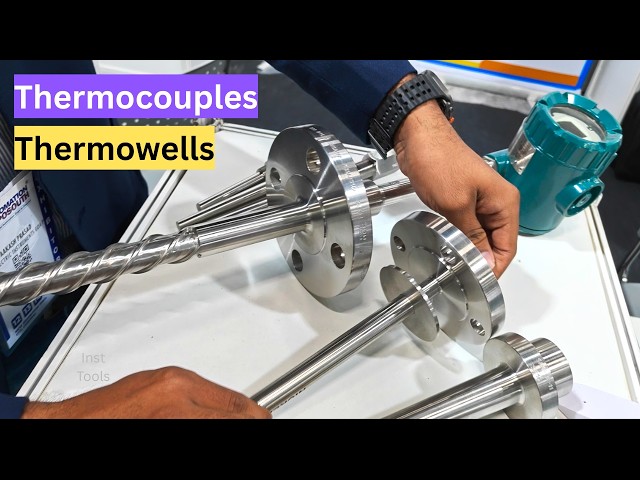
0:01
So basically this uh design which you
0:03
are seeing uh this assembly is with the
0:05
helical design. Okay. So this is used to
0:09
basically to reduce the vibration I mean
0:11
which is created by the process fluid
0:17
Now this is thermouple. This thermouple
0:20
design thermal. Okay. So this uh which
0:24
you are saying this is a van design
0:26
thermmo. This the basically this is for
0:31
to sustain the high pressure.
0:34
This well is with the nickel se. So
0:37
basically for the harsh environment and
0:39
the corrosive application these are just
0:44
Uh these are those perm wells actually
0:46
and this is uh this uh design we
0:49
actually give it to nan.
0:54
So this is also a sample of one farm
0:57
oil. This was made from a single barge
1:05
So I'll just show you the complete
1:19
So this is our standard SMB base.
1:23
So this is basically a
1:26
you can see the cut section also. This
1:28
is basically a PT0000 sensor RTD. So in
1:32
RTD we have a two types of sensor like
1:34
one is a tensor and one is a Y1. So you
1:37
can say this is a Y1 sensor which we
1:40
generally give it to Lines. So I'll just
1:43
explain what's the difference between
1:44
the RTD and thermouple. So basically if
1:47
you want to measure the temperature like
1:49
below 500° then we use RTD and above
1:52
500° if you have to measure then we use
1:54
a thermocouple. So basically it depends
1:56
on the application that what we are I
1:58
mean giving. So this which you are
2:01
seeing is MI cable sample this we
2:04
manufacture inhouse only and this MI
2:07
cable we take into this assembly. This
2:10
you are saying this is a MI okay see
2:13
this is a cut friction part. There's a
2:19
springloaded mechanism basically.
2:25
Uh see there's a part actually this
2:29
there's part actually here. See there's
2:32
a pot and this is a nipple. So like uh
2:35
this is as per the painful criteria
2:40
So the OD of this part and the ID of
2:43
this nipple the distance should be
2:45
maintained less than 39 mm. So it is
2:48
employment as per IC standard.
2:56
So this is a heater skin type
2:59
thermouples. Generally
3:02
this thermouple is used to measure the
3:05
surface temperature. Okay, I'll just
3:07
explain to you this thing. This is a
3:09
weld pad actually. This weld pad goes
3:12
onto the wall of this uh tube. Okay. And
3:17
here there's a ceramic block completely.
3:20
And this sensor part goes inside this
3:24
this. Okay. The sensor part goes inside
3:27
this and it measures the outer surface
3:30
templation and we give this expansion.
3:32
You know what happens like uh we give
3:35
this expansion like near to the sensing
3:37
point. Okay. So what happens like
3:39
whenever the temperature increases uh
3:41
this heater tube also I mean this
3:44
expands actually so because of this it
3:47
may damage the junction or like it pull
3:49
the cloud with alcohol. So like it can
3:53
this expansion which we keep it's like
3:56
to prevent the I mean mechanical stress
4:11
this assembly I mean this is a
4:13
thermouple with the hexaring
4:16
tube. This is a thermouple with the
4:20
hexular protecting T. Basically this is
4:22
designed for the harsh environment such
4:24
as corusive and all this thing. So this
4:26
is this assembly is with the purging
4:28
system. I just let you know see this
4:31
assembly. This is the outer protecting
4:32
tube is of the hexo which is the six
4:35
grade of uh center silicon carbide.
4:38
Okay. Having the inner protecting tube
4:40
of ceramic and then inner there will be
4:43
the temperature sensor. Okay. So this is
4:45
a purging system. You can say this
4:48
purging system which we I mean uh it's
4:51
given like there will be continuous flow
4:53
of air or inert gas like usually we push
4:56
for nitrogen here. So there will be no I
5:00
mean processed gas will enter this
5:04
system it's like used in the nerators
5:07
then uh sr units then gasification. So
5:12
like the temperature where the
5:13
temperature is around 1500, 1500° way
5:17
there we use the shack of
5:22
so actually a special thermouple. These
5:27
are called multi-point thermoper. All
5:29
the assemblies which you have seen
5:30
earlier it's single point. This is a
5:33
multi-point thermoser which I mean you
5:36
know what happens like uh in the reactor
5:39
there is exothermic reactions. So
5:41
because of the exothermic reaction hot
5:43
spate on this catalyst and you know
5:46
efficiency is very important there. So
5:48
to track the catalyst profile we use
5:51
this multipoint thermouple. Okay, there
5:54
are almost of 48 points here inside this
6:00
this is with the actually pressure
6:02
indicator. Uh say this portion is a
6:05
containment chamber. If there will be
6:07
some leakage like in the operation mean
6:10
running operation. So might there might
6:13
be chance like the process gas will come
6:15
up here. Okay. So that will store up
6:18
here in the containment chamber and here
6:20
from the with the help of this pressure
6:22
indicator you'll be able to see the
6:24
detection. So you can detect like this.
6:29
So basically there are different
6:30
different designs for depending on the
6:32
purpose you can show this is basically
6:36
this design. This is a bedtype
6:38
thermouple here. There is a profile and
6:41
this from on this part this thermouple
6:45
MI cable this is going from inside and
6:48
striking like from the complete circle.
6:50
So yeah, it's measuring the first phase
6:52
gears and then second profile
6:57
and all the connections of here will be
7:06
These are all certification which we
7:09
have. We are two CQ certified ESM and we
7:16
and CC. We all this one certification
7:24
that's a normal type of gauges show the
7:31
so this is basically a temperature gauge
7:36
biometallic type yes this is MNC gauge
7:48
This is a don PG pressure gauge di
7:53
the working principle is like the
7:55
pressure can sustain like here you'll
7:59
C and this are standard like all the
8:06
and uh we are into a level measurement
8:08
that is for the boiler instrumentation
8:11
and the level gauges and these are my
8:13
products. Right now we have this uh
8:16
boiler instrumentation that is a level
8:18
which shows the steam as well as water.
8:21
This is required as per the Indian
8:24
boiler regulation act. And these are the
8:27
uh level gauges which are been uh used
8:30
for the process industries to show the
8:32
physical level apart from the electronic
8:34
level. And these are the uh this is the
8:37
magnetic level gau which is installed on
8:39
the site on the vessels. This is
8:42
basically on the based on the principle
8:45
of uh float. As the level rises inside
8:49
the liquid rises, it shows you it gives
8:51
you the level which is being uh shown by
8:54
the different uh flat as you can see and
8:57
uh this is a uh float which is inside
9:01
this chamber and uh these are the
9:05
present technologies. We have this uh
9:07
magnet restrictive transmitter which is
9:10
installed on the top of the magnetic
9:12
level gauge and it gives you the photo
9:15
20 millia output apart from apart uh
9:18
from the uh gauge and we also have this
9:20
uh guide radar which is installed on
9:23
this magnetic level gauge which is a 4
9:25
to 20 media output. So that is
9:27
electronic output as well as the
9:30
physical output. Thank you.
9:31
>> So good afternoon. Uh this is Akash
9:33
Prasad from Pyro instrument.
9:37
So as you can see under Pyro group we
9:40
have four different companies like for
9:42
pyro electric instruments RA for
9:44
temperature sensors we manufacture RTD
9:48
inulated cables multipoint which is a
9:51
special type of assembly. Then to
9:53
measure the surface temperature we
9:54
manufacture skin thermouples.
9:57
Then we have a collaboration with a US
9:59
company called plants. In that we
10:01
manufacture level type gauges uh this
10:04
magnetic as well as blast type. Then we
10:06
have a hydronometics in that we
10:08
manufacture this uh for venture meters
10:12
no spit tube anubar. Then we have a GT
10:17
for PG and AG temperature gauges. So for
10:21
more details you can contact me on this
10:23
the number which you have shown.