Up next in 10


The Galactic Federation had a name for the Terran species. Gentle. Predictable. Bound by quaint moral codes no other civilization bothered to adopt.
They called it weakness. They called it softness. They built an entire diplomatic strategy around the assumption that humanity would never, under any circumstances, fight without rules.
They were right about one thing. Humanity did have rules.
What they failed to understand was that those rules were never meant to protect humans.
They were meant to protect everyone else.
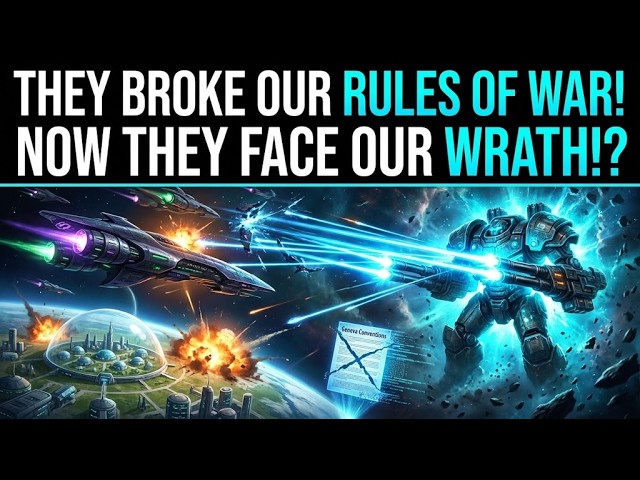
This is the story of what happened when those rules were revoked — not by politicians, not by generals, but by a species that had just watched twelve million civilians burn under orbital glass.
Like and subscribe for more stories from the edge of known space.
Show More Show Less View Video Transcript
0:02
They had a word for us. Every species
0:05
did.
0:08
>> The Galactic Federation indexed every
0:10
known species on a behavioral taxonomy
0:13
chart. 47 categories. Everything from
0:17
territorial aggression scores to
0:20
reproductive strategy classifications.
0:23
It was thorough, clinical, the kind of
0:26
system a civilization builds when it's
0:28
been cataloging the galaxy for 11,000
0:32
years and believes deeply and sincerely
0:35
that it has seen everything. Humans were
0:38
indexed in year 6,112
0:41
of the Federation's standard calendar.
0:44
First contact had been unremarkable. a
0:48
small probe, a radio signal, a species
0:52
that had barely crawled beyond its own
0:54
moon. The assessor spent 19 days
0:57
studying Earth's broadcasts, its wars,
1:00
its music, its pollution, its
1:02
extraordinary tendency to argue with
1:05
itself about everything. The final
1:07
classification was straightforward.
1:10
Terren category two moderate
1:13
intelligence high social bonding
1:16
moderate aggression poorly directed
1:19
technological ceiling estimated at
1:21
point4 on the Harmon scale projected
1:24
time to galactic relevance 800 years
1:28
minimum they were wrong about the
1:30
timeline they were wrong about the
1:32
ceiling but the error that mattered the
1:36
one that would eventually cost the
1:37
galaxy more than anyone could calculate
1:40
was simpler than that. They looked at
1:43
humanity's rules of war and concluded
1:46
that a species which voluntarily limits
1:48
its own violence must not be capable of
1:51
very much violence to begin with. What
1:54
follows is based on compiled accounts
1:56
from multiple galactic archives,
1:59
diplomatic transcripts, and what remains
2:02
of the hegemony's internal records. Some
2:05
dialogue has been reconstructed. Some
2:08
details remain disputed between sources.
2:11
The broad shape of events, however, is
2:14
not in question. Everyone remembers what
2:17
happened. The disagreement is only about
2:20
whether it was justified. Humanity
2:23
joined the Federation in what Terran
2:25
would mark as 2314. The process was
2:28
unusual. Most species petitioned for
2:31
membership after achieving faster than
2:34
light travel. humans achieved it, then
2:37
waited 6 years before even acknowledging
2:40
the Federation's existence. When asked
2:43
why, the Terran ambassador, a woman
2:46
named Catherine Akafer Singh, reportedly
2:49
said that they had been busy and that
2:51
joining a galactic bureaucracy was not
2:54
at the top of the list. This was taken
2:57
as a joke. It was not a joke. The early
3:00
years were unremarkable in the way that
3:02
most diplomatic integrations are
3:05
unremarkable.
3:06
Trade agreements, cultural exchanges, a
3:10
few misunderstandings about human
3:12
dietary requirements that resulted in a
3:15
minor diplomatic incident on Verath
3:17
station. Humans were considered odd but
3:21
manageable. They talked too much. They
3:24
asked too many questions. They had an
3:27
unsettling habit of befriending species
3:29
that no one else wanted to talk to. But
3:32
the thing that genuinely puzzled the
3:34
Federation was the document. Every
3:37
species had military doctrine. Every
3:40
species had strategic boundaries and
3:43
escalation protocols. This was normal.
3:46
What was not normal was codifying those
3:49
limits into a publicly available legal
3:51
framework and then actually following
3:53
it. the Geneva Conventions, or rather
3:57
the Terran Conventions on Warfare, as
4:00
they'd been updated and expanded for
4:02
interstellar application.
4:04
214 articles governing the conduct of
4:07
armed conflict, rules about
4:10
proportionality,
4:12
rules about civilian infrastructure,
4:14
rules about prisoners, rules about
4:17
medical vessels, rules about
4:19
environmental damage to biospheres
4:22
during orbital engagement. The Crayle
4:25
High Command reviewed the document and
4:27
formally requested clarification.
4:30
They wanted to know if it was satirical.
4:32
It was not satirical. The VRN
4:35
directorate studied it for 3 weeks, then
4:38
filed a report describing humanity as
4:41
philosophically immature but
4:43
strategically predictable, which they
4:46
considered a net positive. A species
4:49
that tells you exactly what it will and
4:51
won't do in a war is a species you can
4:54
plan around. The Dominion of Sacrai
4:57
didn't bother reading it at all. Their
5:00
military assessors noted that the Terran
5:02
fleet was midsized, competently
5:05
organized, and equipped with weapon
5:07
systems that were functional but
5:09
unspectacular.
5:11
They assigned humanity a threat rating
5:13
of four on a 16point scale. Modest,
5:17
manageable. What none of them
5:19
understood, what none of them had the
5:21
cultural framework to understand was why
5:24
the document existed in the first place.
5:27
They assumed it was aspirational, a
5:30
young species trying to seem more
5:32
civilized than it was, or perhaps
5:34
theological.
5:36
Some species developed moral codes
5:38
rooted in spiritual traditions. The
5:41
Federation had seen that before. It
5:44
usually faded after the first real war.
5:46
They did not consider the third
5:48
possibility that the document was a
5:51
leash. That humanity had looked at its
5:54
own history, at the things it had done
5:56
to itself over thousands of years of
5:59
conflict and decided collectively and
6:02
with great deliberateness that there
6:04
were parts of its nature that needed to
6:06
be locked away. Not because those
6:09
capabilities didn't exist, but because
6:12
they did. The Geneva Conventions were
6:14
not proof of human weakness. They were
6:17
proof that humans knew exactly what they
6:19
were capable of and had decided for the
6:22
sake of everyone to stop. Ambassador
6:26
Akafer Singh tried to explain this once
6:29
during a diplomatic reception on the
6:31
Citadel station. A crit commander named
6:35
Vorath Sen had been drinking something
6:37
fermented and decided to press the
6:40
issue. According to diplomatic
6:42
transcripts, the conversation went
6:44
approximately like this. Vorath asked
6:47
why humans handicapped themselves in
6:50
combat. Akafer Singh said they didn't
6:53
consider it a handicap. Vorath pressed.
6:56
He said that in real war you use
6:58
everything. No limits, no mercy. The
7:02
strong survive. That is the natural law
7:05
of the galaxy. Akafer Singh is recorded
7:08
as having paused for a long time. Then
7:11
she said something that would later be
7:13
quoted in over 40 historical analyzes
7:16
across 12 species. She said that the
7:18
strong don't need rules. Rules exist to
7:22
protect the weak from what the strong
7:24
are capable of doing. She said that
7:26
every rule in the Terran conventions was
7:29
written because a human at some point in
7:31
history had actually done the thing the
7:34
rule prohibits. every single one. And
7:38
then she said that if Commander Vorath
7:40
wanted to see what humanity looked like
7:42
without those rules, she sincerely hoped
7:45
he never got the chance. The room,
7:48
according to three separate accounts,
7:50
went very quiet. Vorath laughed. He said
7:53
the human was being dramatic. He said
7:56
small species always had big talk. Aafer
7:59
Singh smiled. She finished her drink.
8:02
She left the reception. 14 years later,
8:06
Vorath Sen would remember that
8:08
conversation in detail. By then, he
8:11
would no longer be laughing. For 14
8:13
years, the balance held. Humanity
8:16
traded. Humanity explored. Humanity did
8:20
what it had always done, which was to be
8:22
simultaneously chaotic and productive in
8:25
ways that confused everyone watching.
8:28
They colonized 17 systems in the first
8:31
decade which was fast but not alarmingly
8:34
so. They built stations, established
8:38
agricultural worlds and created a
8:41
network of civilian settlements that
8:43
stretched across what they called the
8:45
Terran corridor. Some of those
8:47
settlements were on contested border
8:49
worlds. The Federation advised against
8:52
it. Humans went anyway. They had a
8:55
cultural concept called homesteading
8:58
that translated poorly, but essentially
9:00
meant planting a flag on land. Nobody
9:03
else wanted and daring the universe to
9:06
do something about it. One of those
9:08
settlements was on a world called Veland
9:11
4. Vel 4 was not strategically
9:14
important. It was a temperate planet on
9:16
the edge of the outer reach, closer to
9:19
hedgemony space than most humans were
9:21
comfortable with, but not technically
9:23
within any claimed territory. The soil
9:27
was good. The climate was mild. The
9:30
colony grew to 12 million people in 11
9:33
years, mostly agricultural families,
9:36
researchers, and the kind of people who
9:38
liked being far from everything. They
9:41
built schools. They built hospitals.
9:44
They grew a strain of wheat that could
9:46
survive the local soil chemistry.
9:49
Children were born there who had never
9:51
seen Earth, who thought of Veland for as
9:54
home in the deepest possible sense of
9:56
the word. It was a quiet place,
9:59
unremarkable, the kind of settlement
10:01
that shows up in no strategic briefing
10:04
that matters to no one except the people
10:06
who live there. The hedgeimmony of
10:09
Drathal was not a single species, but a
10:11
coalition of four bound together by
10:14
military alliance and a shared
10:17
philosophy that could be summarized
10:19
simply. Expansion is survival. Weakness
10:23
invites extinction. Mercy is a defect.
10:26
They had been watching humanity with the
10:29
same condescension as everyone else, but
10:31
with an additional layer of calculation.
10:34
The hedgeimonyy was expansionist. It
10:37
needed new territory. The outer reach
10:40
was largely unclaimed. And the primary
10:43
obstacle to hedgemony expansion into the
10:46
outer reach was a species that had
10:48
publicly declared in writing exactly
10:51
what it would and would not do in a
10:54
conflict. The hegemony's strategic
10:56
council met 14 times in the year before
10:59
the attack. Internal records recovered
11:02
after the war show that the debate was
11:05
not about whether to move against human
11:08
territory. It was about how far they
11:10
could push before humanity responded.
11:13
Their analysts had studied the Terran
11:16
conventions in detail. They noted the
11:18
emphasis on proportional response. They
11:22
noted the prohibitions on civilian
11:24
targeting. They noted the escalation
11:27
protocols, the mandatory cooling off
11:29
periods, the requirements for formal
11:32
declarations.
11:34
One analyst, a Drathal strategist named
11:37
Shyavan, wrote a memo that would later
11:40
become infamous. In it, he argued that
11:43
the optimal approach was to strike a
11:45
civilian target first. His reasoning was
11:48
clinical. A military target would
11:51
trigger a proportional military
11:53
response. And while human fleets were
11:56
not the galaxy's most powerful, they
11:58
were competent enough to make a direct
12:00
engagement costly. But a civilian target
12:03
would trigger the Terran legal
12:05
framework. Humanity would convene
12:08
councils, draft formal protests, demand
12:11
reparations through Federation channels.
12:15
By the time they organized a military
12:17
response, the hedgeimony would have
12:19
fortified the outer reach. The memo
12:22
concluded with a sentence that would be
12:24
quoted at Shiaon's trial. It read, "The
12:28
Terran have bound themselves. We need
12:30
only take what they have placed beyond
12:33
their own reach. Veland 4 was selected
12:35
as the target. The attack came on what
12:38
the colonists called a Tuesday, autumn.
12:42
The wheat was nearly ready for harvest.
12:44
Hedgemony vessels entered the system at
12:47
1,400 hours local time. 37 capital
12:51
ships. No communication, no warning, no
12:54
demands. They did not invade. They did
12:57
not land troops. They did not attempt to
12:59
capture the colony. They opened fire
13:02
from orbit. Kinetic bombardment followed
13:05
by thermal lancing. The military term is
13:08
glassing. It means exactly what it
13:11
sounds like. You heat the surface until
13:14
the soil turns to glass. The colony had
13:17
no military installations, no orbital
13:20
defense platforms, no warships. They had
13:23
a communications array, a weather
13:25
satellite network, and a single patrol
13:28
corvette that was destroyed in the first
13:30
11 seconds. 12 million people. The
13:34
bombardment lasted 4 hours, not because
13:37
it needed to. The colony was
13:39
functionally destroyed within the first
13:41
20 minutes. The remaining 3 hours and 40
13:45
minutes were, according to recovered
13:47
hegemony communications for thorowness.
13:50
When it was over, Veland 4 had no
13:52
atmosphere, no liquid water, no life.
13:56
The hedgemony fleet withdrew to
13:58
pre-established defensive positions in
14:01
the outer reach. They sent a single
14:03
communication to the Federation, a
14:06
formal claim of territorial sovereignty
14:08
over the region, effective immediately.
14:11
They expected protests, sanctions,
14:15
perhaps a sternly worded resolution.
14:17
What they did not expect was silence.
14:20
For 9 days, humanity said nothing. No
14:23
diplomatic communications, no emergency
14:27
federation sessions, no demands, no
14:30
threats, no public statements. The
14:33
Terran embassy on the Citadel went dark.
14:36
Every human ambassador in the Federation
14:39
recalled to Earth simultaneously without
14:42
explanation. The Federation was
14:44
unsettled. Several species attempted to
14:47
contact the Terran government directly.
14:50
No response. The VRN directorate
14:54
dispatched a diplomatic vessel to Saul.
14:57
It was turned away at the system border
14:59
by automated defense platforms that had
15:02
not existed 3 days earlier. Nine days of
15:05
nothing. In the hedgeimonyy, the
15:07
strategic council interpreted the
15:09
silence as confirmation of their thesis.
15:13
The Terran were paralyzed. Their legal
15:16
framework was grinding through its
15:18
protocols. Committees were being formed.
15:21
Votes were being taken. By the time they
15:24
acted, it would be too late. Shyavan
15:26
reportedly celebrated. On day 10, a
15:30
single transmission was broadcast on all
15:32
Federation frequencies. It was short. It
15:36
was not encrypted. It was intended to be
15:38
heard by everyone. The transmission was
15:41
from the Terran United Council. It was
15:44
not a declaration of war. It was a
15:47
notification of policy change. The exact
15:50
wording according to Federation archives
15:53
was as follows. to all member species
15:56
and non-member entities of the Galactic
15:58
Federation.
16:00
On the date specified, forces of the
16:03
Drathal Hedgeimony conducted an
16:05
unprovoked orbital bombardment against
16:08
the civilian colony of Veland 4,
16:11
resulting in the complete destruction of
16:13
the settlement and the deaths of
16:15
12,416,39
16:21
Terran citizens. No military targets
16:24
were present. No declaration of
16:26
hostilities was issued. No terms were
16:29
offered. This was not an act of war. It
16:32
was an act of extermination.
16:35
Effective immediately, the Terran United
16:38
Council has ratified emergency protocol
16:41
7. All provisions of the Terran
16:44
Conventions on Warfare are suspended
16:46
with respect to the Drathal hedgemony
16:49
and its affiliated species, territories,
16:52
and assets. This suspension will remain
16:56
in effect until the Terran United
16:58
Council determines that sufficient
17:00
corrective action has been taken. This
17:03
is not a declaration of war. This is a
17:05
notification that the rules no longer
17:08
apply. The transmission ended. No
17:11
questions were taken. In the Federation
17:14
Council chambers, according to multiple
17:17
witnesses, there was a pause that lasted
17:20
almost a full minute. And then quietly,
17:23
a VR diplomat turned to a Cray colleague
17:27
and asked a question that nobody in the
17:29
galaxy had thought to ask before. What
17:32
are the Terran conventions actually
17:34
preventing them from doing? Nobody had
17:37
an answer because nobody had ever
17:39
bothered to find out. The first
17:42
indication that something fundamental
17:44
had changed came within 48 hours. The
17:48
hedgemony had fortified three systems
17:50
along the outer reach border. Standard
17:53
defensive positions, orbital platforms,
17:57
minefields, sensor nets, garrison
17:59
fleets. Their analysts had projected
18:02
that a Terran response, if one came at
18:05
all, would follow conventional military
18:08
doctrine. Fleet engagement at range,
18:11
attempts to establish space superiority,
18:14
ground campaigns, if necessary. The
18:17
hedgeimony had prepared for all of
18:19
these. What arrived was not a fleet. Or
18:22
rather, it was not only a fleet. The
18:24
first thing the hedgeimmony sensor nets
18:26
detected was disruption. Not ships, not
18:30
weapons signatures. Disruption. Their
18:33
FTL communication relays went dark. Not
18:36
jammed. Dark as if they had never
18:39
existed. Within an hour, every
18:41
hedgeimonyy installation in the Outer
18:43
Reach lost contact with every other
18:46
installation. Each one was alone. Then
18:49
the sensor nets themselves failed. Not
18:51
destroyed, reprogrammed. They began
18:54
feeding false data to the garrisons,
18:57
fleet positions that didn't exist,
19:00
attack vectors that led nowhere. The
19:03
hedgemony's commanders were fighting
19:05
phantoms while the real threat was
19:07
already inside their perimeter. Humanity
19:10
had spent 14 years inside the
19:12
Federation.
19:14
14 years of cultural exchanges and trade
19:17
missions and scientific collaborations
19:20
and joint fleet exercises. 14 years
19:23
during which human engineers had worked
19:25
on Federation communication systems.
19:29
Human scientists had contributed to
19:31
shared sensor technology and human
19:34
diplomats had smiled and been polite and
19:37
learned exactly how everything worked.
19:40
Everything. The Crayle High Command
19:43
would later describe what happened as
19:46
the most sophisticated information
19:48
warfare operation in galactic history.
19:51
But that description, while accurate,
19:54
missed the point. It wasn't just
19:56
sophisticated. It was patient. 14 years
20:00
of patience. Every handshake, every
20:03
joint project, every shared database,
20:06
every collaborative upgrade to
20:08
Federation infrastructure. All of it was
20:11
genuine. All of it was also preparation.
20:14
Not because humanity had planned for
20:16
this specific scenario, but because
20:19
humanity always prepares for the worst.
20:22
It's a species level habit born from
20:25
10,000 years of doing terrible things to
20:28
itself. You build the weapon before you
20:31
need it. You hope you never need it. And
20:33
you never ever let anyone see you
20:35
building it. The hegemony's border
20:38
fortifications held for 6 hours. They
20:41
did not fall to overwhelming force. They
20:44
did not fall to brilliant tactical
20:46
maneuver. They fell because they stopped
20:48
working. Orbital platforms powered down.
20:52
Mine fields deactivated.
20:55
Garrison ships found their navigation
20:57
systems locked, their weapons cycling
21:00
through diagnostic modes that had no end
21:03
point, their life support systems
21:06
functioning perfectly. Because as one
21:08
human commander reportedly noted, the
21:11
intention was never to kill the crews.
21:14
Not yet. The Terran fleet arrived after
21:17
the fortifications were already dead.
21:20
They moved through the disabled defenses
21:22
without firing a shot. This was not
21:25
mercy. This was efficiency. Why destroy
21:29
what you've already turned off? The
21:31
hegemony's core systems were 4 days
21:33
travel from the border at standard FTL
21:36
speeds. The Terran fleet covered the
21:39
distance in 9 hours. How they did this
21:42
remains classified. The Federation's
21:45
physics division submitted a formal
21:48
inquiry. It was denied. Human FTL
21:52
technology had been assessed as
21:54
functional but unspectacular.
21:56
That assessment, like so many others,
21:59
appears to have been based on what
22:01
humanity chose to show. The hegemony's
22:04
strategic council received word of the
22:06
border collapse and immediately
22:08
activated their contingency protocols.
22:11
Full military mobilization. Every
22:14
available ship recalled to the home
22:17
systems. Defense in depth. They had
22:20
numbers. They had firepower. They had
22:23
four species worth of combined military
22:26
experience. What they did not have was
22:29
communication. Every order had to be
22:31
carried by courier ship. Every
22:34
coordination attempt was a guess. Every
22:37
fleet movement was blind. The hegemony's
22:40
military was not destroyed. It was
22:43
disconnected. 400 warships with no
22:46
ability to talk to each other, making
22:48
individual decisions based on incomplete
22:51
information, reacting to threats they
22:53
couldn't verify. The Terran fleet did
22:56
not engage them directly. Not at first.
23:00
Instead, they did something that no
23:02
species in the Federation had ever seen
23:04
before, and that several species have
23:07
since formally requested be banned under
23:10
a new galactic convention. They used the
23:13
hegemony's own infrastructure against
23:15
it. Every power grid, every water
23:19
treatment facility, every atmospheric
23:22
processor, every food distribution
23:25
network, every transportation system on
23:28
every hedgeimonyy world. All of it ran
23:31
onorked systems. All of it had been
23:34
upgraded at various points over the past
23:37
decade with components that were
23:39
compatible with Federation standard
23:42
architecture. Federation standard
23:44
architecture that human engineers had
23:46
helped design. The systems didn't shut
23:49
down. That would have been crude. They
23:52
optimized. Power grids began routing
23:55
energy away from military installations
23:58
towards civilian hospitals. Water
24:01
treatment plants increased output to
24:04
residential areas while reducing flow to
24:06
military bases. Transportation networks
24:10
rerouted, creating cascading delays that
24:13
made troop movement impossible without
24:16
affecting civilian transit. The
24:18
hegemony's military was being starved,
24:21
not of resources, of priority. Their own
24:25
infrastructure had decided quietly and
24:28
without announcement that civilians
24:30
mattered more than soldiers. The cruelty
24:33
of it was in the precision. No one died.
24:36
No cities were bombed. No populations
24:39
were terrorized. The hedgemony's
24:41
civilians barely noticed anything had
24:44
changed except that the power was more
24:46
reliable and the water was cleaner.
24:49
Their military, however, was collapsing.
24:53
Ships ran out of fuel because refineries
24:56
were prioritizing civilian heating.
24:59
Weapons factories slowed because power
25:01
was being diverted to schools. Garrison
25:05
troops went hungry because supply chains
25:07
had been restructured to feed population
25:10
centers. First, a hedgeimonyy admiral
25:12
named Keth Veranis sent a message by
25:15
Courier that was intercepted and later
25:17
declassified.
25:18
It read in part, "They are not
25:21
conquering us. They are making us
25:23
irrelevant. Our own worlds are choosing
25:26
their priorities over ours. How do you
25:28
fight an enemy that turns your home
25:30
against you without breaking a single
25:32
thing? The answer, as Admiral Veranis
25:36
discovered, was that you don't. The
25:38
ground campaigns when they came were
25:41
unlike anything the galaxy had ever
25:44
documented. Human soldiers did not fight
25:47
like the hedgemony expected. They did
25:49
not fight like humans had fought in any
25:51
conflict the Federation had observed.
25:54
The Terran conventions had prohibited
25:56
certain tactical approaches,
25:59
psychological warfare beyond specific
26:02
thresholds,
26:03
autonomous weapons systems with lethal
26:06
authority, certain chemical and
26:08
biological agents, nanocale intrusion
26:12
systems, neural disruption fields. All
26:15
of those prohibitions were now
26:17
suspended. The details of the ground
26:20
campaigns are difficult to describe
26:22
because many of the surviving hedgemony
26:25
soldiers have declined to discuss them.
26:28
What is known comes from Terran
26:30
afteraction reports which are clinical
26:33
in a way that several Federation
26:35
psychologists have described as deeply
26:38
disturbing. The reports describe
26:40
operations that were completed in hours.
26:44
entire garrison installations
26:46
neutralized without a single Terran
26:48
casualty. Not because the fighting was
26:51
one-sided in terms of firepower, but
26:54
because the hedgemony soldiers stopped
26:56
fighting. One report describes a
26:58
garrison of 6,000 Drathal warriors,
27:01
heavily armed, fortified, prepared for a
27:05
siege. The Terran force was 300. They
27:09
did not attack the garrison. They
27:11
surrounded it and activated something.
27:13
The report refers to only as a
27:16
persuasion architecture. Within 4 hours,
27:19
the garrison surrendered. No shots were
27:22
fired. No one was harmed. The Terran
27:25
commander afteraction summary contained
27:28
a single note on the method. It read,
27:31
"Applied effective recommend
27:34
reclassification when conventions are
27:37
reinstated. What the persuasion
27:39
architecture actually was has never been
27:42
disclosed. Several species have formally
27:45
requested the information. All requests
27:48
have been denied. The Terran response to
27:52
each inquiry has been identical. That
27:54
capability exists within the suspended
27:57
provisions of the Terran Conventions on
28:00
Warfare. Upon reinstatement of those
28:02
provisions, it will be decommissioned.
28:05
The implication was clear. We have
28:07
things we don't use. We chose not to use
28:10
them. You took that choice away from us.
28:13
Now you see why the choice existed. The
28:16
war lasted 31 days. That number is
28:19
misleading. The actual combat operations
28:22
lasted approximately 72 hours. The
28:26
remaining 28 days were logistics
28:28
processing and the systematic
28:30
dismantling of the hedgemony's ability
28:33
to project military force. ever. The
28:37
Terran approach to the endgame was
28:39
methodical in a way that the cralith
28:41
military historians described as
28:44
surgical to the point of being
28:45
philosophical.
28:47
Every hedgemony warship was disabled and
28:50
towed to designated collection points.
28:53
Every military installation was powered
28:56
down. Every weapon stockpile was
28:59
cataloged, removed, and destroyed. But
29:02
civilians were not touched.
29:04
Infrastructure was not damaged.
29:06
Governments were not toppled. The
29:09
hegemony's political structure was left
29:11
entirely intact, stripped of its
29:14
military capability, but otherwise
29:16
unchanged.
29:18
A hegemony council member named Drath
29:20
Vain asked the Terran occupation
29:23
commander why they hadn't simply
29:24
conquered the hegemony's worlds. Why
29:27
leave the government standing? The
29:30
commander, a general named Marcus Adami,
29:33
reportedly looked at Drath Vain for a
29:36
long time before answering. He said that
29:39
conquest was easy. Any species with
29:42
enough ships could conquer. He said that
29:44
what humanity wanted was for the
29:46
hedgeimonyy to understand, to understand
29:49
that the Terran conventions had never
29:51
been a sign of weakness, that every
29:53
article, every provision, every
29:56
limitation was a choice. A choice made
29:59
by a species that had spent its entire
30:02
history learning at terrible cost to
30:04
itself. What happens when those choices
30:07
are not made? He told Drath Vain that
30:10
humanity had fought wars without rules.
30:14
Many times he said the rules were
30:16
invented because of what happened during
30:18
those wars. He said the conventions were
30:21
not aspirational. They were a memorial.
30:24
Every line was written in human blood.
30:27
not alien blood, human blood. And then
30:31
he said something that Drath Vain later
30:34
repeated to the Federation Council and
30:36
that has since been taught in
30:38
militarymies across 37 species. General
30:42
Adami said, "We didn't create rules of
30:45
war because we are gentle. We created
30:48
them because we know exactly what we
30:50
become when we don't have them." You
30:52
just saw a fraction of it, a controlled
30:54
fraction. be grateful that we are the
30:57
kind of species that puts the leash back
30:59
on. 12,416,39
31:04
people died on Veland 4. Humanity built
31:08
a monument on the glass, not a statue,
31:11
not a plaque, a garden. They brought
31:14
soil from Earth, engineered plants that
31:17
could grow in the fused silicate
31:18
surface, and built a garden that covers
31:21
six square kilmters on a world that was
31:23
supposed to be dead forever. It grows
31:27
slowly against every expectation. In
31:30
soil that was meant to hold nothing ever
31:32
again, green things push upward. The
31:35
caretakers are volunteers. They rotate
31:38
in six-month shifts. There is always a
31:41
waiting list. The Terran Conventions on
31:44
Warfare were reinstated 4 months after
31:47
the ceasefire. The vote in the Terran
31:50
United Council was unanimous. Every
31:53
suspended capability was formally
31:55
decommissioned.
31:57
Every classified system was returned to
32:00
storage. Every protocol was re-engaged.
32:03
The galaxy watched this happen with a
32:06
kind of collective disbelief. The VRN
32:08
directory updated their assessment of
32:11
humanity. The new file was three words
32:14
long. Do not provoke. The craleith high
32:17
command quietly restructured their
32:19
entire strategic doctrine around a
32:22
single principle. Never give humanity a
32:25
reason to remove its own limitations.
32:28
Commander Vorath Sen who had laughed at
32:31
Ambassador Akafer Singh 14 years earlier
32:34
submitted a formal request to meet with
32:37
her. The meeting was granted. No
32:40
transcript exists, but witnesses say it
32:43
lasted 2 hours and that Vorath left the
32:46
room looking older than when he entered.
32:49
He never spoke publicly about humanity
32:51
again. Shavon, the strategist who had
32:54
written the memo recommending the attack
32:56
on Veland 4, was tried by a joint
32:59
tribunal. He was convicted. His sentence
33:03
was served in a hedgemony facility, not
33:06
a human one. When asked why humanity had
33:09
not demanded custody, the Terran
33:12
representative to the tribunal said that
33:14
the point had already been made. The
33:17
Federation formally proposed a new
33:19
galactic convention on warfare, modeled
33:22
with explicit acknowledgement on the
33:25
Terran Conventions, 41 species signed.
33:29
It was the fastest ratification in
33:31
Federation history. Ambassador Akafer
33:34
Singh was asked to comment. She
33:36
declined. She was later seen at the
33:39
memorial garden on Veland 4. She stayed
33:42
for 3 days. She did not give interviews.
33:45
She planted a tree, a specific species,
33:48
a white oak native to a region on Earth
33:51
called Virginia. When asked about the
33:53
choice, the only thing she said was that
33:56
white oaks grow slowly. They take a
33:58
hundred years to reach full size, but
34:01
they last for centuries after that. She
34:04
said someone needed to be thinking in
34:06
centuries. The galaxy is quieter now.
34:09
Not peaceful. Exactly. Peace implies an
34:13
absence of threat. This is something
34:15
else. an awareness, a shared
34:17
understanding that exists in the silence
34:20
between diplomatic exchanges, in the
34:23
careful language of trade negotiations,
34:26
in the way that every species in the
34:28
Federation now reads the Terran
34:30
Conventions not as a curiosity, but as a
34:33
warning, not a warning of what humanity
34:36
will do. A warning of what humanity has
34:39
chosen not to do. The garden on Veland 4
34:42
is visible from orbit now. A small green
34:46
wound on a glass world. Growing,
34:49
patient, quiet. Some species see it as a
34:53
memorial. Some see it as a promise. Some
34:56
see it as a threat. Humanity sees it as
34:58
a reminder. Aimed inward. The leash is
35:02
back on. The rules are reinstated. The
35:05
monster is sleeping. And somewhere in a
35:08
garden on a dead world, a white oak is
35:11
growing one ring at a time toward a
35:13
future that depends entirely on whether
35:16
the galaxy has learned what the tree
35:18
already knows. That the thing holding
35:21
the leash and the thing wearing it have
35:23
always been the same. If this story
35:26
stayed with you, you know what to