0:00
I'm not quite clear in my own mind that this will move the dial necessarily and in Labour's direction
0:06
An ITV poll has said that of the 1.6 million teenagers who will be able to vote
0:12
30% do trend to Labour, 20% to reform, 18% to Greens, 12% to Live Dams and only 10% to the Conservatives
0:21
And I think it was the FT that said in electoral terms
0:24
lowering the voting age to 16 is a bit of a nothing burger. Well, I think that's what we're going to discuss
0:31
Polling 16 to 17-year-olds in isolation is really difficult. And the details around that ITV poll are, shall we say, rather opaque in terms of the methodology
0:41
And very little polling actually has been done since the election just on 16 to 17-year-olds
0:47
But I think the more important point is the one you made about possible impact
0:51
It's only going to be 2.8% of the electorate, this additional age group
0:57
And so even if that whole group voted in one direction and all voted, it would still need a relatively close election in order for it to make a difference
1:07
Now, of course, in some individual constituencies, it is going to have an impact
1:12
But even then, you'd have to have a close election for that to have an impact overall
1:17
And so I think it's relatively minor. OK, I think we're in agreement on that
1:21
I find this all quite complicated. It's to do with who's second, isn't it
1:25
So, giving 16 to 18-year-old the votes will have an impact, you say, in some constituencies. I've seen lists already. It seems that it will take possible seats away from reform. Can you tell us why
1:40
well the theory is and i do stress the theory is that is that we assume that 16 and 17 year olds
1:52
will broadly speaking vote in a similar way to 18 19 20 21 year olds and so that that youth vote
1:59
if you like if we're counting youth as 21 and under uh will expand and it will be relatively
2:04
similar and because that at the last election for instance tended to shift more towards labour
2:10
than other parties, the theory is that next time around, they will be more favourable to
2:15
Labour than the electorate as a whole. But the election isn't for four years. And so
2:19
you can wildly speculate about what might happen in individual constituencies. But the
2:24
reality is, we simply don't know. It depends on the national polling. And yes, young people
2:29
may be more likely to vote Labour. But come the next election, that may be, they may only
2:35
be a small proportion of young people because so many people have been turned off Labour
2:39
but we don't know. A lot can change in four years. And crucially voter preference is only one aspect of this The other really important point is whether people turn out to vote or not And generally speaking the younger you are the less likely you are to vote
2:58
But with four years until the next election and so much coverage of 16, 17-year-olds
3:03
it's not inconceivable that at the next election, for instance, 16, 17-year-olds are more likely to
3:09
vote because of this novel exercise. Sorry to talk over you. Is voter ID a factor in the
3:18
disinclination of young people to vote and particularly 16 to 17 year olds? I mean
3:23
they presumably have passports, they have proof of address, but they're not necessarily in college
3:29
So what's the issue around voter ID and luring the franchise? Well, we don't know yet because
3:35
not enough work has been done to investigate exactly what ID differentials there are between
3:42
16-17 year olds and 18-19 year olds. But in terms of photo IDs, driver's licenses, for instance
3:50
are a common form of ID that's used. And they're obviously not available to people under 17
3:55
And indeed, many 17 year olds won't have passed their tests. And so there is an impact there. But
4:01
But, of course, you made the point about the Labour Party doing this to benefit them
4:07
And if you were being cynical, yes, you would say that that would be the case
4:11
But similarly, if you were being cynical, you'd say that all governments, when they make changes to the electoral rules, do it for their own benefit
4:18
The Conservatives introduced voter ID because at least some people believed that would help the Conservatives
4:26
by minimising the number of young people and reducing that. although there are suggestions that wasn't true and it backfired
4:33
And so the same may be true here. You mess with these rules at your peril
4:37
and there's no guarantee, as I say, because of the lack of evidence, you can speculate
4:42
but there's no guarantee that things will move in one direction or the other. I've got two quick questions for you
4:47
before we get to our social media staff for the Reform Party
4:53
And it's this. I mean, do you think that this move will throw into
4:59
even sharper relief, the fact that the political system is no longer two main parties duking it out
5:05
for control every four years or so. But voters are much more promiscuous now, especially
5:12
younger voters who like the attractions of the Greens, reform, the Lib Dems
5:18
and even this new party that hasn't even been born yet, which is co-hosted by Zahra Sultana
5:24
and Jeremy Corbyn. I mean, do you think there's any chance that Labour will look back and think
5:29
this is one manifesto commitment we shouldn't have honoured in this Parliament
5:34
I think it a possibility but I think the more worrying possibility and perhaps even the more likely possibility is that 16 and 17 join the feeling of disenfranchisement
5:45
that people have in the political system, and the belief that no political party represents
5:50
them, and the trend towards lower turnouts that we've seen, not so much in recent elections
5:55
but certainly some previous elections, when people feel that no party is the right home
6:01
for them. It may be that that is the pattern that we see as a result of these changes. And there's a
6:06
lot of evidence that shows that if you don't vote in the first election in which you're able
6:11
you lose out from voting in subsequent elections. So you're just less likely to do it. You don't get
6:16
into the habit of doing it. And I think that would be bad for democracy generally
6:21
Does reform think that lowering the voting age to 16 is going to drive votes to Nigel's party
6:27
Well, I think we can always hope for more votes for our party
6:32
But, you know, if you look at someone like Nigel Farah, she now has 1.1 million, 1.3, sorry, million followers on TikTok
6:40
Over half of those followers are of the age between 13 and 18. So they really are the sort of core demographic on that platform
6:48
And he now has more followers than every other MP combined in the House of Commons
6:53
which is an insane statistic really when you think about it but it's purely because he has
6:59
made that effort to reach out to young people who hopefully in 2029 will come out in droves and vote
7:05
for us. Yeah you probably haven't done ysis of how many 17, 16, 17 and 18 year olds or I suppose
7:14
some of the 13 year olds could hit become 16 by the time the next general election rolls around so
7:20
So all of those followers could potentially vote for Nigel, which could be a game changer for reform
7:27
Precisely. And he was really on this sort of two years ago. So that's when I was brought in and was brought in to help
7:34
And, you know, he told me at the time he really wanted to focus on TikTok because it was a way that other politicians were not utilising to reach young people
7:43
So it's exactly as you said, those people now who are 13, 14, by the time 2029 comes along or the next election, they will very likely be voting for Nigel Farage and Reform UK
7:54
I mean, Robert Jenrick in the Tories has gone viral too on TikTok when he does his gonzo stunts in the tube stations
8:03
Well, I think he has tens of thousands of subscribers, whereas Nigel has one
8:08
OK. I'm not really sure. So you're young. I mean, you must be in your early 20s. Thank you. I'm 24
8:16
Okay And so Nigel got a young team that knows how to use social media to reach young voters Yes Obviously you think reform is doing that much more effectively than other parties But what is the evidence so far that that could translate into actual
8:36
votes at the ballot box? Well, I think it's very hard to find actual any evidence currently
8:42
because there hasn't been... Well, you've had by-elect, you've done well in council elections
8:46
you've got your five seats. Sure. But all I would say is that growth that we've seen
8:54
has happened quite rapidly over the last year or so. So we have risen with the age group that
8:59
we're discussing, 16 to sort of 18-year-olds, you know, significantly since the last election
9:07
And obviously, if we continue to do our job and Nigel continues to reach out, which I know is
9:12
an important aspect of what he's doing. Hopefully that will only continue to increase
9:19
Now, this is an easy question. What do you think that young voters or newbie voters see in Nigel
9:28
Farage? And why does he resonate with them? Why do they like him across the road to say hi
9:35
Well, he resonates mainly because he actually has a personality. He's a fun
9:41
individual to be around and he has a laugh and a joke so yes you see that side of him that is the
9:47
serious politician and the man that you could see leading the country in 2029 but also that man that
9:52
actually you know you would like to have a drink with in the pub or you would like to you know have
9:57
a two-minute chat with and I think you'll you've seen over the last year especially people of all
10:02
ages have come around um and especially young people and it is primarily because of TikTok
10:09
talk and also I'm a celebrity as well um you know don't forget millions of people watched him um in
10:14
the jungle um and that really I think um opened him up to um a much wider pool of people you say
10:20
all ages but it isn't the evidence that Nigel's fan base is mainly young white males that not
10:29
necessarily university educated or am I wrong um I I would push back on that I there was a recent
10:36
poll that came out that I think has seen our support amongst young women almost double
10:41
That came out a few weeks ago. So I would definitely say that that's not entirely accurate
10:45
and that that is changing. Okay. So if this is going to be so good for reform, why did your
10:52
leaders say that it was gerrymandering trying to rig the election when Keir Starmer announced it
10:59
Well, he's just commenting on Labour's and Keir Starmer's sort of mistake, really
11:05
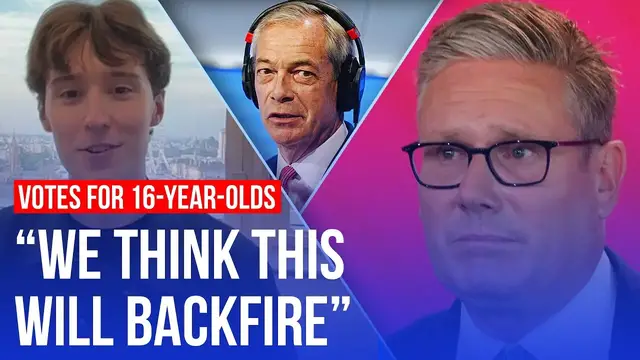
They believe that this move will benefit them. And what we're saying is that actually it might backfire, it probably will backfire
11:15
and that we will benefit from this change