0:00
When you think of the most successful
0:04
>> one of the first countries that may come
0:09
>> Since 1978, when China was first
0:11
formally allowed to compete in the IBF,
0:14
now BWF, World Championships, China has
0:17
amassed 72 gold medals and is handily
0:20
the most dominant nation. And while
0:22
China does have a significant number of
0:24
highlevel players making each other
0:26
better internally and strong government
0:28
backing in developing high performance
0:31
there are things that China does
0:32
uniquely from other nations that has
0:35
given their players an edge. In this
0:38
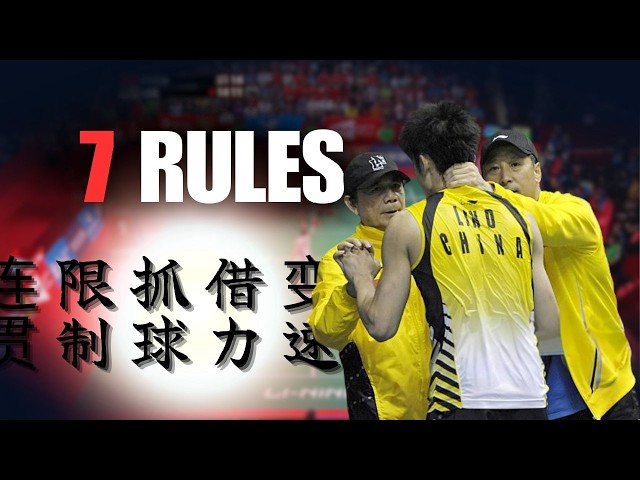
video, we're going to talk about seven
0:40
Chinese badminton principles that you
0:43
can practice and apply to your game. And
0:45
yes, all seven work for both singles and
0:48
doubles. The first Chinese concept we're
0:51
going to talk about is the concept of
0:55
>> the direct translation on Google
0:57
Translate is coherent, but it doesn't
0:59
quite get the meaning right except for
1:01
this part about ideas being arranged
1:03
logically allowing them to flow in a
1:06
reasonable connected manner. Our
1:10
>> in the bad mitten context is flow. Your
1:12
game should be flowing where every
1:14
action you do and will do should be
1:20
One of the easiest ways to understand
1:21
this is to think about footwork.
1:24
What surprised us a little when training
1:27
in China was just how little time they
1:29
spent working on footwork. Of course,
1:32
everyone will develop their basic
1:33
scissor kick, shuffle, and crossover
1:35
movements, but after that, there is not
1:39
a significant amount of time allocated
1:41
towards dedicated footwork practice.
1:44
This is because Chinese players often
1:46
train with the principle that footwork
1:48
should follow and flow with the game. If
1:50
you play a really good full smash, for
1:54
you're not going to shuffle back to
1:55
middle, split step, and then go up for a
2:01
Most likely you'll just sprint to the
2:03
net right after the smash and kill it.
2:06
And so your footwork practice is just
2:08
about finding your timing on court in an
2:11
actual rally. It should follow the pace
2:13
of the shots you hit and what your
2:16
opponent is able to return back. And
2:20
you should be training your mental to
2:22
continuously follow the next shot to
2:24
keep the game flowing.
2:26
This is also why you'll see Chinese
2:28
players have a much smaller split step
2:30
compared to players like Europeans who
2:32
put more emphasis on the actual
2:44
Speaking of thinking about what your
2:45
opponent is able to return back, another
2:51
>> the direct translation of this is limit,
2:53
which is about right. One of the things
2:56
that Chinese players put high emphasis
2:57
on is learning how to limit their
3:00
opponent's shot options. They pay
3:02
special attention to angles and shot
3:04
speed to force their opponents into just
3:06
a few options. If you guys watched our
3:09
video about 2008 Lindan's secret
3:11
strategy, you'll know that Lindan is
3:13
especially good at limiting his
3:15
opponents. One concept from that video
3:18
is how it's much easier for players to
3:20
cut off flat shots from their forehand
3:22
side than their backhand side. It's also
3:25
easier for players to produce more power
3:26
from that forehand side.
3:29
Chinese players understand this well and
3:32
so they will purposely push and lift
3:34
higher towards their opponent's forehand
3:37
sides while playing flatter shots at the
3:39
backhand. And when you combine this idea
3:42
with making your game flow, the game
3:45
should generally become easier to play.
3:47
For example, if you play a good spin
3:50
net, your opponent is generally limited
3:52
to trying to reet or lift. In these
3:55
cases, you don't need to step so far
3:57
back as you have time to get back to the
3:59
high lift. Similarly,
4:02
no one is going to spin net a drive, and
4:04
as long as you're not heavily outclassed
4:06
by your opponent, there is no room to do
4:09
a deception either. The only responses
4:12
are generally blocks, lifts, or the most
4:14
dangerous one, a drive back. And so,
4:17
your focus when you drive should
4:19
generally be these three shots. and your
4:22
mental and footwork should speed up with
4:24
your shot. In doubles, this concept
4:27
becomes even more interesting because
4:31
One case, for example, is attacking the
4:33
middle when you're the backourt player.
4:35
As long as your shot has good downwards
4:37
angle, your opponents are pretty much
4:39
limited to just lifting it high. If they
4:41
try to initiate any sort of drive or
4:43
net, the shots are generally really easy
4:46
for your partner to cut off.
4:48
You may also play certain shots to force
4:50
your opponents into an undesirable
4:52
rotation or put yourself into a good
5:00
When you're good at limiting your
5:01
opponent's shot selection,
5:03
you should also be able to convert those
5:05
opportunities into winning points. There
5:08
is a Chinese phrase that you'll hear
5:09
frequently in badminton called
5:13
the direct translation of catch the ball
5:15
shouldn't be taken quite literally. And
5:18
a better phrase would be catch the
5:19
opportunity or in other words,
5:23
There are many levels to anticipation,
5:25
but the first and general level that
5:28
should be mastered right at the start is
5:30
to be ready to attack when your
5:31
opponents are out of position. Whenever
5:33
your opponent takes it late in the front
5:35
or back court, they're really only able
5:38
to play close to the net or into the
5:40
back court. So when that happens, you
5:43
need to be ready to attack by either
5:45
taking the loose front court shot early
5:48
or attacking [music] in the back court.
5:49
The next level after is then combining
5:52
this idea with limiting your opponent's
5:54
shot selection. If you block towards the
5:56
service line and your opponent is taking
5:59
the shuttle below the tape, it is very
6:01
likely for them to instinctively push or
6:04
lift. And here's where you can have some
6:06
of that intention where you may actively
6:09
position yourself to move to the back
6:13
Here are some examples.
6:39
It's not just the back court either. You
6:41
can also do the same in the front court.
6:59
that seems a little bit uh in danger.
7:09
Now, what we just talked about can also
7:12
be interpreted as a form of the next
7:14
[music] Chinese concept.
7:17
>> In English, this means change speed. And
7:20
you might hear us or others say change
7:23
pace as well. Given how the Chinese play
7:25
heavily with ideas of rhythm and flow,
7:28
it also generally becomes a principle
7:30
that winning points will rely on
7:32
breaking your opponent's rhythm and
7:33
flow. And one of the most effective ways
7:36
to do this is through changing speed.
7:39
Pace changes, when done correctly, will
7:41
lead to your opponent mistiming their
7:42
split step and taking the shuttle late.
7:46
There are many different kinds of pace
7:47
changes and you can combine different
7:50
elements like your footwork and shot to
7:53
make your pace changes more deadly. For
7:57
one thing you can do is speed up your
7:59
footwork in certain scenarios and then
8:02
play a slower shot. When you approach
8:05
the shuttle fast, opponents are often
8:07
expecting fast shots like drives or
8:09
smashes, so the sudden slow shot can
8:12
catch them off guard. There are also
8:14
times when you can maintain the same
8:16
speed in your footwork and then inject
8:19
pace with your hand to punish those who
8:35
Another way to create opportunities for
8:36
yourself and break your opponent's
8:38
rhythm is a Chinese concept called
8:43
this one translates to get rid of or to
8:45
break away in English. We prefer the
8:47
breakaway definition, but it does
8:50
require some more explanation. In our
8:52
eyes, this Chinese concept is about
8:55
breaking away from your opponent's shot
8:59
We already talked quite a bit about how
9:01
gameplay is supposed to flow where, for
9:03
example, if you full smash, you should
9:06
naturally just follow up to the front
9:08
court immediately in singles. Well, the
9:11
next level is to understand some of the
9:13
things that your opponent naturally
9:14
wants to do, like smash, follow up,
9:16
kill, and then counter it. If your
9:19
opponent smashes and you're able to whip
9:21
a return crosscourt, many times you
9:24
would be able to break away from your
9:25
opponent's attacking combo and position
9:27
yourself to be on the attack.
9:30
You can use this concept in doubles,
9:32
too. Whenever your opponents are
9:34
attacking, the ultimate goal is to get a
9:36
loose block or halfcourt lift that they
9:39
can kill to finish the rally.
9:42
Knowing this, you can practice
9:44
countering by practicing and using
9:46
returns that are not desirable for your
9:48
Some good returns include lifting cross
9:51
or drive blocking to stop a continuous
9:55
Of course, executing this takes a great
9:58
deal of skill, and you're not expected
10:00
to completely stop your opponent's
10:02
attack on their very first shot.
10:04
Your goal, however, is to not let your
10:07
opponent continuously play consecutive
10:09
shots that they want to play.
10:11
A general rule of thumb is that after
10:14
one or two attacking shots from your
10:16
opponent, your opponent should feel the
10:17
need to neutralize the rally.
10:28
If they play three or four shots that's
10:30
within their combo, you will most likely
10:35
>> That serve a long time. He was doing
10:37
that yesterday against the wind.
10:46
away from the tactical side of things a
10:48
little bit, there are a few Chinese
10:50
concepts we wanted to mention that will
10:52
help develop your technical skills.
10:55
The first one is one you may have
10:57
already heard us refer to in previous
10:58
videos and that's a concept called
11:02
>> the literal translation is make it tight
11:04
or to tighten. And although there is
11:06
some element of this where you [music]
11:08
need to tighten your core, we don't want
11:10
people to mistaken this concept to being
11:12
more stiff and tense on the court. After
11:14
all, if you're too stiff and tense on
11:16
the court, you won't be able to play
11:19
your shots well. Instead, we like to
11:22
>> as returning to a ready- hitting
11:24
position as fast as you can.
11:28
This doesn't mean returning back to the
11:30
middle necessarily, but moving your body
11:32
to a position where you're ready to push
11:34
off and play the next shot as soon as
11:37
your opponent hits. If you want to
11:39
effectively execute some of the
11:41
previously mentioned principles, then
11:43
getting really good at this upper body
11:45
recovery is super important as it'll
11:48
give you the time to actually react to
11:56
And for the final Chinese principle in
11:58
this video we want to talk about is
12:01
>> aka borrow force. The badmitten context
12:04
is you want to borrow force from various
12:06
elements to play your shots. For
12:08
example, your smash power doesn't just
12:10
come from your arms and it shouldn't. A
12:13
very strong and quick smash is a
12:15
combination of arm and body rotation
12:18
Similarly, a good spin net often comes
12:21
not from you trying to spin the bird as
12:23
much as you can with your fingers and
12:24
arm, but from the momentum you have
12:29
You can also use the concept of
12:31
borrowing force on your opponent.
12:33
Whenever your opponent plays a fast shot
12:35
against you, a lot of the time you don't
12:38
need to add a lot of your own power into
12:41
It can be just as, if not more
12:43
effective, to simply redirect their shot
12:45
to a different direction.
12:48
In fact, this is what a younger Lindan
12:49
excelled at. A lot of players will watch
12:52
Lindan and think he's an allout
12:54
attacking player, but actually he
12:55
doesn't attack that much in the way that
12:58
a lot of people think. He's not the type
13:00
of player to force spin nets and then
13:03
sprint back and jump smash. Instead,
13:06
what younger Lindan was really good at
13:08
was punishing his opponents for trying
13:10
to pressure him. A lot of players will
13:13
go for fast pushes or punch clears to
13:15
try and make their opponents take a late
13:16
forehand or backhand. But younger Lindan
13:19
doesn't take late shots all that often
13:21
and instead cuts off fast shots early
13:23
and redirects the shot speed back at his
13:33
>> You can use this on defense, too. Your
13:35
opponents might go for very hard full
13:37
smashes and simply sticking out your
13:40
racket can generally be enough. When you
13:43
successfully defend like this, your
13:45
opponent is going to be the one who's
13:47
way more tired. And if you're constantly
13:50
the one using less energy because you're
13:52
leveraging your opponent's strength,
13:54
then you're going to win more easily.
13:57
This concept of borrowing force is even
13:59
more important in doubles where your
14:02
shot depends so much on the preciseness
14:04
of your swing timing. You can't afford
14:06
to always do a full pullback on every
14:08
shot. And so the game relies heavily on
14:10
your ability to leverage momentum from
14:12
other sources such as your opponent's
14:23
Now these seven badmitten principles are
14:25
not unique to Chinese badminton players
14:27
nor are they a full comprehensive list
14:29
of all Chinese badmitten principles
14:32
but they are concepts we hear frequently
14:34
from Chinese badminton coaches and
14:36
rarely from other non-Chinese coaches.
14:38
Regardless knowing these concepts is one
14:41
thing and executing is a whole other.
14:46
It is our hope though that this video
14:49
has given you some things to keep in
14:50
mind when you go into your next
14:52
practice. If you like this video, make
14:55
sure to hit the like and subscribe
14:57
button so you don't miss out on future
14:59
content. Let us know what you would like
15:02
to see in the comments below. And as
15:04
always, thanks for watching.