0:03
Welcome back to Altitude Addicts, where
0:05
we break down the engineering pushing
0:07
modern aviation past its limits. Today
0:11
we are looking at Russia's next major
0:13
step toward bringing back supersonic
0:15
passenger flight centered around the
0:17
experimental Strish Demonstrator.
0:20
Stick around until the end because we
0:22
are covering how engineers are taking a
0:24
fighter jet engine, mounting it on top
0:26
of the fuselage, and adding a flat
0:28
nozzle to quiet the sonic boom.
0:34
turboan engine is a critical component
0:36
of the experimental stish demonstrator
0:39
as Russia makes strides in developing
0:41
its next generation supersonic civil
0:43
aviation technologies.
0:45
This power plant is an adaptation of a
0:48
wellestablished Russian military
0:50
aviation engine for a different purpose
0:52
to showcase the technologies necessary
0:54
for future supersonic passenger
0:58
UEec Kleov of the United Engine
1:01
Corporation developed it in
1:02
collaboration with the Zukovsky Research
1:05
Center N and the Central Institute of
1:07
Aviation Motors known as DIAM.
1:11
The STRish program includes evaluating
1:13
an integrated propulsion system that has
1:16
been specifically engineered to meet the
1:18
aerodynamic and acoustic requirements of
1:21
civilian supersonic flight. The
1:24
configuration uses two RD93MS
1:26
engines, each connected to a flat jet
1:29
nozzle with an oblique cut and a
1:31
specially developed air intake.
1:34
Ground testing has verified the engine's
1:36
thrust characteristics meet the
1:38
technical specifications established for
1:43
So how do you actually take a military
1:45
power plant and adapt an established
1:47
engine like the RD93MS
1:50
for a completely new application?
1:53
The RD93MS is a member of the RD93
1:56
engine family which UEC claim originally
1:59
developed for military aviation.
2:02
The Chinese FC1 and JF17 fighter
2:05
aircraft are powered by the RD93 and its
2:08
development provided UEC Kleov with
2:11
experience in compact turboan propulsion
2:13
for high performance aircraft.
2:16
For Streish, however, the requirement is
2:19
different which requires changes to the
2:21
installation arrangement and exhaust
2:25
Accordingly, the RD93MS
2:28
has been modified to operate with a
2:30
speciallyesed exhaust nozzle and
2:32
specialized air intake apparatus.
2:35
The engine must receive air from the
2:37
intake under necessary conditions and
2:39
the nozzle must manage the exhaust flow
2:42
so the resulting assembly functions as a
2:47
The big thing to remember here is that
2:49
passing a test on a concrete stand is a
2:52
whole different ballgame than flying
2:54
passengers at Mach 2. The reported tests
2:57
confirm compliance with the
2:59
demonstrators thrust requirements, which
3:01
is a critical distinction.
3:04
They do not in isolation demonstrate the
3:06
readiness of a production supersonic
3:08
passenger aircraft or establish the
3:11
engine's ultimate performance across all
3:15
That brings up a major design question.
3:17
Why does Strish use two RD93MS engines
3:21
and why are they placed so unusually?
3:24
The Streish demonstrator is currently
3:26
under development to examine various
3:28
technologies for a future Russian civil
3:33
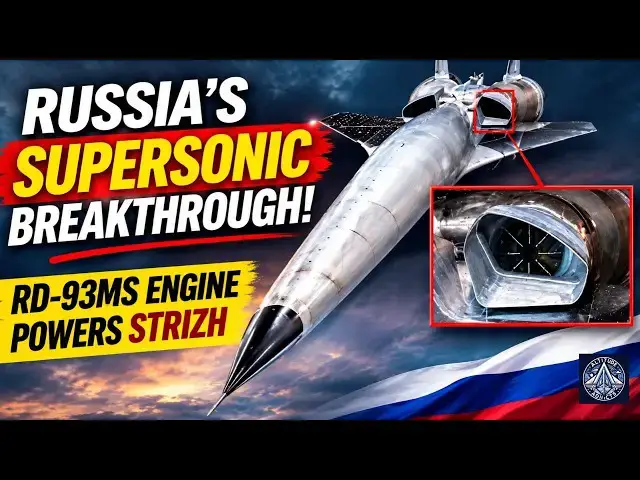
The proposed upper fuselage positioning
3:36
of the propulsion system is one of its
3:38
most significant features.
3:40
The stris configuration differs from
3:43
traditional aircraft installations
3:45
because the engines are located on the
3:46
upper portion of the airframe rather
3:49
than beneath the wings or alongside the
3:53
The purpose of this arrangement is to
3:55
mitigate the intensity of the sonic boom
3:58
reaching the ground and to affect the
4:00
propagation of shock waves around the
4:04
The propulsion systems engineering
4:06
requirements are also influenced by the
4:08
engine's positioning.
4:10
The engines must receive air through
4:12
specifically engineered inlet ducts and
4:15
the exhaust must be directed in
4:17
accordance with the aircraft's
4:21
TCGI has been responsible for
4:23
investigating these aerodynamic and
4:25
propulsion integration challenges.
4:28
Before conducting wind tunnel
4:30
experiments, its engineers developed and
4:32
produced models of the air intake
4:34
devices and exhaust nozzles.
4:37
Under the tested conditions, the air
4:39
intake characteristics exceeded the
4:41
standard reference values as stated in
4:44
the institute's December 2025
4:48
The str demonstrator also demonstrated
4:51
acceptable pressure losses associated
4:53
with the flat jet nozzle. Full-scale
4:56
ground testing of the adapted RD93MS
5:00
engine was later conducted on the basis
5:04
If you are still with us here on
5:06
Altitude Addicts, we are about to get
5:08
into the weirdest looking piece of
5:10
hardware on this whole aircraft. Coming
5:13
up next, we will look at how engineers
5:15
manufactured a flat angled exhaust
5:18
nozzle and how they are trying to
5:20
silence the roar of takeoff.
5:23
Moving into that hardware, the flat
5:25
nozzle introduces a completely different
5:28
engineering challenge. The flat jet
5:31
nozzle with an oblique cut is one of the
5:33
most distinctive features of the RD93MS
5:36
installation. And this is not simply a
5:39
change in external appearance. To
5:42
accommodate the aircraft's upper mounted
5:44
engine arrangement, the nozzle must
5:46
regulate the exhaust flow as part of the
5:48
propulsion systems aerodynamic design.
5:52
Circular exhaust nozzles are the norm
5:54
for conventional fighter engine
5:58
In contrast, the Streish program is
6:00
dedicated to studying a flat
6:02
configuration that can be seamlessly
6:04
incorporated into the demonstrator's
6:06
airframe architecture.
6:09
Trying to balance stealthy aerodynamics,
6:12
low noise, and raw thrust in a single
6:14
flattened pipe is a total headache for
6:16
aerospace engineers. The development is
6:19
especially pertinent because the nozzle
6:21
geometry can significantly impact
6:23
acoustic behavior, exhaust flow
6:26
characteristics, and thrust recovery.
6:29
Rather than optimizing a single
6:31
characteristic independently, engineers
6:33
must maintain a balance between these
6:35
factors. The nozzle was produced through
6:38
a combined process that included
6:40
laserining, welding, and milling. This
6:44
manufacturing method was chosen to
6:46
generate the necessary structural
6:47
characteristics and geometry.
6:50
The flat nozzle with an oblique cut is a
6:53
first in domestic aviation practice.
6:55
According to test EI, before the engine
6:58
underwent ground testing, its
7:00
aerodynamic characteristics were
7:02
initially examined using experimental
7:05
models in wind tunnels.
7:07
The results are significant because a
7:09
nozzle that functions properly in
7:11
isolation must also function accurately
7:14
when connected to the engine and
7:16
integrated with the aircraft's air
7:18
intake system. The strish program is
7:21
designed to verify the entirety of this
7:24
arrangement rather than individual
7:28
Solving the exhaust shape is only half
7:30
the acoustic battle which is why TEI
7:33
also created a system to mitigate
7:37
Another critical component of the RD93MS
7:40
development is noise reduction.
7:43
Supersonic passenger aircraft encounter
7:45
two distinct acoustic challenges. The
7:48
sonic boom associated with supersonic
7:51
flight and the noise emitted during
7:55
The strish program uses unique
7:57
engineering methodologies to resolve
8:00
The purpose of the upper mounted
8:02
propulsion arrangement is to explore
8:04
methods for mitigating the sound impact
8:06
of the sonic boom. In the interim, TESS
8:10
A has created a specialized noise
8:12
suppression system to mitigate the noise
8:14
produced by the engine's exhaust jet
8:18
During the ground testing phase, the
8:21
system was installed on the flat nozzle.
8:24
Its objective was to mitigate the
8:26
acoustic intensity of the exhaust stream
8:28
during high thrust operating conditions
8:31
associated with takeoff.
8:34
Because let's face it, nobody living
8:36
near a major airport wants a supersonic
8:38
airliner rattling their windows every
8:43
This is particularly significant for
8:45
civilian aviation as the availability of
8:48
supersonic aircraft at existing airports
8:50
can be influenced by community exposure
8:53
and airport noise restrictions.
8:56
Before we wrap up the full picture,
8:58
let's look at the final test milestones
9:00
and the organizations actually running
9:02
the show behind the scenes. Coming up,
9:05
we will see how the civil 2025 GI trials
9:09
came together and what has to happen
9:11
next before this demonstrator ever
9:15
All of that acoustic and aerodynamic
9:18
work leads directly to how ground
9:20
testing confirms the engine's thrust
9:24
The completion of groundbased engine
9:26
testing at UEC Clemov was the most
9:28
significant milestone in the RD93MS
9:32
development. The tests were conducted in
9:35
collaboration between UEC clim
9:38
specialists as part of the civil 2025
9:41
TIG research program.
9:43
SEAG subsequently reported that the
9:46
research phase had yielded various
9:48
noteworthy results. These included the
9:51
successful wind tunnel investigations of
9:54
the intake and nozzle arrangements, the
9:56
manufacturer of the flat nozzle, and
9:58
fullcale ground testing of the engine
10:01
with noise suppression.
10:03
Numerous Russian aviation organizations
10:06
are involved in the strish program. Tess
10:09
AGI coordinates the demonstrators
10:11
technological development while UEC
10:14
Kleimov develops and adapts the engines.
10:16
Tesim contributes its expertise in
10:19
aviation propulsion research and the
10:21
Zukovsky Research Center coordinates
10:23
government sponsored research programs.
10:26
The next challenge is to convert these
10:29
ground test results into an operational
10:31
flight demonstrator.
10:33
Thanks for tuning in to Altitude Addicts
10:35
and let us know in the comments whether
10:37
you think overwing engines are the real
10:40
key to bringing back quiet supersonic
10:46
We thank the people who have shared,
10:48
subscribed and hyped the videos.