Up next in 10

Russia’s Sanctioned Yard Krasnoye Sormovo Targets a Major Shipbuilding Expansion
Oct 25, 2026

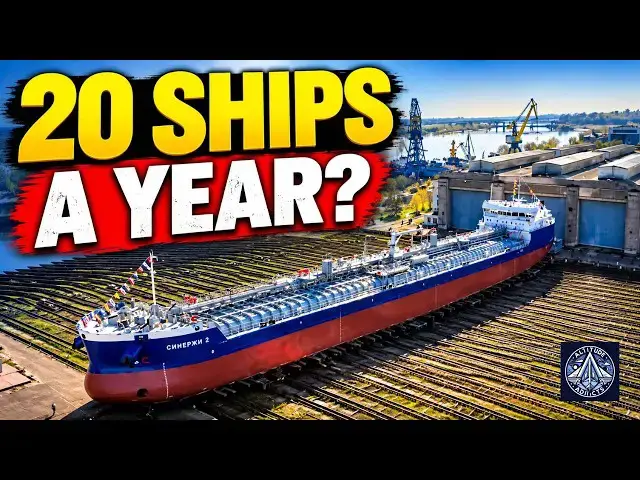
Russia is stepping up its shipbuilding ambitions, and the Krasnoye Sormovo shipyard has set its sights on a major increase in vessel production.
Sergey Lyashenko, general director of the United Shipbuilding Corporation's Krasnoye Sormovo shipyard, has outlined the company's plans as Russia updates its shipbuilding industry development strategy through 2050.
The Nizhny Novgorod-based shipyard currently has contracts for RSD59 river-sea dry cargo vessels, Project 00840 Karelia cruise liners, and KSP01 vessels under Russia's “Quotas Under Keel” programme. The enterprise also specialises in building tankers and container ships.
The production targets are ambitious. Krasnoye Sormovo plans to launch eight RSD59 dry cargo vessels this year, followed by ten next year. Its longer-term objective is to reach an annual output of 20 vessels.
Achieving that target will require more than additional orders. The shipyard plans to pursue technical modernisation and organisational improvements to increase production efficiency.
The company has also faced challenges in replacing imported components. According to the shipyard, its engineering personnel have helped overcome these difficulties by finding domestic suppliers and adapting to new sourcing requirements. The company says its current orders meet the applicable technical requirements.
The expansion plans come as Russia seeks to strengthen its shipbuilding capacity, increase serial production and develop the skilled workforce needed to sustain industrial output.
Can Krasnoye Sormovo reach 20 vessels a year? The answer will depend on production modernisation, supply-chain reliability and the shipyard's ability to scale up manufacturing.
Watch for more updates on Russian shipbuilding, cargo vessels, industrial modernisation and maritime technology.
#Russia #Shipbuilding #KrasnoyeSormovo #RussianIndustry #RSD59 #CargoShips #Shipyard #MaritimeIndustry #IndustrialDevelopment #UnitedShipbuildingCorporation #USC #RussianTechnology
Be a Member for exclusive privileges - https://www.youtube.com/channel/UCviEFTf1xIPKsjmyF_zvFug/join
Twitter : https://x.com/AltitudeAddicts
Telegram: t.me/altitudeaddicts
Show More Show Less View Video Transcript
0:02
The government has updated its ship
0:04
building strategy until 2050. Over the
0:07
next 11 years, Russian shipyards are
0:09
expected to build more than 1,500
0:12
civilian vessels, which should seriously
0:14
strengthen transport links within the
0:16
country and internationally and become a
0:18
driver of economic growth.
0:20
>> At a recent cabinet meeting, officials
0:23
focused on renewing the domestic fleet.
0:26
By 2050, the share of serial ships
0:28
produced at Russian enterprises is
0:30
supposed to reach roughly 80% at least
0:33
according to the current plan. Priority
0:36
projects include vessels for the
0:38
northern sea route and the north south
0:40
transport corridor. These are mainly
0:43
large tonnage ships, crude oil tankers,
0:46
gas carriers, chemical and product
0:48
tankers as well as bulk carriers.
0:51
We have significantly increased support
0:53
for manufacturers and customers of
0:55
vessels and components. More than half a
0:58
trillion rubles have been allocated from
1:00
the federal budget for these purposes
1:02
over the next six years. This is a
1:04
record amount of funding for the
1:05
industry with a significant portion of
1:08
the funds provided within the framework
1:10
of the new national technological
1:12
leadership project for the industrial
1:14
support of transport mobility. The
1:17
government emphasized that in the
1:18
context of sanctions, the development of
1:21
the domestic fleet is of key importance.
1:24
In the 1980s, the Soviet merchant fleet
1:27
was one of the largest in the world. The
1:29
sea transport fleet alone numbered more
1:31
than what on 800 ships under the red
1:33
flag. What do we need to regain lost
1:36
ground? We'll figure it out right now.
1:38
Welcome to our studio Vladimir Gamza,
1:41
chairman of the council on financial
1:43
industrial and investment policy, member
1:46
of the board of the chamber of commerce
1:48
and industry of the Russian Federation.
1:50
Vladimir Andrevich. Hello, good evening.
1:53
Many viewers immediately draw parallels
1:56
with civil aviation and ask whether the
1:58
situation was really that bad, whether
2:01
we relied excessively on foreign
2:03
suppliers and effectively lost this
2:05
branch of industry which we are now
2:08
forced to rebuild in emergency mode.
2:11
We missed almost all branches of heavy
2:14
and medium engineering and everywhere we
2:17
achieved that imports accounted for 50
2:20
to 80% in these branches as
2:23
technologies, equipment, components,
2:25
materials and so on and so forth.
2:35
Therefore, we can say that in a number
2:37
of industries, we are starting
2:39
practically well, if not from zero, then
2:41
from the lower bar.
2:44
>> Vladimir Andreovich, help us understand
2:46
what happened to the once powerful
2:47
Soviet fleet. How did it change over
2:49
these 30 years? Did it simply become
2:51
obsolete?
2:52
>> Exactly. It became obsolete. Part of the
2:55
ship simply sank or were decommissioned
2:59
due to age. Many are rusting at births.
3:02
Some were scrapped, others sold off,
3:05
including aircraft carriers, submarines,
3:07
and other major vessels. And in this
3:10
way, the fleet gradually disappeared. In
3:13
terms of domestic ship building, by the
3:16
early 2020s, imported solutions were
3:19
already providing about 80% of what we
3:22
used.
3:26
And now you know that it really caught
3:30
my eye at the meeting at the government
3:32
actually speaking the phrase that was
3:34
heard in the context of sanctions the
3:36
development of the domestic fleet is of
3:38
key importance that is again it turns
3:41
out that if it weren't for sanctions
3:43
there would be no way without good uh
3:46
well that's roughly how it actually
3:49
turns out. The fact is that in order for
3:51
us to after
3:55
>> you know it's very difficult to blame
3:58
the government so that at the beginning
4:00
these are not accusations these are just
4:03
things in their own names so that it's
4:06
clear at the beginning of the 2000s the
4:09
task was to quickly somehow raise the
4:12
standard of living and well-being in the
4:14
country and then we got lucky mineral
4:17
prices went up and went up very Well,
4:23
naturally we concentrated on expanding
4:25
the raw materials economy and in many
4:28
respects this made sense at that moment.
4:31
However, industry should never have been
4:34
sidelined. We actually did forget about
4:36
it. We took pleasure in extracting raw
4:39
materials, selling them and buying the
4:42
most advanced foreign technologies and
4:45
finished products.
4:49
And that's why we lost a lot. Therefore,
4:52
today in fact, ship building is a very
4:55
difficult task. Today, of all the ship
4:59
building that we are currently carrying
5:01
out, 3/4 are in fact defense products
5:04
for the defense industrial complex.
5:10
And if we need to build one and a half
5:12
thousand new ships by 1936, then this
5:15
means that we must triple the number
5:17
that exists today. This is a very
5:20
serious task and the resources that are
5:23
invested there, a little more than 500
5:27
billion rubles of course are not enough.
5:30
Still, yes. Yes. Well to be clear today
5:33
I have already said that ship building
5:36
mainly the defense industrial complex
5:40
spends about a trillion a year.
5:48
Yes roughly a trillion per year.
5:51
Therefore, we must understand that if we
5:53
want to move to invert the pyramid and
5:57
for civil ship building to occupy 75 80%
6:02
of our ship building there and at the
6:04
same time for us to also increase the
6:08
amount of production there by three
6:10
times then it is quite obvious that
6:12
investments in this sector. Our viewers
6:16
write that the Navy itself was not hit
6:18
as hard after Perisroka whereas the
6:20
river fleet was largely scrapped.
6:23
Why is business not involved in the
6:25
development of ship building in any way?
6:26
This means that the state will build the
6:28
ships and business will operate them.
6:29
They have settled down. Well,
6:31
>> let us talk more concretely about what
6:33
the future fleet should look like. It is
6:36
quite obvious that the state will
6:38
provide assistance
6:42
in the construction of a fleet that will
6:45
carry out state tasks. And this is first
6:48
of all naturally a fleet that will be
6:50
associated with the delivery of
6:52
minerals. These are oil tankers, bulk
6:55
carriers, liqufied gas tankers.
7:06
plus dry cargo vessels, container ships
7:08
and related classes. It is also obvious
7:11
that ice breakers for northern waters
7:13
will play a special role.
7:16
The river fleet by contrast falls mainly
7:19
under business responsibility and this
7:21
is where we see major difficulties.
7:26
A river fleet can only operate
7:28
efficiently if the required
7:30
infrastructure exists.
7:33
Today, the infrastructure on most
7:36
rivers, especially in Siberia and the
7:38
Far East, has been destroyed. That is,
7:41
it has simply practically disappeared.
7:44
Take the Yanisa as an example. Once upon
7:48
a time, river navigation on the Yanice
7:50
was well organized.
7:52
But when the vessels disappeared, the
7:54
associated infrastructure gradually
7:57
collapsed as well.
7:59
And today we need not just to build
8:01
ships.
8:03
Business is actually capable of
8:05
producing the required number of ships.
8:07
Today there are no problems. But we need
8:10
to build the infrastructure. That is
8:13
here one thing leads to another. You
8:15
know, if we want to have efficient
8:19
mechanical engineering at the end,
8:21
including ship building, we need to
8:24
build the entire chain starting from
8:27
education because we are lagging behind
8:30
in many ways in education, starting from
8:34
education, science, nucra, machine tool
8:37
manufacturing, material science and so
8:40
on. And only at the end will we then get
8:44
efficient modern competitive mechanical
8:47
engineering.
8:49
>> Uh if we want modern efficient
8:51
mechanical engineering including ship
8:53
building, we must reconstruct the entire
8:55
chain starting from education where we
8:58
are noticeably lagging through basic
9:00
science, applied RD, uh modern machine
9:03
tool manufacturing, material science and
9:06
related disciplines. Only then will we
9:08
obtain advanced competitive mechanical
9:10
engineering at the end of this chain.
9:12
>> Welcome to the air.
9:14
>> Yes, good evening.
9:15
>> Tell us about your production. What
9:17
types of ships are built at the
9:19
enterprise? How many are produced?
9:23
>> Yes, today the company has a contract
9:26
for the construction of vessels of the
9:28
Recomoria dry cargo class.
9:32
We also have a contract for the
9:34
construction of cruise ships also of the
9:37
Recomoria class for the Vod company.
9:41
This is in fact our cruise ships.
9:46
We are replacing production which in
9:48
Soviet times was located in the SAP
9:51
countries. We are building the second
9:54
liner in history in the modern history
9:57
of the country. that is Must Karim is
9:59
our first liner which we delivered walks
10:02
on our rivers transports tourists.
10:05
We are also building Recomoria class
10:07
river sea cruise ships for the Vodokut
10:09
company. These vessels form the basis of
10:11
our modern cruise fleet.
10:13
We also we also specialize in the
10:17
construction of Ecomore class cargo
10:19
ships. These are tankers container ships
10:22
just for the development of the north
10:24
south corridor. This is our
10:26
specialization and we are completing a
10:28
series of raiding vessels under the
10:30
quota under the kill program.
10:36
Sergey Mkhyovich, but there is
10:38
undoubtedly production. Can you clarify
10:41
how many ships Kasnoya or Movo launches
10:44
per year and what are the plans
10:46
regarding cruise ships? We heard that
10:49
there are plans uh now a second ship. It
10:52
is planned to produce one cruise ship
10:54
per year and in general what is the
10:57
production of the enterprise.
11:01
>> So production clearly exists. Could you
11:04
specify how many ships Kaso Sormo
11:06
launches each year and what your plans
11:07
are regarding cruise ships? We heard
11:09
that a second ship is being built now
11:11
and that later one will be produced
11:12
annually. But what about the overall
11:14
production volume?
11:15
>> And the goal is to reach 20 units per
11:18
year. To do this, we need to carry out
11:20
both measures related to technical
11:23
re-equipment and accordingly
11:25
organizational measures that uh
11:30
will allow us to increase the efficiency
11:32
of our activities and accordingly make
11:36
our products the most competitive so
11:38
that the customer perceives them and
11:40
takes them into operation with leasing
11:43
programs with normal payments. That is
11:46
we are currently dealing with these
11:49
issues. In short that is eight next year
11:52
10 but
11:55
plus accordingly the cruise ship and
11:58
further the task should reach 20 units
12:01
per year.
12:02
>> These changes should increase our
12:03
efficiency and make our products highly
12:05
competitive so that customers willingly
12:07
acquire them using leasing tools and
12:08
manageable payment schedules. In
12:10
summary, eight vessels this year, 10
12:11
next year plus a cruise ship and later
12:13
we plan to move to 20 units per year.
12:16
Well, look, in Soviet times, there was
12:19
an enterprise there that specialized in
12:21
the construction of submarines. Here in
12:24
general, technologically the orders and
12:27
projects are a little different, so to
12:29
speak. Yes, that is they are more
12:31
knowledge intensive, more labor
12:33
intensive. Yes. But I think in the best
12:37
of times probably plus or minus even 20
12:39
is such a very ambitious task. Somewhere
12:43
if you compare in terms of labor
12:44
intensity somewhere in the area there
12:46
are 10 12 I think I worked out the
12:48
formula.
12:50
In Soviet times the plant primarily
12:53
specialized in submarines which are
12:56
completely different products
12:57
technologically.
12:59
The current orders and designs are
13:02
different in character. They are more
13:04
knowledge intensive and require more
13:06
complex labor.
13:10
>> Given the large state defense order in
13:12
the past, we now position ourselves
13:14
within the corporation as a center for
13:16
civil ship building. The corporation is
13:18
investing serious funds in us and we are
13:21
obliged to justify this support by
13:23
delivering strong results.
13:25
How have you managed in recent years
13:27
under sanctions? What happened with
13:30
components and the import substitution
13:32
of critical parts which has caused
13:34
serious problems for many enterprises.
13:38
We survived well. Uh the only thing here
13:41
my colleague correctly added yes it is
13:44
good for ships and vessels. If in the
13:46
state defense there is a share of
13:48
Russian products it is quite decent.
13:52
Then in this commercial segment in fact
13:54
from Russian well to put it bluntly
13:57
there was only one metal before work.
14:00
Everything else we received all the
14:02
components from the west.
14:05
Accordingly after the introduction of
14:07
sanctions our esteemed partners who were
14:10
extremely reliable now as we understand
14:13
suppliers in quotation marks put all
14:16
this on hold. We had to look for
14:17
alternative so to speak suppliers. We
14:21
found some in Russia.
14:24
After the sanctions, our western
14:26
partners uh previously extremely
14:29
reliable suppliers effectively halted
14:32
cooperation. We had to search urgently
14:35
for alternative suppliers and found
14:38
several in Russia.
14:40
Thus, we launched an import substitution
14:42
program and now our ships comply with
14:44
Russian government resolution number 799
14:47
on local content. We also switched some
14:50
supplies to friendly countries which we
14:52
all understand.
14:56
Next, from the point of view of import
14:58
substitution, we set ourselves a task. I
15:00
as the general director of the
15:02
enterprise, yes, this is the development
15:04
of winter steering columns entirely of
15:06
our production. We have a project of our
15:09
design bureau for a propeller which is
15:11
part of the structure of the USC group
15:13
which was developed under the program of
15:15
the Ministry of Industry and Trade.
15:18
He passed the tests.
15:21
The equipment has passed all the
15:23
necessary tests.
15:26
Uh but based on an order also placed at
15:29
the SK Enterprise, we want to mass scale
15:31
these speakers and starting next year we
15:34
will offer them to customers.
15:37
But in the working procedure of the GTLK
15:40
company, uh as it is our customers, we
15:42
discussed this topic as soon as we put
15:45
it into production. From that moment on,
15:48
accordingly, we will replace Chinese
15:50
speakers with Russian ones. Such a task
15:53
is worth it. At the same time, we must
15:56
ensure the price at the level of our
15:58
current supplies.
16:01
The same with the steering devices, but
16:03
these are in fact such key components of
16:06
the ship. The only problem now, well, it
16:10
is probably the key one is with the main
16:12
engines. But I hope the state will solve
16:15
it. And after all from some point we
16:18
will have domestic main engines on
16:20
reccomot ships.
16:23
>> We are following a similar path with
16:25
steering gear and other key ship
16:27
components. The main remaining
16:29
difficulty probably the most serious one
16:31
concerns main engines. I hope the state
16:34
will solve this issue so that in due
16:36
course we will have domestic main
16:38
engines for Recomoria class ships.
16:41
>> Viewers are very interested in the
16:43
staffing problem. A TV viewer from the
16:45
Ivanova region asks where you will find
16:47
workers and whether you will have to
16:49
bring in migrants. Everyone knows that
16:51
the country faces a personnel shortage.
16:53
How do you cope? Who worked respectively
16:56
for specific enterprises.
16:59
Now it also exists but there is no such
17:02
so to speak centralized vertical
17:05
motivation for young people who would
17:07
continue to come to factories and work.
17:14
Well, not only us, probably all
17:16
industries have encountered this. That
17:18
is we solved this issue in the following
17:20
way. We have opened a training center
17:23
which has received the appropriate
17:24
licenses for the right to train and
17:26
retrain personnel. We are ready for the
17:30
main workers. Well, we accept yes how we
17:32
work. We accept students and teach if
17:36
they have not graduated from some
17:38
colleges, have not received a specialty
17:40
or have not transferred from other
17:42
factories. This is the first.
17:45
Secondly, that is regarding migrants to
17:48
enterprises like ours. Well, we simply
17:50
do not hire such people because we still
17:53
have part of the state defense order and
17:56
plus the products themselves, they are
17:58
strategically important. And my
17:59
understanding as a general director is
18:02
that we still need to develop the
18:03
potential of our citizens in order to
18:05
accordingly grow our own engineering
18:08
staff because one thing well it's like
18:11
dealing with wine products without any
18:13
hassle.
18:15
Another thing is high tech which is the
18:18
ships we produce and training an
18:20
engineer is the codes. A management
18:22
engineer who can steer these processes.
18:25
Yes, he must have the appropriate
18:27
education. And this is a decade
18:32
here. And understanding the last aspect,
18:34
the fact that we have a generally
18:35
difficult time with engineering
18:36
personnel. Yes. Who understand and can
18:39
accordingly understanding that we
18:41
generally lack engineering specialists
18:43
who can competently manage business
18:44
processes at high-tech industrial
18:46
enterprises. We decided to act. We at
18:49
our training center which is located on
18:52
the territory of the enterprise decided
18:54
to remember the well-forgotten Soviet
18:57
experience and together with the nishni
19:00
nogarot polytenic university opened
19:03
accordingly a department where we will
19:05
teach from September 1.
19:10
Classes will be held after working hours
19:13
and the specialty is technology of ship
19:16
and vessel production.
19:19
Sergey Mikyovich, thank you. Thank you
19:21
for the story. I think that all our
19:24
skeptical viewers have received answers
19:26
to their questions. Sergey Illesenko,
19:28
general director of the USC Kasnaya
19:30
Sorova plant in Nijn Nogoroth was in
19:33
touch with us.
19:34
>> Well, again our viewers mention how long
19:37
it will take
19:39
for this preparation for these people to
19:42
go to work for these measures that the
19:44
state is now taking to bear fruit.
19:47
In fact, the measures are already
19:49
bearing fruit.
19:52
Compared to the period before the early
19:55
1920s, we have already doubled the
19:57
production of civil courts. This is a
20:00
very serious result in fact
20:06
and I think that further that is we have
20:09
already overcome the import dependence
20:12
that was technology. Yes, in fact I
20:14
agree. Now the main problem is engines.
20:17
Diesel engines of course but I think
20:19
that we are already making engines for
20:21
airplanes. I am sure that we are also
20:24
making engines for ships. Of course the
20:26
power is different and for ships these
20:29
engines will also be made.
20:33
Therefore from a personnel perspective
20:36
the solution is actually very simple.
20:41
Our labor productivity still lags two to
20:44
threefold behind that of leading
20:47
industrialized countries in Asia.
20:52
Therefore, modern technologies are
20:54
highly efficient
20:58
will absolutely provide the necessary
21:00
amount of labor resources.
21:04
There is also a global trend as the
21:07
general director correctly noted whereby
21:10
large enterprises themselves organize
21:13
staff training in partnership with
21:16
universities. First general education
21:18
then specialized training for the
21:20
company's needs.
21:25
I suspect we are somewhat exaggerating
21:27
the personnel problem. The key is to
21:30
focus on raising labor productivity.
21:33
With a population of about 150 million,
21:37
Russia has more than enough people to
21:39
sustain a diversified economy
21:45
>> economy and probably no one has canled
21:47
automation either. This is the basis of
21:51
productivity, automation, robotization,
21:55
digitalization,
21:57
and in fact, right now, national
21:59
projects are exactly what we need.
22:02
>> Vladimir Andrevich. Well, to be honest,
22:04
I'm afraid of what 30 years of downtime
22:08
in this area. We have lost a lot of
22:10
competencies in ship building. Well,
22:12
correct me if I'm wrong, but on the
22:14
other hand, this is a chance for us to
22:15
immediately reach a new next level in
22:18
this area. Such work is underway. We are
22:21
looking in this direction. Well,
22:23
naturally, in fact, our universities in
22:25
recent years
22:31
57 have greatly restructured their work.
22:34
A number of scientific and educational
22:36
centers have appeared. A number of
22:38
universities there are territorially
22:41
united around scientific and educational
22:44
centers where work is carried out
22:46
precisely on the creation of modern
22:49
technologies. This is precisely one of
22:52
the main tasks of technocrats today.
22:59
so on. I think you know by the way we
23:01
have a chance in fact you also know what
23:04
in connection with what in recent years
23:08
in the world the volume in ship building
23:10
has fallen only LNG tankers have grown
23:14
everyone else has slowly decreased the
23:16
volume of production.
23:23
Therefore, if we can maintain the pace
23:25
we have now for an extended period, we
23:27
have a realistic opportunity to achieve
23:30
very solid results.
23:34
Vladimir Andrevich, thank you. Vladimir
23:36
Gamza, chairman of the Council on
23:38
Financial, Industrial and Investment
23:39
Policy, member of the board of the
23:41
Chamber of Commerce and Industry of the
23:43
Russian Federation was with us in the
23:44
studio.
23:45
>> This is a reflection. We will be back
23:47
soon.
Science