0:02
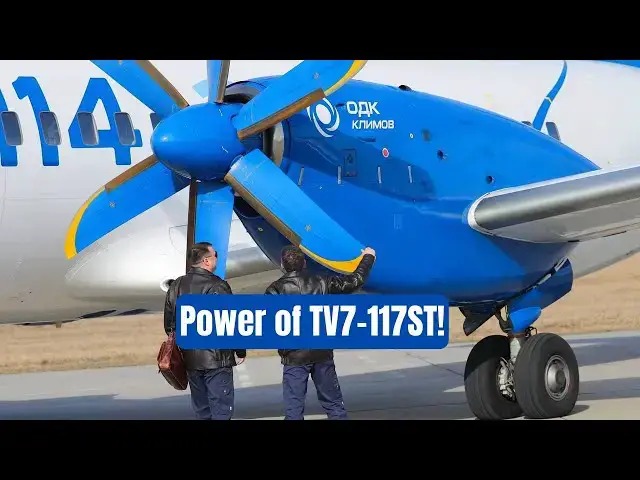
TV7117 ST01 aircraft engine which is a
0:07
TV7117 power plant family exhibited its
0:10
dependability during flight tests of the
0:13
IL114300. The Kleoff power plant is a
0:15
turborop and turbo shaft engine series
0:18
that was developed by JSC Kleof in
0:20
Russia. It was certified in 1997 and its
0:24
origins can be traced back to the
0:26
modernization of Soviet era engines to
0:28
enhance their reliability, fuel
0:30
efficiency, and service life. The
0:32
engine's modular design enables the
0:34
field replacement of its nine modules,
0:37
thereby substantially reducing repair
0:39
costs and delay. The engine is equipped
0:41
with an electronic hydromechanical
0:44
control system that optimizes
0:46
operational precision and efficiency.
0:48
The Svariant was initially developed for
0:51
the Illusian L114 regional commuter
0:54
aircraft and was subsequently made
0:56
available for modern Russian turborops
1:01
IL114. The version V turbo shaft engine
1:04
was added into the engine family to
1:06
power rotary wing aircraft such as the
1:08
Milme 38. Industrial power facilities
1:12
and marine drives for high-speed boats
1:14
also use this version. Russian
1:16
facilities that manufacture these
1:18
engines include Kleimov JSC in St.
1:20
Petersburg, Chernesev JSC in Moscow and
1:23
Buronov JSC insk. The
1:25
TV7117 family offers numerous variations
1:28
tailored to specific application needs.
1:31
The SM and ST turborop variant
1:33
implements full authority digital
1:35
electric control FedEx systems to
1:37
enhance reliability and maintainability.
1:40
The turborop variant features an
1:42
encapsulated centrifugal wheel, a
1:44
climboff patented innovation that boosts
1:46
power output by 10%. Upgrades for
1:48
helicopters such as the MI28 and KF50,
1:51
KF-52 are supported by the VK variant,
1:55
while the V and VM turbo shaft version
1:57
is used to power helicopters like the
1:59
Mi38. There is also a naval derivative,
2:03
TV7117K. The engine's sophisticated
2:06
design is underscored by its technical
2:08
specifications. It is equipped with
2:10
annular combusters and a two-stage axial
2:13
flow turbine in addition to a single
2:15
shaft axial flow centrifugal compressor
2:17
with five axial stages and one
2:20
centrifugal stage. It exhibits an
2:22
exceptional level of efficiency and
2:24
performance with a maximum power output
2:26
of 2800 horsepower and a fuel
2:29
consumption rate of 199 g per horsepower
2:32
per hour during takeoff. Currently,
2:35
there are four primary varieties of
2:37
engines used in aviation. The ST01
2:40
engine, which was certified in December
2:42
2022, is specifically engineered for the
2:47
L114300 turborop. This cuttingedge
2:50
engine, which is coupled with the
2:53
AB112114 propeller and is equipped with
2:55
a Fedc Bark 65SM electronic control
2:59
system, yields increased thrust and
3:01
improved fuel efficiency. Flight tests
3:04
can now be conducted at altitudes of up
3:06
to 7,600 m. As the Federal Air Transport
3:09
Agency of Russia has granted permission
3:13
operation, a pre-production program is
3:16
currently in progress to provide six
3:18
engines for three aircraft as part of
3:21
IL114300 development. Mass production is
3:24
anticipated to commence after successful
3:27
testing. The TVRS 444 LDOA regional
3:30
aircraft is intended to be equipped with
3:31
the ST02 variant. Currently, this engine
3:35
undergoes rigorous certification and
3:37
testing with operational deployment
3:39
scheduled for the near future. It is a
3:42
derivative of the ST family that has
3:44
been optimized for regional aviation
3:47
applications in order to increase
3:49
efficiency and reliability. In
3:51
helicopter applications, the MILM38 is
3:54
powered by the V Turbo Shaft engine.
3:56
This variant has effectively completed
3:58
flight testing and certification and is
4:01
currently in commercial operation. The
4:03
engine is employed by the MY38 for
4:06
various purposes such as cargo transport
4:08
and offshore operations and it benefits
4:10
from its advanced features and extended
4:13
service life. Another variant the VK is
4:16
designed for military helicopters
4:18
including the MY28 and K50 and K52. Its
4:23
support for enhancements to these
4:25
platforms guarantees improved
4:27
performance and reliability in demanding
4:29
operational environments. The
4:32
TV7117 family's operational status
4:34
underscores its certification and
4:37
deployment milestones. The version S, a
4:40
first generation engine, has accumulated
4:42
approximately 30,000 hours of
4:44
operational time. Conversely, the ST
4:47
variants, a second generation engine,
4:49
are in the process of transitioning to
4:51
serial production. The reliability of
4:54
helicopter variants such as the version
4:56
V has been confirmed by Russian aviation
4:58
authorities and they are currently in
5:00
active use on platforms like the
5:03
MY38. Last year new my38 helicopters
5:07
which were endowed with version VI
5:08
engines successfully flew 6,500 km from
5:12
Kazan to Magadon despite the extreme
5:15
temperatures of minus40°. The ST
5:18
variants, a second generation engine,
5:20
are in the process of transitioning to
5:22
serial production. There are numerous
5:24
Western equivalents to the Climoff
5:27
TV717 power plant family that fulfill
5:30
comparable functions in helicopters and
5:32
aircraft. These engines are similar in
5:34
terms of power output, efficiency, and
5:37
application versatility with some
5:39
variations in design philosophy and
5:41
market integration. The Prattton Whitney
5:44
Canada PW100 series is a notable
5:46
equivalent to the S and ST variants for
5:49
fixedwing aircraft. Regional aircraft
5:52
including the ATR42 and 72 and
5:55
Bombardier-8 are powered by the PW100
5:57
series which boasts sophisticated
5:59
electronic control systems, high
6:01
reliability and modular construction
6:04
similar to the Russian engine. The
6:06
Honeywell TPE 331 which is used in
6:09
aircraft such as the Dornier 228 and
6:12
Beachcraft King Air series is another
6:14
comparable engine. Similar to the
6:16
Russian engines, these western engines
6:19
aim to optimize fuel efficiency and
6:21
durability in regional and utility
6:23
aviation. The Saffron Ardan 3G turbo
6:26
shaft engine is a close equivalent to
6:28
the V and VM variants in rotary wing
6:30
platforms. Helicopters such as the HAL
6:34
Droove and Airbus helicopters H175 are
6:37
powered by the Ardidan 3G which provides
6:39
comparable fuel efficiency and power
6:42
output. Another significant Western
6:44
equivalent is the General Electric T700
6:47
engine family which is used to power
6:49
military helicopters such as the
6:51
Sakorski UH60 Blackhawk and the Boeing
6:54
AH64 Apache. Designed for military
6:57
helicopters such as the MY28 and KF50
7:00
and K52, the T700 is similar to the VK
7:04
variant. Although Russian and Western
7:06
engines share modular designs,
7:08
sophisticated control systems, eg FADC,
7:11
and high powertoweight ratios, Western
7:14
engines frequently benefit from broader
7:16
global certification standards and
7:18
larger production scales. Furthermore,
7:21
Western engines are more extensively
7:23
integrated into international aviation
7:25
markets than their Russian counterparts
7:27
which are designed to meet domestic
7:29
requirements and platforms. Now, do you
7:32
think Russia has got this engine
7:35
right? Let us know in the comments.
7:37
Please like and share our videos and
7:39
subscribe to our channel. Please also
7:42
take membership in our channel to