0:05
Modern aerial warfare is no longer
0:07
exclusively defined by radar
0:09
invisibility, maneuverability, or speed.
0:12
Infrared guided weapons, which are
0:14
missiles that detect heat rather than
0:16
shape, are becoming more critical for
0:19
survival in contested skies.
0:21
In light of this, engineers from the
0:23
Zhukovsky-Gagarin Air Force Academy have
0:26
introduced a promising new technology
0:28
that has the potential to considerably
0:30
reduce the thermal and acoustic
0:32
signature of jet aircraft.
0:36
This innovation, developed and patented
0:38
in Voronezh, shifts focus directly to
0:40
the turbofan engine rather than external
0:43
stealth shaping or coatings.
0:46
By modifying how hot exhaust gases
0:48
combine with cooler air, the system
0:50
offers an unusual yet powerful way to
0:52
reduce both infrared visibility and
0:55
acoustic detectability.
0:57
And as Altitude Addicts explores in
0:59
depth, this shift toward internal could
1:02
redefine how future aircraft survive in
1:07
Now, as we move deeper into the evolving
1:09
battlefield, the growing danger of
1:11
infrared detection becomes impossible to
1:15
For decades, stealth technology has been
1:18
synonymous with radar evasion.
1:20
Aircraft like the F-22 Raptor and the
1:23
F-35 Lightning II were engineered with
1:26
radar-absorbing materials and angular
1:28
surfaces to minimize their radar
1:32
However, radar is only one part of a
1:34
much larger detection ecosystem.
1:38
Today, modern air defense systems
1:40
increasingly rely on heat-seeking
1:42
missiles and infrared search and track
1:45
These systems detect the intense thermal
1:48
signature generated by jet engines,
1:50
especially the exhaust plume where hot
1:52
gases escape at extremely high
1:56
Even the most radar-invisible aircraft
1:59
can become vulnerable if their heat
2:01
signature is easily detectable.
2:04
Infrared guided missiles specifically
2:06
target the heat emitted by aircraft
2:10
Once locked on, they require minimal
2:12
guidance and are highly resistant to
2:14
traditional countermeasures.
2:16
This makes reducing thermal signatures
2:19
one of the most critical challenges in
2:21
modern fighter design.
2:23
Which brings us to the core idea behind
2:27
reorganizing the exhaust flow itself.
2:30
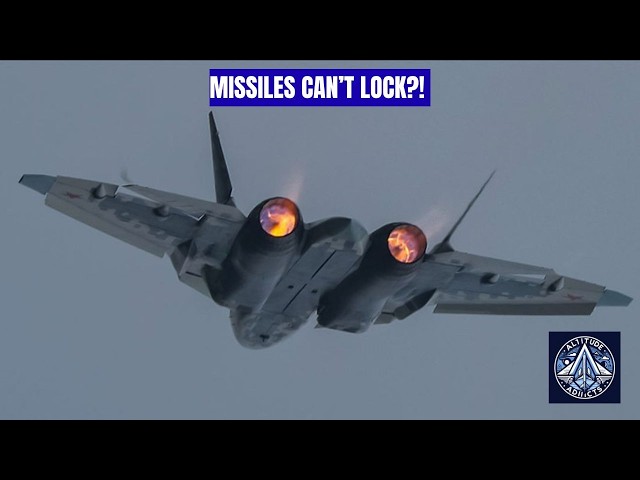
The newly patented Russian device
2:32
introduces a mechanically sophisticated
2:35
yet elegant solution.
2:37
It fundamentally changes how hot exhaust
2:39
gases and cold bypass air interact
2:42
within a turbofan engine.
2:44
In a typical turbofan engine, air is
2:46
divided into two streams.
2:49
One stream passes through the combustion
2:51
chamber, becoming extremely hot and
2:54
forming the primary exhaust jet.
2:57
The other bypasses the core, remaining
3:01
These streams mix before exiting the
3:03
engine, but this mixing is not optimized
3:07
The Zhukovsky-Gagarin Air Force
3:09
Academy's innovation changes this
3:13
It partially separates and regulates
3:15
these flows at the entrance to the
3:19
This is achieved through four movable
3:21
flaps installed inside the engine.
3:24
As we transition into how this creates
3:27
an invisible exhaust, the engineering
3:29
becomes even more fascinating.
3:32
These flaps are not stationary
3:35
They are dynamically controlled using
3:37
hydraulic mechanisms, allowing them to
3:39
adjust based on engine operating
3:43
In doing so, they regulate the thickness
3:46
and distribution of the cold air stream
3:48
surrounding the hot exhaust.
3:51
This colder air acts as a protective
3:55
It envelops the hot gas jet, preventing
3:57
the hottest regions from being directly
3:59
exposed to external sensors.
4:02
As a result, the infrared radiation
4:04
emitted by the engine is significantly
4:08
At the same time, the system reduces
4:12
Jet noise is largely generated by
4:14
turbulent mixing between hot and cold
4:18
By precisely controlling this
4:20
interaction, the device lowers
4:22
turbulence intensity and reduces overall
4:26
This dual benefit is exactly the kind of
4:28
innovation that Altitude Addicts
4:30
highlights when discussing
4:32
next-generation stealth breakthroughs.
4:35
Moving further into the science behind
4:37
this system, precision design becomes
4:42
The effectiveness of this technology
4:44
depends heavily on exact engineering
4:48
The dimensions and placement of the
4:49
flaps are critical to achieving the
4:54
Parameters such as length, width, depth
4:56
of penetration into the airflow, and the
4:58
distance at which mixing occurs all play
5:03
If the cold air layer is too thin, it
5:05
fails to shield the hot exhaust
5:09
If it is too thick, engine performance
5:11
may suffer through reduced thrust or
5:13
increased fuel consumption.
5:16
Achieving the perfect balance between
5:18
stealth and efficiency is essential.
5:21
This is where advanced computational
5:23
fluid dynamics modeling likely comes
5:27
By simulating airflow patterns under
5:29
different conditions, engineers can
5:31
fine-tune the system for maximum
5:35
When compared to conventional infrared
5:39
the advantages of this design become
5:43
Traditional approaches include exhaust
5:45
cooling systems, special coatings, and
5:47
external nozzle modifications.
5:50
While effective, these often introduce
5:52
tradeoffs such as added weight, reduced
5:55
efficiency, or higher maintenance.
5:58
In contrast, this Russian system is
6:00
integrated directly into the engine's
6:04
It avoids bulky external components and
6:07
adapts dynamically to different flight
6:11
Whether cruising at low thrust or
6:13
performing high-power combat maneuvers,
6:15
the system adjusts accordingly.
6:18
It also delivers a dual-layer stealth
6:21
advantage by reducing both thermal and
6:23
acoustic signature simultaneously.
6:26
This is especially important in modern
6:28
battlefields dominated by multi-sensor
6:33
As we consider the broader implications
6:35
for military aviation, the potential
6:37
impact becomes significant.
6:40
Aircraft equipped with this technology
6:43
could become much harder targets for
6:45
heat-seeking missiles.
6:47
Fighters, bombers, and unmanned aerial
6:49
vehicles would all benefit.
6:52
Even a small reduction in detectability
6:54
can make a major difference in
6:56
high-threat environments.
6:59
Delaying missile lock-on or reducing
7:01
detection range gives pilots valuable
7:03
time to evade or deploy countermeasures.
7:07
This could also reshape future aircraft
7:11
Instead of focusing only on external
7:14
stealth shaping, engineers may
7:16
prioritize internal signature
7:19
Engines themselves could become central
7:21
to stealth technology.
7:24
Looking at the broader strategic
7:25
context, this innovation reflects a
7:28
global trend in military development.
7:31
As detection systems grow more advanced,
7:33
countermeasures must evolve alongside
7:37
Infrared stealth is rapidly becoming a
7:39
key frontier in this technological race.
7:43
Countries investing in next-generation
7:45
and sixth-generation fighters are likely
7:47
to adopt advanced thermal management
7:51
The Russian development from Voronezh
7:53
fits perfectly into this trajectory.
7:56
And as Altitude Addicts continues to
7:58
track these advancements, it's clear
8:01
that engine-level innovation will define
8:03
the next era of air combat.
8:06
Of course, no breakthrough comes without
8:10
Integrating movable components into
8:13
high-temperature, high-pressure engine
8:15
environments requires exceptional
8:17
durability and reliability.
8:20
Hydraulic systems must operate
8:21
flawlessly under extreme conditions.
8:25
Retrofitting older aircraft with this
8:27
technology may also prove difficult.
8:30
It is more likely to be implemented in
8:32
new engine designs rather than existing
8:37
Yet despite these challenges, the
8:39
concept represents a significant step
8:43
By addressing one of the most persistent
8:45
vulnerabilities in modern aircraft,
8:47
their heat signature, it opens new
8:50
possibilities for stealth design.
8:53
And as we reach the conclusion, the
8:55
importance of this innovation becomes
8:58
The Zhukovsky-Gagarin Air Force
9:00
Academy's patented system offers a
9:02
practical and forward-looking solution
9:05
to reducing infrared and acoustic
9:08
In an era where missiles track heat with
9:12
such advancements are not optional, they
9:17
This technology may well define the next
9:19
generation of truly invisible aircraft,
9:22
hidden not just from radar, but from the
9:28
If you like the video, please subscribe,
9:31
share, and like. Also, please take the
9:33
membership of the channel to encourage