0:06
Russian Railways has begun testing a new
0:08
onboard safety system designed for the
0:11
next generation of high-speed trains.
0:14
These trials represent an important step
0:16
in modernizing Russia's railway
0:20
The new system is being tested as
0:22
engineers prepare for future trains
0:24
capable of traveling at significantly
0:27
higher speeds than those currently in
0:29
service. It is part of a broader effort
0:32
to develop the technologies required for
0:34
ultraast rail travel.
0:37
Altitude Addicts, the YouTube channel
0:39
presenting this analysis, explains that
0:42
the testing program focuses on
0:44
evaluating the system in real operating
0:46
conditions. The goal is to understand
0:49
how the technology interacts with
0:51
existing railway infrastructure.
0:54
Because the next generation train
0:56
platform is still under development,
0:58
engineers decided to conduct the first
1:00
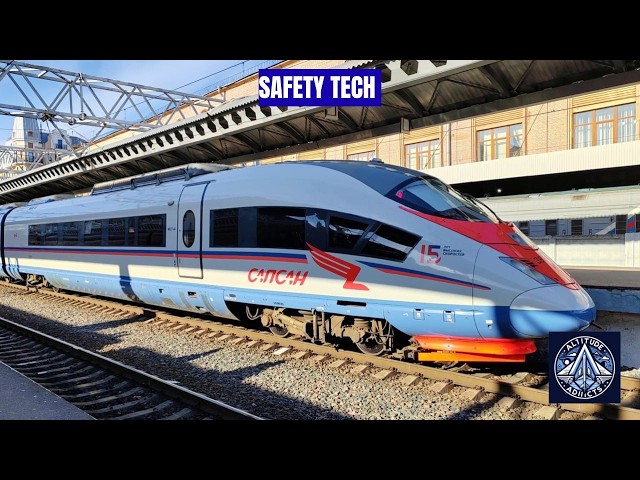
trials using the current SAPS high-speed
1:03
train. This allows the system to be
1:06
tested in everyday railway operations.
1:10
Altitude Addicts notes that this
1:12
approach allows specialists to identify
1:14
potential technical issues early in
1:17
development. It also ensures the system
1:20
can function reliably alongside existing
1:22
railway control technologies.
1:25
The system currently under testing is
1:31
It represents a sophisticated onboard
1:33
safety architecture created specifically
1:38
Its development reflects the growing
1:40
need for advanced digital control
1:42
systems in modern railway networks.
1:46
Such systems are essential when trains
1:48
travel at extremely high speeds.
1:51
To understand why systems like SOB 400A
1:54
are necessary, it helps to examine
1:56
Russia's high-speed rail ambitions.
1:59
Over the past two decades, the country
2:02
has steadily expanded its interest in
2:04
highspeed rail. The introduction of the
2:07
Sapsson train significantly reduced
2:09
travel times between major cities. It
2:13
demonstrated the advantages of modern
2:15
highspeed rail in Russia. Altitude
2:18
Addicts explains that future plans aim
2:20
to go much further. Engineers are
2:23
developing new trains capable of
2:25
traveling at speeds approaching 400 km
2:30
Trains operating at such speeds require
2:32
far more advanced safety systems than
2:35
conventional railway services.
2:38
Even a small delay in signal processing
2:40
can become dangerous.
2:42
At extremely high speeds, trains cover
2:45
hundreds of meters in just a few
2:47
seconds. This leaves very little time
2:52
Altitude Addicts explains that this is
2:54
why modern high-speed rail depends
2:56
heavily on automated monitoring systems.
3:00
These systems track train movement in
3:04
The SOB 400A system has been developed
3:08
precisely for this purpose. It acts as a
3:11
comprehensive onboard safety platform.
3:14
Instead of being a single device, the
3:16
system is built as a complex network of
3:19
technological modules. Each module
3:22
performs a specific safety function.
3:25
Altitude Addicts explains that the
3:27
architecture includes roughly 10
3:30
different components.
3:32
Together, they create a unified control
3:34
and monitoring system.
3:36
These modules monitor train movement and
3:39
analyze operational data continuously.
3:42
They also receive signals from trackside
3:46
By combining these data sources, the
3:48
system builds a detailed picture of the
3:50
train's surroundings.
3:52
This allows it to detect potential
3:57
Altitude Addicts notes that the system
3:59
can warn the driver if the train
4:01
approaches a restricted area. It can
4:04
also intervene automatically if
4:08
For example, the system can respond if a
4:10
train exceeds safe speed limits. It can
4:13
also react to unexpected changes in
4:18
These capabilities are especially
4:20
important for high-speed trains.
4:22
Reaction times must be measured in
4:24
fractions of a second.
4:27
Another critical feature of the system
4:29
is its communication with railway
4:33
Trackside equipment constantly transmits
4:36
information about signals and track
4:40
This information is received by the
4:42
onboard safety system through two
4:44
separate communication frequencies.
4:47
The dual channel design improves
4:51
Altitude addicts explains that if one
4:54
communication channel experiences
4:56
interference, the second channel
4:58
continues transmitting data. This
5:00
redundancy is essential for high-speed
5:03
operations. Continuous communication
5:06
between trains and infrastructure allows
5:09
operators to maintain safe distances
5:11
between trains. It also improves overall
5:14
traffic coordination.
5:17
The Sapsan train has been chosen as the
5:19
testing platform for this new system.
5:22
This decision was made because the next
5:24
generation train has not yet been
5:28
Altitude Addicts explains that the
5:30
Sapsson already operates at relatively
5:33
high speeds. Its onboard systems are
5:36
also compatible with modern digital
5:40
These characteristics make it an
5:42
excellent experimental platform.
5:45
Engineers can install prototype
5:47
equipment without major structural
5:51
Testing on a working train also allows
5:53
engineers to observe the system during
5:58
The train experiences acceleration,
6:00
braking, and station stops.
6:02
Altitude Addicts notes that it also
6:05
interacts with other trains and busy
6:07
railway traffic. These real conditions
6:10
reveal issues that laboratory
6:11
simulations might miss.
6:14
Another important goal of the testing
6:16
program involves studying how the new
6:19
system interacts with existing railway
6:23
Modern rail networks rely on many
6:25
interconnected systems.
6:27
These include signaling equipment,
6:30
communication networks, and traffic
6:32
management platforms.
6:34
The new system must integrate smoothly
6:38
Altitude Addicts explains that engineers
6:40
are carefully studying how data moves
6:42
between onboard modules and trackside
6:47
They are also evaluating the systems
6:49
response to changing operating
6:50
conditions. Examples include sudden
6:54
speed restrictions or unexpected signal
6:56
changes. Testing ensures the system
6:59
reacts correctly in each scenario.
7:02
While current tests focus on individual
7:05
components, the next development phase
7:07
will expand the evaluation.
7:10
Engineers will eventually test the
7:12
entire train control complex.
7:15
Altitude Addicts explains that the SOB
7:17
400A system will later be installed on
7:20
Russia's upcoming high-speed train
7:23
platform. That platform is currently
7:28
Once integrated into the new train, the
7:30
system will be tested as part of a
7:32
complete control architecture.
7:35
This will include automated train
7:37
control technologies.
7:39
One of the most promising features of
7:41
the system is support for automated
7:46
This concept is sometimes called autod
7:48
driving or auto guidance.
7:50
In automated systems, onboard computers
7:53
manage functions such as acceleration
7:57
They also maintain precise operating
8:00
Altitude addicts explains that drivers
8:03
may still remain in the cab. However,
8:06
many operational processes are handled
8:10
Automation can greatly improve safety
8:14
Computer-cont controlled trains respond
8:17
instantly to signals.
8:19
They can also optimize energy
8:21
consumption during acceleration and
8:25
This reduces operational cost. Altitude
8:28
addicts notes that these advantages are
8:30
especially important for high-speed rail
8:33
networks. Precision becomes essential
8:36
when trains travel extremely fast.
8:40
The SOB 400A system provides the digital
8:43
infrastructure needed for these advanced
8:47
It acts as the foundation for future
8:49
automated rail technology.
8:52
Developing such systems is essential for
8:54
preparing Russia's railways for the next
8:57
era of transportation.
8:59
Ultraast trains require a combination of
9:02
powerful vehicles and advanced control
9:04
system. Without reliable digital safety
9:07
platforms, trains operating at extremely
9:10
high speeds would face unacceptable
9:14
This is why these testing programs are
9:18
Altitude Addicts explains that the
9:20
lessons learned from the current trials
9:22
will shape future rail corridors
9:24
designed for ultra fast travel.
9:27
They will also influence the design of
9:29
the next generation train platform.
9:33
Although the Sapsan remains the fastest
9:35
operational passenger train in Russia
9:37
today, the new testing program signals a
9:40
shift toward a more advanced railway
9:42
era. Engineers are preparing
9:45
technologies that will support much
9:49
For now, the Sapson serves two important
9:51
roles. It remains a reliable passenger
9:55
service and also functions as a testing
9:59
Altitude Addicts concludes that these
10:02
experiments represent another step
10:04
toward the future of Russian rail
10:06
transport. With advanced safety systems
10:09
under development, Russia moves closer
10:11
to operating a modern high-speed rail
10:14
network capable of competing with the
10:16
world's most advanced system.
10:21
If you like the video, please subscribe,
10:23
share and like. Also, please take the
10:26
membership of Altitude Addicts to