0:05
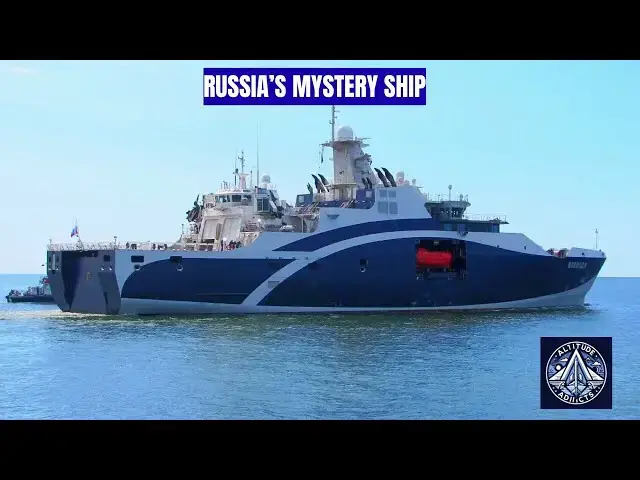
Vovota is among the most enigmatic
0:07
vessels built in Russia in recent years.
0:11
It presently stands as the sole
0:13
representative of project 23700.
0:17
In 2025, the Baltic shipyard Yantar
0:20
effectively concluded all testing phases
0:22
of the vessel and transferred it to
0:27
The 111 m long vessel with a
0:30
displacement of approximately 7,500 tons
0:34
is officially designated to facilitate
0:36
search and rescue operations as well as
0:39
the transportation and provisioning of
0:41
small search and rescue craft.
0:44
At the same time, specialized sources
0:46
present two differing interpretations
0:48
regarding the vessel's actual purpose.
0:54
was designed by specialists from the
0:56
Northern Design Bureau, also known as
0:58
Severnoi PKB in St. Petersburg.
1:02
Construction began at the Baltic
1:03
Shipyard Yantar in the Kaleningrad
1:08
At the time, it was reported that the
1:10
vessel would serve as the lead ship of a
1:13
planned series with initial delivery
1:15
expected between 2019 and 2020.
1:20
However, Volvo only began factory sea
1:22
trials at the end of 2023.
1:25
The testing phase required nearly two
1:27
additional years. By the end of 2025,
1:32
confirmation was finally released that
1:34
the vessel had been commissioned into
1:39
Several Russian and international
1:40
publications asserted that Voiv was not
1:43
a rescue vessel, but rather a luxury
1:46
yacht intended for highranking
1:49
The origin of this claim dates back to
1:51
April 2017 when a major publication
1:54
cited anonymous industry sources.
1:58
According to those sources, the vessel's
2:00
appearance led them to conclude that it
2:03
resembled a yacht more than an emergency
2:05
rescue ship. They noted the absence of
2:08
visible cranes, lifting beams, and other
2:11
typical rescue equipment.
2:13
This interpretation, despite lacking
2:16
substantiated technical evidence, has
2:18
continued to circulate through blogs and
2:20
secondary sources up to 2025.
2:24
The same publication added that the
2:26
vessel would be one of a kind and
2:28
suggested that the project designation
2:31
indicated a military ship. This
2:34
statement remains notable when compared
2:36
with later industry disclosures.
2:39
On April 7th, 2025, the specialized ship
2:43
building portal pseudory published an
2:45
article discussing the development of
2:47
fastening systems and blade coatings for
2:50
controllable pitch propellers intended
2:55
specialurpose vessel.
2:57
Importantly, the article referenced
2:59
project 2 3700 vessels in the plural,
3:03
indicating expectations beyond a single
3:05
ship. The stated objective of this work
3:08
was once again linked to emergency
3:10
rescue operations and the use of
3:12
domestically produced components
3:16
within the professional ship building
3:17
community. Vovota is consistently
3:20
described as a specialized rescue and
3:22
support vessel. The yacht narrative
3:25
exists primarily outside the industry
3:27
and appears to be rooted in early
3:29
speculation rather than verified
3:31
technical assessments.
3:34
Some international observers have
3:36
attempted to associate Voyoda with the
3:38
main directorate of deep sea research of
3:41
the Russian Ministry of Defense.
3:43
According to this theory, the vessel
3:46
allegedly transports covert underwater
3:48
equipment while being outwardly
3:50
disguised as a civilian ship.
3:53
There is no official confirmation
3:55
supporting this claim.
3:57
No verified evidence exists indicating
4:00
that Voyoda has been assigned to deep
4:02
sea intelligence operations.
4:05
As a result, this interpretation remains
4:09
An independent visual analysis conducted
4:12
by altitude addicts based solely on
4:14
publicly available imagery allows for
4:16
several cautious observations without
4:19
reliance on official statements or
4:23
First, the vessel's exterior does not
4:25
resemble that of a conventional combat
4:28
ship. There are no visible heavy weapon
4:31
systems, missile launchers, close-in
4:33
weapon systems, or rifle mounts. This
4:36
strongly suggests that Vood is not
4:39
intended for frontline combat roles.
4:42
At the same time, the vessel does not
4:44
conform to the appearance of a standard
4:47
civilian rescue ship. The hull and
4:50
superructure feature angular forms,
4:52
inclined surfaces, and a notable
4:54
reduction in exposed external equipment.
4:58
While not a stealth vessel in the strict
5:00
sense, these design choices indicate
5:02
deliberate radar signature reduction.
5:05
Such considerations are uncommon on
5:07
purely humanitarian platforms and
5:10
suggest anticipated operations in
5:12
sensitive or monitored maritime
5:15
The superructure carries a dense
5:17
concentration of ray domes, antennas and
5:20
communications arrays distributed across
5:23
multiple levels. This configuration
5:25
implies heavy reliance on satellite
5:28
communications, data exchange and
5:30
network coordination.
5:32
It is consistent with a vessel
5:34
functioning as a mobile command,
5:36
coordination or support hub rather than
5:39
a simple transport platform.
5:42
Large side openings along the hull house
5:44
enclosed boats that appear significantly
5:47
larger than conventional lifeboats.
5:50
These craft are likely missionspecific.
5:53
Combined with the vessel's broad beam
5:55
and high freeboard, this indicates an
5:57
ability to launch and recover auxiliary
5:59
craft in open sea conditions,
6:02
potentially including unmanned surface
6:04
or underwater systems.
6:07
The vessel's proportions along with the
6:09
limited number of crew observed on deck
6:12
suggest an emphasis on long duration
6:14
deployments supported by extensive
6:18
This aligns with modern Russian
6:19
auxiliary ship building trends that
6:21
prioritize reduced crew size and
6:24
multi-roll functionality.
6:27
The vessel's distinctive paint scheme
6:29
featuring flowing patterns of dark blue
6:31
and light gray further sets it apart
6:33
from conventional naval or civilian
6:36
designs. While not traditional
6:38
camouflage, it increases visual
6:40
ambiguity and complicates immediate
6:42
classification at distance.
6:45
Taken together, these visual indicators
6:48
suggest that Vood is best understood as
6:50
a next generation strategic support
6:52
vessel. It appears optimized for rescue
6:55
operations, specialized missions,
6:58
support of autonomous systems, and
7:00
coordination roles rather than direct
7:03
This assessment does not rely on
7:05
assumptions of hidden weaponry or covert
7:07
intelligence missions. Yet, it clearly
7:13
beyond the scope of a conventional
7:17
Vovota therefore remains enveloped in
7:19
mystery not because of confirmed secrecy
7:22
but because its design does not fit
7:24
traditional categories.
7:26
It is neither a luxury yacht nor a
7:29
standard rescue vessel and certainly not
7:33
The more compelling explanation is that
7:35
Voiv reflects a modern Russian approach
7:38
to maritime support platforms.
7:41
It integrates endurance, discretion,
7:43
modularity, and advanced communications
7:46
into a single hull. The true enigma lies
7:49
not in hidden equipment, but in how such
7:52
vessels fit into the evolving
7:53
architecture of naval operations in the
8:00
If you like the video, please subscribe,
8:03
share, and like. Also, please take the
8:05
memberships to encourage us.