0:07
The Russian civil aviation sector is on
0:09
the brink of a critical juncture.
0:12
The country's premier carrier, Aeroflot,
0:15
anticipates receiving its first
0:16
domestically produced aircraft by the
0:20
following years of sanctions, disrupted
0:23
supply chains, and a comprehensive
0:25
effort to replace imports.
0:28
This is more than a routine fleet
0:29
update. It is part of a broader push to
0:32
achieve technological independence in
0:37
But as optimism builds, a more complex
0:39
reality begins to emerge.
0:42
Although most aircraft systems have
0:44
already been developed, the biggest
0:46
obstacle has surfaced elsewhere,
0:50
Today, the timeline for Russia's
0:52
next-generation airliners is being
0:54
shaped not by engineering breakthroughs,
0:56
but by the ability to prove safety and
1:01
This brings us to the expected timeline,
1:03
where first deliveries are now projected
1:08
Over the past few years, Aeroflot has
1:10
consistently outlined a detailed roadmap
1:13
for integrating domestically produced
1:15
aircraft into its fleet.
1:17
The transition is not just about
1:19
replacing planes. It is a complete
1:21
transformation of the airline's
1:23
operational ecosystem.
1:26
As part of this transformation, the
1:28
airline has emphasized the need for
1:30
parallel investments on the ground as
1:35
Aircraft like the Irkut MC-21 require
1:38
modernized maintenance, repair, and
1:40
overhaul infrastructure.
1:42
New hangars are being built and existing
1:44
ones adapted to handle composite
1:47
airframes and domestically developed
1:51
Beyond infrastructure, preparation
1:53
extends deeply into human capital and
1:56
Training programs for pilots, engineers,
1:59
and ground crews are being redesigned to
2:01
support the transition from Western
2:03
aircraft to Russian platforms.
2:06
At the same time, spare parts
2:08
inventories, domestic supply chains, and
2:11
digital maintenance systems are being
2:13
developed to support long-term
2:17
As Altitude Addicts explains, this is
2:19
not just fleet renewal, it is ecosystem
2:23
Hangars, simulators, certification
2:25
processes, and technical documentation
2:28
must evolve together to ensure smooth
2:30
operations from day one.
2:33
At the center of this ambitious plan
2:37
Designed as a next-generation
2:39
narrow-body aircraft, it is intended to
2:42
replace foreign jets and become the
2:44
backbone of Russia's future fleet.
2:47
The scale of ambition is massive.
2:50
Aeroflot aims to receive 108 MC-21
2:53
aircraft by 2030, with long-term plans
2:56
potentially reaching up to 200 units.
3:00
If successful, this aircraft will define
3:02
Russian aviation for decades.
3:05
However, timelines have already shifted
3:09
Earlier projections suggested an earlier
3:12
entry into service, but technical and
3:14
regulatory challenges forced delays.
3:17
Now, the industry is cautiously aligned
3:20
around late 2026 as the most realistic
3:25
To understand why, we need to look at
3:27
the aircraft itself, where ambition
3:29
meets engineering reality.
3:32
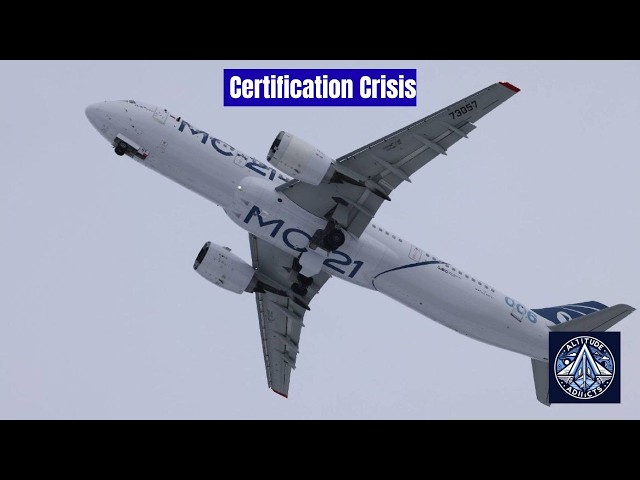
The MC-21 was developed to compete
3:34
directly with aircraft from Airbus and
3:36
Boeing, carrying between 163
3:43
What sets it apart is its near total
3:45
reliance on domestic components.
3:48
It features Russian avionics, a locally
3:50
produced composite wing, and engines
3:52
such as the Aviadvigatel PD-14.
3:56
This makes the aircraft not just
3:58
commercial, but strategic.
4:00
Russia is effectively building a fully
4:02
independent aviation ecosystem, from raw
4:05
materials to software.
4:08
Yet this shift has introduced
4:11
Replacing foreign components has
4:13
increased aircraft weight and altered
4:15
performance characteristics, making
4:18
testing and certification more complex.
4:21
And this leads directly to the biggest
4:23
bottleneck, certification.
4:26
While systems have been successfully
4:28
developed, proving they meet strict
4:30
safety standards has become the hardest
4:34
As Altitude Addicts highlights, the
4:36
industry has effectively hit a wall at
4:40
All major systems exist, but validating
4:43
them requires enormous effort and time.
4:46
Software verification stands out as a
4:51
Engineers estimate that verifying code
4:53
takes nearly 10 times more resources
4:57
This reflects the uncompromising safety
5:00
standards of aviation, where even the
5:02
smallest error is unacceptable.
5:05
The situation is further complicated by
5:07
early miscalculations.
5:10
Many suppliers assumed certification
5:12
would be straightforward if systems
5:16
Instead, they now face a demanding
5:18
process involving extensive
5:20
documentation, testing, and validation.
5:25
At the same time, the industry is under
5:27
strain due to a shortage of skilled
5:31
Certification requires highly trained
5:33
engineers, programmers, and verification
5:35
experts, many with niche aviation
5:40
As a result, some companies are falling
5:44
Outsourcing has become a solution, but
5:46
it introduces coordination challenges
5:49
and additional risks.
5:51
Another major hurdle is the endless
5:53
cycle of testing, modification, and
5:57
Each change requires the
6:00
Despite these challenges, the next
6:02
phase, mass production, presents its own
6:06
To meet targets, manufacturers must
6:08
produce dozens of aircraft annually,
6:10
roughly one every two weeks.
6:14
Such output demands stable supply
6:17
Any disruption, especially in engine
6:19
production, can halt the entire process.
6:23
Engines themselves remain a critical
6:27
The MC-21 relies on advanced engines
6:30
like the PD-14, which require years of
6:32
development and precision manufacturing.
6:36
Accelerating this process places
6:38
enormous pressure on engineering teams.
6:41
Even minor delays can ripple across the
6:47
For passengers, these developments could
6:49
eventually mean a renewed fleet and
6:51
reduced reliance on foreign aircraft.
6:55
But in the short term, availability will
6:57
remain limited, with gradual rollout and
7:00
possible schedule adjustments.
7:02
As Altitude Addicts concludes, the story
7:05
of Aeroflot's new aircraft is not just
7:07
about delivery timelines.
7:10
It is a test of whether an entire
7:11
aviation ecosystem can evolve under
7:16
In the end, 2026 stands as a defining
7:20
Success would mark a major breakthrough
7:22
for Russian aviation.
7:25
Failure could mean further delays.
7:28
Either way, one thing is clear.
7:32
The future of Russian aviation will
7:34
depend not only on engineering
7:36
innovation, but on mastering
7:37
certification, scaling production, and
7:40
sustaining a highly complex industrial
7:47
If you like the video, please subscribe,
7:51
Also, please take the membership of the
7:53
channel to encourage us.