Up next in 10


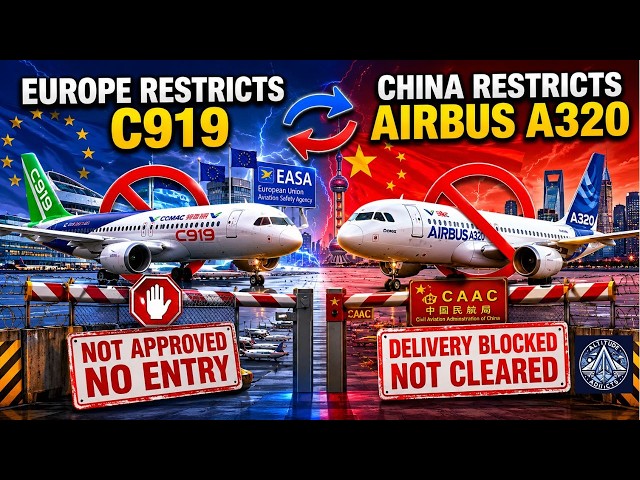
Aviation is becoming about far more than airplanes. Reports suggest that Chinese authorities delayed approvals for nearly 20 Airbus aircraft, preventing them from entering service even after delivery. While Airbus described the issue as an administrative matter that has since been resolved, many observers believe the move was connected to China's efforts to secure European certification for the COMAC C919.
In this video, we examine the growing aviation standoff between China and Europe, the strategic importance of the C919 program, and why European certification could determine whether China's first modern narrowbody airliner becomes a true global competitor to Airbus and Boeing.
We also explore a challenge that often receives less attention: production. Despite significant publicity and hundreds of orders, COMAC's production ramp-up remains far slower than those of Airbus and Boeing. Can the company scale manufacturing to international levels? And even if European certification arrives, will COMAC be able to deliver enough aircraft to challenge the established duopoly?
As regulators, manufacturers, and governments navigate an increasingly complex aviation landscape, the Airbus approval delays offer a rare glimpse into the geopolitical, economic, and industrial forces shaping the future of commercial aviation.
Watch until the end for a detailed breakdown of the C919's certification journey, production challenges, and what this latest development could mean for airlines, aircraft manufacturers, and the future balance of power in the global aerospace industry.
#China #Airbus #C919 #COMAC #Boeing #Aviation #Aircraft #AirlineNews #Aerospace #Europe #EASA #CAAC #CommercialAviation #Geopolitics #A320 #AviationNews #Airliner #ChinaNews #AirbusA320 #GlobalAviation
Be a Member for exclusive privileges - https://www.youtube.com/channel/UCviEFTf1xIPKsjmyF_zvFug/join
Twitter : https://x.com/AltitudeAddicts
Website: https://www.altitudeaddicts.com
Show More Show Less View Video Transcript
0:04
A much larger conflict that is unfolding
0:06
within the global aviation industry has
0:08
been revealed by a quiet bureaucratic
0:11
dispute between China and Europe.
0:14
According to reports, the final
0:16
approvals for nearly 20 Airbus aircraft
0:19
that were intended for Chinese airlines
0:22
were postponed by Chinese authorities.
0:25
Despite the fact that the aircraft were
0:27
already completed and prepared for
0:29
delivery, they were unable to enter
0:31
commercial service.
0:33
Airbus officially classified the
0:34
situation as an administrative matter.
0:38
Guillaume Faury, the CEO of Airbus,
0:41
announced that the issue had been
0:42
resolved and that deliveries would
0:44
resume in the second quarter.
0:47
However, Beijing's strategic message is
0:50
concealed beneath the diplomatic
0:51
language. The certification process for
0:54
China's Comac C919 is proceeding at an
0:57
excessively slow pace in Europe. This
1:00
dispute underscores how industrial
1:02
competition, economic influence, and
1:04
geopolitical leverage are increasingly
1:06
intertwined with aircraft certification,
1:09
which was previously perceived as
1:10
primarily a technical and safety issue.
1:14
Let's look closer at the Airbus
1:15
deliveries that could not fly. The Civil
1:17
Aviation Administration of China, or
1:19
CAC, is to blame for the delays.
1:23
Aircraft that are delivered to Chinese
1:25
airlines are unable to enter service
1:27
legally without these approvals.
1:30
According to reports, the approval
1:32
backlog covered nearly 20 Airbus
1:34
aircraft.
1:36
The timing was especially difficult for
1:38
Airbus as China continues to be one of
1:40
the most important customers and one of
1:43
the world's largest aviation markets.
1:46
Airbus's first-quarter delivery
1:48
performance was its weakest since the
1:51
aftermath of the 2009 global financial
1:54
crisis as a result of the disruption.
1:57
The impact went beyond statistics.
2:00
Airbus was unable to deliver completed
2:02
aircraft to customers, resulting in the
2:04
accumulation of billions of euros in
2:07
inventory during the quarter.
2:10
These aircraft had already been
2:11
manufactured, tested, and prepared for
2:14
delivery.
2:15
They were essentially anticipating
2:17
regulatory approval. Now, let's look at
2:20
this practically.
2:22
Having a bunch of completed jets just
2:24
sitting on the tarmac is a massive,
2:26
expensive headache that totally messes
2:29
up the factory's rhythm.
2:31
Delivery delays can generate cascading
2:34
effects throughout the supply chain.
2:36
Production schedules are tightly
2:38
coordinated, and storage space is
2:40
limited.
2:42
Future production flows may be
2:44
influenced by each aircraft that
2:46
occupies a parking space. Aircraft
2:48
factories are designed around continuous
2:50
movement.
2:52
Space must be made available for the
2:54
following aircraft after a jet has
2:56
departed the final assembly line.
2:59
To prevent bottlenecks, manufacturers
3:02
must sometimes slow down portions of
3:04
production, modify logistics plans, and
3:07
locate additional parking areas when
3:09
deliveries are delayed. The real issue
3:11
here comes down to Europe and the C919.
3:15
The Airbus delays, according to many
3:17
industry observers, were intended to
3:19
convey a message to Europe regarding the
3:21
certification of the COMAC C919. The
3:24
Commercial Aircraft Corporation of
3:26
China's C919
3:28
represents China's most ambitious
3:30
attempt yet to challenge the
3:32
long-standing dominance of Airbus and
3:34
Boeing in the narrow-body market.
3:37
The aircraft entered commercial service
3:40
in China after obtaining domestic
3:42
certification with the intention of
3:44
directly competing against the Airbus
3:46
A320 family and the Boeing 737 family.
3:50
However, domestic certification is only
3:53
one aspect of the challenge. To achieve
3:55
major international success, COMAC must
3:58
obtain the approval of significant
3:59
global regulators.
4:02
Among the most significant is the
4:03
European Union Aviation Safety Agency,
4:06
or EASA, whose certification is
4:08
acknowledged throughout Europe and has a
4:10
large global impact. EASA confirmed
4:13
earlier this year that it was conducting
4:15
validation flights in Shanghai with the
4:18
C919, and that certification work was
4:20
ongoing in collaboration with the CAAC
4:23
and COMAC.
4:25
Nevertheless, the regulator did not
4:27
specify a completion date. Beijing
4:29
appears to be experiencing an increasing
4:32
level of frustration due to this
4:34
uncertainty, which brings up the
4:36
critical significance of European
4:38
certification. At first, some observers
4:40
may question why China is so
4:42
enthusiastic about European
4:44
certification, given the substantial
4:46
demand for new aircraft among domestic
4:48
airlines. The answer lies in legitimacy
4:51
and market access. Many airlines,
4:53
leasing companies, insurers, financiers,
4:56
and regulators worldwide are still
4:58
hesitant to adopt a new aircraft type in
5:00
the absence of certification from the
5:02
United States Federal Aviation
5:04
Administration, or EASA.
5:07
Financing institutions often choose
5:09
aircraft that are supported by globally
5:11
recognized certification systems,
5:14
regardless of whether an airline is
5:16
interested in purchasing the C919. The
5:19
credibility of the C919 program would be
5:22
swiftly enhanced, and doors would be
5:24
opened across multiple regions with
5:26
European approval.
5:29
Additionally, it would fortify COMAC's
5:31
position in negotiations for future
5:33
sales campaigns conducted outside of
5:35
China. In practical terms, EASA
5:38
certification would transform the C919
5:41
from a primarily domestic Chinese
5:43
aircraft into a potential global
5:45
competitor. This is precisely the reason
5:47
why the certification procedure has
5:49
become so strategically significant. But
5:52
Europe is not moving at China's desired
5:54
pace. Although COMAC had initially
5:57
anticipated obtaining European
5:58
certification at a much earlier stage,
6:01
European regulators have consistently
6:04
stated that the process will require a
6:06
significant amount of time. EASA
6:08
officials have indicated that the C919
6:11
may not be certified for several years.
6:15
Before granting approval, the agency
6:17
must conduct a comprehensive assessment
6:19
of the aircraft's design, systems
6:21
integration, testing data, operational
6:24
performance, maintenance procedures, and
6:26
safety documentation. The challenge is
6:29
not simply paperwork. COMAC is a
6:31
relatively new player in the major
6:33
commercial aviation sector. In contrast
6:36
to Airbus and Boeing, which have
6:37
extensive certification histories and
6:40
decades-long relationships with Western
6:42
regulators,
6:44
many aspects of the aircraft must be
6:46
independently validated by European
6:49
authorities prior to granting approval.
6:51
Regulators have consistently underscored
6:54
the importance of certification
6:55
standards being centered on safety,
6:58
rather than political or commercial
7:00
considerations.
7:02
Nevertheless, the extended timeline is a
7:04
substantial impediment to COMAC's global
7:07
aspirations from Beijing's perspective.
7:10
And even if the C919 were to receive
7:12
European certification tomorrow, COMAC
7:15
would still encounter another major
7:17
obstacle, which is its own production
7:19
capacity. One of the most disregarded
7:22
components of the C919 narrative is the
7:25
aircraft's production rate in comparison
7:27
to its Western counterparts. Despite the
7:30
fact that the C919 has garnered
7:32
substantial attention and accrued
7:34
hundreds of orders, actual deliveries
7:36
are still limited.
7:38
The commercial service of aircraft has
7:40
been confined to a relatively small
7:42
number, primarily with Chinese airlines.
7:46
Production has been increasing
7:48
incrementally as opposed to quickly.
7:50
Let's pause and take a look at the
7:52
actual reality of commercial aircraft
7:55
manufacturing.
7:57
Building these massive passenger jets
7:59
requires an incredibly complex global
8:01
network of suppliers.
8:03
And honestly, you just can't scale that
8:05
up overnight.
8:07
The construction of a modern airliner
8:09
necessitates a highly coordinated
8:11
industrial ecosystem, extensive testing,
8:14
stringent quality control procedures,
8:16
and the involvement of thousands of
8:18
suppliers.
8:20
It is impossible to acquire these
8:22
capabilities overnight. COMAC has set
8:24
ambitious production objectives and
8:26
intends to considerably augment its
8:29
annual output in the years ahead.
8:32
Nevertheless, Altitude Addicts note that
8:35
current production levels are
8:36
considerably lower than those of Boeing
8:38
and Airbus.
8:41
Airbus alone manufactures hundreds of
8:43
A320 family aircraft annually, while
8:46
Boeing continues to produce a
8:47
substantial amount of 737 aircraft in
8:51
spite of recent challenges. There is an
8:53
immense disparity that exists.
8:55
Furthermore, challenges in the supply
8:57
chain persist.
8:59
The aircraft's dependence on foreign
9:01
technology is another factor that
9:03
restricts production growth.
9:06
Although it is marketed as a Chinese
9:07
airliner, the C919 is equipped with a
9:10
variety of international components.
9:14
Foreign suppliers with decades of
9:16
experience in commercial aviation are
9:18
responsible for the development of its
9:20
engines, avionics, flight control
9:23
systems, and other critical
9:24
technologies. This dependence causes
9:27
vulnerabilities. Production schedules
9:29
can be influenced by any disruption in
9:31
international supply chains.
9:34
Export restrictions, sanctions, trade
9:36
disputes, or supplier bottlenecks could
9:39
all potentially impact COMAC's capacity
9:41
to achieve delivery objectives. In an
9:43
effort to mitigate these dependencies,
9:46
China has been making major investments
9:48
in its domestic aerospace capabilities.
9:52
On the other hand, the substitution of
9:54
mature Western aerospace technologies
9:57
with locally developed alternatives
9:59
is a lengthy and intricate process that
10:01
could last for years or even decades.
10:04
This makes the narrative about much more
10:06
than a simple Airbus-Boeing rival. The
10:09
C919 is often referred to as China's
10:11
response to the Boeing 737 and Airbus
10:14
A320.
10:16
Although technically accurate, that
10:18
description fails to adequately convey
10:21
the aircraft's importance. The program
10:23
is a long-term goal by China to reduce
10:26
its dependence on foreign aerospace
10:28
manufacturers, cultivate domestic
10:30
industrial capabilities, and establish a
10:33
national champion in one of the most
10:35
technologically demanding industries in
10:38
the world. Airbus and Boeing have
10:40
historically dominated the commercial
10:42
aviation industry.
10:44
In addition to engineering expertise,
10:46
regulatory acceptance, production scale,
10:49
maintenance networks, financing support,
10:52
and global consumer confidence are all
10:54
necessary for breaking into that
10:56
duopoly. The ongoing certification
10:58
dispute between Europe and China serves
11:01
as an illustration that aircraft
11:03
manufacturing includes considerably more
11:05
than the manufacturing of aircraft.
11:08
Additionally, it pertains to market
11:10
access, influence, standards, and trust.
11:13
The C919 has emerged as a representation
11:16
of China's overarching aspiration for
11:18
climbing the industrial value chain, and
11:21
compete in sectors that have been
11:23
historically dominated by Western
11:25
companies.
11:27
Not only would success generate economic
11:29
advantages, but it would also establish
11:32
strategic prestige. This leaves us with
11:34
a glimpse into aviation's future. The
11:36
Airbus approval delays may ultimately be
11:39
regarded as a relatively inconsequential
11:41
incident in the history of global
11:43
aviation.
11:45
Airbus has announced that deliveries
11:47
have resumed and it anticipates that the
11:49
affected aircraft will be delivered to
11:51
customers. However, the incident offers
11:54
a provocative perspective on the future
11:56
of aerospace competition. China aspires
11:59
to establish the C919 as a genuine
12:01
international alternative to Western
12:04
aircraft.
12:06
Europe is committed to guaranteeing that
12:08
all aircraft operating within its
12:10
regulatory framework adhere to the same
12:13
standards as those of established
12:15
manufacturers.
12:17
Airbus desires uninterrupted access to
12:20
one of its most critical markets.
12:23
Additionally, COMAC seeks to establish
12:25
itself as a credible global competitor.
12:27
Those objectives are not necessarily at
12:29
odds. However, Altitude Adicts argue
12:32
they are becoming more interconnected in
12:34
a manner that combines industrial
12:36
policy, regulation, and geopolitics. At
12:39
present, Altitude Adicts view the C919
12:42
primarily as a success story in China
12:45
rather than a global one.
12:47
This could potentially be changed by
12:49
European certification.
12:52
Nevertheless, COMAC will continue to
12:54
face the formidable task of bolstering
12:56
production, establishing global support
12:59
networks, securing supply chains, and
13:01
persuading airlines worldwide that it
13:04
can consistently compete with the two
13:06
titans that have dominated commercial
13:08
aviation for decades, even if approval
13:11
is ultimately granted. The delays that
13:13
have affected Airbus indicate that
13:15
Beijing is no longer willing to wait
13:17
silently for the process to unfold.
13:21
The certification that commenced has
13:24
grown into a more comprehensive debate
13:26
regarding the individual who will
13:28
determine the future balance of power in
13:31
the global commercial aviation industry.
13:36
We thank the people who have subscribed
13:38
the channel, liked, and shared the
13:40
videos.
13:41
We also thank the channel members for
13:43
encouraging us.
13:45
Last but not least, we also thank the
13:47
viewers who have hyped our videos.
#Science