0:00
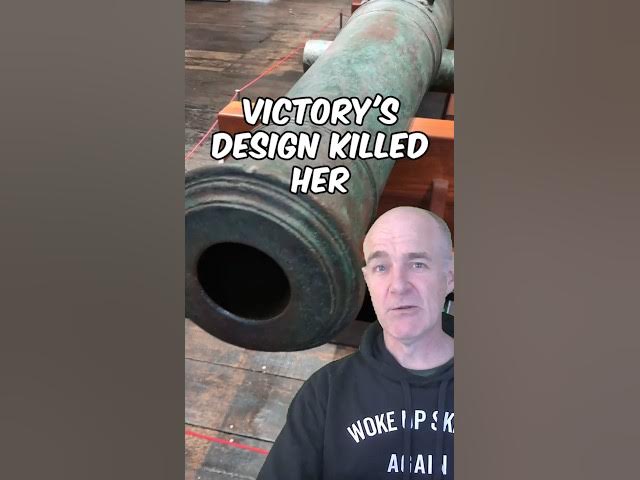
Victory's design killed her.
0:02
A top-heavy ship, overloaded with bronze
0:07
built taller than it was ever meant to
0:10
caught in a storm, it was never going to
0:16
the Admiralty commissioned the most
0:18
powerful warship Britain had ever built.
0:22
She would carry up to 110 bronze cannon,
0:26
the last British first-rate ever armed
0:29
entirely in bronze. Her name was
0:34
The order from above was clear.
0:36
The Surveyor of the Navy told the Master
0:39
Shipwright of Portsmouth to build her
0:42
upper works low and snug.
0:46
He didn't. He built her tall. He built
0:49
her heavy. Three full gun decks, the
0:53
largest and most powerful cannon in
0:56
naval warfare, packed [clears throat]
0:58
onto her upper decks.
1:01
She was launched in February 1737,
1:05
and almost immediately there were
1:08
She required refits just to pass her sea
1:14
Victory was flagship of the Channel
1:16
Fleet. On the 3rd of October, 1744,
1:21
a violent storm hit and the fleet was
1:25
Over the following days, every other
1:28
warship, battered, damaged, but afloat,
1:32
limped into Spithead.
1:34
Victory never arrived.
1:43
years, nobody knew where Victory was.
1:48
a Florida-based salvage company called
1:51
Odyssey Marine Exploration
1:54
was running a large-scale sonar and
1:57
magnetometry survey of the western
2:00
English Channel, they found something.
2:03
A large elliptical mound on the
2:06
bronze cannons scattered across the
2:11
over a hundred of them,
2:12
iron ballast, a 9-m rudder, and red
2:19
Exactly what you'd expect to get on a
2:24
To confirm the identification,
2:26
the Ministry of Defense gave Odyssey
2:29
permission to raise two bronze cannon,
2:33
a 12-pounder and a 42-pounder.
2:37
That 42-pounder is the key.
2:40
Only first-rate warships carried guns of
2:43
that caliber in the first half of the
2:47
And cast near the breech is the royal
2:51
crest of George the First.
2:54
This had to be HMS Victory.