Up next in 10



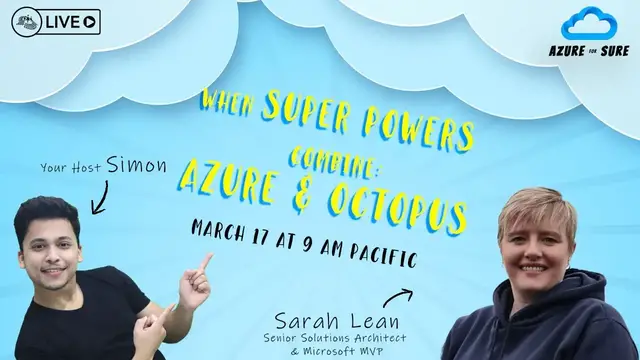
Join this live session with Sarah Lean and Stephen SIMON to learn how Octopus Deploy and Azure work great together on March 17 at 9:00 AM Pacific Time (US).
Microsoft Azure is a great option for organizations looking to host their IT infrastructure in the cloud or as a hybrid partner. While Octopus Deploy is a tool that can help you automate the deployment of your infrastructure and software releases all in one place. In this talk, we'll cover off the possibilities of using Octopus Deploy to help your developers, release managers, and operations folk deploy and manage their Azure resources.
GUEST SPEAKER
With a diverse career that spans over fifteen years, Sarah has been a part of every aspect of the IT world. She began at the bottom of the industry, working hard at the small jobs until she earned her way to her current position. With determination, Sarah accomplished her goals, getting things done in a timely, intelligent way. This led her to see things on a bigger scope as her passion for technology deepened.
#AzureForSure #Azure #live
Show More Show Less View Video Transcript
0:00
Thank you
0:29
Thank you
0:59
We'll be right back
1:29
Thank you
1:59
Hi, everyone, and welcome back to the episode number six of Azure 4 Show
2:09
As you can see, my cloud has changed to green color. I was also wearing green, but it looks a bit different in the live stream
2:16
I'm wearing green and the cloud is green because for the obvious reason, it's St. Patrick Day
2:22
Also, for some of you who may not know it, it's Holi in India
2:26
In India, it's a festival of colors, and I've got some colors for me
2:30
who helped put some for me all right so it is uh i have pink over here let me put this
2:37
that's much better okay so that's what uh welcome everyone uh today we're gonna talk about
2:42
Azure and Octopus and i have no idea what Octopus is so it's going to be really really interesting
2:48
uh we're gonna have our guest Sarah who is a senior solution architect that she last time i
2:54
host she she was working at microsoft now she works at octopus she's also microsoft mep
3:01
so without any further ado let's bring our guest in Thank you
3:54
Hi Sarah, welcome to the Azure for Show Live show. Thank you, thank you for having me
3:59
And I love the festival of colors. I wish I would have done the same
4:06
Oh yeah, someday if you come to India we will celebrate only together. Sarah, so a quick question, where are you joining us today from
4:13
Just outside Glasgow in Scotland. Okay, that's great. So Sarah, before we begin and talk all this text stuff
4:20
text up by Octopus and Asia writes a quick about who you are and what you do actually at Octopus
4:26
Yeah so I'm a techie from Scotland as you can probably tell from the accent but at Octopus
4:32
what I do is work in the community team and there's a few of us there's Derek, there's Pete
4:37
there's myself and Kelly who all work in the community team and basically our job is to do
4:43
things like this do events with the community, speak at conferences, write blog posts and just
4:49
engage with the community and try and help them understand where they can fit Octopus and deploy
4:54
inside their technology stack and solve some of the problems they may have with Octopus
5:00
Just fill in those gaps and just interacting and having fun as well, Simon, to be honest
5:05
Yeah, I mean, look at your logo, right, Octopus. It's very creative. It has five legs or five hands
5:11
I don't know what it's like. It's pretty cool. So Sarah, let's start with very simple and basic
5:18
question of what is actually octopus at the very first place so octopus and deploy helps with your
5:24
devops automation right um when we think about devops we think about that whole automation
5:30
pipeline or the ci cd pipeline um and octopus basically can help with that we help with the
5:36
deployment of your software of your infrastructure and it can help with like managing and maintenance
5:43
tasks it that one shop where you can do things with your software you can deploy that out you can do things with your infrastructure deployments It a great tool as part of your DevOps chain Okay that makes sense So it helps
5:58
me with the CI, CD. Okay, I get that. Now, if I look from a bird eye, the deployment is that one
6:08
side is the dev, and the other side is the production. So where does Octopus sit in this
6:15
situation? I've actually got a small diagram if you want to share that with our audience
6:21
It just shows the CI CD pipeline. I did draw this out, so it was not the design team
6:28
it was me having some fun in PowerPoint. But basically, your CI CD pipeline is you maybe
6:33
working on your code, whether that's your software code or your infrastructure code on your own
6:38
machine, Simon. Then you commit that to a source control repository. Maybe that's GitHub, maybe it's
6:44
has an Azure DevOps repo, maybe it's Git Labs, could be something anywhere that stores that source code for you
6:49
You then use a build server to maybe build out your software deployment
6:55
Maybe you're doing a .NET build or something like that, to build out that software and make it
7:00
packageable to deploy to your infrastructure. Then once you have that packaged up and ready for deployment
7:07
you can hand that over to Octopus and then Octopus will help you try and figure out how to deploy
7:13
that to your test environment, your production environment, and make that process a bit simpler
7:18
for you. You may have stages inside that deployment where you have to stop a server or start a service
7:25
or even build out your test environment before you can deploy your software for it. And we can do all
7:32
of that inside Octopus. So that's kind of where Octopus sits inside your CI-CD pipeline. So I don't
7:39
know if that makes sense does it Simon? Yeah it makes sense I mean I get it right so it helps me
7:43
between the dev and the production and since Octopus has five hands then I have only two hands
7:49
so definitely it's far better than I am at my job so Sarah you know my manager never allows me to put
7:58
the code into the production I'll be very honest so I think Octopus would be very very helpful
8:04
um so let me ask you this so sometimes uh i have my as you say sometimes my code is on on my local
8:10
server right sometimes it is on cloud so how does it work with the octopus i mean is it like a pass
8:18
or is it something that i can download it uh how does octopus help there so there's two ways that
8:23
you could run um octopus in your environment you can use our cloud service which is a fully pass
8:30
or SaaS solution, depending on how you want to look at it. You would just log into a browser
8:35
and we would take care of all the underlying infrastructure and do all that for you
8:40
So you can have that cloud experience with Octopus as well. Or if you wanted to, you could spin up like a Windows server
8:47
or a container and then host Octopus on top of that. So you have that traditional method of taking the software
8:54
installing it and looking after everything yourself. Or you could run Octopus in the cloud
8:58
depending on, again, what your desire is and where your business strategy is
9:02
You have those two options. Okay, so either I can download it on my system
9:07
and on my server that I own, or I can also use the services that are available online
9:12
So is there any major difference? I think, I believe it's online that you guys are taking care of all the tough tasks, right
9:18
Yeah, we take care of all that underlying infrastructure. So we look after that, so server patching
9:23
all of that, like upgrading the Octopus software and stuff like that
9:27
So again, it's like that PaaS and SaaS service that lots of people want, but you get that familiar interface with Octopus
9:35
So again, it's really just about what your business strategy is, whether you're all in the cloud and you want another cloud solution
9:42
or whether you still want to manage some servers and look after all of it yourself
9:46
And yeah, it'll just depend on your business strategy. Okay, so Sarah, I don't know how I'm coming with so many random questions
9:55
That's fine. so so here's what you know uh it may be it may be gear of actions it may be jen canes
10:03
you you kind of end up writing a lot of scripts right i i feel it i mean as is the things a lot
10:09
of automated these days i know it right but at the end you have to write scripts in one or the
10:14
other way does octopus help in that way does it is it like if i put octopus in between they're
10:20
like no you don't have to write the code just do it to me and i'll handle everything on my own So you would still have to write the code for your build server
10:26
So if you were using, say, GitHub Actions to build your .NET application
10:31
for example, Simon, you would still have to write that fun YAML file where you put out the stages in the jobs
10:38
However, when you get to Octopus, you actually have, and let me see if I can share my screen, Simon
10:44
you actually have the option to do it in a GUI fashion here. So if you're not someone who loves writing YAML
10:51
I know lots of people do. I know lots of people hate it. However, when you come into Octopus
10:55
we have this great graphical interface so you can build out the process
11:00
And here's a process that I've got of deploying a sample application out
11:05
And that was all driven by the GUI. Like I can click add a step
11:09
and I can then find what I want to do. So if I want to deploy something to Azure, for example
11:15
I click on that. I can run a script. I can deploy it out to an ARM template
11:20
Everything that you can do inside Octopus is GUI driven. So it's great for those people that are maybe like operations teams
11:28
who don't love sitting inside YAML. I'm one of those people that I can write YAML Simon
11:33
but I prefer a GUI when I have it. So yeah, there's options in there
11:38
So it depends on again where you sit inside that IT department I always see the CI part of that if you using a build server if you using GitHub Actions it something that your developers would do necessarily
11:52
And then when you're actually deploying that software out to your infrastructure
11:56
this is probably where your operations team come into play. So yeah, you've got a lovely GUI interface
12:02
if you wanted that inside Octopus. Yeah, I would love that GUI
12:06
And let me tell you, yeah, sorry, I'm still learning StreamYard. Young folks don't like YAML. I don't know. I've just figured it out. No matter my connection
12:17
is learning YAML. So, okay. So, Sarah, I get it, right? I see Octopus is very helpful. You guys
12:24
have built a great tool that is helping us with the deployment. So, from a very business perspective
12:32
what are some of these steps that will be involved if I need to bring Octopus in the scenario
12:38
yeah so it's relatively simple um for introducing octopus into your environment and let me just be
12:47
clear to the audience and yourself Simon see when I started octopus six months ago I had never
12:51
touched the tool so I am a beginner I'm a learner I'm still trying to figure out a lot of this
12:57
so when I say so when I say it's a relatively easy um stage I'm not being conceited or anything
13:05
I've been on a great learning journey with this product, and it is very intuitive to pick up and introduce into your pipeline
13:14
If you have existing DevOps practices, it may be a little harder to put Octopus in there
13:21
But again, it's about finding out what your pain points are inside your organization, inside your DevOps pipeline
13:27
and understanding if Octopus can actually solve them. because let's face it, nobody wants to introduce a tool just for the sake of introducing a tool into their environment
13:37
or a product into their environment. You've got to be introducing it to solve a pain point
13:42
So depending on where you are on your DevOps journey and depending on where your problems are
13:48
Octopus can be a great tool to fit in. But yeah, in terms of learning it, in terms of the learning curve that you're on once you have Octopus
13:57
it's great and it's relatively easy to pick up. And hopefully the team have done a great job
14:03
on documentation. And if not, it's kind of my job to try and help find those gaps
14:07
and understand where they are to help our customers as well. So yeah, there's lots of information out there for you
14:13
Yeah, I was just going through the resources and we'll come back to it. I mean, there's a lot of content
14:17
that you and your team have built. It's great. So I was just going through the website, right
14:22
The website is absolutely great. And I found this an image, right
14:26
which is pretty cool you see uh on your left you have this github most probably to get up actions
14:32
you have jenkins you have azure devops and then in the bottom you have some frameworks programming
14:37
language python php talker and to the right you have this cloud services and in the middle
14:43
sits is your octopus you can interact with all these three yes and can help you work
14:49
in in from any framework any cloud or in any tool that you use so i really i really found
14:55
this image to be helpful to understand what octopus does it so good to the team who made it
15:02
yeah the team have done a great job in integrating with lots of build servers so like you said like
15:08
GitHub actions and then a lot of technologies and being able to interact with the infrastructure that
15:14
people have whether that's cloud or whether that's their on-prem service servers again so
15:19
yeah there's lots of integrations and I think if you were to look at the roadmap features as well
15:24
There's some exciting stuff coming out very soon. I can't say too much, but the roadmap does look exciting
15:30
and they should be launching pretty soon as well. Yeah, that's great
15:34
That's great. So here's another quick problem that I face, Sarah. Yeah
15:38
Right. So as, you know, my manager, I hope he is not watching the show
15:45
My manager has access to all the services tools and out there, right
15:48
All the servers. So when there's a deployment happens, he really wants to know that salmon is it done or not so he'll keep on pinging me but say salmon
15:57
is it done or not let me know let me know once it's done so is there any way I can have like
16:02
once the deployment is done he can get an email or he can get a slack message or a teams or
16:08
whatever so he comes to know okay the deployment has happened any way possibility for that yeah
16:13
there's some great steps we can add into the deployment process you can send an email to
16:18
someone you can interact with slack um or teams there's ready built steps inside octopus and i've
16:25
used them as well and they're pretty simple um in terms of if you wanted to send someone a teams
16:30
message or if you wanted to put something in a teams channel you can add a step inside octopus
16:35
and literally all you really need to know is that web hook that would hook into that team's channel
16:40
and slightly more complex to give slack chat and permissions to build a post and stuff like that but
16:47
But yeah, you don't need to be a developer to make that happen, Simon
16:52
And I think that's one of the key things. So you can add that
16:57
whether you're a developer, an operations person, a release manager, working on the service desk
17:02
and trying to improve the processes and stuff like that. There's a lot of things inside Office that help you
17:08
no matter where your skill sets are inside the tech team. Perfect, perfect
17:14
So let me ask you one more question. So you said you started your journey with Octopus six months back, right
17:19
You didn't knew anything, right? So once you joined it, right, what was the first thing that you started learning
17:27
I mean, what was the first thing? You're like, okay, today's my first day. I'm going to learn this
17:32
What was that first thing? My first thing was actually to take a copy of the software and install it on a server and find out how it actually ran So I did the old school kind of traditional installation of Octopus because I wanted to understand what mechanisms run in the back because the cloud service is great Simon
17:50
And I love it. And I use that. And that's why I was showing you a few minutes ago
17:54
It's great. But you kind of lose the understanding of how the product works
17:59
Like, does it use a SQL database? Does it have services? How does it run
18:02
like is it quite a resource hog heavy one or you know just that understanding of getting close to
18:09
the product and so yeah that was the very first thing that I did was build a server and then
18:14
install Octopus on top of it and then try and configure it and break it and play with it that
18:18
way and learn some of the the kind of underlying infrastructure that you need to make Octopus
18:23
actually run in your environment so um stayed straight to my roots so all right so everyone
18:30
tuning in and watching us later on this is what something you all should do after the live events
18:34
go ahead and and install octopus and see uh often often it looks pretty if you just watch this live
18:40
show like okay oh i can go ahead and do it but once you do it then then you find the little more
18:44
pieces and in fact that it finds it all right so what what else is there in octopus right what what
18:51
else you would like to share that some some of the features that you really love about octopus
18:54
deploy? I've been digging into runbooks which is something that we can use to do like maintenance
19:03
tasks so I'm sure we've all had to restart like the IIS server service on a Windows server a few
19:10
times two in the morning or whatever so you can create like automation tasks to do that inside
19:16
runbooks but actually what I've been doing recently Simon is figuring out how to take my
19:21
Azure Bicep templates that I love and use and deploy them out through a runbook so that if I
19:27
had to demo something, I can click a button. It will build out all of my Azure infrastructure
19:32
without me having to set up the portal and click on the buttons and build it all out. So I'm trying
19:37
to take all those Azure Bicep templates that I've got for a lot of demos and actually make them
19:42
deployable in an automated fashion. So I've been having fun with that and obviously learning Azure
19:48
bicep which is is pretty cool as well yeah i love Azure bicep too i miss arm templates
19:53
people say people see behind the scenes is still arm templates yeah so it's okay
20:01
so what is what is the what what what i have said what four times anyway so what is the call to
20:10
action right so people i know you guys have built a very good content there right if i go to their
20:15
website octopus.com there's on the navbar i can find resource top download documentation it's on
20:20
github it's everywhere so how after this live show ends what should people go in and do it what
20:26
should be their first step yeah installing is right but how should they get started i would
20:30
encourage everybody to sign up for a free trial of octopus so you can head over to octopus.com
20:36
slash start and you can get a 33 day trial and we've got some great getting started content which
20:43
will take you through your very first deployment and spoiler alert if you actually do your very
20:48
first deployment you'll get the option to apply for a sticker pack so you can get some free stickers
20:53
if you sign up and do a deployment with octopus but yeah give it a go I think you'll be
21:00
massively impressed by what the product can do and trying to understand it so I really just
21:06
encourage everybody to take advantage of that free trial have a go try a deployment and earn
21:11
some stickers and see what problem points it can actually solve for you in your environment and
21:17
give it a go. Take that time and learn it and give it a go. That's really just my call to action
21:22
all the time. All right, so go ahead and hit octopus.com start. You may end up getting a pack
21:30
of stickers from Octopus. So Sarah, I keep on following Octopus on Twitter for a while now
21:37
your tweet and Derek, I do remember that you also offer a special discount or something for
21:42
Microsoft MVPs. Is it still there? I'm not sure. Yes. So if you're a Microsoft MVP or a friend of
21:50
Redgate, that program as well, you can get a free license. So just ping me on Twitter or you can
21:56
actually email mvp at octopus.com and we will sort you out with a free license. And we love
22:03
when people come to us for the free licenses. And again, there's more swag as well involved
22:08
in some of that as well. So definitely worth signing up for, definitely worth trying out and reaching out to us
22:13
because we do, like you say, offer free licenses to Microsoft MVPs
22:18
All right, Sarah, that was absolutely amazing. This dude looks very promising. I encourage everyone watching now
22:22
and watching us later on to go ahead and actually at least go ahead and give it a try
22:27
So it's free. At least I think the price is at least free, I believe. so yeah Sarah anything else you would like to add before we end the show
22:35
no just thank you Simon for your time I really do appreciate it always fun to work with you and
22:41
yeah if you've got any use cases with Octopus that you want to have a go with then reach out
22:47
to me and let me know yeah all right everyone thank you Sarah and everyone follow of Techie
22:53
on Twitter and Octopus deploy. They're very active in community. And yeah, Sarah, I think that's how we end the show
23:04
It was a hard time to be honest, picking up your accent. I've always said in the past
23:11
But thank you everyone for joining in. This was Azure 4 Show episode number six
23:15
and we'll see you next Thursday at 9am. Bye, Sarah
#Business & Industrial
#Computers & Electronics
#Virtual Worlds
#Distributed & Cloud Computing