Up next in 10


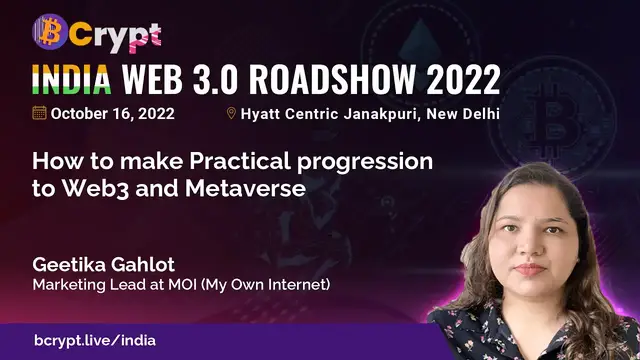
India is developing an index in the contemporary world economy by exploring a diverse array of technological innovations in the BLOCKCHAIN ecosystems around the nation, which provide faster and cost-effective growth to businesses.
Through Bcrypt we would like to provide you with a deep insight into a recurring set of back-to-back conferences that will be held in India, starting with Chennai, Hyderabad, Mumbai, Jaipur, & Delhi from October 8-16, 2022-INDIA ROADSHOW. This roadshow will facilitates Influencers, Entrepreneurs, Investors and Developers to foster and promote the adoption of WEB 3.0, NFTs, BLOCKCHAIN, CRYPTO, METAVERSE, & DeFi.
Visit #Bcrypt : https://bcrypt.live
Show More Show Less View Video Transcript
0:27
I was building a community for ICOs
0:34
Then I was working on building a DAO where people can collaborate and buy NFTs as a DAO
0:42
I've been with Moi, my own internet, from FIB, and I head marketing there
0:49
Moi stands for my own internet. It's an L1 blockchain company. How we have Ethereum, Solana, and multiple others
0:57
We are also our own blockchain. But before we get into what Mois is doing, what Mois is building
1:03
let's talk about today's topic, how to make practical progression in Web3 and Metaverse
1:10
Lot of people are building lot of different ideas on Web3. Each of them aim to solve mostly one or two use cases
1:21
But what about the foundational problems that we have currently? I'll be elaborating more on those foundational problems using examples in the next few slides
1:32
But I want to understand here first how many of you are familiar with blockchain, cryptocurrency, metaverse
1:39
Or you have some idea? Awesome. So let's step back and think
1:47
Why did we feel the need of building blockchains or cryptocurrency or metaverse in the first place
1:54
Something was missing in the current systems. That's why we felt the need that they need to improve
2:01
That is the reason we felt that, okay, we should look at something better
2:06
So, how humans have evolved? Similarly, in parallel, tech has also evolved over the years
2:14
First, we had the computing age, then the information age, and now we are in the digital age
2:22
So computing age, a good example would be payroll system maybe, or calculators, where you were doing something using technology
2:34
Then was the information age, where everything revolved around the information we are sharing
2:39
A good example can be social media, can be e-commerce websites. Now we are moving towards digital age. It's the age of robotics, IoT, blockchains
2:49
So it's all about creating interactions. The systems have to talk to each other rather than humans
2:57
The systems have to work around humans rather than humans building and working around the systems
3:07
So if we talk about the slide, if you can see, like the first few systems were distributed in nature
3:14
We had a client, we had a server, and most of the people who are college students, they
3:20
must be learning the same thing right now also, I'm pretty sure
3:24
We start with, especially when we're learning Java, we start with that client-server interaction, right
3:30
Then came peer-to-peer network, where the network used to control all the interactions, for example
3:36
Facebook, Twitter. All your interactions are controlled by them. If Twitter wants, they can ban your account tomorrow. Why
3:44
data, they own your interactions. They can filter out and say this is offensive, this
3:49
is not offensive. The control lies with them. Now what we are building at Moai is personalized
3:57
internet. So by personalization, the entire idea is that the systems have to be aware
4:02
of the context. In what context do you want to do a particular transaction? What is the
4:09
priority here. And the user is put in control. As I said, I think these concepts
4:16
will be more clear as we move towards the examples. And we are creating
4:22
self-serving and zero-knowledge proofs. We have our own identity storage and metaverse solutions
4:32
And the idea is to create a democratized, not democratized, individualized trust
4:38
So for example, when we started with the tech initially, everything was permissioned
4:44
But now when we are moving towards blockchain, in most of the blockchains, we look at democratic systems
4:50
But I have a fundamental question to ask. Do you think everyone, let's say there is a DAO, there are 100 people
4:58
do you think all 100 of them will be capable to answer some particular questions in exact same way
5:04
Won't some people have more knowledge? Shouldn't those people's opinion get more weightage
5:12
But none of the blockchains currently are working towards it. We are working on a very flat model that we assume everybody's needs are same
5:21
We assume everybody's requirements are same. We feel everybody requires some set of guidelines
5:28
But then how is it truly decentralized? Because if you cannot personalize it
5:35
How will you decentralize it? That's the angle we are coming from
5:40
So let's say earlier when we started, the technology used to support day-to-day functions like payroll management
5:48
Now technology is a way of life. Example, social media. We are moving towards a digitally interacting world
5:56
And the technology has to emerge so that we can fulfill the demands of the new world
6:02
rather than just building products for the sake of building products. Ultimately, it is about usability
6:09
Ultimately, it is about creating business solutions that work. Ultimately, it is about having impact on the user's day-to-day life
6:23
Yeah, I think we can skip this. Sure. Now, so first of all, I would like to say
6:30
because I'm talking about other blockchains, why they don't work. I'm not against any other blockchain
6:35
But rather, those are the blockchains that have paved for us as well
6:42
They were the torchbearers for blockchain. But if there are certain issues that we have
6:49
what is stopping the practical migration from Web2 to Web3? Why everybody..
6:54
Blockchain has been around for a long time. If it is so great, why has everybody not moved to Web3 already
6:59
Why are we thinking? Where is the hesitation? And trust me, it is not lack of resources. That is a factor in it for sure, but that is not the top priority. The hesitation is because we are still trying to figure out if the blockchain industry will actually work. People are still sitting and trying to yze if it's actually going to solve their problems
7:22
So the main three problems we have right now is the environmental cost obviously
7:27
Then the lack of regulation. So now when we are talking about democratic systems if we add regulation to them won they become undemocratic And the entire idea of blockchain is to have democratic systems But there has to be some sort of personalized
7:47
regulation. For example, let's say a bank wants to shift to blockchain tomorrow. Do you
7:55
think they want to store all their data in enormous nodes? Like how will it make sense
7:59
for them. That's why they are not moving, because it doesn't solve their problem. But
8:03
if there was an option to add, let's say, out of 100 nodes, one node of their own choice
8:09
where they get to maintain a copy of all the transactions, that will help them, that will
8:16
give them that confidence that, you know what, we can personalize regulation to a certain
8:22
extent. But at the same time, if you personalize, if you regulate it too much, then again, it
8:28
beat the purpose of being blockchain so it has to be a smart balance between both of them and
8:33
that is where we are at how many of you have ever transferred btc to any of your friend
8:44
how much time it took two to three minutes you're lucky Polygon is, yeah, okay
8:56
They are scaling and solving certain problems, of course. But on Ethereum chain
9:05
10 to 15. Okay, let me ask one more question. Let's say, we say why cryptocurrencies are not becoming mainstream
9:12
Why we are not able to pay in a coffee shop or in a shopping mall using a cryptocurrency
9:18
Would you stand in a queue for 10 minutes just for your payment to get verified and processed
9:23
No, right? That's why we are not getting adoption on Web3. Because we are not solving the real world problems
9:31
We are trying to work more on the concept rather than the practicality
9:37
So, before I talk about Moai, I want to discuss something called Chroma
9:50
So this is a new computational framework and this is for typical tech people
9:56
If you guys want to read more about it, I'll be happy to provide some resources because
10:00
I cannot cover Chroma in like five minutes. So when I talk about personalization, when I talk about practical adoptability, when
10:09
I talk about how we are solving the real world problems, this is our base
10:15
This is how we started. And the first implementation of Krama is called My Own Internet
10:23
It works around people, personalization and context. People should be able to personalize their own blockchains using context
10:35
That is the entire idea and this is the world's first personalized blockchain
10:39
Using Krama other personalized blockchains also can be produced. So Krama is the vision and Moi is the implementation
10:51
Billion transaction million nodes. How many of you are validators for any of the blockchains? None
11:00
Okay, how many of you are aware of the concept of validators
11:04
What are validators? What they do? Awesome. So, if you google and see, most of the blockchains have very limited validators and those validators
11:16
are also in some way there are people who can control it because majority of the validators
11:23
belong to a particular group or just set of three or four people who hold like 60-70
11:28
of the nodes in a particular network. Then how it is democratized
11:33
Until, unless you add so many validator nodes that it becomes impossible to hack them or
11:40
to create a group or something where they can be controlled, there is no point of having
11:46
validators and saying this is for democratizing the society, the digital society I mean
11:51
So we aim to have million nodes and we already have around 800 nodes on us and we just started
12:01
the process like 3 months back. We aim to onboard up to 50,000 validators within next 6-7 months because ultimately validators
12:11
are gonna be backbone of a blockchain and that is how we ensure that the transactions
12:18
scale. Again, this is a very tech slide. I would not go through each and every component
12:27
because all of you might not be interested in this, but how exactly if some of you might
12:32
be thinking, okay, Ayesha is talking about personalizing, solving problems. What about
12:37
the tech part? How is it being built? So these are all of our trademark technologies. We'll
12:44
We will be launching a language called Coco Lang soon. It is quite similar to Solidity and other Web3 languages out there, so the transition
12:52
will not be difficult. Then Krama, of course, is in the middle of it
12:57
We have something very interesting called Tesseract. So we have a very different data structure that enables transactions to process much
13:06
more faster. I'll be elaborating about that soon. So what happens in blockchains is that most of the transactions, like for example, let's
13:20
say there are two different applications. They all share the same data structure because they are on the same blockchain
13:26
But what about the fact that if we have multiple parallel data structures, so that each of
13:32
your application works on a personal blockchain, it acts like it is on a personal blockchain
13:40
So your transactions are not hampered or affected in any way by the actions of others on your blockchain
13:48
Your data is your way. So when we talk about personalization and creating applications that work, I'll give
14:00
you a few examples. First example is when we say pictures. So I used the word context
14:07
For every context the solutions cannot be same. Let's say you have vacation picture, you went to a cool place, you want to share them with
14:13
everyone, right? That's why we have Instagram and Facebook and so many other social media apps that are flourishing
14:21
But what if we have a title deed, land title deed? Do we want to share it with everybody
14:25
No, we want to store it securely. So on our blockchain, you need not have two different applications to do these processes
14:34
The applications built on our blockchain are smart enough that you can choose which images
14:41
based on the context will go where. Where will the images be stored
14:46
So, that is the entire idea of creating context-aware blockchain. Then I'll come to another example, coffee and house
14:56
Let's say you're buying a $5 coffee versus you're buying a $1 million house
15:03
transactions are happening on blockchain We are in 2050 crypto is everywhere and we have not improved on the current processes How will it typically go To send any BTC you need 5 blocks to record the transaction
15:20
But do we need same 5 blocks for buying a house as well as for buying a coffee
15:27
When you are buying coffee you want speed even if 1 or 2 blocks register it and it makes your work much more easier
15:33
Won't you go for it? Why do you need 5 for every single thing
15:37
But when you are buying a house, won't you prefer to have more nodes registering what you are doing and emphasizing more on the security part rather than the speed
15:50
So the context differs, the value differs and value is not always about money
15:57
So that is what we aim to solve where you can have your transactions based on different contexts
16:07
And another problem that we foresee with most of the other blockchains was that when you talk about metaverse
16:14
if two transactions are happening in parallel, I'm talking here, there might be two people in the backseat talking to each other
16:21
aren't they happening in parallel, but if you have to register them in most of the blockchains today
16:26
at least what I'm aware of, if I'm wrong, please correct me, none of the blockchains support you to parallelly record events
16:37
They will be recorded one after the other even if they were happening in parallel. Like
16:45
Solana support. Solana support? We'll discuss. Sure. So what is missing when we talk about… Sorry
16:59
So when you build on Moai, you can choose
17:16
When you're building your own application, you can customize it. You can personalize it to your requirements
17:25
I have to be a developer first? Like whatever business is building that application, they can customize as per the requirement
17:35
as per the business goals. Okay, but see I may have both the requirements
17:40
Some things I want to be public and private. Right. So can I ensure, like how do I ensure in the application that some things are public
17:46
and others are private? You can code on us. You can code and ensure that
17:51
Okay, so your blockchain actually supports that. Other blockchains would not even through coding allow that thing
17:57
So it's actually a good question actually. So basically we don't work under the framework of using Web3 only
18:07
If you want to build, if your business wants to build an application where you need three
18:11
features which are Web3 enabled and two features which are Web2, why should I force you to
18:17
adopt all Web3 features for the sake of it? That's where we are coming from
18:24
That's why it is personalized. You choose. And what about the addition of nodes
18:30
That's also done by the coders? Like addition of nodes based on use case
18:35
So you cannot choose the nodes, obviously. But you can choose the number of nodes
18:40
You cannot choose the exact nodes because that will hamper the anonymity
18:44
But of course you can choose the number of nodes based on what your requirement is
18:49
So for example, draw a limit that for transactions, below this limit I'll have lesser nodes and
18:54
for transactions... That is optional, I mean if you want it. It is not for every application that has to be built, has to be built that way
19:03
In case you want to do it like that, there is an option. If you want to keep it same for everybody, you can keep it same for everyone
19:08
As of now, there is no other blockchain which allows such applications to be created
19:12
Not to my knowledge. Not to my knowledge. Okay, thank you. Also, another differentiator that we have is on the smart contract level
19:23
Usually for identity storage, ledger and compute, everything is managed at the smart contract level
19:30
However, ours is a decoupled architecture which means identity storage and ledger
19:36
They don't get affected directly by each other. So what happens is that you don't need to write smart contract if you want to just use
19:44
our identity solution. Why should you write a smart contract? It should be as good as plug and play
19:51
come, write code for two, three days, use our identity management solution. That's how
19:55
we work. That is how our... I have a question. What languages are supported? Solidity and what
20:03
Sorry, what? What languages is support? So right now you can build on Solidity, but we are working on launching our own language
20:11
It's called Coco. And we'll be launching it in January. It is quite similar to Solidity
20:17
So it is very easy for somebody who knows that to migrate
20:22
Yeah and you talked about that you need to use all blockchain when you are integrating
20:28
That's not the case. That depends upon the use case you want. You can use and customize the blockchain as per that
20:34
A lot of blockchains do that. Sorry? Polygon allow you to use Polygon ID just for DID. Right
20:40
There's so many solutions everybody is having. See Polygon, I'm not against Polygon but they are layer 2
20:46
They are forking Ethereum. I am talking about what our blockchain does, VRL1
20:50
So L2s are optimizing it, Ethereum which is great. There are a lot of L1 players who are doing that thing
20:57
So I will, if you want I can tell you the list, lot of players are there
21:00
Sure, sure, I would love to know. Okay. Okay. Okay. No problem. Sorry
21:07
There's a complete . Okay. No problem. Sorry? There's a complete
21:16
So we have three solutions in our ecosystem right now
21:27
Identity, storage and metaverse. So when we talk about our identity solution, it is context specific, it is ZKP enabled
21:36
and the user control authentication. So user control authentication means that you have the complete freedom to choose how
21:44
how you want to shape or structure your identity management. We have a unique thing called avatar
21:53
So if some of you have downloaded IOMI app today. So we have a feature called avatar
22:01
So it's an interesting feature. Let's say you go to a pub where they need to know if you are 18 plus or not
22:09
Every time you have to pull out your ID card to prove
22:14
ID card has all the information. They have information you like you're sharing your house
22:18
address, you're sharing your picture, everything. Imagine a world where you just have to carry a
22:25
small verified token which says you are 18 plus and you don't have to pull your ID card ever again
22:33
You don't have to share your information every time. So that is one avatar of you. Similarly
22:39
if we are talking about let's say ecommerce website, there your complete
22:44
address your landmark other things are needed So the requirement is different for different digital identities Why have the same format for every single scenario So we have avatars If you come and create your certain avatars
22:59
based on the application, you are in control of how much information
23:03
you want to reveal to a particular app. Then we have a storage solution
23:13
So zero-knowledge interaction we have decentralized. So it is on demand. And it is, yeah, I guess I'll not bore you guys with the full thing
23:27
But if anybody has any more questions about this, they can reach out to me because it's
23:32
a little complicated to explain. Cool. And we also have Moiverse. It is a metaverse solution
23:42
a metaverse solution we have already have our adopter on us uh it's an nft marketplace where
23:48
people can buy crypto sorry nfts without crypto as well you can use your debit or credit card
23:55
and buy nfts there and it has a plug and play format so it is very easy to build metaverse
24:04
apps on that compared to other systems out there. So we already have 15 plus adopters
24:11
and around 30 people that we are talking to. That is where we are at as a company, as a protocol
24:19
The concept started in 2018. For one and a half years people were researching. Some of our
24:24
foundational team members come from Ethereum Foundation and then we collaborated and started
24:30
building the chain three years back and now we are ready to launch the smart contract functionalities
24:37
very soon. So all the talk that we did about what is missing, what is the requirement of
24:47
the new emerging world, that is what this comes down to. In Web2 we have availability
24:54
integrity and confidentiality which are independent on each other. If we have any product managers
25:00
from Web2World. I'm sure they are quite familiar with the CIA triad. So what happens is availability
25:07
of information, making sure the information is secured in a certain manner. For example
25:14
if we take a bank example, not everybody need to have access to customer records. The person
25:21
who is working on like debit card theft department maybe, they might need to access some information
25:29
the customer but they need not know the pin number of customer, right? So that is confidentiality
25:35
Availability, it should be available. Integrity, it should be authentic. It should not be missing
25:40
So this is how Web2World applications were structured. When we came to Web3, we had a different dilemma
25:47
We had scalability, security and decentralization. If we scale too much, there is a problem with
25:58
with decentralization or security with most of the other solutions. This information is out there on the internet. I don't want to take names
26:06
If you just Google what is blockchain trolemma and why it is hampering
26:10
you will figure out that most of the solutions out there, they will get
26:14
impacted negatively as they grow. So, Krama is somewhere in between, where
26:22
we want the applications to have the confidentiality, they should be available, there has to be integrity and
26:32
at the same time we should not be choosing between scalability and
26:36
decentralization or scalability and security. As we are moving to the future
26:44
if you remember I started from comparing a human evolution with tech evolution
26:50
but this is the future. We are all going to merge one day with the technology
26:54
Maybe we'll all be cyborgs. Who knows? This is what we are heading at
26:59
So the solutions have to work around humans rather than humans working around solutions
27:05
We cannot lose control to machines. Machines have to be designed around our needs
27:12
That's it. And I guess a lot of people had questions, so I'm happy to take up now
27:24
The question I have is related to the problem that right now most of the blockchain is facing
27:36
That is transition per second. Okay, the TPS is the problem that nobody is able to solve and UPI TPS if you search is
27:46
very high and already government has stated that if anybody can solve the TPS of that
27:53
blockchain is going to survive otherwise everybody will be shut down after some time
27:57
Agreed. So what are your views on that which way you can solve that because the way I am seeing
28:05
you, you are web 2 plus web 3. No. You are not going properly web 3
28:11
We are, see, there are two ways to see it. Either you take definition of web 3 and try to fit us into that mode or you see what we
28:20
are building and see if web3 functionalities work on us. So we support as I said, if you
28:28
want to use two features that are from web2, tomorrow web4 will come, web5 will come. Technically
28:33
we are web infinity but I don't want to start new controversy. Already we have all this
28:38
web5, web6 all that thing going on. So we are outside the trilemma
28:42
And what about the interoperability part because that's the basic point that every
28:49
blockchain is facing. Tomorrow we do not know which blockchain is going to be used by which
28:54
country. So have you already started working on it or is there a way we can do interoperability
28:59
already in it? Okay. See there are multiple again ways to look at this question. But the
29:11
thing is most of the things can be personalized on blockchain. But I can definitely take this
29:17
to my developers and get a better understanding in terms of how I should explain it to you
29:24
Any other? I think there is one at the back. Hello. So can you please tell us more about the MoE marketplace that you are building
29:42
upon and is there any cross-chain transfers available there? So cross-platform transfers will be available from March onwards
29:54
We are still very young, we are still building, people can build smart contracts on us but
30:00
we are still building a funnel for them to access the right developer docs, like we are there
30:06
We are quite behind, we are a baby in Moy. But definitely people can do transactions and I can show you a demo of the marketplace
30:17
if we can connect after the talk. Yeah, sure. Thank you so much. Thank you. All right. Can we give a round of applause for Gitka, please
30:25
Thank you, everyone. Very good presentation
#Business & Industrial
#File Sharing & Hosting
#Virtual Worlds