Up next in 10

How can Governments, Businesses and Universities Develop Education, Policies and Solutions
Nov 9, 2023


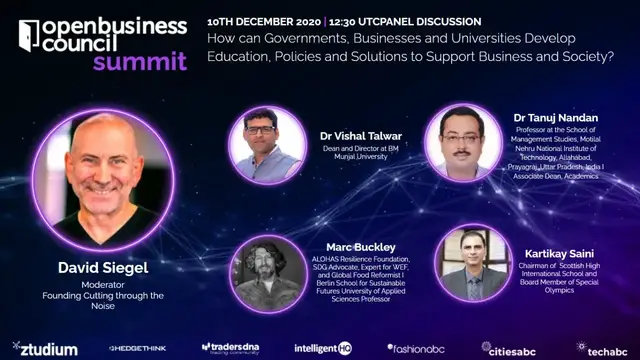
Panel How can Governments, Businesses and Universities Develop Education, Policies and Solutions to Support Business and Society?
David Siegel | Moderator | Founding Cutting through the Noise - https://www.linkedin.com/in/siegelventures/
Dr Vishal Talwar | Dean and Director at BM Munjal University - https://www.bmu.edu.in/faculty/dr-vishal-talwar/
Dr Tanuj Nandan | Professor at the School of Management Studies, Motilal Nehru National Institute of Technology, Allahabad, Prayagraj, Uttar Pradesh, India I Associate Dean, Academics - https://www.researchgate.net/profile/Tanuj_Nandan
Marc Buckley | ALOHAS Resilience Foundation, SDG Advocate, Expert for WEF, and Global Food Reformist I Berlin School for Sustainable Futures University of Applied Sciences Professor - https://marcbuckley.earth/
Kartikay Saini | Chairman of Scottish High International School and Board Member of Special Olympics - https://www.scottishigh.com/core-management-team/chairman/
at openbusinesscouncil Summit #obcsummit
FULL PROGRAM https://openbusinesscouncil.org/summit/
JOIN THE CONVERSATION https://twitter.com/openbusinesshq
https://twitter.com/citiesabc__
Show More Show Less View Video Transcript
0:00
in the 21st century. I have with me Dr. Cardike Saini, Michelle Talwar, Mark Buckley
0:08
and Tanuj Nandong. They are going to introduce themselves at the beginning of when they speak
0:14
I want to thank the Open Business Council for putting on such a fantastic event and
0:19
Dennis Guarda for organizing everything. It's been really exciting. Yesterday was fantastic
0:26
and I have some really great experts here and today the idea is to think different and go big
0:35
and talk about what big changes we need and I want to start with a bit of a premise
0:42
that education is completely broken and that's put together in this book by Brian Kaplan
0:50
why the education system is a complete waste of time and money
0:55
So this is my thesis. This is my assumption that education is not working
1:01
and that we can't fix it and we shouldn't fix it. We should do something else
1:07
And that's what I'm interested in talking about. Of course, we have experts here who will give their views
1:12
But I just want to show, I just want to start with one quick quote from the book
1:15
More college grads in the United States, college means university, same thing, four years from age 18 to 22
1:29
More college grads work as cashiers or waiters than mechanical engineers. More college graduates work as security guards or janitors than network and computer system administrators
1:46
More work as cooks and bartenders than librarians. And college prepares the next generation of cashiers and janitors for their careers
1:59
in most cases you will get preferential hiring as a janitor if you have a college degree
2:09
So most of this, Brian Kaplan claims that most of this is signaling
2:15
and we have to readjust to address the serious problems in the world
2:21
Now, I have a proposal I'm going to give at the end, but I want to hear from our panelists
2:26
and uh and just i'll just go from top to bottom because it's just randomly that way so let's hear
2:32
from kardike and the goal the goal here is to is to build a a platform for innovation and human
2:43
thriving in the 21st century and no rigorous nonsense right so so so let's destroy the myths
2:52
and whether it's education or training or, you know, we've got 50 percent of all jobs today are not going to exist in 30 years
3:00
And that's always true. So we've got a large scale problem on our hands. Kartike, tell us about what you're what you're thinking
3:08
Thank you, David, for this opportunity. Let me tell you briefly something about myself to introduce myself
3:15
I have spent 15 years of my life in the Defense Forces in the Indian Navy as an engineer
3:24
I served in the first aircraft carrier of the Navy in frigates in training units
3:30
was a member of the first Navy-wide IT project by the name of Integrated Logistics Management System
3:37
Those days, it was X.25 switches and, you know, these lines and no sat links and no Vsats and no Wi-Fis
3:45
I retired prematurely as a commander and then joined my family business of manufacturing
3:52
But one thing which was very close to my heart and I founded was a school 15 years back by the name of Scottish High International School
4:00
It's one of the largest international baccalaureate schools of the world with 2,400 IB students under one roof
4:09
It's an ESPN unified school for inclusiveness and rated as top 10 in this country
4:16
I also have a background of working 12 long years in the field of disability
4:22
I was the chair of Special Olympics of India for four years
4:28
1.2 million athletes with disability and a board member of Special Olympics International Washington
4:35
under Timothy Shriver, the nephew of President John F. Kennedy. SOI handles 177 countries and 5.5 million athletes with disabilities
4:46
So that's what I am. The topic of today, David, has a very, very large expanse
4:55
Governments, businesses, universities, what do you do? What policies do you develop to support business and society
5:03
So I'm going to just narrow down as one of the panelists to a couple of things which I'm very, very passionate about
5:14
Because as such, I'm going to be talking of education and an education about K-12 education because my fellow panelists are from universities and national institutes of higher education
5:26
So they'll be covering that. Sure. And within education, I want to touch upon two things, and that is leadership and inclusiveness
5:41
David said, you said, you know, we got to bring out radical ideas, transformatory ideas
5:49
There are no incremental solutions we need to talk about. Not what you get, what you pay
5:55
We don't have to give answers like that. And a quick review of your book, The Pull, and your essay on the book, which doesn't exist, The Machine Economy, really set the pace in thinking that if after 10 years, that's the book
6:13
So if after 10 years, we're going to land up in a situation where human beings are going to be sitting as drivers, but not really driving the car, but a software, drones would be controlling an accident-free environment
6:27
the world of 2030 is going to be totally different. Imagine what it was 10 years back
6:34
I mean, without the web revolution and without the communication revolution. So if somebody would have slept and woken up today
6:45
he couldn't have survived a day. Right. You know what? we are living that sleep with millions of children in this world in schools now yeah they are sleeping
7:02
yeah they are sleeping right the pedagogy the curriculum the syllabi whatever is happening i'm
7:09
an educationist 15 years one of the premier institutions and i speak like that they are
7:15
sleeping they will wake up after 10 years when they pass out of school or university
7:19
and they're going to find themselves in a different world. They'll wake up from
7:24
that sleep Can we wake them up now That what I talking to be talking about Okay So there are a lot of curricula U has its own curricula
7:36
There's Cambridge IGCAC. There's International Bachelorette, National Curricula, Provincial Curricula in the states of India and China
7:45
We talk of academics. We talk of technology. You teach the latest technology, latest software languages
7:51
latest front ends and back ends. But I don't see a subject which says how to handle change in technology
8:02
We talk of in one of your own essays, David, you have said, you have derived that another 10 years, we will have a situation where the top management, the higher wages earners and the lower wage earners may remain
8:21
but the middle-aged learners will vanish. They will be replaced by machines
8:26
We are just producing middle-aged learners today. Exactly. So what happens to all of them
8:36
Am I supposed to believe that all the students who pass out after 10 years from a college or from a school
8:42
would be jobless? Yes, that's what it seems. Sure. So what do we do
8:50
so I hear of schools like Eton in the UK who produce leaders I have been I'm an alumni of a
8:59
of a national defense academy which which kind of teaches a lot of leadership but what about
9:05
millions of schools government and private schools in India and abroad yeah where you're just teaching
9:11
the subjects in a in a in a way which we really we are not going to discuss today
9:19
not the teaching learning process. What I would like to say is that today the education system
9:26
the curricula, the syllabi, the pedagogies are not supposed to be upgraded
9:34
not supposed to be revised, not supposed to be chiseled. They are supposed to be trashed
9:42
Yes. Now what should we do? They should be checked. so what do we do so
9:50
you got to begin one of my fellow panelists is going to
9:55
talk a lot about that why you would want to begin at home etc
10:00
I think it just cannot happen overnight it has to happen like a revolution
10:09
it has to be happening like a disaster management like a COVID management there has to be a vaccine
10:16
produced in the next 45 days, that is the urgency with which it has to be attempted by governments
10:22
government bodies, by educational institutes, by educators, by researchers. I mean, where do we have
10:29
we don't have a single subject called leadership. You may talk about a leader in a history class
10:35
that doesn't change anything. What about teaching, learning, assessment? I mean, it has to come
10:41
come together. There are SEND policies by the International Baccalaureate, by the IGCSE
10:48
how a blind student takes a test, for example, or how an autistic child can have a right or two
10:55
in an examination. More time, extra time. No. Where is the teaching learning? In India
11:02
you would be having let's say how many let me i have some statistics here 1.5 million government
11:12
schools getting to 260 million students 40 000 private schools 79 million students
11:19
there is not even one special educator for each school not even one for one school
11:29
not even one for 149 schools when you're talking of an autism ratio today that one every 35
11:42
children born is autistic at some spectrum and this is autism you're talking about dyslexia
11:48
epilepsy right so what do you do it has to be taken at an international level in a country at
11:58
a national level. You just can't make a national education policy and say that we have not addressed
12:06
leadership. We have not addressed inclusion. Or if we have, it is somewhere in the afterward
12:14
Can I save the rest of it for the conversation and we can move through everybody? Is that okay
12:21
Kardake has really put the nail on the problem. The way I sum it up is that 500 years ago
12:28
you could have gone to any classroom and you would have seen more or less what we have today
12:32
Teachers talking to students and students writing things down. Okay. No other profession is the same
12:39
as 500 years ago. Okay. Just one. Okay. Not even porn is the same as 500 years ago. So
12:49
so let me hear from, I'd like to get five minutes from the other panelists and let's go to Vishal
12:58
Good morning, David, and thanks very much for having me here today
13:03
Just a brief on myself. As Dr. Saini mentioned, I'm part of higher education for almost 20 years now
13:11
Having worked, studied in the UK, so I have a perspective on UK higher education institutions
13:21
having been at places like London School of Economics, Manchester Business School
13:24
and of course for the last seven years I've been applying my trade in India with higher education
13:29
itself predominantly administrative roles so I think the situation is not that different as far
13:36
as the Indian higher education system is concerned of course we have recently come up with a new
13:42
education policy which obviously will take some time for it to be implemented and then we might
13:47
see some output and outcome positive, of course, of that. But I think a lot of it is on the implementation
13:56
Yes, we would like to move away from the systems that have been designed 400, 500 years back
14:01
helped us create a middle class. But now it's kind of reached a certain barrier
14:08
And now this barrier essentially is what next? Because at the end of the day, what are we staring at
14:15
You know, as a higher education person, what are we staring at? We are essentially staring at rising student expectations
14:21
The fact is that most higher education institutions in India are predominantly agile setups
14:28
Agile setups because, you know, if you're coming in from a resource constrained kind of environment
14:35
a lot of the dependence and a lot of hope and expectation is around, let's say, a job or a placement
14:41
right so technically speaking a lot of higher education institutions have kind of designed
14:46
themselves in that kind of model being able to place being able to provide a job but at the end
14:53
of the day what kind of job you know you did talk about earlier you know a lot of people might have qualifications but they not necessarily doing roles which kind of should have been done by them Right I not denying the fact that you know I not saying that any role is not equal
15:08
But the fact is that many times a lot of these people who graduate from higher education institutions are not necessarily doing what they were supposed to be doing
15:17
Is it because of the skill? Is it because of not upskilling at the right time
15:21
Is it because of not necessarily getting the right kind of quality education being in higher education institutions
15:30
So rising student expectations, a very competitive graduate jobs market, rising costs of higher education
15:37
Some years back when even the UK universities increased their undergraduate fees to a great extent
15:44
And of course, and there's always that debate in this whole thought and actual fact that a lot of students who are graduating from undergrad as well as postgrad programs are essentially in debt as soon as they leave those institutions
15:59
So automatically, not many of them are actually on the back foot. So the other issue is, are we doing justice to the sole technological change that you talk about in your book
16:10
you know if and the other you know irony on economy here is yes we're talking about careers
16:17
we're talking about living a life we're talking about livelihoods but at the same time in the
16:22
same breath we're also talking about automation we're also talking about the fact that man and
16:26
machine together we're also talking about the fact that industry 4.0 is very different you know to
16:31
the other three industrial revolutions wherein in this particular industry 4.0 revolution the
16:36
machine doesn't necessarily need the human being to do a better job right so automatically a lot
16:43
of these things will then impinge on the success rates or the success what we define as success for
16:50
graduates who are coming out of higher education institutions right so how do you then tide over
16:55
the technological change is something that most universities across the world and COVID
16:59
is definitely an example of that you know now with you know all universities moving online
17:04
have we been able to tide over this situation very well not necessarily yes we do teach them
17:11
as you know dr saini was mentioning we teach them the software we teach them the programs
17:15
but what else is there more to be done there that's something that we're still you know kind
17:20
of coming to terms with how do you operate in a global context right the fact is that this whole
17:26
work from home model will suddenly change things a great deal you might be sitting in the middle of
17:32
Delhi and managing a team based in New Mexico. How do you then operate in that kind of environment
17:41
How do you recruit the best faculty? The fact is that the higher education institution is as good
17:46
as the faculty that exists within that institution. And of course, the faculties are also transitioning
17:52
from a certain system, which essentially was, let's say, 300, 400, 500 years old
17:57
and are also in a way requiring a lot of training. So these are the relevance of the curriculum
18:03
How do you approach the learning? A lot of this does require a major overhaul
18:10
maybe an understatement, may not be enough. I think a lot of deconstruction needs to happen
18:16
A lot of change needs to take place. A lot of what I would call elephants would need to start dancing
18:22
in my opinion, to be able to then ensure that we're able to come up to terms
18:27
with the kind of change we'll see in the long term. So you want to keep education, secondary, not secondary
18:37
Higher education. You want to keep higher education for most people. Well, you know, that's obviously a debate
18:44
In a country like India, you know, there is a goal of ensuring
18:49
that by about 2030 we have at least 50% of the people
18:53
or the graduate enrollment ratio of 50. which means that 50% of the students who are eligible for undergraduate education
19:02
at least are in higher education institutions or universities. So automatically a country like India will definitely require
19:12
we are at a stage where more and more people should at least experience higher education
19:19
The fact is that there's a lot of atomization in higher education itself
19:23
right so whether it is universities whether it is some other form of you know education
19:28
fulfillment that happens and that needs to be brought in and of course the COVID and the
19:33
technological change itself has brought in many other education models which could be useful
19:38
right of course the same logic you know whether you know there was about 20-25 years back there
19:45
was a lot of impetus within UK universities as well when they you know wanted more and more people
19:50
to be studying in universities. So of course we can debate whether it's a good thing or a bad thing
19:56
But the fact is that we'll have to have a very measured approach
20:01
I'm going to, I'm assuming it's a complete waste of time, but let's hear from everybody else
20:05
Tanush, you're next. Tanush? Do we have a technological issue
20:20
Can you hear me? Okay, I'm going to switch to Mark, and then we'll see if Tanuj will catch up
20:29
Mark, you've heard the assumptions, and you know things are urgent. And my question is, first, tell us a bit about yourself and where solutions lie
20:41
first of all i think that we've overstated our our bounds already in this panel uh as far as
20:52
discussions go and we're proving that education and literacy is behind the times we don't even
20:58
know how to hold into the moderated panel uh first of all i'd like to give respect to sir ken
21:06
Robinson, who passed away this year, August 22nd. He is the pinnacle of rethinking literacy and
21:13
education throughout the world. And he passed away the day before Earth Overshoot Day
21:20
The other thing is a little bit about me, but it's not about me. Yes
21:25
Can you give us a minute on your background? Okay. That's what I'm doing
21:31
so I'm an adjunct professor for the United Nations Sustainable Development Solutions
21:39
Network that's online MOOC courses at graduate and PhD levels executive certificates that are
21:46
up to the date real-time information literacy to date and true I'm also adjunct professor for
21:52
future IO Institute the Berlin School for Sustainable Futures which is a university of
21:59
Applied Sciences. And today I left the UNESCO Future Literacy Summit. It's in its third day
22:06
to be at this event. I take part in future literacy and the importance of education all
22:13
the time. So I hope that what we can give today is really up to speed to where we need to be
22:20
During the pandemic I created Earth School with TEDx and several other commissions like the World economic forum in the United Nations In the first three days it reached 70 million people It was a 30 quest for children who were in lockdown
22:37
couldn't go to school, to learn at home and have an offline activity outdoor nature
22:43
included in their parents. That's a little bit about me. And your thoughts, how would you like to scale up and what big changes would you like to see
22:53
systemically. So I'm a big believer in the systems view of life. Systemic approaches are the only
23:02
way we'll solve our global grand challenges. You're absolutely correct. Literacy and education
23:08
is stuck in the dark ages, middle ages to say the least. Nothing has been improved or updated
23:15
and we're not getting up to speed with even the digital revolution in that respect. And so
23:20
I would like us to keep up to speed with our exponentially growing world by using emerging
23:25
technologies, future thinking, future literacy, and apply those tools and models and tricks
23:32
that are already on the market today and put them in our classrooms, put them in our homes
23:38
and put them in the empowerment of students and teachers for a nice exchange. One of the biggest
23:45
leaders of our time is Elon Musk and he created Ad Astra, a school specifically for his children
23:52
that is not divided into grades or classes, that everybody has the same curriculum depending on how
23:59
they learn and they thrive, they flourish, and there's numerous other models like that. The book
24:06
Reimagining Learning Reimagined. It's by Graham Martin Brown. It was also in conjunction with
24:15
Sir Ken Robinson. Has some wonderful tips and tricks from world leaders in the education
24:21
industry around the world. What have you learned? You've done MOOCs. You've done
24:26
scalable teaching. What are your learnings? What were you? I believe that every individual needs to be picked up there where they're at, meaning the level that they're at, no matter what their age, their gender, what level of entry
24:43
And it only takes one wonderful leader to change the future of our youth
24:51
One wonderful leader can change the outcome. One wonderful educator can change the outcome of each and every individual
24:59
a message, a connection, and the way of doing that. And so I believe that instead of doing
25:05
curriculums that are very strict and rigid and force fed and spoon fed with a grading system
25:12
we need to come up with new ideas to reach out and touch those lives that really need it
25:19
There's numerous models, and that goes back to the systemic approach. There is no one size
25:24
fits all or one silver bullet to solve it all. We need to make it very specific to each and every
25:30
individual, whether it's grade school, college, university, PhD level, we need to pick everybody
25:38
up where they're at. How can we do that at scale? It's the right idea. Now, how do we do that for
25:46
you know, when we have 9 billion people on the planet and this presumably, you know
25:50
a billion and a half children or something. I really believe it starts that we start to cover
25:58
the basic needs of every human being where we start with hunger and poverty and alleviate those
26:05
issues, which then have effects on infrastructure, that we get the infrastructure and those basic
26:11
needs up to speed so that those individuals are even in a place to begin learning to be thinking
26:18
about school. If they don't have the basic needs, food, drinking, water, shelter over their head
26:24
there's no way in hell you're going to get them to think about school or an education
26:27
If they're a refugee from a conflict area, even at high school or college level
26:34
if they're worried about how they're going to live, they don't care about school. They're
26:38
worried about their existence. So it's really about the basic needs that we get those resolved
26:44
as humanity first. And then we can slowly change the education system. Now in a developing
26:49
country, we don't have those problems, but we can still change our education systems in developed
26:55
countries because they also are based on an old model infrastructure that needs to be ramped up
27:01
What we experienced, what bubbled to the surface during the time of the pandemic
27:05
was unbelievable. It was wonderful because it's shown the microscope on all the problems and all
27:12
the problems bubble to the surface, that we really hadn't hit the technological revolution
27:16
that we haven't done digitization, that we weren't prepared to do teaching from home and teaching in
27:23
a different way than we've ever done before. Many schools pivoted, many schools didn't, and many
27:29
parents became educators, which they weren't prepared for. And the numerous amount of problems
27:35
that arose out of that is enormous. Right on. Okay. Very good. Thank you, Mark
27:42
You know, 30 years ago was 1990 and the internet was just getting started and a lot of things
27:47
interesting things have happened. You can sort of compress all that and multiply it by about 10,000 for the next 30 years, right
27:54
It's not even going to be close. It's going to make the last 30 years look like cakewalk
27:59
So how are we going to get where we need to go? Tanuj, are you back with us
28:09
Tanuj, can we hear you? No? Tanush
28:20
Can you just give me a minute to reconnect? Okay, sure. No problem
28:25
All right. So I want to go back to CardiK because CardiK nailed the problem
28:30
And I really want to know. And Mark has some really relevant, important experience at scale with the TEDx and with
28:39
MOOCs and using technology. so let's talk about solutions where are the solutions kardake do you have some
28:45
some specific let's try to you know you know go around and talk about solutions now
28:51
yeah so i think mark had wonderful and meaningful points here and uh in a developing on most
29:02
developing countries there are other challenges like vishal said in a country like india for
29:07
example, there is so much of population. The focus of the governments of think tanks has not
29:17
reached to a level where you were talking about leadership and inclusion and special educators
29:23
for example. That's what I was talking about. But the primary aim is to first get literacy into
29:29
the population and then give them jobs because there is hunger, there's poverty, people need jobs
29:34
people need to earn, etc. But at the end of it all, all these are incremental
29:40
By the time you reach there, you would have your goalposts switched a mile further
29:45
So like Mark said, we got to get together now. We got to change systems
29:50
I mean, I'm very impressed with the example he gave about Astra
29:54
I would like to read more about it. So where is the impact
29:59
Where are experiential qualifications? Vishal would be able to probably answer that
30:05
I mean, today you may have a law for child marriage. You may have a law for child labor, but everything happens, right
30:13
Because when you're hungry, you've got to work. So a retailer who has not studied beyond grade eight has been a retailer for 12 years
30:23
could take a better class in retail management than a professor. Sure
30:29
I believe so. If you look at the curriculum. So where is experiential qualification
30:36
How do we manage, Mark? How do we? This is a question to you that, yes, we need to begin with the level of every person
30:45
That includes people with special needs, right? That's my focus area. But the idea is what happens to a place where you don't have schools, where you don't have teachers
30:53
where you have 500 children in a government school in a rural area
30:58
which is non-accessible by road. Forget about Wi-Fi and all the gadgets there
31:04
And there is no teacher. What do you do there? As I said, 1.4 million only athletes, okay
31:15
amongst another 32 million disabled people in remote areas and villages cannot connect to a coach because they don't have a mobile what do you do there so so the country
31:29
every country is is is is kind of in a conflict between the basics and what we are trying to
31:36
achieve for the 21st century so so i do not know where where would you david where would you
31:42
do you mind if i answer david please okay so there's a there's a couple reasons why i was
31:48
asked to be on the panel because I'm also an advocate for the sustainable development goals
31:52
for the United Nations. And as I said, we kind of need to address the basic needs because
31:57
if the basic needs aren't met, the education and literacy is always surpassed. If people don't have
32:03
food, water, if they don't have a shelter over the head, they're worried about other things in
32:09
education or literacy. And they're usually making children and girls, boys and girls work on farms
32:15
or work instead of going to school because of those needs aren't being met
32:20
The United Nations Sustainable Development Goals, the 17 goals, targets and indicators
32:25
have really gone under the bus. And I have to apologize. A lot of people don't know what they are and what it is
32:31
I'm going to tell you right now, it's the world's ever first global moonshot
32:35
It is a historical precedence, none that the world has ever seen before in my lifetime
32:41
in your lifetime, and since the existence of humanity. The only other time in our world that we've had a moonshot before was John F. Kennedy 51 years ago sending men to the moon and bringing them safely back to Earth
32:55
And that was one nation, one country and a few other maybe thousand players
32:59
This is the world's first ever global moonshot. And it is a historical precedence
33:04
197 countries came together for the first time ever to take care of the basic necessities and
33:12
needs of humanity and to raise the bar higher for all humanity on a global field. And that is a
33:20
historical precedence. If you think about it, it's hard enough for two countries to decide where
33:27
they're going to go to lunch, let alone 197 decide on a roadmap for the future. Now, it's not perfect
33:33
and there's a lot of mistakes. But if everybody knew that that's a roadmap for the future
33:38
where quality education is a big player in that, but really to get that sustainable infrastructure
33:45
worldwide at a level where everybody has inalienable rights to quality education, literacy
33:54
and the movement forward for education. Thank you, Mark. Now, I don't know if we have Tanuzia or not
34:01
because Tanush is probably having some internet issues, I assume. Do we
34:06
Can you talk now, Tanush? Yes. Can you hear me, David? Yeah, for now
34:16
Go ahead. Take about four minutes. I only have 25 minutes left
34:24
Right. So I'll be really quick about this, David. But whatever you say
34:31
No, we just don't have good enough connectivity. We just can't hear it
34:40
Maybe can you try taking off your video? At the bottom... I'll switch
34:46
Turn off your video. I'll switch off my camera. Yeah. Yes. Okay, try now. Right
34:54
Is it better now? I think it might be. Alright, so I'll just proceed with the hope that it proceeds well
35:04
So anyway, I am Tanuj Nandan and I'm a professor at the National Institute of Technology in
35:11
this place called Allahabad, India. It's a government of India institution. And in addition to my responsibilities as a professor here, I also sit in the placement office
35:22
So I look after the placements of all our students. We have bachelor's programs in engineering
35:28
we have master's programs in engineering, in business administration, and then we have the PhD programs
35:33
So essentially we take off where Dr. Kartike leaves the students and like you said, David
35:39
it's pretty much the same as in the US. So the undergraduate engineers come in around
35:44
when they're around 18 and they complete the program when they're just about 22
35:50
And so there I sit in the placement office and I'm also associate dean of academics
35:55
And it just gives me a unique kind of a perspective because I'm looking at education from three different viewpoints
36:05
Firstly, as an academic master. Secondly, as someone who is responsible for getting
36:10
students .. Then in the .. And then also looking after academic administration
36:20
looking after assessments and curricula and things like that. And I was really interested in listening to the discussion that happened beforehand because
36:34
Your audio is not good now. Now we don't hear very well
36:40
I'm really sorry. It's not good. I'm going to have to switch a little bit
36:45
You can bring your video back and listen, but I can't really make this work
36:52
I would like to be the fifth panelist, if I may. I haven't introduced myself. I'll do it quickly. I'm a lifelong entrepreneur from Silicon Valley
37:00
I've started 15 companies. And I do a lot of thinking about this stuff. And I'm going to
37:07
propose a three-step radical solution for people who are 18 years old. Number one
37:14
first of all we going to live to age 90 on average or 100 on average Children born today many of them will live up to 100 years old Many of them will be working well into their 70s
37:27
Most people will be who are born today well into their 70s. So my solution is in three parts
37:33
Number one, you work four days a week. Number two, you learn one day a week for your entire life
37:41
And this doesn't have to be exactly, you know, Monday, Thursday, and then Friday you learn
37:45
It's one fifth of the time. You're learning. You're skilling. You're upskilling
37:49
You're trying to take the next step in your career. And number three, we educate and really help employers understand that the degrees and the signals mean nothing and that they should stop looking at educational, you know, signals
38:06
And they should start figuring out how to integrate people to solve real problems
38:11
And there are many ways to do that that they're not doing today
38:14
And Elon Musk has said he doesn't want to know if you have a degree. He doesn't care. It doesn't matter. Other people say this, but they don't really do it in practice
38:22
So it takes going to take a lot of evangelization and proselytization to get companies to stop the nonsense and start hiring people for their skills
38:33
And what they can contribute and what they can further learn and keep developing their whole lives long
38:39
So that's my radical solution. 18 years old, forget about school, get into the workforce, but get into apprenticeship programs, get into companies that will nurture this concept of work four days and learn one day
38:52
That's a radical proposal. I'm open to anybody. Now we have 20 minutes
38:58
It's really not a radical proposal. It's called evolution. I wasn't an avid reader I wasn't an avid learner I did average grades until I got into college
39:09
but I'll tell you what I read a book a week minimum now I love learning I will continue
39:16
learning until I'm dead it's the way to innovate it's the way to have a successful
39:21
successful social enterprise it's the way to solve our global grand challenges and the thing
39:29
that we're experiencing in this call is really unique. We have the brightest minds with us here
39:34
today, some great credentials, some wonderful people. But what we're seeing is that our digital
39:40
transition is not up to speed. I'll tell you, I promise this is not a commercial for Elon Musk
39:48
but Starlink broadband is almost at halfway point of its required Starlink broadband satellites
39:56
which will give us one sim, a high-speed internet across the entire globe
40:01
And if you've ever heard Peter Diamandis or Singularity University or any of those institutes
40:07
this will be the rising of the billions. Those people without smartphones, without internet, without that basic infrastructure
40:14
they're going to leapfrog onto a system of global access to knowledge and wisdom
40:21
Now, don't get me wrong. There's going to be tons of fake news and bullshit on there as well, but we're going to be intelligent enough through AI and algorithms to sift through that, to dispel misinformation and remove bias and get to the information that's vital for our particular type of learning, whether that's art, creativity, engineering, architecture, healthcare, whatever it is, to get us on the right side of history and to create those resilient, desirable futures
40:52
Now, he's not the only one working on that Starlink broadband. There's a couple other companies doing it as well. But I promise you, what we're seeing in 2024 by 2030 would blow your mind away of where we're going to be
41:08
Let's get to those infrastructures. Let's make that transition to that future of how we use these technologies for good so that people can get an education at home if we're put in another lockdown situation
41:21
That they can use the tools of books and online medium wherever they are on this planet
41:28
Do Wooks? Go ahead, Vishal. I think, yeah. Yeah, so I was going to say learnings aren't going to go out of fashion, quite frankly, but degrees possibly, you know, in the longer term
41:43
So I don't think degrees and learning may have a perfect correlation
41:48
I would love to say technology could be the answer. But the fact is that so far, at least the evidence, you know, suggests that technology could be the answer or technology assisted learning could be the answer for a certain category of student
42:03
and not necessarily a large base of the students, right? So even if you look at some research that's coming out from Stanford
42:10
I think a certain base of students of a certain behavioral orientation do benefit far more, whereas a large base of students
42:18
maybe at different levels in the distribution curve, don't benefit as much
42:22
Maybe that's because of the fact that a lot of us as universities are essentially taking the same thing and transitioning that
42:29
into the online mode. That possibly could be one of the reasons
42:32
But the fact is a lot more needs to be done with the technology, a lot more needs to be done with the content, a lot more needs to be done in how that content is delivered to be able to make sure that, you know, at least countries like India, where there's a lot more reason for us to push up, push the boundaries, make more and more people literate, could be taken advantage of
42:52
But so far, the other issues obviously are fatigue, you know, issues are of screen time that we see
42:59
So I would have loved to say technology could be an answer. But so far, you know, there's a long way to go, David
43:04
You know, after you're 25, 20, 30, 35, 40, none of the stuff you learned in school matters at all
43:12
So how do we keep upskilling for our entire lives? I mean, our working lives are going to be much longer and education will recede into the background as you as you get older
43:22
and you still have many decades to work. How do we keep upskilling
43:31
So I think, you know, if you look at the sole concept of micro-credentialing
43:36
honestly, we'll have to be learners for life. The sole concept of just-and-time education
43:41
will be important, more important than degrees, honestly. You know, and, you know, if you look at
43:47
let's say, for example, we've had a new education policy after 30-odd years
43:52
And that policy also talks about the fact that you can, you know, you can drop in, you can drop off whenever you would like, engage with industry, bank a certain number of credits, come back when you would like, and then maybe continue
44:04
So maybe, you know, micro-credentialing, just-in-time learning, technology-assisted or face-to-face could be part of the answer
44:12
But how do we deliver? What do we deliver? Who delivers? Still remain big questions
44:16
Google has opened a micro-credentialing school, a micro-certification school that has been very popular
44:24
And is that part of the future solution? What are the main ingredients we're looking for
44:29
What are the big different things we wanna start doing that we gotta do a lot more of right now
44:37
I think we have to focus on the content We have to focus a great deal on you know the asynchronous and the synchronous nature of what we deliver We have to focus a great deal on
44:46
making, at least from, you know, our context, the Indian context, you know, how our students learn
44:54
has to change, right? So, you know, we do talk about flipped approaches to learning. We do talk
44:58
about the fact that, you know, students should come in prepared and then take more benefit
45:03
a constructivist approach to learning but the fact is it's quite difficult moving in from a
45:08
very different cognitive approach to learning to a constructivist approach that needs to fundamentally
45:12
change as well. Mark yeah what works what do we have to do? So I love I love all that's been said
45:22
I really think that we need to move away from this nationalistic view of education for the simple
45:30
fact is if we look at the numbers of Indian workers that work remote for other countries
45:36
around the world, other cities around the world, it is enormous. And there is an exorbitant amount
45:43
of labor force and those who were educated in India but are working around the world for
45:49
different corporations and company, customer service, whatever it may be, technology, programming
45:54
and the the issue that arises is that cultural difference where there's a language barrier
46:01
misunderstanding of how people do business in other countries and we need to get more of this
46:06
global aspect where we kind of get a global operating system a global standard that no
46:12
matter where you received your education that it's of the same standard and quality anywhere
46:17
and but it's one that's continually evolving and up to date so that you can deal with people all
46:23
over the world and solve their problems and help them and to be efficient and feel of worth and feel
46:30
like you no matter where you go, no matter what your situation dictates, that you have value
46:36
anywhere on this planet, not just because you're from here and there's no stigmatized that you're
46:42
from India, you're from Africa, you're from Europe, from Germany or wherever, that you're
46:48
better than anyone else. That's bullshit. We need to get rid of neo-Darwinism, neoliberalism that
46:55
doesn't exist. That is not survival of the fittest natural selection. It's about cooperation
47:01
collaboration, and thinking about the truly global world. We are all citizens of this planet Earth
47:07
and therefore we need to get the big history. There are some other great educators
47:11
David Christensen and Bill Gates also has kind of pushed some of this big history learning
47:18
movements where we're not even getting the basics about the big history of our planet
47:22
They're getting muddled up with information that is not vital to our future, not vital to
47:30
what our core learnings should be. Let's talk about just-in-time education. We've got Udemy, Khan Academy, the whole YouTube
47:39
Whenever I want to do something, I go to YouTube and figure it out first, and then I go do it
47:43
This is on a small scale. I might watch for three minutes and then go, you know, make bake something or fix something
47:50
And in Russia, they have something similar, you know. So so what about just in time learning
47:59
Anybody? I'm a big advocate of just in time learning. I almost think it's more of a skill set
48:08
I think it's more of a tool. I don't know if it would be classified as higher education degrees or something like that
48:14
I think it's somewhere where you've lacked in picking up or developing the basic skills
48:20
of the tips and tricks of making life easier or doing some things that you're like, well
48:25
I want to bake these cookies or I want to fix some plumbing or do something like that
48:30
that it really puts you a step up that you're an equal to others
48:35
But now there's that added layer. If you say, wow, I learned in this plumbing video that I really enjoy working with my
48:43
hands and this labor and I might want to be an engineer or I want might want to be going to this
48:48
direction then you can dive in to the specifics and find that college that university that MOOC
48:54
course that will give you the latest up-to-date technology and information about that field and
49:01
then you can go down that that direction another thing going back to the systemic that you touched
49:06
upon is before we were really in this world of specialists doctors PhDs experts and specialists
49:12
in one area, but they couldn't find their ass with both hands on a big systemic problem
49:18
because they were so tied up in one specific facet. And you'd ask them a question and say, I can't speak about that because that's outside
49:26
of my area of expertise. Well, I'll tell you what, humanity is a general skill in education
49:34
We need you to be, in some respects, a generalist and understand the systems view approach of
49:40
solving our global grand challenges. This siloed and linear approach isn't helping humanity anymore
49:46
We need to think differently. So I think, sorry, the silos would definitely, because of the pressure break, you know, you're already seeing that
49:56
Universities collaborating with ed-tech companies, ed-tech companies collaborating with universities. Of course, you know, to a large extent, this may also be commercially driven at times
50:08
The fact is, if you're looking at that kind of standardization, if you're looking at, you know, everybody getting a certain, you know, base of education, irrespective of where they are, I think you'll have to open the locks of knowledge repositories that are existing in different parts of the world
50:22
So some universities are actually doing that. They're opening up a lot of the learning. They're opening up a lot of their courses, which I think is a step in the right direction
50:29
I think we've learned from COVID and it's a tragedy of immense proportions, but also it has shown us that education is mostly facilities and real estate
50:40
And that's what we don't need. Right. I think that we we have to get away from facilities and in-class learning to I study economics and I've I've pushed the boundaries in economics
50:50
And I'm working at the sort of the tip of the spear in parts of automating monetary policy
50:55
And I do that because I watch video lectures and I learn everything online
51:01
And a big resource for getting smarter is something like MRU, Marginal Revolution University
51:06
where they can put half a million dollars into a video to explain macroeconomics that no professor, no class can come close to
51:15
They can do something because it's at scale, because they know 10 million people will watch it
51:20
right? And they have the budget. So I think that's the kind of scalability we've got to look for
51:26
And it's, again, I think even though it's intellectual, even though it's PhD level
51:30
it's still just in time learning for when you have time to learn what you want or need to know
51:39
Final words from people. Let's go around. Kardike, you're muted. Sorry for that
51:49
Yeah So I think everything comes down to the foundations If today Mark is reading a book a week he can doctorate in disability management from a university in India at this age
52:05
just finished a Harvard course on entrepreneurship skills after having so many businesses behind me
52:10
and trust me I learned I mean I hadn't heard about John Osher
52:15
and a serial entrepreneur in the US and I had so much learning so how does it happen to some
52:21
and how does it not to others I think it should begin with the school at the foundation level
52:29
I agree with Vishal about content, about, you know, facility, about holistic learning
52:35
But then more than that, we need to get a child understand before he moves out of school that learning is lifelong
52:44
Exploration is good. Research is good. Dissent is good. Questioning is good
52:49
thinking forward is good. Going by the threatened path is not good
52:56
You got to choose something which is revolutionary. And this doesn't come in a day
53:01
You got to give him that vibe. You got to give him that strength. Mark said, what
53:07
a leader, one single leader can do to a student? Probably the entire
53:11
organization can't. That is true. So that leader has to be found for each child
53:16
So that's how, throughout the life, your life, you would be just-in-time learning
53:23
upgradations, online learning, what you are doing, David, and what you're doing, Mark and Vishal. That's how it will happen. And that's
53:30
where it cannot come in if we have an age-old pedagogy, age-old system, syllabi, curriculum. And that needs to
53:38
change. Right on. I love the urgency from CardiK. Tanuj, are you
53:42
better or not? Can you say it? You want to say a few things? I think I'm as good as muted when I'm unmuted. But then if you can hear me, I'll just add my two bits. Yeah. So, you see, I think there's been a lot of talk about this lockdown and the social distancing having taught us things. And that's true. I mean, like we've learned to take education or the classroom online
54:08
but then there's only so much that you can teach online my proposition here is okay if you want to
54:14
learn something about programming or IT skills or maybe economics it's good enough but if you want
54:22
to learn skills like Mark said if you want to be a good plumber or something like that so my
54:26
proposition really is that more of the learning actually has to go out of the classroom and that's
54:31
a real drastic change because I think are the the spheres of knowledge in which we operate have
54:37
expanded tremendously and our education system has not kept up with it and what we focus upon
54:44
and I think that's true for many institutions across the world is equipping our students with
54:49
information with data with with knowledge but without the understanding of how to translate
54:54
that into practice and for that reason we need to depend more upon apprenticeships internships
54:59
we need to make it open classroom and so the owner shifts really both upon academic institutions as
55:07
well as upon industry, academic institutions, because they need to rethink their processes
55:11
and they need to be more open. So, I mean, I'm putting the onus on myself principally
55:16
but then if we look at the industry, do they have the space, you know, it's a numbers game. So
55:21
do they have the space to accommodate so many interns or apprentices? Possibly not. And maybe
55:27
then you can tie in, like, I believe that at least in India, we have a sizable focus on
55:33
corporate social responsibility so maybe the the industry can take some of those funds that is
55:40
dedicated towards corporate social responsibility and invest it into education because that's going
55:45
to come back to them in the form of more skilled people so possibly that that could be something we
55:50
can look at so my what i'm saying here is it's really good that we can take teaching online
55:55
but there's only so much of it that you can actually use online the rest of it has to be
56:00
hands on. Okay, I'm going to wrap up and then I'm going to give Mark the last word. If you read the
56:06
book by Robin Hanson called The Age of M, you will be convinced that 100% of all work will be done by
56:13
machines at some point. If you want to think of it as 2100, that's fine. If you think, oh, that's
56:18
too, that's not possible, then just go to 2200. I don't know what the year is, but at some point
56:24
All, 100%, even entertainment, even painting and sculpture will all be done by machines
56:31
Okay, in that context, the next 30 years are critical to getting people the non-repetitive jobs they need and transition our way toward the machine economy
56:43
I'm going to give Mark the last word. Thank you, guys, and I really appreciate all of you
56:49
Thank you so much. A wonderful panel of great leaders and very intelligent people
56:56
I have a fond heart for India and the people of India, and I appreciate your guys' wisdom
57:03
I want you to know that your president, Shiri Narada Modi's way to gain an election and some of his presidential addresses have been using the latest technology where he presents himself to billions of people
57:18
at the same time via hologram on a stage. I don't know if you've seen it
57:23
I don't know if you've experienced it, but that's using latest technology
57:27
When it comes to getting out of the classrooms or off of the computer
57:33
off of the technology to learn, I'm in full agreement with you
57:37
The problem is if that environment that we're getting out of off of the computer
57:43
is one without sustainable development, without basic infrastructural needs. It's trashy, it's dirty, it's not livable for humanity
57:53
There is no reason to go outside and to learn. So as a world, as all nations
58:01
my plea is that we accept the Sustainable Development Goals, the Paris Agreement, and put our shoulders to the grid
58:09
to make sure that we can transition a new global operating system
58:14
that will give every human being on planet Earth the same basic infrastructures and needs
58:21
so that they can go outside, enjoy clean air, good weather, nature, and interact with themselves
58:29
And then the times that they do spend in front of these crazy computers
58:34
which we've seen plenty of this year, will be efficient and only for that knowledge
58:38
that they want to learn that will help them to get far in the future. and the rest of that time as social beings will be loving each other
58:46
eating great food, and celebrating life. So I thank you guys, and that's all I have to say
58:52
Thank you, Mark. Thanks to your fantastic panelists, Tanuj, Vishal, Kardike. I want to thank Guinness Guarda and the Open Business Council Summit
59:01
for putting on a fantastic event. I really appreciate the chance to have these conversations
59:05
and to start putting them into practice. We hope to see. let's come back a year from now and let's move the ball even further
59:14
Thank you all. Thank you. Thank you. Thank you, everyone. Thank you, David
59:19
Thank you
#Business Education
#Education
#Vocational & Continuing Education
#Special Education