Up next in 10



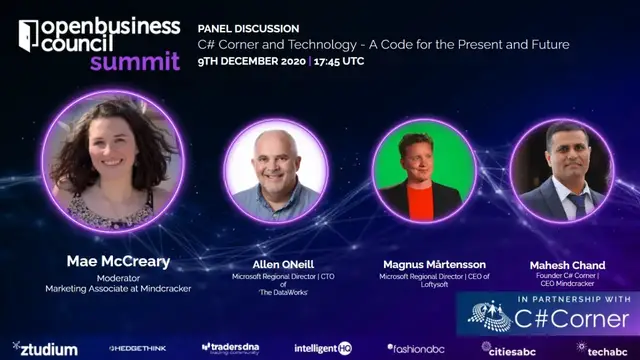
Panel C# Corner and Technology - A Code for the Present and Future
Mae McCreary | Moderator | Marketing Associate at Mindcracker - https://www.mindcracker.us/
Allen ONeill | Microsoft Regional Director | CTO of ‘The DataWorks’ - https://www.thedataworks.co.uk/
Magnus Mårtensson | Microsoft Regional Director | CEO of Loftysoft - http://loftysoft.com/
Mahesh Chand | Founder C# Corner | CEO Mindcracker - https://www.c-sharpcorner.com/
at openbusinesscouncil Summit #obcsummit in partnership with C# Corner
FULL PROGRAM https://openbusinesscouncil.org/summit/
JOIN THE CONVERSATION https://twitter.com/openbusinesshq
https://twitter.com/citiesabc__
https://www.facebook.com/openbusiness...
https://www.instagram.com/openbusines...
Show More Show Less View Video Transcript
0:00
All right, welcome everybody to the Open Business Council Summit. I am Mae McCreary
0:07
the moderator for today. I'm with Mindcracker, and today is made possible by Mindcracker in
0:13
partnership with C Sharp Corner. For those of you that don't know, C Sharp Corner is a community of
0:19
software and data developers of 3 million members with 5 million visitors monthly, whose goal is to
0:26
learn share and inspire so without further ado let me introduce the panel for today we have all three
0:33
microsoft regional directors first we have alan o'neill from ireland alan is a member of the c
0:39
sharp corner community as well as the cto for the data works and then we have mahesh chan mahesh is
0:45
the founder of c sharp corner as well as minecracker outside of the philadelphia area
0:51
And finally, we have Magnus Martinsson from Sweden. Magnus is an entrepreneur and consultant in the cloud business and architecture field, as well as the CEO of Loftysoft
1:04
So all three of you are in senior IT positions. How have things changed since the beginning of the pandemic
1:11
Can you guys speak a little on that to start us off? We can indeed. And I think we're all like angling, trying to figure out who gets to go first
1:21
And I did because I was fastest. And so I have been inside of this room basically since February
1:29
And that's extremely weird for someone like me. And those of the people who know me know that I enjoy meeting people, communicating, interacting
1:39
And I love traveling to conferences. I go and deliver all kinds of consulting and things on a global scale
1:46
I could go to Sydney or somewhere. I live in Sweden. or the US
1:53
But this year has been nothing. So it's changed a lot for someone like me
1:58
And if you scope that out to the industry, our industry, the technology industry
2:05
my goodness, we work from home a lot. We are fortunate. We are the fortunate ones that all of a sudden
2:10
everything could possibly just be done from home. It used to be the case that
2:16
oh, you have to be on site. You have to meet the customer. You have to be there in the team, blah, blah, blah
2:20
All of a sudden, it doesn't have to be that way anymore. Everyone can work from home
2:27
Yeah, I mean, go ahead, Alan. From my point of view, it's interesting because people say I have been training for this all my life
2:36
Because I work mostly remotely. So, to me, it's life as normal
2:41
and it's interesting because a large proportion a very large proportion of the IT industry
2:49
and yes they they would previously have commuted and gone to work every morning and gone to an
2:56
office and met people and all of these things and wonderful collaboration and water fountain
3:04
conversations ad hoc things for sparking brilliant ideas and everything else but mostly I didn't do
3:10
that and there's actually a whole different part of the IT industry and I'm sure some others
3:16
that predominantly work remotely and for me most of my work has always been
3:25
doing things remotely and working with people in different time zones so probably for me it's
3:32
it's not so different the only downside for me is not being able to go and meet up with my friends
3:39
and far-flung corners of the world? Mahesh? Yeah, I mean, thank you, May. First of all, good question
3:47
Actually, as Magnus and Alan already said, most of us work from home
3:55
which is a good thing as far as work-wise. But obviously, so many people who are struggling, we feel for them
4:02
and hopefully things get better soon. um besides work i think you know the conferences we do c-sharp corner conferences we do we
4:11
definitely miss that part you know traveling to india and also you know i do a lot of
4:17
speaking at conferences and events here in the u.s as well in different cities so the traveling part
4:23
and the speaking and interacting people that part is definitely kind of we are kind of at the stage
4:29
we're like, come on, when can we, you know, get going? So that's really the missing part
4:35
Otherwise, you know, things are from at least people who are in tech
4:39
who are in software development, they're not that bad compared to, you know, other fields
4:44
Yeah. Thank you all for sharing. And moving forward today, we are going to discuss emerging technologies
4:51
including cloud computing, IoT, AI and machine learning, blockchain, voice-enabled system, and mobile apps
4:59
So, Alan, I'll direct this question to you first. I know you're involved in a lot of these technologies
5:05
What do you see as the fastest growing of all of these emerging technologies
5:11
The one that covers absolutely everything, the one that will be everywhere
5:17
and the one that there are most opportunities is AI. and ai um is not separate from blockchain or iot or cloud or any of these things it is something
5:30
that is becoming fast to be part of the plumbing of everything and it will be is being used um to
5:39
optimize everywhere and it is being used to add value tremendously from a business point of view
5:45
and if you think even, oh, my business doesn't need AI, we just do basic stuff
5:52
I guarantee you if you get somebody in who knows a little bit even
5:58
enough to be dangerous about AI and knows a little bit about your domain and your business
6:05
they'll be able to find a way that can help you improve your business
6:09
by injecting some machine learning and some AI in there. And by the way, one of the important things to know about this is that AI is not like the end of the world
6:19
The robots are coming. OK, and AI is very stupid. AI is like a computer
6:24
It will do exactly what you tell it to do. OK, so don't be afraid of it
6:29
Embrace it. It's not going to do people out of a job
6:34
It's going to create new jobs and it's going to free us up to do more interesting and more worthwhile things
6:40
So, AI is the top of everything, and it will only improve things and spread even wider and better in all of the industries and the areas that you mentioned
6:52
Well, I think to add to that, Alan, what Alan just said, you know, we all can chime in as well, Magnus
7:00
When, you know, people think of AI, they always think of, as Alan said, you know, robots are coming and, you know, machines are running our lives
7:07
but AI in today's day, almost every large corporation is already using AI, right
7:15
For example, you get all these emails and emails you get, oh, this is it
7:20
This email goes to your spam. This goes to your inbox. This goes to your prioritize This is part of AI You go to Facebook and all you see is the content that is just really you know relevant to you these things are already happening and your
7:36
systems are already using AI you know look at this your iPhone and you open iPhone with your
7:42
face recognition it's part of all AI machine learning face recognition is a part of that so
7:47
these things are already happening either look at our car we get in the car car recognize us right
7:54
our home systems and so on so forth so as ellen said ai is everywhere before um magnus um answers
8:02
because i know he'll appreciate this one um people say okay but what's the difference between ai and
8:10
machine learning um and it's really simple um ai is written in powerpoint and machine learning is
8:16
written in python that's it okay so in other words when we say i is ai especially from a business
8:23
point of view, don't think of it as something magic because it's not. Every programming language
8:29
comes down to three things, if, then, else. And this is what we do when we wake up in the morning
8:35
We say, oh, is this a weekend? Great. I lie in bed. No, I get up out of bed and I put my foot in front
8:42
of the other. It's just if, then, else. Everything is binary. Everything is simple. It's not something
8:48
you have to worry about. It's something you need to embrace. So, Magnus
8:53
No, that's cool. I want to be brief about it. I loved your answer. It's to the point. AI is
8:59
probably my pick as well. What's interesting is that AI obviously existed before the cloud and
9:05
AI exists still. And I was there when the cloud was a teeny tiny baby, right? I worked in this
9:11
industry before the cloud and then the cloud could, like at the beginning, could deploy your
9:15
web application, right? That was like the cloud, right? And we've had data centers before
9:20
though cloud technology is different inso the fact that you can just provision anything you need
9:25
and be built by the minute you consume it. But some years down that line, we have now cloud
9:34
technology that is very, very sophisticated. And the things we have built on top of that is that
9:42
we have added things like we have enabled AI capability and AI power to everyone through cloud
9:49
technology. So with many of these IoT, AI, many of these technologies did exist before the cloud
9:57
but have been very, very seriously democratized through cloud technology. Now everyone can use it
10:04
And one thing really interesting there, and something that everybody has said
10:08
the magic in all of these things is when you bring everything together
10:15
Yeah, and basically automate it, right? Automation is the key where we don't have to manually do the work
10:22
Yeah. And that's what machine learning is all about, that machine, we put some algorithms there
10:28
machine figures this out and do work for you while you're sleeping. Yeah, thank you all so much for your input
10:37
But really interesting to hear the perspective of that machine learning or AI is stupid
10:46
I definitely think the general consensus around AI is, you know, robots are going to take over
10:51
So it's nice to hear that reassurance. All right. So the next question, Magnus, I know you work closely with Microsoft Azure team and CTO
11:04
Where do you see this cloud computing is going and what is the future of Microsoft Azure
11:10
And what other exciting things do you see coming out from Microsoft in the future
11:16
Yeah, so that's a really small question. That covers everything. So I was fortunate to get onto that cloud journey as it emerged
11:32
And I consider myself very fortunate to be early in there. In the early days, there was not much business to be had in that space
11:40
There was a cloud, there was technology there, but not every company or very few companies were actually already doing it
11:48
But now everyone is doing it. So it's a technology shift more than anything, because what we are seeing now is that Azure is the cloud which is present in the most geography spaces in the world
12:04
I mean, they're all global. AWS is global. Google Cloud is global. Sure, fine
12:09
But Microsoft Azure has the most by far regional data centers that deliver the cloud capacity known as Azure
12:17
In fact, I live in Sweden and just the other week, it was announced that the data centers that we already knew Microsoft had purchased land for and were building in Sweden were actually going to deliver Azure, it was announced
12:32
And just this last week, it's actually this Monday, this week, Monday, Microsoft announced a massive investment in Denmark and it's also going to deliver Azure
12:42
So I see that, you know, corporations like Microsoft, like Amazon, they have data centers in everywhere and virtually they will have in every country
12:53
And basically, then, are we back to what we had before? Data centers that you could hire space in
12:59
Yes. But the difference is the technology shift where you pay by the minute, you pay per use, and the billing model is quite different
13:12
That paired with what Mahesh was talking about, automation is the huge key there because you will effectively make things much more agile and easy to use
13:25
You want to run a massive workload that requires 5,000 machines? Not a problem
13:30
There's a million physical servers or more. That's not an official number in the data center in Ireland
13:37
Physical servers. And then you virtualize on top of that. So the technology is going to just keep growing. And the types of workloads that you put on there have been increasing in, it's been increasing in sort of sophistication, right? It started with, hey, I can deploy my website. Yay, I can store my files. So what
13:57
But now it's like AI, machine learning, massive things that they are building higher level experiences on top of the capacity that we have in place everywhere now
14:11
Isn't it interesting, Magnus? You know, someone said to me one time quite recently, like they say, what's AI
14:19
I say, what's a cloud? Well, it's somebody else's computer, right? Pretty much
14:25
Yeah. Yeah. And if we look at, you know, in the past, what we did, we started out and we had our own buildings and we had our own stack of servers and our server rooms
14:36
And then, you know, we shoved those into warehouses and we would colo a server down to there and physically own our server
14:45
But they would maybe manage putting, you know, raid disks in and out and pressing the physical button if something went wrong, et cetera, et cetera
14:51
and we very much had a we had this split between IT pros who kind of managed the the physical hardware devices and the networks and all of the systems that ran on those And then we had the sort of the developer side the developer engineering
15:07
side over here. Could you maybe talk to the future of Azure? Because I see it as something that has a
15:15
real edge over Google and AWS because Microsoft has always been a developer company at its core
15:25
right? Sure, it's got the enterprise stuff, but it's always had this developer-centric core
15:31
And it seems now that part of the magic for me, at least, you know, is I can open
15:38
be it Visual Studio or VS Code or whatever, and I have this, like, such integration in there
15:45
that I can bypass all these things and suddenly I am the cloud
15:49
Could you address that kind of development maybe? Yeah, I mean, it's interesting that you say that
15:55
because it started out quite differently with the cloud being very techie and complicated
16:03
It's still technology focused, of course, a lot of it when you come down to that level away from business
16:09
and marketing and others and you come down to the tech part. But what we see now is this massive ease of use being driven harder and harder into everything that we do
16:24
And I mean, there's even a way to use these capacities if you're low tech, if you don't know very much about it
16:33
And that's an interesting aspect as well. But if we stay with technology
16:39
we started out with having just a new technology shift. And now we see things like Azure
16:50
you couldn't possibly compete with Microsoft, no matter who you are, when it comes to development environments
16:58
and developer focus, IDEs like Visual Studio, Visual Studio Code, and languages, Microsoft cleans the board on that
17:06
There's no comparison. And then when you look at things such as GitHub
17:14
the massive acquisition by Microsoft a while ago, already having something called DevOps
17:20
which is very many similar overlapping technologies that Microsoft were building on their own as well
17:26
They own that part now entirely. and AWS and Google cannot compete with that
17:34
And I don't see that they ever will be able to, honestly. That's an interesting aspect of it
17:41
And in the early days of the cloud, when AWS figured out
17:48
let's sell our excess server power, because we have so many servers
17:52
let's sell servers or rent them out to people. That's how the cloud was born
17:57
AWS coined it as a concept. And then Microsoft came on and said, okay, we're going to offer you a platform service, not an infrastructure service
18:06
You're going to be able to deploy your application here. We'll take care of all the hardware. You don't need to, don't think about a VM
18:12
It's not there. Of course, Microsoft had to deliver the VM, but it wasn't the first thought
18:17
It was the second thought they had to deliver. So Microsoft has had this focus on enabling
18:25
but removing a lot of the complexities, such as the hardware, such as the VM
18:30
We don't care about that. We wanted you to be efficient. We didn't want you to bother with the nuts and bolts
18:37
So there are many factors in my view that gives Microsoft a solid edge
18:44
I love that. Yeah, I think to add to that, Magnus, so if you look at any you know fast you know you like go back five six seven ten years back
18:55
you look at any IT company what the foundation of IT was you have to have some you know servers
19:02
you have to have some computers you have to have a network you have to have a data storage you have
19:07
to have you know some way to stream those you know data to internet right so if you combine all that
19:15
and you know you have to have these network engineers you have to have dbas managing your
19:21
databases then you have to have you know these uh deployment engineers their job was just to you
19:27
know application take the application and package it install it and deploy it on different servers
19:32
and make sure servers are running make sure you know we are checking error logs make sure we are
19:39
checking in, you know, in your log files and so on and so forth
19:44
Now, today in cloud world, as an IT company, I don't need a full-time DBA, right
19:51
My developers can do that because database, I don't need to worry about the database aspect
19:56
of it, the server part. All I need to worry about is the data. And if you look, we don't need network engineers or so-called system administrators anymore
20:04
because I know my network, my server is going to up and running 24-7 without any problems
20:12
And then I don't need to worry about how much storage I have because it's scalable
20:17
More data I need put there, automatically my cloud is there. It's configured to add more storage
20:25
And same thing about computing power. Same thing about your other tools you have in the backend
20:31
So this hardware part alone saves so much money and time for these companies
20:41
So, you know, what I'm point I'm making is the cloud is going to eventually everything will move to the cloud
20:47
You know, we like it or not. There are some companies that are still doing their own local databases, data sources
20:53
They still have their network. But, you know, in the long run, you look at the cost and time
20:58
It saves everybody a lot of money. and then on top of that as Magnus said
21:03
there's so many built-in services already there includes your cognitive services all those and your data models there
21:12
so it's all there all you have to do is plug and play so now our software development
21:17
of you know it takes so less time and no literally no work from us
21:23
all we have to do is just figure it out and what we need yeah yeah thank you all for your input on that question again so next question
21:35
I'm gonna direct towards Alan and of course you can all chime in but Alan I
21:39
know you work on several startups so what kind of cool stuff are you building
21:46
with startups recently okay so that's really interesting question first of all
21:55
well, my main startup right now is actually really boring. It's not a boring company
22:02
It's very boring. And we've had a couple of conversations with Mahesh
22:08
on some of the growth mindset events that we've had, and they're well worth tuning into because it's great insight
22:17
And one of the things that I say about this is, listen, if you want to do a startup
22:24
don do something just because it cool do something because there pain involved right there got to be pain involved if you want to make that that startup a success that will actually sustain you sustain your team sustain your family and their families and become something that is can can keep you all going
22:43
OK, that's that's one thing. And you can always find some cool stuff. I'm doing some very cool AI stuff and stuff with big data and everything else
22:50
But I also advise a couple of other folks and startups and they're doing some interesting things with AI
22:58
One of them is a company that's involved with doing these food pods
23:07
Right. So they're trying to bring the food that we grow from the farm to the city
23:16
And we're talking not just about city farms, but these little portable pods that you can bring into your workplace and you can have fresh food in all those spare corners that you have
23:26
And it's growing all the vitamins and everything else that you need
23:30
And that's really cool because they're using all sorts of technology to measure the growth of maybe the greens and the lettuce that you're going to eat and make sure it's getting the right vitamins and it's checking for diseases and it's adding all the right nutrients and everything else
23:45
Another one that I'm involved with at the moment is also really interesting
23:50
and it's a group and they're involved in them a smart city project in morocco and what they're
23:58
doing there is they're actually building a complete new city from the ground up for 30 000 people okay
24:04
not been done before this is awesome it's um the the building um costs alone are over one billion
24:11
dollars um and it's been going for a while and now they're really starting to ramp up
24:15
But the bit that I'm involved in and I'm trying to break out is the whole area of digital twins, right
24:23
So digital twins around a brand new smart city, which is a greenfield situation, is completely awesome
24:31
And like even this concept of what the heck is a digital twin, right
24:35
I always hear these things like digital transformation and digital twin. And I go, oh, God, it's just rubbish, you know, until you can give me a concrete example of what you actually mean
24:45
But digital twins is actually cool. It's basically a digital or an online representation of some physical thing
24:58
So you've all seen previously things like a green screen representation of maybe an aircraft engine, right
25:08
You see like sort of half the real engine and half this green screen wireframe thing
25:13
and that's kind of it so if you think about a um a building and you think about um the air
25:20
conditioning and the heating in that system and you think about the lighting in that building and
25:24
about the elevators that go up and down um and where do all the people congregate and how can
25:30
you have the optimal conditions and environment and everything else so all that fits in but now
25:34
i want you to think about that and i want you to multiply it by a million fold because it's in an
25:39
entire city and how do you map this and how do you do this and there's all sorts of interesting
25:44
things that have gone on around this like for example um down in um one of our beloved cities
25:50
down in india in jaipur um they wanted to go and map the entire city for a digital twin and of
25:56
course one of the problems they had was privacy because guess what they did not want google coming
26:01
in and mapping their their area with their uh cars so they went around and they got a local company
26:07
and they did some work with some existing CAD models they had and everything else
26:14
But Jayapur is an amazing city because it's on all these hills and everything else
26:18
and it's so beautiful. But one of the problems with it is that it's so old
26:24
It's got all these narrow streets, and it's up down hills and everything else, right
26:28
Mahesh, you know it well. And what do you do to be able to go in and map a city like this
26:32
Well, what they did was they got some local IT engineering companies
26:38
They linked in with the universities and they made these backpacks. OK, and the backpack had a portable laptop in it, which had a little LIDAR, a little sort of local radar detector thing, which you can get for a couple of hundred bucks these days
26:51
And they got students to go out and just walk around the whole area. And this mapped the entire thing and then brought it back in
26:57
And they put that into digital twins. and they're just doing these amazing things
27:02
I remember seeing Magnus the first time in Shandigar, standing up on a stage, yep, all those years ago
27:10
standing up on a stage in Shandigar, and Magnus was talking about this new thing called serverless technology
27:17
And he stood up there and he said, and I heard about serverless, and my mind was blown
27:24
And, you know, I wished I had hair like Magnus because then it would look like my mind was blown like Magnus was blown
27:30
Okay. But when you think about this type of stuff here that we're doing right now, we're going around with kids on backpacks
27:37
We're allowing the type of technology that's on a Roomba Hoover to go on the inside of a building and the back streets in Jaipur
27:46
And we're bringing all that back and we're having it in 3D on our screen up in the cloud on Digital Twins
27:52
Wow. I am so jealous of anybody who's like one quarter of my age to see where we're going to be in 20 and 30 years time
28:00
It's just phenomenal. So the cool stuff that's out there, there's so much
28:04
There's so much cool things I want to do, and there's so many cool things that I'm doing and seeing right now
28:11
But it all boils down to one thing, machine learning. If we don't have the machine learning, none of this gets driven, okay
28:19
And I know there's some other really interesting things to talk about
28:24
and I really want to jump into one of the things that Magnus said because I think it's so important
28:27
And he mentioned two words, well, it's four words, low code, no code
28:32
And he talked about the removal of all of this friction and barriers to being able to do things that we did in the past
28:40
And one of the things that we're doing now, and I'm doing it in my company, which is really boring, right
28:45
But it's really interesting as well because it's so cool, is we are using AI and other things to allow people who don't have the training of an engineer to do things that an engineer can do
28:57
with big data and with ytics, right? And this is a huge thing that we're seeing as well in the cloud
29:05
It really, really sits on top of what Magnus and Mahesh said because we're removing and lowering barriers
29:11
And nobody can do this, I swear to God, nobody can do this except Microsoft
29:15
because they're out there, they have everything integrated, they have the power platform
29:22
We have a guy, you can go and, I was going to say, Bing it up, but nobody knows what that means. They think Frank Sinatra, right
29:30
I say these days, bingle it up, but I mean you combine Bing with Google. You don't bingle
29:35
something up, right? So go and bingle up Heathrow Airport and Power Applications
29:41
And you come across this amazing character, and he wasn't IT savvy at all. He wanted to get some
29:48
stuff moving around in his organization. He discovered Power Apps and suddenly somebody who is not an engineer
29:57
using this low code, low tech technology that Magnus is talking about, can remove all that friction that Magnus is talking about
30:05
can leverage all of that background automation and transformation that Mahesh was talking about
30:13
and suddenly you're allowing people who don't have this level of background knowledge to do
30:19
what someone who has 20, 30 years of experience has. And that's awesome, not because it's doing
30:25
me out of a job because it isn't. It's freeing me up, May, to do all the cool stuff you want me to do
30:32
That's awesome. Yeah, I mean, to add that to Alan, I work with a startup, so we are working
30:38
definitely with some cool startup, and augmented reality is growing a lot. There's more need for
30:45
augmented reality after Apple and Google launched their kits. And then another thing is gig economy
30:53
apps right gig economy is growing big big everybody wants to work from their own that nobody wants to
30:59
work and be an employee so apps like you know where you can order you know your services your
31:06
food and that's that's growing a lot um i also see a growth and obviously they all involve ai by the
31:13
way almost in some form or shape they all involve ai and machine learning and in cloud obviously
31:20
so think of that you know whatever everything is being built its own cloud it uses some kind
31:27
of machine learning algorithms and so on and so forth and then we're also working on one cool
31:34
startup actually it's launched in india called go pure and go pure is focusing on health wellness
31:41
as well as gig economy combined and obviously uses it's in the cloud and using machine learning
31:46
so it's a lot of cool stuff going on Awesome, thank you. And Magnus, do you have anything to add? Are you involved
31:54
I think they gave such a complete answer to this one. Yeah. And correct me if I'm wrong, but I'm starting to think that AI is pretty important
32:05
Good thinking. So next question. Magnus, I'll direct this one towards you
32:14
If someone is building a new software application, why should they build it in cloud and BTW
32:19
you and what is cloud native? Yeah, what is cloud native? And should they build it in the cloud
32:26
Okay, fine. So yes, they should. But let me actually make it very simple first and say
32:33
you don't necessarily have to run your workload in the cloud. It's probably, you know, oftentimes
32:40
very often, it's a good idea. But you absolutely have to do your development and your test in cloud
32:47
So the whole notion of having your own test servers, your own machines to do your testing on and so forth
32:53
or the age-old notion of saying, okay, we used to have this production environment
32:58
but it got a little old, so we got a new one. We invested in a whole new set of production servers
33:03
and we still had the old ones, and they were still running, so let's use the old ones for development and testing
33:09
and then we deployed to production on the new ones, which is absolutely stupid
33:14
but we didn't have cloud technology so we couldn't really have the testing
33:20
the deployment, the final testing done on machines that were exactly like the ones that were in production
33:25
So you were effectively testing your system on servers that were not exactly like production
33:30
But that's all before the cloud. So now with the cloud, I don't necessarily say you have to run
33:38
all 100% of your workloads in the cloud but you have to do your development and your testing
33:44
using the cloud because there is no financial model that's going to compare to that at all
33:51
because you should be automating the things you do. You should be deploying things automatically
33:55
You should be doing, you know, all the things that tech people do, continuous integration
33:59
and continuous deployment and automation and infrastructure as code, all the beautiful
34:04
code names that we tech people use. Absolutely use that. And then when you go home on a Friday evening or even overnight when nobody's in the office
34:14
is working you literally delete all the things that you have for development and testing from
34:19
the platform it's gone and it's costing you zero exactly zero and then the morning you can have an
34:25
automated deployment that sets everything up for you the way it was when you arrive at office i
34:31
don't know eight o'clock you start the coffee maker in the office you get your first cup of coffee
34:36
and you go to your desk and start working and it's already there because it was automatically set up
34:40
up at 7.30. There's nothing that's going to compare to that. And the agility, the mindset
34:46
the infrastructure as code, and these values are going to add to your world very much
34:53
Then when it comes to should I deploy my application in the cloud, that's a great question
34:57
There are a couple of factors there. I work with national critical infrastructure in Denmark right
35:07
now and some parts of that cannot be in the cloud and some parts of that actually works disconnected
35:15
as a secure enclave without connection to any other system outside because it it has to be
35:22
right it's it's national power grid infrastructure so really um but but apart from that you know most
35:29
other applications can and then it was like this whole conversation about having public endpoints
35:35
So some of the applications you have need to be internal inside the corporate network and the capacity to build networks that extend from your on-premise, from your ground onto the cloud, onto a public cloud data center is there
35:51
And you can shut everything off so you're inside your own network and nobody can connect to it
35:55
Great. And now technologically, all the services that are in the platform can disable the public endpoint
36:02
And so you can have applications running in a public cloud data center, which are completely secured
36:07
No one can attach to them. So you have that option as well. Even if you don't want to have the ability for someone on the public internet to connect
36:17
to your application, it's still possible to do it in the cloud today. And then, of course, there's this other category of applications that are targeting public
36:27
people, as in your customers or somebody like that, who needs to connect to your website
36:31
or your service. So it depends on the category. More applications than you know are appropriate to run in the cloud
36:41
So it depends on too many things, but I would say the short answer is yes
36:48
you should run it in the cloud. And then you can start to peel off the few applications from there
36:55
that might not be a suitable match. isn't it correct magnus and you would know far better than i would um uh that if you were for
37:07
example a large organization or a government body or something and you want to have the benefit of
37:13
the cloud um but for all of the legal reasons and security reasons you don't want it to be sitting
37:18
on the cloud you can have your own as your cloud now physically inside your four walls can you Isn there something you can do with that It possible It not at the same level as the public cloud because all the new innovation gets pushed to the public cloud first But there an Azure stack which basically means
37:36
or literally means you buy some hardware, and you put the Azure cloud on that
37:42
Yeah. And run multiple services that are also available, the same things that are available in the Azure cloud
37:49
And there are some great benefits to that. You get some good parts of the technology shift from pre-cloud to cloud, except still on your own data center
38:01
Of course, the limitation is obvious. They will roll any new feature to the public Azure cloud immediately
38:09
And you will not get the same feature set and at the same time as you get in the public cloud
38:16
But yeah, there's the option to do that. And I actually seen some people using development and test in the public cloud, and then they take that same application and deploy it to the private, their own cloud, which might even be disconnected
38:30
But it's difficult to run cloud technology still on disconnected hardware. Can I ask you one more question in relation to the end part of what May said
38:41
And again, you know a hell of a lot more than I do in this area. when we say cloud native, right
38:48
If I was to go off and I was doing application, you know, go and do something
38:53
maybe I'd do it like in C Sharp and maybe it was a web type thing
38:59
I'd maybe go, you know, file a new website and then I'd think, okay, well, a few years ago
39:04
I'd have to upload all my DLLs to an IIS server or an Apache server or something
39:12
And, you know, as an architect, And all of us here either architect or have architected systems either before or we still do
39:19
And previously, it was always the case that, you know, we would think about what we were doing and we would split out our database and our business logic and our domains and all these different things, right
39:35
so if if i start to say right well um i'm going to forget everything that i did you know 15 20
39:42
years ago um when i had physical servers and even um seven or ten years ago when i was just dealing
39:47
with virtual machines as as an infrastructure as a service right and i'm trying to think more
39:53
okay so um someone coming out of college right now who is unencumbered by the enterprise uh
40:01
legacy knowledge that I have in my head, right? And they're only, there's some magic college
40:07
somewhere, because I know this doesn't exist except on C Sharp Corner, thank you, but there's
40:11
some magic college out there that teaches these folk a cloud-native way of doing things, right
40:18
So from the ground get-go, from an architecture as a business person, if I say to my CTO
40:25
I want you to go out there and do this thing cloud-native, does this mean that everything
40:30
is serverless? Does this mean that we use a native cloud database? What does that mean
40:36
cloud native, from that point of view? That's a great question. So there's this
40:44
general industry movement towards platform services away from infrastructure services, because almost nothing of what we do actually does require us to even care about the infrastructure
40:57
as such. It's not the interesting part. The interesting part is to deliver an application
41:03
And if you deploy that using some sort of a Kubernetes something or some sort of other
41:07
service, like in AWS, it would be an Elastic Beanstalk, or in Azure, it would be an Azure
41:14
App Service, maybe. That's all platform services, and they're not concerned with the hardware
41:22
as such. That is, of course, a trend in the whole industry that the way we architect
41:30
the way we build applications, we don't think about those things anymore. And so I like your
41:35
angle with the young person or the person coming into the industry now compared to another aspect
41:44
which is a startup. Which startup would go and think today like, oh, I'm going to get this
41:50
startup going. So I need to now get some venture capital and I need to go and purchase some hardware
41:56
and hardware components. And then we need to log them back to our offices, right? And start putting
42:01
them together, right? We buy a cheap Ikea bookshelf and we put the actual physical pieces of our
42:07
hardware on top. No, no startup will ever, ever think like that again. Furthermore, every startup
42:14
now would actually think global from the beginning. They wouldn't bother to build anything unless it's
42:19
global from the start. And it's actually a very big shift in mindset and how younger people and
42:28
startups would think about the world. Again, I work with something which is very heavily IT old
42:34
stuff. And there's a very interesting set of challenges modernizing something that has
42:41
you know, 20, 25 years of IT history legacy behind it. And there's so many interesting things that
42:47
you can do. But cloud native is obviously not a lot of the technology that the partner that I
42:54
consult with now actually do. But still, they also have new applications, new services that they are
43:00
going to build and about to deploy. So they're also on this journey to understand what it means
43:05
to be cloud native, if you will. For me, that mostly means that you're untethered by any physical
43:13
aspects at all in terms of capacity in terms of hardware there are no limits these cloud
43:22
technologies are brilliant no matter regardless which cloud you choose to use they all have it can
43:28
can enable your business tremendously they can enable a virtual no limit scenario for you with
43:35
global availability and global capacity and that for me is cloud native when you think about it
43:43
that way you have no limits it's interesting as well and I'm going to finish talking about
43:51
cloud native on this particular one and I know Mahesh you can talk to this definitely
43:55
because actually you dude wrote one of the first books that I ever read on C-sharp
44:03
many years ago so thank you for that learning right but what I'm going to say is it's interesting
44:11
You know, we talk about the cloud native aspect. Whoa, there we go
44:17
There we go. It's been 20 years. I hope it's a book. Yeah, yeah, yeah
44:23
I have that book. Wow. Okay. So the interesting thing is we talk about cloud native
44:30
And from a business point of view, we talk about cloud native and the benefits. And even as startup, you mentioned the words, or the word Magnus, global
44:38
and when I'm going out as a startup and I write a new application and I don't I don't have to worry
44:44
about oh do I deploy this in Ireland or in Stockholm or in New York because I know that if I get
44:52
customers in those areas and they experiencing lag I can just switch a button that says well spread the load across the planet right Because we doing this stuff now literally planetary scale But if we dig right down and we go down down down deep it interesting how it not just about those big choices but it about the little choices
45:15
And what I'm talking about is even on languages. So, for example, when I'm referring there to Mahesh started out and he wrote us that book on the ASP applications, I had a client about two years ago and they started out not actually with C Sharp but with a Java application and it was getting deployed in the cloud
45:39
And the very best that they could do, the very best that they could do with the constraints of Java was that their particular application was in general sitting around the one gigabyte mark of memory for one process that was running at any one particular amount of time
45:59
Okay. And Java is a, you know, it's an old enterprise tool. It's still the test of time
46:04
It's still out there. It's wonderful. It's awesome and everything else. Right. However, Mahesh is just after going there now
46:11
So thanks very much, Mahesh. So one of the things that I did in my latest startup was I said
46:19
interesting, what's out there now that's actually not encumbered by the past
46:26
And we know that C-sharp, that technologies and everything else are pretty awesome
46:30
But one of the things that we were doing in particular was something that needed to have incredibly high parallelism
46:35
And we were open to anything. So eventually what we did was we started writing our stuff in Go
46:42
And we now primarily use Go for all of our background services, if you like
46:49
And it would be considered a cloud-first, cloud-native language. And this is another example of where we're not just considering something cloud-native in the macro sense
47:03
but in the micro sense as well, where we're saying, even though we have these awesome things we can turn on and off
47:13
are they actually efficient? And can we make it more efficient again
47:17
And you mentioned earlier on, Magnus, the term that used to send shivers down my spine
47:24
which was Kubernetes, right? I was like, oh, Kubernetes. It was like someone mentioning Angular
47:32
or, oh, I need to unlock up, right? And it's like all of these things when you, you know
47:40
the unknown is scary, right? And so anyway, what I'm getting at here is that we switched over
47:49
to the Go language. We could have just chosen C Sharp, the way it was going
47:54
but it was still in beta at the time, so we went with Go and we're very happy with that
47:58
Another cool thing is that Go is initiated and brought up through the Google stack, but we're using that fully embedded now right down in our Azure architecture, right
48:10
And the way we have every single thing employed now, again, from a cloud native stack point of view, we use Go, which is wrapped up inside Docker containers, which is managed by Azure, or sorry, Kubernetes, which is overlapped by the Azure Kubernetes service
48:31
So we're just basically writing these little apps, and then we're using the power of Azure, as you say
48:38
to not only grow on demand, but also to shrink everything down as well
48:44
And one of the things, for example, again, cloud native, one of the things that we're using for that is a thing called Kida
48:50
which you know well as well. And it's a bit of machine learning that monitors our background workload
48:58
and says, is it growing? Is it shrinking? Is it getting behind time? Are we meeting our SLAs? And it goes off and does that
49:08
And I think also very much part of the cloud native stack is open source
49:15
And I think that's been a huge thing that has enabled cloud and the cloud stack and the cloud explosion really over the past 10 years or so
49:25
is the sharing of information and technologies through open source, whereas previously everything was locked down behind these big castles
49:40
Now, in most cases, it's open and it's free. And indeed, you can probably talk as well to the openness that's in Microsoft
49:49
You would have been involved a lot more than I would and have seen that over the years
49:52
Do you want to talk about that maybe and how that's helped? Oh, wow. Yeah, absolutely. Briefly, I guess, but the openness is pretty staggering
50:06
I'm old enough for, let's say, experienced enough to have been here with the cloud when, or with Microsoft even before the cloud
50:14
And I started my career as a young technician. And back then, obviously, Microsoft was pretty much or very much the bad guy, right
50:25
Now Microsoft has the philanthropist Bill Gates working hard to give away all this money, but still earning more money than he can give away
50:35
But technically, also being a company that cares, that takes of this wealth of knowledge, technology, and money, of course, to really invest in enabling all kinds of scenarios that are open source, yes
50:53
And to pair with that, other very important areas as well, where I see Microsoft making tremendous investment is in availability and accessibility for everyone and anyone, right
51:06
It doesn't matter what your limitation might be, right? Even be it financial, you can overcome that
51:14
But if you have some sort of a physical impediment, visual, auditory, anything, they invest tremendous amounts
51:23
And using these AI technologies, speech recognition, voice to text, and all kinds of technologies that they invest so heavily in to make this really, really shine to be available to anyone
51:39
empower. I can't remember the Microsoft slogan right now. It's like empower everyone to do more
51:47
be more or something like that. But they're really serious about that. And all the technologies that
51:52
they have that have gone open source, it's a huge set. And if you are a startup and you're starting
51:58
up right now trying to figure out how to build your thing, there are so many things that they
52:03
give you to get you going. Well, they literally want to sell you on their technology stack, right
52:11
on their platform. They want you to use their cloud, not the other guy's cloud, right? But there are so many things that they give you to get going
52:18
And if you need development environments, you get that. If you need to deploy to Azure, you do that
52:23
And if you need technology as in languages and support for all kinds of things that are able to run in the cloud and run in the Azure cloud it all there It actually a full set I couldn be happier
52:39
with where Microsoft is right now in terms of openness and embracing everyone and enabling
52:45
anyone to be as much as they can be. I sound like a Microsoft salesman, don't I? That's fair
52:54
You did a great job. You paid for that. So next, I have a question for you guys about voice technology
53:08
I want to know your take on voice technology. And who do you think now is the leader in this new technology voice
53:17
Echo, who is Magnus Magnusson? Magnus Magnusson, yeah. I'm on so many phone calls
53:27
I had to go on it's actually telling me now who Magnus Magnus
53:32
is in the background I think when you look at different industries
53:41
I'm going to try and turn off my voice here right now
53:45
maybe it's bothering you yeah when you look at different industries you see different
53:53
uses and leaders in voice. Voice, as Magnus talked about there, is so, so, so powerful
54:08
It is our default setting, right? The voice, the pen, right? I remember seeing a thing a couple of years ago
54:20
And I mean, many years ago, right? we had dragon dictate and that was the best that we had for voice recognition
54:26
And it was truly, truly, truly, truly bad. And when you imagine a dragon spitting fire, that's what that dragon did
54:32
It spat fire because it was so awful. But now pretty much every
54:38
pretty much every talk that I do that is in person used to be
54:47
When I'm doing my PowerPoint slides, I have the inbuilt voice recognition going on
54:55
And one of the seriously, seriously cool things with the Microsoft voice translator is I can be talking in English or I can be talking in a different language
55:07
and Magnus can sit there and he can listen to it in his native Swedish
55:12
or somebody in India can listen to their native Hindi or somebody in Germany, in German or whatever
55:21
And we truly have a Babelfish, right? We truly have that right now
55:26
And then when we look at the expansion of voice into other things
55:33
And we can say, what else does voice do? And we look at the things not just about translation, but using the voice as a bridging tool to enable people to be part of the technological environments that they couldn't be hitherto
55:57
You think of one of the greatest minds that our world has ever seen, Professor Hawkins
56:06
And you think of everything that he was able to do. And, you know, that voice resonates in our head when we hear his name
56:14
We hear that computer speaking and everything else. but I think that it is very very very underestimated what voice technologies are able to do for us
56:29
and while people at the moment I think people by default think of Amazon and Alexa or Google when
56:37
they come to voice because that's in their ubiquitous phone that's in their hand okay
56:42
what they don't see is they don't see the work that's going on in the background with voice
56:47
They don't see the voice translation and recognition. They don't see the use of voice encoders and decoders and translators and sentiment ysis and everything else that's going on in the background and is enabling entire industries to work
57:07
I know that, for example, on a number of banks that I've worked with and a number of call centers that I've worked with, they use voice technology, which is based on Cortana, listening in the background to actually tell us what the sentiment of somebody's voice is as they're talking
57:26
So if you're on a call center and somebody is being angry or you think somebody is saying one thing without meaning another, that comes through, right
57:36
So it's really interesting that people think Alexa and Google think, but actually there is more going on in the background with voice than there actually is on the surface, especially in relation to using voice as a bridge to do other things
57:56
and we see this as well in mixed reality. So where we have the HoloLens, for example
58:04
and we have engineers out in the field and they're using their hands to do things
58:10
They're seeing the overlay of the reality on the world that they're trying to do and everything else
58:15
But they're using their voice as a tool and people forget about that
58:20
So I think that the next explosion that we're going to see is in the processing of the voice in the background and what it can do to assist
58:34
So it's not just about saying, Echo, play my, actually, I don't want to say that
58:40
Please, Echo, do not listen to me. Play my Spotify list or something
58:45
It's more to do with when I come into my office in the morning
58:50
I say, computer, turn on. And I've got it connected up by, I have my house at the moment
58:58
and I'm connecting them up with these Sonoff devices. And I have everything connected with IoT, so it's all voice controlled
59:08
So, you know, I think it's what goes on in the background is more interesting and more important than the names that we see
59:15
Hope that gives something on that. Yeah, definitely. Magnus, do you have any final thoughts on voice to add
59:22
Well, I better because it appears my video is frozen, so that's a very good opportunity to use the voice, I would say
59:31
I'm still here, but my video, I'm glad I made that face when my video froze
59:35
anyway to sort of round this off this has been an incredibly interesting topic or opportunity to to
59:42
talk together here but when it comes to voice of course voice controlling things we're still in
59:50
sort of the infancy of of the technology understanding when we talk to it i still hate when i have
59:59
I have to say echo something. And that's just annoying me. I'd rather it understood when I talked to it
1:00:06
and it could differentiate when I'm talking to it and then when I'm talking to, I don't know
1:00:11
my mother standing next to it, right? To talk about something which is not technologically enabled at all
1:00:19
And I think there's more to be had here. And the future is very interesting for this space
1:00:27
of course the Babelfish love the Douglas Adams reference there is a given
1:00:33
I think to be able to just disconnect from languages actually and to be able to talk to
1:00:42
each other across language barriers it's very very interesting and we're actually we have achieved technologically
1:00:49
the language understanding of biotechnology to really understand what we mean and that's incredible
1:00:56
So there's much more to be had here, but I guess we're running out of time here
1:01:02
Yes. So thank you for your final thoughts, Magnus and Alan, and thank you for joining us today at the new Business Council Summit
1:01:11
It's been such an honor to listen to both of you and your input and all of your knowledge of AI and new and emerging technologies
1:01:19
technologies. And thank you to Dennis, who is running this whole thing behind the scenes and
1:01:27
all of the other speakers and all of the other conferences broadcasted today. Such a great
1:01:36
opportunity and wish you guys a great rest of your day. All right. Thanks. Thanks very much
1:01:42
everybody, for having us. Much appreciated. And best of luck in the rest of the conference
1:01:47
Thank you all I Johnny now So it been a big pleasure I been listening like you said in the shadows It been a fantastic technology way of wrapping up a day that has been going for 10 hours almost But you guys made a very good more deep technological
1:02:04
a lot of things. I like some of your views about AI and technology
1:02:08
and they're very insightful. I live as well in Sweden, so Magnus
1:02:13
So I have that experience with that country and experience and great to have as well all the C-Sharp community worldwide
1:02:20
listen to us, but as well our audience with the Open Business Council Summit. And hopefully, like you mentioned in the beginning of the panel
1:02:27
that you can actually make AI. I have some of my doubts that you can actually do as good as you put it
1:02:33
but I'm working for that. That's the purpose of this event and other events like this
1:02:39
Yeah. Great. Thank you. Thank you for having us. It was a pleasure. Pleasure is all mine
1:02:45
Thank you. so for everyone listening to us around the world i'll do the final remarks uh for the ones that
1:03:01
stay with us until until this moment and for the ones that joined us recently so we it was a long
1:03:08
day uh an amazing list of around 50 speakers and um a lot of people from governments to big
1:03:15
corporations as well. A lot of startups, a lot of thought leaders, CEOs. And I think some of the
1:03:21
conclusions of the day is that I think everyone, especially during this day, and I'm very happy
1:03:27
with that, is that we share the same common vision of using technology to make the world
1:03:33
a better place, but as well a way of looking, how can we accelerate the rhythm of digital
1:03:41
transformation and especially making sure that all the areas related with all this technology all these that actually are tools you can use to make really good not just to disrupt our society but as
1:03:57
well, very practical things. So tomorrow we have a new day and a new summit day
1:04:03
that we'll have another close to 50 speakers from all over the world. We start as well
1:04:07
as 8am UTC time, so London time, and we start actually with a fireside between the
1:04:15
Minister of Science and Technology of Japan and as well Eric Van der Cleef
1:04:19
that is actually one of the architects of London Tech City that became Tech Nation, London Tech Nation
1:04:25
or UK Smart Nation and as well we have one of the directors of the Bangladesh government
1:04:33
Vietnam and a lot of other governments but as well a fantastic list of
1:04:37
experts and thought leaders that are really pushing the boundaries and as well making sure that this
1:04:43
theory, the practice and the ideas behind the practice can work. digital transformation is here we discussed especially in the last panel is interesting
1:04:51
you synthesize a lot of the ideas in terms of technology from digital twins that is one of the
1:04:56
areas that i'm particular very very uh excited so from digital twins to ai blockchain the fourth
1:05:03
industrial revolution society 5.0 all of this is taking our world by storm and of course covid19
1:05:11
just put all of this upside down and accelerate that and i think that's what we discussed today
1:05:15
very concrete things. You can actually follow us on our YouTube channel. Most of the things on
1:05:22
YouTube channel are visible and available. After the panels, of course, we have the lives
1:05:26
You can interact with us as well. I'll try to see if you can actually be more interactive for
1:05:30
the people that are with us live. We have today 20,000 people. And before the event
1:05:36
we reached 2 million people already. So it's been a pleasure. And I'm very humbled for all
1:05:41
these people reaching us around the world I want to thank you all and thank especially all the speakers participants and as well people that made this event possible This is an event of social impact
1:05:54
There was not a lot of economical movements here. We've been investing on making this an event that actually can actually really create change, but as well be motivated to create an ecosystem
1:06:06
and everyone listening to us around the world can join to be part of this and make sure that we really make
1:06:11
a world less dystopian and the world where we can actually still believe
1:06:15
that we can use these tools to make it better. So thank you all from all over the world
1:06:19
with all my heart. And I thank you as well, our team from Serafina, Sinkina
1:06:24
Hilton Supra, Arnaldo, Anne, Sylvia, Rachel, and a lot of Leon and a lot of people around the world
1:06:31
that have been helping us making this possible. We've been as well working
1:06:35
with the C Sharp community, with Startup Bangladesh Limited, that is a platform that has been collaborating with us
1:06:41
and all the different organizations have been working with us, from GMax to, of course, our websites
1:06:48
And I want to thank everyone involved from openbusinesscouncil.org, that is our biggest platform
1:06:53
And as well, focus on creating a decentralized, distributed business ecosystem that uses blockchain to create a certificate for businesses
1:07:02
and is already in beta. and we are trying to bring thousands of business
1:07:07
to create a profile for this business, a bit like a Wikipedia crunch base for businesses
1:07:12
where it actually can look at the business if you try to do business between different countries
1:07:17
I want to as well thank you to all our other platforms
1:07:20
So citiesabc.com, that is a platform to create a data benchmark for cities and citizens
1:07:27
And of course our websites, intelligentsq.com, fashionabc.org, tradersdna.com and edgfink.com. So thank you all
1:07:35
It's been a privilege to be here. And the ones that are up for the next challenge
1:07:40
tomorrow there's more. Thank you so much
#Enterprise Technology
#Online Communities
#Windows & .NET