Up next in 10



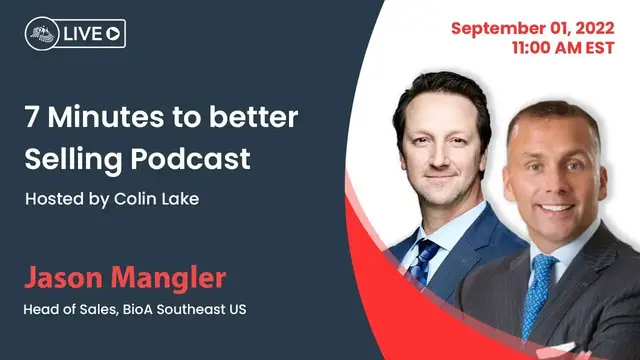
7 Minutes to Better Selling Podcast Ep. 28
Show More Show Less View Video Transcript
0:00
Thank you
0:29
Welcome, everybody, to the 7 Minutes to Better Selling podcast
0:45
Thanks for joining us. We have a heck of a show, a heck of a guest on with us, and so excited to dive right into that
0:51
But before I bring him on, just give you a brief overview of what's to be expected over the next few minutes that we spend together
0:57
So I am your host, Colin Lake. and I'm also the president and founder of a firm called Developing the Next Leaders
1:04
We are a firm that's on this mission, this passionate mission to help salespeople
1:09
sales executives, sales teams, and sales organizations love what they do every day
1:14
It's really hard to love selling stuff if you're not very good at it or your clients aren't
1:18
appreciating what you're doing. So our job, our role, our mission is to get people to do it better
1:24
help them love it more, and help them help their clients even more than they are currently
1:29
So from a logistics perspective, although our title is the 7 Minutes to Better Selling Podcast, the live shows last anywhere from like 9 to 12 minutes or so
1:38
And then we take it to the editing floor, pick out the best and biggest pearls of wisdom, and then we bring all of that back to you and out to the social media world where you all get to have it for your viewing pleasure asynchromoniously, you know, whenever you want to take a look at it
1:54
So I'm going to welcome Jason Mangler. Jason, welcome. Thank you very much, Colin. Happy to be here
2:02
Yep. Jason's the head of sales for a division of Sartoris. So he'll tell us more about that
2:07
in just a second. But Jason and I happen to know each other for a long time, 20 plus years
2:15
Jason and I sat on the beach as lifeguards in Avalon, New Jersey for a number of years together
2:20
So like I said, Jason's a longtime friend and a heck of a professional. So Jason, again
2:25
happy to have you here. Wonderful. Thanks for the invite. Can't wait to help. Yep. Awesome. Jason, let me ask you this. So we are like intermittently communicating with each
2:36
other, say over the last 25 years. So maybe in like a minute or two, give people like where you
2:42
started in the professional world to how you got to running this division and in a big role as head
2:49
of sales. Sure thing. So, you know, you talk about loving selling. And when you talk about the podcast
2:56
I love science, right? I came to love selling, but I loved science
3:00
So the background for me really is, you know, a focus on education around science
3:05
science from an undergrad perspective, science from a graduate program or a graduate degree program perspective
3:12
And then being on the bench for two three years in a science world as an ytical chemist Within two years of that role I realized being a part of every conversation
3:23
with vendors that would come into that laboratory and into that business
3:28
I had a seat at the table and enjoyed those conversations. And someone figured out I'd be better served on the other side of that equation
3:37
So that started my journey into sales. 10 years then from that significant portion of that time with GE, a division of GE water escalating from carrying a bag to several different roles of managing a team and managing teams
3:54
And then beyond that, into the startup world for a period of time and now coming back into a highly matrixed organization like Sartorius, helping to run a portion of the sales team for their sales in pharma, biotech and academic research
4:08
Hmm. Sartorius, I mispronounced it on the intro. I apologize. You know, there's a whole school of education around the art and science of sales. And the science piece of sales interests me a lot. Like, if we do this, like biologically speaking, the person we're talking to is most likely to do that
4:34
So your science is a bit different than the human science, I'm imagining
4:40
But do you ever catch that, Jason, in the way that you think about the selling world
4:45
You know, again, over the years, having, again, sold myself and now helping to coach and drive and manage teams to sell, I think there's some hard and fast rules that are just like that
4:55
When you go in one direction or you land on one topic, you know more than likely you're going to connect the dot to allow you to move to the next step
5:03
you know, first and foremost, goals and objectives. So as broad as that may sound
5:10
and as much as I'm focusing on B2B selling, even across the board, if someone you're talking
5:17
across the table to or at the table with on sale from a sales perspective, or a sales pitch
5:22
they have goals and objectives, you have goals and objectives for your business and in your
5:27
prior life and in more of a commercial or a corporate world. I have goals and objectives
5:32
That person that you're selling to has a goal and objective that they need to move through or they need to check a box to ensure throughout the year that they've met that goal and objective for their performance
5:45
I've always taught my team and found that if you can show where your product helps that customer align on one of those goals and objectives or meet one of those goals and objectives, you're likely to move to the next step
5:57
We're having more engaging conversation around your pitch and around your opportunity
6:02
hmm i love that so so let me ask you this how do you how do you get the client or prospective client
6:12
to tell you those things to share those goals and objectives i mean the simple thought would be
6:18
just ask i mean that's definitely part of it but but i'd be interested to hear what you'd say to
6:22
that question sure thing um so one thing i i've learned in the past is um whiteboard a whiteboard
6:30
rules And now I know certainly you know post COVID we in a slightly different world We had to adapt But there are many virtual or online whiteboard tools that your viewers right and sales folks out there can use
6:42
But from a more Spartan perspective, being in a room with the people that you have to
6:47
pitch to, all the stakeholders, simply asking the question, we can all, you know, we've
6:53
all been through the process of vomiting information, whether it's feature benefits, whether it's
6:57
technical information, you know, whether it's death by PowerPoint, right? We've all heard those kinds of metaphors or comments, but getting in the room to say
7:05
I could speak about this product or these products or this solution endlessly
7:10
Let's talk about what's important to you. What are your goals and objectives, customer team, and one by one listing them out
7:17
More than likely, many of them overlap. And so you then have a visual representation of what's really important to the folks in
7:23
that room, the stakeholders on that project, and then making sure that you're aligning
7:28
your solution to those overlapping goals and objectives is really as easy as it sounds
7:35
I have like a light bulb on top of my head here. Yes, it's not just the shape of the head
7:40
I'm thinking like, you know, when I do presentations virtually, what if I have 40 people on the call? Let's just say that. Yeah, sure. My first slide is a whiteboard
7:53
and I say, okay, so before I show the next slide, before I talk about the next point
7:59
I would like to hear what the goals and objectives are of the team. Now, maybe I say something like
8:04
obviously not all 40 of you are going to comment, but I have three listed here and we're not going
8:08
anywhere until I get three. What do you think of that? Yeah, I think it's a great idea. Also
8:14
this is where it comes into this perspective, something that's been really grabbing a lot of
8:19
time and a lot of headline and has proven to work is this whole idea of a challenger sale
8:25
right? The challenger sales process and the challenger sales product that exists in the
8:30
world that has been useful for me and my team. And not to give them an advert, but the idea in
8:37
the challenger sale of going into a customer, knowing as much as you can about them, how they
8:41
do business, what's important to them, I think in this case is really useful. You walking in and
8:47
seeing there's 40 people in the room or being online, there's 40 people. You'll never get through
8:51
that list in a reasonable period of time. But if you go in and establish credibility and say
8:56
here's what I know about your company and about this team, having done your homework ahead of time
9:01
and then saying, I'd like to think I know what the goals and objectives of this division
9:05
of this team, of this project is. Maybe I've written a few of those down. Can you confirm
9:10
these are the things that are easy, right? So you're leading questions. You're getting them
9:15
And just to approve what you've done your homework on is another way to get at the end
9:19
the end result of understanding exactly the goals and objectives that you need to meet
9:24
to move the opportunity forward. Love that because I chose preparation. I'm a huge fan of that
9:29
And also, Jason, you know, great word choice throughout that. One additional question to ask, I'm sure this list is not comprehensive
9:37
I'm sure I missed at least one. What would you suggest that would be
9:41
That would make sure that there's more interaction, right? Yeah, right. So, hey, we're going to talk about what this team wants to talk about, what this project
9:48
wants to talk about But by no means is this the end all be all right Giving yourself the opportunity and the door for the next meeting to say I like to make sure those that I haven answered I have an opportunity to follow up
10:00
whether it be from my legal team, from my scientific team, from my product management team
10:05
I'd like to make sure I have those answers, but maybe also then uncover any other goals
10:11
and objectives that this team has that were not mentioned today. And we can do that Friday
10:17
We can do that next week. We can do that right on Teams call or in person
10:22
But having that next go-to, right, I think is a great way to say this person isn't here
10:28
to try to close the sale here now today. They are confident enough to suggest when they don't know the answer and they're going
10:36
to go and find the answer that we want and gives us an opportunity to rephrase this if
10:40
we need to. All right. I'm going to do a little play on words here
10:46
How about a closing thought for the podcast listeners on closing? So once you've learned this stuff, how do you help them take the next steps
10:56
Sure. You know, throughout any selling opportunity, any selling facility, any selling project
11:07
that I've been a part of or been, you know, at the table to represent my business, financial acumen
11:16
So at the end of the day, someone's spending money somewhere, somehow
11:20
It may be an individual's money if you're selling B2C, maybe a company's money or a company's budget if it's B2B
11:25
Having that financial acumen, having financial literacy to understand the person that's going to sign off your economic buyer
11:32
I think is probably the most useful tool that anybody can have in their bag, regardless of what you're selling or who you're selling it to
11:38
Yeah. Know your client and then price product accordingly and position the price accordingly, etc. Yes
11:47
And yes. And certainly here's not just an ROI, but you're going to spend money on my product
11:54
Here's not only what it's going to do for you, but if you were thinking about how it's going to help your business going forward and the impact it could have on your business
12:02
other aspects of your business where you might have to spend or not spend by using my product
12:09
incredibly useful, incredibly helpful in any sales opportunity. Love it. Okay. So awesome. Love it. How did they find you and how did they find more about
12:19
the products, the company, et cetera? Sure. So, you know, I'm sure you've heard it. And as I've
12:25
watched a few other episodes and guests that you've had on, I think LinkedIn is probably one
12:29
of the greatest, you know, assets that exist out there. And thank you for putting that up to find
12:34
me, to find the company Sartorius, German multinational that's been around for over 100
12:40
years providing scientific equipment, both upstream and downstream to pharma, biotech, and academic government research. Sartorius.com, easiest way to find us. And if you're working in
12:53
the life sciences and we can help, please don't feel, you know, feel bashful about reaching out
12:58
That's great. And there's a website. Jason, great to see you. Wonderful, wonderful thoughts to share
13:03
And good selling, everyone. Thanks, Kevin
#Business Operations
#Jobs
#Sales