Up next in 10

How Blockchain and 4IR can Transform our Traditional Business, Governments and Markets
Nov 9, 2023


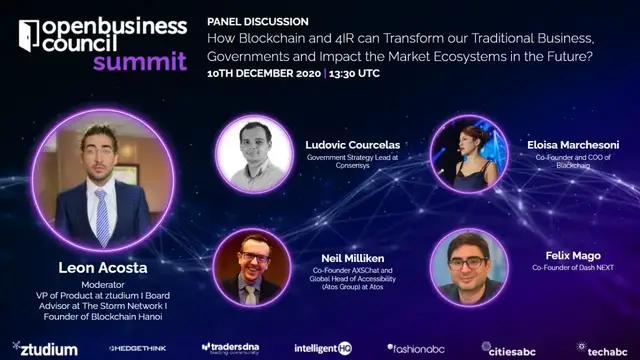
Panel How Blockchain and 4IR can Transform our Traditional Business, Governments and Impact the Market Ecosystems in the Future?
Leon Acosta | Moderator | VP of Product at ztudium I Board Advisor at The Storm Network I Founder of Blockchain Hanoi - https://www.linkedin.com/in/lnacosta91/
Ludovic Courcelas | Government Strategy Lead at Consensys - https://www.linkedin.com/in/ludovic-courcelas/
Eloisa Marchesoni | Co-Founder and COO of Blackchain - https://www.startupgrind.com/u/m2g3sn/
Neil Milliken | Co-Founder AXSChat and Global Head of Accessibility (Atos Group) at Atos - https://atos.net/en/expert/neil-milliken
Felix Mago | Co-Founder of Dash NEXT - https://dashnext.org/
at openbusinesscouncil Summit #obcsummit
FULL PROGRAM https://openbusinesscouncil.org/summit/
JOIN THE CONVERSATION https://twitter.com/openbusinesshq
https://twitter.com/citiesabc__
Show More Show Less View Video Transcript
0:00
So hello, welcome to Open Business Council Summit Day 2. Thank you all for being participants and
0:09
assisting today, both the viewers and the panelists. I'm glad to be moderating this
0:13
panel between such recognized characters and looking forward to creating and bringing value
0:18
to the ecosystem within this hour of protagonism. This time our panel's main topic is about how
0:26
blockchain and for AR can transform traditional business, governments and impact the market's
0:31
ecosystems in the future. Today we have aligned the multidisciplinary panel, very decentralized
0:38
having a new American that is Natos representative on the Business Disability Forum Technology Task
0:45
Force. Previously he worked at Lansys, one of the largest providers of integrated
0:51
assistive technology solutions in the UK and he's leading accessibility ventures and initiatives
0:56
around the globe. We have also Ludovic Corsela, who is talking from France. Ludovic is a government
1:03
strategy lead at ConsenSys, a blockchain company, and he has leading the EU Blockchain Observatory
1:11
and Forum, a major research initiative of the European Commission that aims at yzing blockchain
1:18
use cases and setting up a coherent regulatory framework in the continent. We have also Eloisa
1:25
Marquezoni from Italy that is actually in New York now. Eloisa is co-founder and CEO of blockchain
1:33
and known as a consultant in the blockchain and AI space. Moreover, she's an influential
1:39
author of articles for major national and international newspapers on the same topics
1:44
and a recognized token model architect, fintech leader and influencer. Felix Mago from Thailand, he's an expert on DeFi, crypto payments and decentralized businesses
1:56
And he's the co-founder of multiple entities within Dash, where he drives biz dev and partnerships
2:04
and established the first crypto payment ecosystem in Asia. So we can see that all the occupancy vary from business to product, technology, to strategy, accessibility
2:17
And to give a bit of background to this panel, the idea is today talking about 4AR technologies
2:25
and especially blockchain because they are revolutioning the way that fintech technology
2:30
used to be. However, the future of blockchain is a lot more than Bitcoin, cryptocurrencies or vintage
2:37
blockchain tech is impacting every major area of business from finance and accounting to operations
2:44
and logistics and it has the potential to transform organization businesses nations
2:50
and the way we interact with each other so now i would like the different panelists to introduce
2:57
yourselves to have a better understanding on how your career experience and current occupations
3:02
touch blockchain digital transformation and for AR government strategy governance inclusion accessibility sustainability startup ecosystem future markets and COVID so I invite all the
3:18
viewers to share the panel in their socials with the hashtags obviously summit and I would like to
3:23
start with Eloisa so please go ahead and give us a bit of your background yeah hi everyone and
3:31
thanks to the open business council summit for having me thank you lian for the intro
3:37
um so basically if we're talking about career experience mine's pretty pretty short but very
3:45
intense we all know that in this disruption industry uh only a couple months can be worth
3:51
a couple years and i started out um going to the equivalent the italian equivalent of an american
3:58
ivy league uh bocconi university i was studying uh finance economics and management and it was
4:06
around the time that all the icos started coming out and actually started um and you know that the
4:12
bubble around uh these new token offerings um popped like any other financial bubble and um so
4:20
that's where i decided to sort of create the role of the token architect uh specifically the token
4:28
model uh starting to approach all the startups that had great projects but um that were in danger
4:37
of um not being able to uh well express how the value would have been created among all the actors
4:46
of the ecosystem and how it would have been shared. And lastly, how these tokens would have represented a unit of such value
4:56
And so I started using my university studies, applying those to these new disruptive ecosystems
5:05
And it was actually not hard to see that basically the same models would fit with just a little tweaks
5:12
And I came out there as being listed as top of these new token model architects
5:21
And I went from there, from the startups to the bigger projects
5:27
and eventually to being noticed by the traditional businesses that were at the other end of the spectrum
5:40
They had the capital and they needed to innovate. And that's how my consulting activity basically got, you know, fell under the category of innovation management consulting
5:55
That's what I'm doing right now. Yes, still for the traditional businesses, more for the institutions
6:03
That's actually why I had the pleasure to be, you know, to come here to the U.S. in such hard times, not only because I'm also a U.S. citizen, not just an Italian one, but also in Trump Tower, because I am speaking to and I was speaking to Trump administration
6:23
we're going to do great things and on top of that I am also working with
6:33
projects that are in DeFi right now which seems to be the new buzzword
6:39
I'm seeing a lot of over leveraging of funds, I hope it's not
6:43
a new bubble, what we learn with the ICOs for sure will come handy now
6:48
but these projects are of my great interest because they really do help
6:53
mass adoption really are decentralized and they seem to answer the question, you know
6:59
whether to go on the Bitcoin blockchain or Ethereum. And well, Ethereum seems to be the
7:04
one that, you know, with the smart contracts really can be used even in the governments
7:10
and in the PA fields. So that's a bit about myself and what I'm doing right now
7:18
Thank you, Eloisa. So Felix do you want to go next Sure Thank you very much for the intro already great to be here with you all guys my name is Felix Felix Mago from dash specifically dash next which is one entity
7:38
in the decentralized dash ecosystem dash for all of you who don't know stands for digital cash
7:45
we are one of the very old projects out there started in 2014 and as the name tells we are
7:52
very focused on crypto payments on crypto mass adoption and i think we have been um driving that
7:58
a lot for the last the last years i mean especially considering you know crypto payments is one of
8:04
the first use cases out there and everybody was was talking about that before things became so
8:10
crazy as a reason i just just elaborated but there's a lot happening in blockchain and i'm
8:16
you know super proud being being part of that you mentioned defy and being a hype or not from my
8:22
perspective this year 2020 a lot has changed in blockchain number one we see so many projects
8:29
finally build something or build something that is working it's not only a fantasy anymore it's not
8:35
only a concept of on a piece of paper it's many things many projects that are working and by
8:42
working they they have the potential to work together and this is where where things getting
8:47
really really interested and this is why now we're talking about money legos and new building blocks
8:52
i think dash also fits very much into that and i want to mention four things we are we are really
8:58
focused on and maybe one thing first i'm i said i work for dash next so dash is completely
9:03
decentralized we don't have one you know headquarter or or a corporate entity like everybody
9:09
is used to we have a DAO that is distributing funds in the background and every or everybody
9:15
can pitch for these funds and with that we have established kind of teams all around the world in
9:21
Asia is where I am based with Dash Next, Dash Philippines, Dash Thailand so very much focused on
9:27
business development on partnerships and it's really a mass adoption but we have teams like
9:34
Dash Core in the US or in Latin America, even in Africa. So like I said, we are focused on four
9:41
things that go along the lines, I just made the intro that things come and work together. I think
9:47
number one is that we still focus on building this merchant ecosystem and again we have established
9:54
a lot. In fact you can pay with Dash at thousands of merchants and if we take also the multiplicators
10:00
like hotel platforms we are talking about in the millions right you can book millions of
10:06
millions of hotels or a lot a lot of things number two is that we have a special feature
10:14
called instant sense which enables essentially instant transactions so driven by dash core group
10:20
we have established or just launched something called the fast path network that's where we
10:26
brought together partners to integrate that features and what it does know is that you can
10:30
send dash and lightning speeds around the world which is especially or obviously especially
10:36
interesting for everything trading so if you can send your cryptocurrency from exchange to exchange
10:42
and have it instantly confirmed without waiting for x block times and i've seen
10:47
sometimes waiting for a week for something to arrive it's a huge thing and especially a huge
10:52
thing if you are using all this this new stuff and leveraging up and margin trading and everything
10:59
um number three is that we are especially me and personally because i really fell into the
11:05
deep rabbit hole this year and think it's freaking amazing what's happening there and
11:10
wrapping your head around that is simply it's so exciting that i cannot sleep anymore sometimes
11:16
And, you know, the way I see it is that also what I said before, it's really building bridges
11:23
and it enables different blockchains now to come together and build things together, if
11:29
you will. Take the example of Wrapped Bitcoin and see the amount of Wrapped Bitcoin that is now
11:34
traded on Ethereum and that is staked in DeFi projects. And also by having these bridges, in this case, the Wrapped asset enables you to go back
11:45
and forth and to do many things. The same we want to go build with Dash right now and this is what
11:51
I'm focused on and this leverages then on number four we are about to release Dash platform
11:57
The first release super proud that this is coming really in the next in the next days and weeks
12:02
and what it enables is decentralized cloud storage, decentralized APIs and some simple things are
12:08
supposed to be simple and user like usernames so you can then dash around um by just having
12:16
a contact list in your telephone so i think these are all exciting things and super excited to be
12:21
here with you guys thank you very much felix and yeah completely agree that interoperability
12:27
is one of the keys to allow the ecosystem to grow and ludovic do you want to go for next
12:33
Yeah, sure. Thank you so much for the invitation. I'm very happy to have this discussion with
12:40
all of you today. So my name is Ludovic. I'm government strategy lead at ConsenSys. ConsenSys
12:46
for those who don't know, is a blockchain software company that has been funded in 2014 by Joe Lubin
12:53
who is also the co-founder of Ethereum. And so ConsenSys, as a software company, is composed of
13:01
of many engineers, 500 today, and blockchain experts that are gathered all around the world
13:09
We are the largest blockchain player in the world, and we focus on deploying blockchain software
13:17
for big corporations, for governments, and for startups. What we do is mainly building infrastructure software
13:26
for the decentralized web. And so, for example, some of our products like Infura
13:33
which is today the main gateway to the Ethereum network with billions of calls that are being handled through Infura
13:42
We have Metamask, which is the most popular Ethereum wallet. We have a protocol team that is dedicated to working on the Ethereum protocol
13:52
and that is responsible for the development of the Quorum Ethereum client
13:58
We also build software that is targeted to developers. Our Truffle Suit is used by more than 80,000 developers around the globe
14:12
And also, finally, we build software for corporations and governments that is more targeted for specific industries
14:21
such as, for example, Global Trade, Financial Services, DeFi. And so our clients include the biggest organizations and governments in the world
14:31
And so myself as ConsenSys, I've been responsible for the last two years of the EU Blockchain Observatory and Forum
14:39
The ConsenSys has been appointed by the European Commission to run this project
14:44
which was basically a research project looking into blockchain use cases and the legal and regulatory framework in order to make Europe the best place for the development of the technology And so as part of these activities I also the author of multiple reports on decentralized
15:08
identity and blockchain in general that were targeted at looking at the regulation
15:15
and also at the specific use cases. That's what I can say in a few words
15:20
Thank you very much. I think what you're doing in ConsenSys of creating different tools for developers and
15:31
allowing the ecosystem to have the right tools is quite amazing and the way that you're fighting
15:35
against the regulations and creating frameworks is also amazing. So thank you very much
15:41
Neil, please, go ahead and give us a little bit of your background
15:47
Thank you very much. I'm globally responsible for accessibility and inclusion at ATOS
15:52
We're a what you would traditionally call a systems integrator. We're a digital transformation organization
16:00
We build systems from systems. We've got 110,000 people worldwide, 74 different countries that we operate in
16:07
We do everything from landing space probes on comets for the European Space Agency
16:13
to doing the IT for the Olympics and Paralympics to... more mundane stuff like making sure people's day-to-day workplace experience works. Now
16:25
I'm interested in changing the way that we utilize technology to make our societies a lot more
16:35
inclusive. We've got an aging population, 20 percent, 15 to 20 percent of that population around the
16:41
the globe have a disability that's going to grow as populations age so there's a huge economic
16:48
benefit for individuals and for the planet and societies when we build technology that works for
16:55
everyone and so the fourth industrial revolution and things like distributed literature technologies
17:02
have a role to play in making sure that we do include people as we build our new society and
17:10
And I think that the sort of shift that we've seen and the adoption of new tech, particularly in the space around sort of how we're working right now, has actually been a real eye opener for a lot of organizations
17:24
And that this is something that the disability community had actually been adopted a long time ago around flexible working and so on
17:33
So there's an awful lot of challenges that we face as a lot of people with disabilities use tech
17:42
to access other tech and services. And so one of the challenges that we face right now
17:49
is making sure that all of that stuff works together. So particularly focused on standards
17:54
open standards and interoperability, because it's when you have open standards and clear ways of making stuff work together
18:01
that we're leveling the playing field and making it possible for people to participate in society
18:07
So that's kind of what I'm doing right now. And it's quite amazing
18:14
So thank you, thank you for that. So I want to start a round of questions
18:19
because I'm really interested in what you said individually. So Eloisa, given your 360 degree vision
18:26
on the global blockchain industry market, you're involved in like several different projects
18:31
and being recognized as an influencer in FinTech, blockchain, AI, and also travel around the world
18:38
What do you think are the characteristics of blockchain that has the bigger potential to transform
18:43
and impact the markets of today, that is actually transforming, and of the future
18:49
Yeah, so I think it is the one and only transparency that we were all actually looking for since
19:05
the beginning and that this mysterious guy Satoshi was trying to give to us or gift us
19:13
I'd say. And I mean, it's hard to only choose one characteristic. I would also say that blockchain
19:22
is very important because it sort of shifts, especially in governmental environments
19:30
the trust from a central authority, a political party, an idea, a person to the technology
19:37
you know I don't really like to say that it works in trustless ecosystems I just like to say that
19:44
it's a shift of trust and and the matter now I think is to just be patient and sort of
19:52
wait until we get to a more specific state of the technology itself where we can
19:58
stop asking ourselves so many questions about it and let it become the new standard
20:07
just like the HTML became the new standard years ago with the internet revolution
20:15
I love when I'll have kids that they will use their smart devices and their applications
20:23
and not even have to worry about whether or not they're running on blockchain and which kind of protocol
20:30
But I think it's transparency that I love the most. For now, for sure, not speed of transaction or speed of recording the transaction
20:48
And I leave improvements of that part and all other technicalities to guys like Felix or the guys at ConsenSys
21:00
And that's why we all need collaboration. I myself, you know, you mentioned
21:09
you keep mentioning that I'm an influencer and yet, you know, I myself
21:15
I'm not really clear about what kind of role that really is, but I just kind of go with the flow
21:21
And what I like doing as an influencer is to aid the integration of disruptive technologies
21:29
with the institutions because I am not as much a crypto anarchist
21:38
even if you look where I come from, but I am very much all about seeing an ecosystem
21:45
where I can be able to speak to the vice president of JP Morgan
21:51
and not have him still be so dazzled about the concept of blockchain
21:59
even though they do have you know they're all their coins but i'm speaking about the real stuff
22:05
here so yeah yeah i'd say when it's transparency and from these projects that you're working now
22:13
um that you came to the us and so on uh which one of them do you think has the biggest potential and
22:20
why and it about transparency as well so um i think you know i working on a very nice project and actually it stemmed from Italy It called DT Circle and they are using tokens as units of value that represent the big data generated by the users in the network
22:49
and they've been acquiring lots of patents and also just recently came out with an application
22:57
that is a real encrypted chat and call application and that is what actually the Trump administration
23:10
was interested in adopting. It was one of their points in the program
23:17
So that project is the one that I have been bringing to many events
23:24
panels, as an example, even having the founder speak with me. Right now I'm very highly selective on the projects that I represent
23:34
Reputation is very important, especially because I am an influencer in the scene
23:38
but yeah and what is important in that project is that blockchain
23:45
is what it runs on but it's not even that the founder is talking so much about it
23:53
what is really important is that it's aiding the mass adoption and that people in their network in their
24:02
ecosystem are actually using these tokens and becoming aware of the big data generated, how it's being used, if they want to sell it or not
24:15
and then using the tokens to actually carry out their daily activities and purchasing stuff
24:23
So, yeah. Yeah, that's amazing. And talking about blockchain being massive, right, Felix
24:31
You have been quite active creating solutions for mass adoption of crypto and blockchain technology, particularly in Southeast Asia, right
24:38
So what are the most important projects in decentralization that you have seen that are reaching this end
24:44
And what challenges are they facing in your eyes? Also, referring a bit to my previous speakers, I strongly believe that the more I am in blockchain and trying to drive mass adoption
25:00
mass adoption, I realized I'm super excited about it. I love it. I'm so deep into it. And I cannot
25:09
I'm enjoying even getting another podcast when I'm in the gym. I can't even stop and listen to
25:13
another crypto podcast. But I realized this is me. And actually, it's not everybody out there in the
25:20
world. And there's many people and we are actually a big minority right now. This is one thing. The
25:25
other thing is blockchain is at the end of the day business as usual and if you want to grow a
25:31
company you have to grow a company and you have to get people that use your products or that's
25:35
that's in in some way does a business so the question is a blockchain or not is kind of
25:41
irrelevant for most people who are not in blockchain and now coming to to what you said
25:46
we have driven driven market options so this was a lesson i i learned and i had to learn the
25:51
the way by going there and a very design research focused method going out there explaining what we
25:57
do hey you can accept crypto payments and all that and ended up in a sales pitch that actually
26:03
works a million times better if i don't even mention the word crypto but just go there and
26:07
say hey listen we have an alternative payment solution you can save money it's super fast
26:11
you can immediately transfer the dash to your local currency because we have a third party who
26:18
can help you with there. There is a company who makes business doing that and you can connect it
26:23
It's kind of risk-free. So do you want it or not? And it doesn't cost you anything if you install it
26:30
because it's an open source software. You can just use it for free. And the moment you go in there
26:34
with that kind of pitch, instead of saying, hey, we do crypto, you can be your own money. You don't
26:39
have to, you don't need third parties, censorship, resistance and everything. This is all amazing
26:44
but as a sales switch, the other version works much better for driving adoption
26:50
especially when you want to work with corporations. And then it goes up the ladder
26:55
Obviously, the bigger the corporation, the more the compliance and the more the things that they are scared of
27:01
and they want to insure before it starts. So, I mean, just taking this case of crypto payments
27:08
it's very simple that you go out with end-to-end solutions and not just tell some nerdy stuff you can potentially do
27:16
but you have to take care of all yourself. So this is one big aspect
27:21
The other thing, and also adding a bit to what Neil said
27:25
this is amazing. I also come from this background of innovation management
27:29
and was helping big banks to upgrade their tech stacks and being the middle part between business and technology
27:37
at the end of the day it's it's it's a really hard challenge especially if you are an established
27:43
company to design to take this new technology and integrate it in your business in a way that you do
27:49
better business because truth is if you have a successful business without blockchain you have
27:53
a successful business so the way is the question is always how can you leverage this leverage it
27:59
leverage new technologies blockchain iot or whatever it is to create your business better
28:05
and the more you run the harder it is this is why we now see a lot of companies that are that are
28:10
really amazing so for me i think the one the most potential right now is everything finance
28:15
and the reason for that is simple because money is global money is fast and money moves to where
28:20
it makes the most babies so in this sense i think all the the defy products really in a crazy
28:27
interesting angle as a business case yeah and there's some particular project that you see that is having mass adoption and what
28:38
kind of resources or things do you see that make it special and that is causing that effect
28:47
again what i've seen is that you that you use classic methods to to drive in customers you
28:51
have to it's not only it's not only enough to have a fantastic and a brilliant tech team this
28:56
it's very important to have it but it's also important to have the business people around it
29:00
to explain it it's also important to have a marketing in place that gets there this is the
29:06
challenge and this is i think the the stepping stone to project getting out there and getting
29:11
customers so for me there is a good reason why for now there is only a few companies that really
29:16
really manage to do that and the most famous example exactly there a particular use case that
29:24
you see that like some company that is doing this problem is having that that is driving the
29:30
scenes through uh the more traditional approach and not saying blockchain or
29:37
i'm sorry i didn't understand the question i was i was asking more about like a particular
29:42
project you see that is going in that direction in order to see an example i mean ethereum and consensus is right here at the table i i think there are a fantastic
29:53
example how you can bridge these worlds. And I've seen many presentations from you guys in my understanding
29:59
is that the sales cycles are extremely long. So it's nothing that is done overnight
30:06
but it's exactly that, that you need business people and connection pieces to do that
30:13
So I see, yeah, this is essentially the question. And the other thing is the other successful projects
30:18
are I think all these new DeFi projects that are building automated market makers
30:25
and oracles that essentially have an inherent value proposition of saying we can shift the trade that is right now happening on
30:34
centralized financial markets and there's huge money going over there every day, money exchanged
30:40
stocks exchanged. So if you give this money a new opportunity to be more efficient, faster
30:47
and move around cheaper and earn higher yields, that's, I mean, that's the use case for now as I
30:55
it you know compared to that everything we were talking about like putting water on the blockchain
31:00
and you know doing this and that is it's still nice it's still an amazing use case even properties
31:07
and all but there's a reason why fifa is taking off so fast and other things are rather hard to adopt
31:15
yeah so coming to to consensus and and following that that path of use cases that they are creating
31:22
One of the very, very interesting things of the blockchain is about creating digital identities in a decentralized environment
31:32
Could you, Ludovic, explain us what a digital identity is and how you're working on that
31:40
Yeah, sure, definitely. Maybe just before I jump into it, I just want to mention that I agree very much
31:50
with what Felix just said. A lot of people are getting excited about DeFi
31:58
And the main reason behind that is because there is a lot of innovation that is currently happening
32:05
in the space in DeFi, and so people are following that. so that's the main aspect
32:11
I'm sorry I have a phone that is running next to me so yeah so that's what is exciting
32:17
and when you were asking Felix before about mass adoption mass adoption is happening at the moment
32:23
but currently it's more about money being moved into blockchain infrastructures rather than users
32:30
users will come, users are already coming but the exponential growth at the moment
32:35
is more happening on capital And so just to give an example, currently at ConsenSys, we have tokenized more than $1 billion worth of assets using ConsenSys technology
32:49
So this is exactly the core of what people should be excited about at the moment, DeFi and everything that's happening around it
32:58
I'm sorry, I'm coming back to centralized identity now, which is obviously another important topic
33:05
So you really have to look at decentralized identity as a complementary technology to blockchain
33:15
Decentralized identity is using blockchain technology, but if you take a step back
33:21
what everyone around this table is currently believing in and trying to work towards
33:27
is to create a more decentralized web. And so if you want to create a more decentralized web, you need blockchain technology in order to perform everything related to money in a more decentralized way
33:42
You need blockchain infrastructure with smart contracts in order to decentralize business logic in a trustless environment
33:51
And you need decentralized identities in order to have the foundation of how those interactions are going to be done between the different actors
34:05
And so decentralized identity, in its essence, is a very simple concept
34:09
you want to shift the way that people interact with platforms on the internet
34:18
from a model where a user will be creating an account on the platform
34:23
and this platform will be responsible for the data and for the management of the identifier being used by the user
34:32
to a system where the user is creating by themselves their identifier
34:39
and using that identifier to connect to multiple platforms. And so the first big benefit that you get out of this
34:48
is the possibility to use one single identifier in order to connect to many different platforms
34:56
And the second big benefit that you get is leveraging the cryptography
35:01
that has been used and developed over the years and then reused, obviously, in blockchain technology
35:09
you can create digital documents that are going to be signed by actors
35:15
and that will encapsulate information about users. And those digital credentials that we call verifiable credentials in the current standards
35:26
will be able to be verified by third parties in a decentralized way
35:30
And so this is what is so powerful currently about the decentralized identity ecosystem
35:41
It enables a whole ecosystem of different applications in a centralized kind of governance
35:48
And it's quite amazing the potential that that market has and how it is going to be in the future, right
35:54
All the projects coming together. Exactly. And so, ConsenSys has been, since the beginning, very much involved in those efforts
36:03
Maybe some of you know about Uport, which is one of our main products in this field
36:10
which is an identity wallet for anyone that can create then, using this wallet, an identity
36:20
and use it to receive digital versions of documents. So this is really exciting, mainly because it is so complementary to other technologies
36:30
and other things that we develop, mainly in financial services, for example
36:36
But anything that is related to documents will, in the end, be using decentralized identity
36:43
When you look, for example, so I've been working a lot, obviously, with governance. But when you look at the European Commission at the moment, they are looking into ways to digitize diplomas
36:52
diplomas they are looking into ways to give better services government services to their citizens
37:03
and this goes through the digitization of many services and digitizing services means
37:09
digitizing documents and this is where again the digital identity ecosystem comes back so
37:16
very excited about that and obviously very excited about everything around defy at the moment
37:20
as Felix was saying. It an amazing industry with an amazing potential in order to revolutionize a lot of things and to cause a positive social impact Neil talking about these different use cases in blockchain for AR today over a billion people in
37:39
the world have some kind of disability, like a huge market, but accessible tech
37:44
assistive technologies and inclusive design are still not a very explored business. I strongly
37:49
believe that inclusive design in these things should be like an industry standard by today
37:53
right but how do you think that all these tools of blockchain and iraq and identity could help this
38:02
so i think there are a number of things so yes between one and 1.3 billion numbers going to keep
38:08
growing because of our aging populations um so it's a huge market garner estimated it was worth
38:13
something in the region of eight trillion dollars globally um so not small amounts of money um
38:19
So how do we utilize things like blockchain? Well, I think one of the things is identity, because when we're looking to support interoperability
38:27
a lot of people who are amongst that population of 1 to 1.3 billion are not obviously disabled
38:34
You don't look at me and think, oh, he's disabled, but I have dyslexia and ADHD
38:40
so it's a hidden disability, right? And those disabilities make you do things in different ways
38:47
They require you to, you know, you may need help with certain things, but at the same time, you don't necessarily want to disclose all of that publicly
38:55
You know, I'm quite happy. I talk about it openly, but I'm an advocate in the space
38:59
So, you know, using the identity software, you know, a methodology that we just talked about is one way where you can register your needs and your preferences and you can support interoperability with other tech whilst at the same time retaining privacy
39:20
So what you can do is you can give over only the pertinent information needed in order to support you during that transaction
39:27
The other thing that it can also do is looking on a wider scale and supporting stuff at sort of supranational level is looking at how we implement legislation and how we support the flows of finance around the economies of inclusivity
39:49
for example there's lots of legislation at the moment requires you to do stuff
39:53
some of that includes penalties and I think that you know we need to be
39:57
redressing the balance and and looking at ways of also rewarding and that requires trade so this is a value exchange so if
40:06
organizations aren't aren't participating in the inclusive economy then they have to pay the fines or pay
40:15
the subsidies etc but um on on the other hand if you are then the people that aren't doing it
40:23
need to be subsidizing the work that you're doing to build the inclusive economy so that then um
40:30
has loads and loads of complexity and and i think that blockchain is one way that you can
40:36
manage that complexity of micro transactions to be able to um transfer the the funding and
40:45
the resources into the places where it's needed. And I think that we can take models like carbon trading as an example
40:55
because essentially the stuff that people are doing right now, where they're making products that don't work for people with disabilities
41:03
that's an externality. We take the economic concepts and an externality is like pollution
41:08
So you apply the same models that we're applying in the sustainability world
41:12
to the sort of inclusivity world, then you can apply technologies and methodologies
41:21
to be able to make that value transfer. So I think that that's one of the areas
41:25
where I'm particularly interested in the discussions and the sort of technologies that we're talking about today
41:34
Yeah, that's quite interesting and more the concept of the tokenization of everything
41:41
and how tokenization can allow enable different kinds of interactions. Eloisa, do you want to talk about the tokenization of everything and how we can apply those concepts
41:56
to a lot of things? You've been a part of so many projects and calling yourself a token model architect
42:03
I suppose you have quite a formal image on that, right? Yeah, so I guess you're referring a bit the tokenization process, which more or less is the same for, I mean, the phases are the same for every project
42:29
I usually go through three phases and, you know, there's the discovery, design and deployment, which right now I can say I can also use to divide the path that we've been following since the beginning of ICOs up until now
42:51
and right now we're much more in the deployment phase of the tokenization era because this is
43:00
the point where we're trying to understand how these tokens work, if they work, and how we can
43:07
use other disruptive technologies like machine learning-based algorithms to automatically correct
43:16
all the failures that necessarily such ecosystems based on tokens are showing
43:26
But anyways, briefly, the discovery phase for any project is where I usually help the teams
43:36
map the actors that are involved from a first restricted circle of actors
43:47
which is a minimum viable ecosystem, to the outer circles of the actors that
43:57
even if not directly included in the beginning, are going to have to adopt the token
44:05
to get into the ecosystems. Otherwise, as Neil was saying, they're going to pay the fines
44:16
They're going to suffer losses from not being in it. And that is a mechanism
44:23
that should always be included in such token designs. Then after mapping the actors
44:31
it is very important to map the value creation drivers and the value sharing flows among the actors
44:41
And I always try to focus on the biggest function of the tokens
44:50
which should be hindering certain behaviors and incentivizing other behaviors in order for the value to flow better
45:07
And after this first phase, I become, you know, what's most unique about my role is that I have
45:13
to become sort of an interface between the market layer, which usually my colleagues and other
45:21
marketing experts take care of in order to create the, you know, the go-to market strategy
45:27
and the ledger layer that the techies, so I call them, need to take care of, right
45:37
Because I feel like in the beginning of this era, the problem was that nobody was really
45:45
in there, you know, trying to market what these geniuses were doing on the tech and where
45:53
marketing geniuses were creating the market. Nobody was really there to back up
45:58
their concepts with real tech. And, you know, that's where you choose the protocol
46:06
what will work best. Does it fit the market? Does it fit the layer? And so on. And lastly
46:12
what I like most is the deployment and that is what really
46:17
I'm most excited about, especially when speaking about the governmental applications, institutional applications. And I've been discussing
46:27
certain solutions also with Vitalik. He's very active on Twitter as well
46:36
and he's all about the ZPK and so on. But what we have..
46:48
I think we lost it. Well, I think what she was saying
46:54
is super interesting. And I think... I hope that that's where other technologies can really
47:02
really come in and where we can stop talking so much and we will
47:10
more and more bring to the panels like this examples. Yeah. And I think there are two things that are
47:22
super important when we are deploying any kind of new economy when we create a token, right
47:28
And I think those two things are like being able to create
47:32
a community but also to educate that community. Felix, can you tell
47:36
us a bit about community and education and the efforts that you're doing? I think it's
47:40
quite interesting the work that you have been doing so thank you you're happy to do that um
47:47
i think in blockchain everybody is always on the page to say we need to educate people we need to
47:54
educate people as i said before actually a great tech product is one where you don't really have
48:00
to explain much and kind of self-explanatory this is why i mean look look at the very successful
48:06
tech companies out there they're creating exactly this product so it's in blockchain obviously
48:11
there's a lot long way to go and there is a lot to build to incentivize users to do anything else
48:18
than trading so if you are in a blockchain project of course and going what what Elisa just said it's
48:27
highly important to really focus on these these value flows and to identify who is actually the
48:32
target group and in many cases you will realize that investors or traders are also an important
48:38
group which not necessarily match with your business i mean i want to separate two things
48:43
one is like to use the blockchains to do things and another the use cases that are actually in
48:48
the blockchain right if if we are talking about d5 for example right most of the people enters
48:54
into the fight because they don't um know what it means but they see the potential of making money
49:00
but they don't know what it is and i think education in any financial product is key and
49:06
that's why i was talking about that and that's why i think it's important right
49:12
yeah again i think it's super important you're you're right but it needs to grab people somewhere
49:17
if i realize i can make money most probably i'm willing to learn more by myself which is something
49:22
different than then i really have to go out and educate someone and to be very honest with you
49:27
guys i've i read about d5 the the first half of the year and didn't try it out and the moment i
49:33
tried it out i realized i haven't understood the thing just by reading it and it's super important
49:38
to try it out and and that's the moment when when it really sucks you in so the same goes goes for
49:45
dash this is why we constantly really um hosting meetups and we we we went out to say we don't want
49:52
to host the meetup anymore with the powerpoint presentation no let's do it in the let's have a
49:56
drink at one of our merchants and let people try to use cryptocurrency and let's incentivize them
50:02
a bit by saying by going to the merchant say no i bring you a a bunch of people regularly we're
50:09
doing meetups here but can you give us a discount on that because i want people to try out paying
50:14
with cryptocurrency and matter of fact we're in 2020 and and who has paid anything with with
50:21
cryptocurrency right even even in these panels where i am it's usually rare that that you really
50:27
did something and for me obviously being working for for dash and with dash it's one thing is to
50:34
drive this adoption and another thing is also to drive the coin because of course we want to we
50:39
want to stay relevant so you have to you have to balance these things and you you have to find
50:43
interesting ways but i mean for me the story is simple to say uh earning money with investing is
50:49
nice spending money on a nice meal with your friends and some beers is most likely even nicer
50:54
so why why not have the next meetup somewhere so there's you have to find your angle is what i'm
50:59
angle is what i'm saying and depending on on the business case i think we have we have something
51:03
cool going on with dash here and and also for me what i mentioned at the beginning building bridges
51:08
now and and i want to have a wrap dash on ethereum because it opens the door to so many new partners
51:13
it opens the door to many new use cases but what i also want is that these guys on ethereum which
51:19
don't have the merchant network have an exit door to to come to our dash merchant and do something
51:24
nice with it right so kind of why not work together and use and also leverage on these amazing
51:30
communities we have all built so far this is also one one thing this is why i said at the beginning
51:35
i'm super happy to see blockchains coming out together because there's all amazing communities
51:39
around there but they kind of live on their old islands and they're not even able to take a boat
51:44
to the other island so this is where where i see a lot of potential coming in yeah i think i think
51:50
incentives are key for these things i made my first buying with cryptocurrency in 2014 i think
51:57
like a shawarma i was still not vegan at the time talking about incentives and gamification
52:04
so ludavic you have been also involved in multiple international efforts for gaming right
52:11
you're a board member of the blockchain game alliance could you talk about like gamification
52:18
and and how all these things are revolutionary not just a blockchain space but also like every industry
52:27
yeah sure definitely so um so the blockchain game alliance is an industry that is looking at ways
52:38
to incentivize the use of blockchain technology for in the game industry so that means creating
52:48
more games that will be leveraging the technology partially or totally. So
52:56
this is very exciting because this opens many new opportunities for gamers in terms
53:04
of what they can play. And so that is something that has been going on for
53:12
two years now. And that was really at the forefront and is still really at the forefront of technology development
53:23
I will give one main example, which is the one of NFTs. So non-fungible tokens in the gaming industry
53:30
NFTs are something that is very big because this is direct digital scarcity over items that can be unique
53:40
And so for a gamer, that's something that has a lot of value and in the game ecosystem can be traded
53:48
that can be used in different platforms. And so that is definitely something
53:54
that's at the forefront of technology development. And so that's why this is so much so important
54:01
I think your question was a bit on another aspect, which is the one of gamification
54:07
I think that what can be said is mainly that gamification has been used a lot in order to teach people about blockchain technology
54:18
I'm sure that some of the viewers here may have heard before of Crypto Zombies
54:25
which was basically one of the best and is still one of the best tutorial for smart contract development
54:34
And so it's very important, obviously, to leverage gamification for education because it's one of the most powerful tool that we have currently
54:44
And I think that actually this is not something that is particular to blockchain technology like here
54:49
Blockchain is just using what works best. And so gamification has proven itself to be a very powerful tool
54:59
And so it's just normal that in this industry we reuse what is considered as best practice
55:08
And, yeah, talking about games still, Neil, ATOS has provided IT solutions to the Paralympic
55:16
Games since 2002. Could you talk a bit about that and how you're preparing the next Paralympics
55:25
what kind of technology solutions are you bringing this time? Yeah, sure. So, we do the Olympics too, so it's not just the Paralympics. So, we're
55:34
the IT partner for both. So we provide all of the sort of security infrastructure
55:41
all of the sort of real-time data, you know, the IT backbone for all of the games
55:49
And obviously 2020 was meant to be the year where we celebrated in Tokyo
55:55
It's going to be 2021. but aside from the sort of the the technology behind the games every time there is a games
56:07
there is also the building of a an entire um mini city which i think is is super interesting as well
56:16
because it's an opportunity to build an inclusive city and experiment so in london you know they
56:22
built an inclusive uh accommodation for all the athletes that that athletes village the the olympic
56:27
and paralympic villages were were inclusive and and each time there are efforts to embed new
56:33
technologies into the olympic villages now we don't provide all of that because quite often
56:39
that's the host nation that's doing this but but i know you know that um for example toyota
56:45
had been um looking at autonomous vehicles to transport para athletes between events and
56:51
so on um so toyota actually have changed how they describe themselves from being um a a car company
57:01
to a mobility company and i i think that this is this is this is it uh as a we've reached a point
57:09
where um everything is becoming a service so even though we're still making physical products
57:16
the the product isn't the end game it's the end result that um that is important so so you know
57:25
in this case it's getting from a to b and doing that inclusively and enabling people that may not
57:30
be able to drive to still do that independently so uh so that's some of some of the tech that that
57:37
is sort of being embedded into how we envision the games obviously um with big projects like this
57:45
you start years and years in advance. So, you know, we're already working towards Paris 2024
57:51
and thinking about how we can make that particularly accessible, particularly important since we're headquartered in Paris
58:01
So no pressure. So, but there's also games around the games. And actually the IPC has been working on a game
58:13
which would introduce people to Parasport and that will launch in line with the games
58:23
It would have been this year. It's quite exciting, but I can't say much more about it right now
58:29
But there's a really serious team of very well-respected Japanese game designers
58:36
that have worked on this, that have sort of a long track record
58:41
And if you like games like Final Fantasy, then this will be right up your street
58:49
Yeah, that's amazing. And we should all think about everybody in every solution that we do and everything that we start
58:58
So we are getting to the end of the panel and I'm really grateful for having you all here
59:04
I think we could be like talking for hours, there's so many interesting topics
59:09
for doing such amazing characters. So thank you all for being participants
59:14
and thank you all the viewers for having to watch it. So yeah
59:23
Thank you. Big pleasure. Thank you guys. Thanks. Thank you. Oh, is Hilton coming
59:32
Okay, so we'll have Hilton coming. Hello, it's Hilden Supra here. Thank you very much, Leon. That was a very, very interesting panel
59:46
You got a lot of insights from your colleagues who are joining you on the panel
59:53
I just wanted to do a bit of a recap before we go to our next event in about
59:59
in 17 minutes. I just wanted to recap what we had today. We started this morning with the
1:00:07
global business and startup digital tech landscape and the challenges and opportunities
1:00:12
And that was chaired by Eric van der Klee, who was a co-founder of Eden Base and the greater of
1:00:19
Level 39 and the former advisor to the UK Prime Minister. He was joined by Kata Ochi, who was also
1:00:26
a special advisor to the state minister, business and political consultant, who's involved in filmmaking and television
1:00:33
And the esteemed Minister of State and Science and Technology, Noakazu Takamoto
1:00:40
Here, I remember when they were talking, they were talking about, essentially, one of the key takeaways
1:00:45
is the digitization and digital transformation in the society 5.0 concept that Japan had instigated
1:00:54
and in particular the big suffering that they had in terms of the brain drain
1:00:59
It was quite interesting that Eric, of his work that he had been doing with the UK government, had developed quite a few strategies
1:01:07
to ensure that a lot of that talent came back to the UK
1:01:12
and really 10 years ago to where we are today, Silicon Roundabout came about and they were essentially bringing
1:01:20
a lot of that technology skill and that brain drain ceased, and we had an inward track back to the UK
1:01:30
And following that, they were joined by the, in terms of the global startup digital tech landscape
1:01:39
and the challenges and opportunities in terms of, you know, in a global context, what startups can do
1:01:47
And that was the two key members of that along three key members, which were Luisa Rubio Arribas, who was head of YRX, which is part of the Telefonica group
1:02:03
Very, very strong initiative by telcos, as we picked up. And she was joined by the CEO and founder of Banglaja Startup Initiative
1:02:14
which is Tina Jabin, who has a long career in Silicon Valley
1:02:17
and now actually bringing us the startup community and accelerating that in Bangladesh
1:02:25
And then, of course, amazing work done by the Deputy Minister of Digital Transformation for IT in Ukraine Alexander Borinikov sorry apologies for not getting his name right But essentially I mean what Ukraine has done of course they did suffer
1:02:45
from the war with Russia a few years ago. Now, they've really been accelerating. And
1:02:53
some of the initiatives that Ukraine are doing in terms of the ultimate objection is to remove
1:02:59
PayPal and go completely digital in terms of the bureaucracy of Ukraine
1:03:04
That was very, very interesting. And the massive work that Tina's doing in Bangladesh to grow the ecosystem
1:03:11
In the beginning, when they started with startups, they had a few, a handful
1:03:15
I mean, I think it was like 75 applications. And now they're receiving 1,000 applications for the assistance of startups in Bangladesh
1:03:23
And, of course, Luis Arubio from Weira. I mean, incredible amount of work that Telefonica are doing globally in terms of bringing startups and actually building an ecosystem on a global context
1:03:37
That was incredible. I'm really, really proud to be able to listen to that
1:03:41
And then, of course, we were joined by a colleague of ours, Jarvid Khatak, who was the co-founder and CEO of Zix Properties
1:03:49
properties which essentially fractionalizes the investment in property and some of the work that
1:03:58
he did back in proof of concept had brought that to the UK and it's an FSA licensed business in
1:04:08
terms of the token effectively the token and asset backed tokens for the investment in property
1:04:13
really really amazing work that they're doing there and he was joined by Kohei Kourihara who
1:04:18
is a co-founder of Privacy by Design Lab. And he's really part of the government
1:04:25
with the government, he's part of the Blockchain Association and president of the Tokyo chapter
1:04:30
And he was joined by Edwin Dinder, who was the CDXO and vice president
1:04:36
government and public sector for the global business unit of Huawei Enterprises
1:04:41
And he was joined by Craig Skelton, who is with the Bay Center at the University of Edinburgh
1:04:48
the University of Edinburgh and us at Studium are very, very, we're working very closely together on various initiatives
1:04:56
particularly to do with the indices that we are building for sustainability
1:05:00
for companies and for cities. And then of Armando Gonzalez, the CEO of Ravenpack
1:05:06
Now, Ravenpack is a very interesting company. They have essentially taken great data from you know recognized media and they using in financial markets
1:05:19
And they've created insights into that, using AI to actually look at what these sentiments are, all based on various news feeds, and actually providing that information to us actually in terms of COVID-19 on the Cities ABC website
1:05:34
And then we moved on to an ecosystem digitization, decentralized digital assets and DeFi, blockchain and crypto
1:05:44
There was a very interesting discussion between Simon Cocking of the Irish Tech News and Babak Behabudi
1:05:56
who's basically the co-founder and CEO and head of global operations at Synchronium, which is based in Turkey
1:06:03
And there was some extensive discussions to do with, and also they were joined by, sorry, Sergei Kitarov, who's the founder of Listing, which helps to, you know, and works in terms of investment, crypto investments at Jets Capital
1:06:23
this was a great discussion in terms of the digitization of the new economies that we have
1:06:29
at this present time moving forward and you know looking at the adoption of digitalized digital
1:06:36
assets the investment in digital assets the digitization of everything eventually and this
1:06:42
was a very very interesting discussion and peter christensen also joined and he was of jp fund
1:06:49
services and his contribution was enormous in terms of you know as a he says you know I don't
1:06:55
use the word but you know old old people like us you know we understand what the challenges are of
1:07:03
digitization what the opportunities are of digitization and it was incredible how you know
1:07:09
the the youth of today really they just they're they use it as a utility but they haven't actually
1:07:15
and the great need for it going forward. And then later on this afternoon
1:07:23
there was a very interesting discussion on education. This is the one I really, really enjoyed
1:07:28
It says, how can governments, businesses, universities develop education policies and solutions
1:07:33
to support business and society? This was chaired by David Segal, who's a founder of Cutting Through the Noise
1:07:44
Great title. He was joined by Dr Carter K Sani the chairman of the Scottish High International School and a member of the Special Olympics I mean his foresight in terms of education and adapting education
1:08:00
was incredibly inspiring. He was joined by an amazing man, Mark Buckley, who is working. He's
1:08:11
an SDD advocate and expert for WEF and global food reformers. He's based in Berlin
1:08:18
He's worked with the Berlin School for Sustainability, Futures and Applied Sciences
1:08:24
He's a professor there, you know, an advocate of, you know, using technology to do the things that need to be done
1:08:32
but actually to really work with family and enjoy life and use technology to really embrace a lot of things
1:08:40
And then Dr. Vishal Talwar, who was the dean and director of Bielmo Munjial University, great contribution by him in terms of how education is going forward
1:08:50
And of course, unfortunately, Dr. Tanju Nandan has a few technical issues
1:08:55
He's a professor of school management and studies in Uttar Pradesh, India, and associate dean of economics
1:09:02
And the key takeaway really from the education was, you know, with David Siegel as lead, was at the end of the day is that education is continuous, skills training is continuous
1:09:14
You know, the paradigms that we have at the moment in terms of education are the old linear fourth, third industrial revolution tenant of training people for specific dirty jobs is not going to cut it
1:09:34
You know, we're going to have a high middle class of uneducated. Well, when you say uneducated people, they're educated, but their jobs won't be useful
1:09:41
So anyway, thank you very much indeed for staying with us. We are one or two minutes away from our next panel
1:09:52
and that's looking at cybersecurity in particular in terms of governments and cities and interplay between AI, big data, and Internet of Things
1:10:03
It's going to be chaired by Agia Chib from Cicra, and he's going to be joined by Antio Santos from Atos and Shamia Tali
1:10:15
Tahu who's the global CTO of AccuBits thank you and look forward to seeing you
1:10:21
the next time
#Arts & Entertainment
#Business & Industrial
#Finance
#Government