0:02
plants are ukareotic multisellular
0:04
organisms that form the kingdom planty
0:06
they have several key characteristics
0:08
that distinguish them from other
0:10
kingdoms plants have ukarotic cells with
0:13
membranebound organels and specialized
0:16
tissues unlike animals they produce
0:18
their own food through photosynthesis
0:21
making them autorophic their cell walls
0:23
are made of cellulose providing
0:25
structure and protection and unlike most
0:28
animals plants are generally non-motile
0:30
meaning they cannot move from place to
0:33
place the defining feature of plants is
0:36
photosynthesis the process by which they
0:38
convert sunlight water and carbon
0:40
dioxide into glucose and oxygen through
0:43
this remarkable process plants capture
0:45
energy from sunlight using chlorophyll
0:48
in their leaves this energy is used to
0:50
combine carbon dioxide from the air with
0:53
water from the soil to produce glucose
0:55
for energy and oxygen as a
0:58
byproduct kingdom plante exhibits
1:00
remarkable diversity from tiny mosses to
1:03
giant trees all sharing the basic plant
1:07
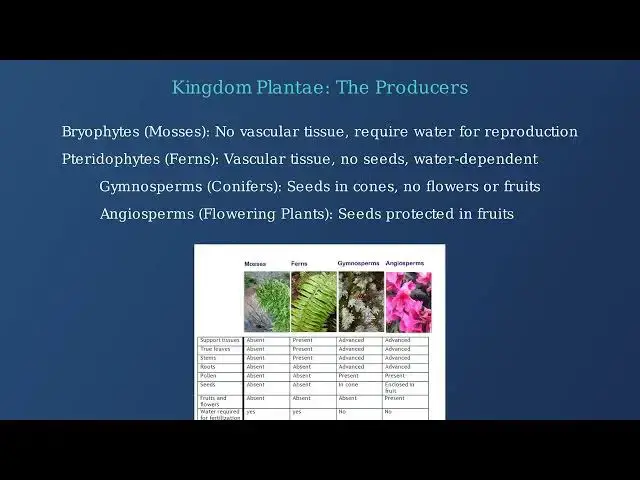
characteristics plants are classified
1:09
into several major groups bryophyes like
1:12
mosses lack vascular tissue and require
1:14
water for reproduction teratapites like
1:17
ferns have vascular tissue but still
1:19
depend on water for reproduction
1:22
gimnoperms like pine trees produce seeds
1:24
in cones while angioperms the flowering
1:27
plants protect their seeds within fruits
1:30
these adaptations represent evolutionary
1:33
advancements that allowed plants to
1:36
environments a distinctive feature of
1:39
plant cells is their cellulose cell wall
1:42
this rigid structure provides support
1:44
and protection for the plant cell
1:46
determining the plant's overall shape
1:50
plants play crucial ecological roles in
1:53
our biosphere they produce oxygen
1:55
through photosynthesis providing the air
1:57
we breathe as primary producers they
2:00
form the base of most terrestrial food
2:02
chains plants also create diverse
2:04
habitats and help regulate the water
2:10
transpiration whitaker's classification
2:12
system uses five key criteria to
2:15
determine which kingdom an organism
2:17
belongs to the first criterion is cell
2:19
structure whether an organism has
2:21
proarotic or ukareotic cells proarotic
2:25
cells lack a nucleus and membrane bound
2:27
organels found only in kingdom mana all
2:30
other kingdoms have ukarotic cells with
2:32
a true nucleus the second criterion is
2:35
body organization whether an organism is
2:37
unicellular consisting of a single cell
2:39
or multisellular made up of many
2:41
specialized cells the third criterion is
2:45
mode of nutrition auto troughs like
2:47
plants produce their own food
2:49
heterotroofs like animals consume other
2:51
organisms saprophyes like fungi absorb
2:54
nutrients from dead matter the fourth
2:56
criterion examines filogenetic
2:58
relationships the evolutionary history
3:00
and connections between organisms the
3:03
fifth criterion is reproduction whether
3:05
organisms reproduce sexually through the
3:07
fusion of gameamtes asexually through
3:10
methods like binary fision or
3:12
both together these five criteria help
3:16
scientists determine which of Whitaker's
3:18
five kingdoms an organism belongs to
3:21
each kingdom has a distinct combination
3:23
of these characteristics