Up next in 10



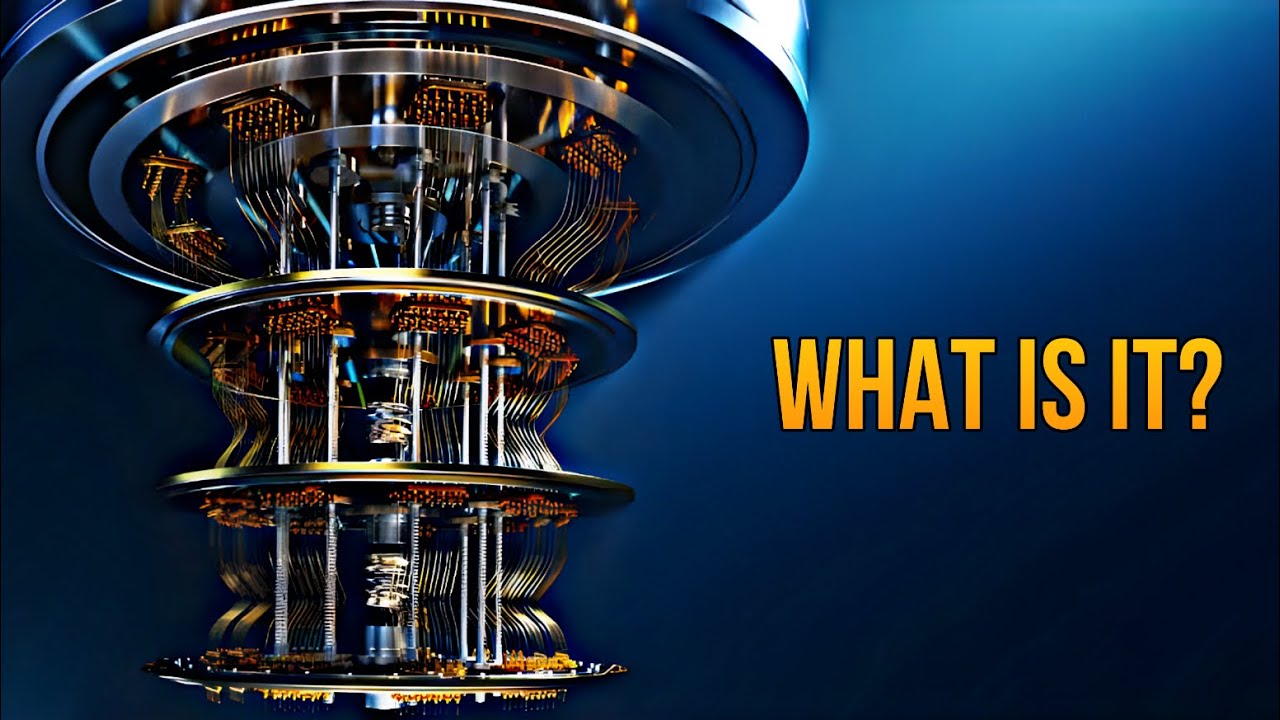
Whats A Quantum Computer? TECH EXPLAINED
Show More Show Less View Video Transcript
0:00
Are you ready to explore one of the most revolutionary technologies of our time
0:04
Today, we're going to be taking a deep dive into quantum computing
0:08
This cutting-edge technology uses the properties of quantum mechanics to process information faster than ever before
0:15
We'll explain how quantum computers work, look at some of their potential applications
0:21
and discuss why they could be the future of computing. Welcome to Best Cool Tech
0:27
Get ready to join us on a journey into the world of quantum computing
0:31
But what is quantum computing? Quantum computing is a revolutionary computing technology that uses the properties of quantum mechanics
0:40
like superposition and entanglement, to process information. Unlike classical computers that rely on binary digits or bits
0:49
quantum computers use quantum bits or qubits. These qubits have some unique properties that allow quantum computers to solve problems much faster than classical computers
1:00
One of the key concepts in quantum computing is superposition. Superposition is a property of quantum mechanics that allows a qubit to be in multiple states at the same time
1:11
This means that a qubit can be a zero and a one simultaneously, which allows quantum computers to explore many solutions to a problem at once
1:20
This is in contrast to classical computers, where each bit can only be a 0 or a 1
1:26
and the computer has to evaluate each solution one at a time. The other key concept in quantum computing is entanglement
1:35
Entanglement is when two or more qubits are connected in such a way that the state of one qubit affects the state of another qubit
1:42
even if they are separated by large distances. computers. This means that a change in one qubit can instantly affect another qubit
1:50
which allows quantum computers to process information instantaneously when compared to classical
1:56
computers. So, how does this all come together in a quantum computer? Well, imagine that
2:03
you have a quantum computer that is trying to solve a complex optimization problem. The
2:08
qubits in the quantum computer are set up in superposition and entanglement, allowing
2:13
the computer to explore many solutions to the problem simultaneously. By exploiting the properties of superposition and entanglement the quantum computer can quickly find multiples of the best solutions to the same problem or even variations of similar extremely complex problems
2:31
By leveraging these unique properties, quantum computers can process data and solve complex
2:37
problems much faster than traditional computers. How much faster you might ask
2:43
About 158 million times faster than the most sophisticated supercomputers of today
2:50
These are devices so powerful that they could do in 4 minutes what it would take a supercomputer
2:54
10,000 years to accomplish. So how does a quantum computer work? It starts with the quantum bit or qubit
3:03
Unlike the traditional bits used in computing, qubits are quantum particles that exist in
3:08
multiple states at the same time. This means that qubits can represent multiple values simultaneously, allowing them to process
3:16
data much faster. One of the key features of qubits is that their state can be represented as a combination
3:23
of the basic states 0 and 1, and each state is described by a complex number
3:29
The coefficients of these complex numbers give the probability of finding the qubit in each
3:34
of the basic states. These qubits work together to form a quantum system that can store, process, and communicate
3:42
data in a completely new way. The power of quantum computing comes from the fact that the qubits are working together
3:48
in a quantum system, allowing them to process more data faster than ever before and hold
3:54
more possible conclusions in memory while computing answers to problems. If you're computing that this video is helpful in understanding some cool tech like quantum
4:04
computers, then why not hit that like button and subscribe? Quantonly speaking, it'll make our qubit superposition happy
4:14
To perform computations, quantum algorithms use quantum gates, which are operations that
4:20
manipulate the state of qubits. These gates can be used to create superposition and entanglement, and to perform measurements
4:27
on qubits. The outcome of a measurement on a qubit collapses its state into one of the basic states 0 or 1
4:35
Despite their advantages, qubits are also very challenging to work with. They are very sensitive to their environment and can easily be disturbed by external factors such as electromagnetic radiation or temperature fluctuations This makes it difficult to maintain the stability of qubits and can result in errors in quantum computations
4:57
Let's take a look at some of the potential applications for quantum computing
5:01
With its extraordinary processing power, quantum computers could be used to create powerful artificial intelligence
5:08
develop new medical treatments and drugs, and even break current encryption methods
5:13
Quantum computers have the potential to simulate complex chemical and biological interactions
5:20
which are currently challenging to model using classical computers. Imagine that we want to study the interactions between a drug molecule and a protein in the human body
5:30
The protein is complex, with many active sites and flexible structures that can change its shape and function
5:37
Classical computers struggle to simulate this level of complexity in a reasonable amount of time
5:43
However, with a quantum computer, we could represent the drug molecule and protein as qubits and use quantum algorithms to explore the interactions between them
5:54
The qubits could be put in superposition, allowing the quantum computer to simultaneously explore all possible interactions between the drug molecule and protein
6:03
The quantum computer could also take advantage of entanglement to quickly evaluate the energy of each interaction
6:10
which would give us a better understanding of how the drug molecule interacts with the protein
6:16
In this example, the quantum computer would be able to explore the interactions between the drug molecule and protein on a quantum level
6:24
which is not possible with classical computers. This would give us a much more detailed and accurate picture of the interactions
6:31
which could be used to divert new drugs that are more effective and have fewer side effects
6:38
By simulating complex chemical and biological interactions, quantum computers could help us understand the world around us
6:45
and find new solutions to some of the most pressing problems we face
6:50
Quantum computers have the potential to revolutionize financial ysis by providing faster and more accurate solutions to complex problems
6:59
Imagine that a financial institution wants to evaluate the risk associated with a portfolio
7:04
of financial instruments such as stocks bonds and derivatives Classically this would involve running Monte Carlo simulations which are computationally intensive and can take a long time to complete Here the quantum computer would be able to perform the risk ysis much faster
7:22
and more accurately than a classical computer, providing the financial institution with valuable
7:27
insights that could inform its investment decisions. This could result in more efficient
7:32
and effective portfolio management, reducing the risk of financial losses and maximizing returns
7:38
Quantum computers have the potential to revolutionize the world of communication by enabling completely secure communication through the use of quantum entanglement
7:48
Here's a hypothetical example of how quantum computers could be used for secure communication
7:54
Imagine that two people, Alice and Bob, want to communicate securely over a public network, such as the Internet
8:01
To do this, they could use a quantum computer to create a shared secret key through the process of quantum key distribution, QKD
8:10
In QKD, the quantum computer creates pairs of entangled particles and sends one particle from each pair to Alice and Bob
8:19
By using the properties of entanglement, Alice and Bob can use the particles they have received to generate a secret key
8:26
Since any attempt to eavesdrop on the communication would disturb the state of the entangled particles
8:33
the presence of an eavesdropper can be detected. This provides a completely secure form of communication
8:39
as the secret key can only be used by Alice and Bob and cannot be intercepted by a third party
8:47
In this example, the quantum computer would be able to revolutionize the world of communication
8:52
by enabling secure communication that is resistant to hacking and eavesdropping. Similar to blockchain technology, it demonstrates the potential of quantum computers to transform the way we communicate and exchange information, making communication more secure and reliable
9:10
So, what's more impressive about quantum physics? Superposition or entanglement? Make sure to let us know your thoughts in the comments below so that we can continue the discussion together
9:21
We hope this video has given you a basic understanding of quantum computing and its potential applications
9:30
Quantum computing is still in its infancy, but it's already showing immense potential to change the way we think about computing
9:37
Stay tuned for more videos from Best Cool Tech
#Hobbies & Leisure
#Computer Science
#Machine Learning & Artificial Intelligence