Up next in 10


Osmotic Pressure Explained in 5 Minutes
In this concise 5-minute video, we delve into the concept of osmotic pressure, a fundamental principle in chemistry and biology. Discover how osmotic pressure influences the movement of water across semi-permeable membranes and its critical role in various biological processes, such as nutrient absorption and cellular function. We will break down the key factors that affect osmotic pressure, including solute concentration and temperature, while providing clear examples to enhance your understanding. Whether you're a student, educator, or simply curious about the science behind osmosis, this video is designed to clarify complex concepts in an accessible manner. Join us for a quick yet informative exploration of osmotic pressure! #OsmoticPressure #BiologyBasics #ChemistryExplained
Website: https://biologynotesonline.com/
Facebook: https://www.facebook.com/biologynotesonline
Instagram: https://www.instagram.com/biologynotesonline/?hl=en
osmotic pressure,osmotic pressure in hindi,what is osmotic pressure,osmosis explained,osmotic pressure explanation,osmotic pressure definition,osmotic pressure meaning,osmotic pressure.,colloid osmotic pressure,what does osmotic pressure mean,interstitial fluid osmotic pressure,osmotic pressure chemistry,blood colloid osmotic pressure,definition of the word osmotic pressure,what does the word osmotic pressure mean,osmotic pressure colligative properties
Show More Show Less View Video Transcript
0:00
what is osmotic pressure osmotic pressure is the pressure required to prevent the flow of solvent through a
0:06
semi-permeable membrane when there's a difference in solute concentration between two
0:14
solutions let's visualize this concept here we have two solutions separated by
0:19
a semi-permeable membrane the left side has a high concentration of solute particles while the right side has a
0:26
lower concentration the natural tendency is for water to flow from the low concentration side to the high
0:32
concentration side to equalize the concentrations osmotic pressure is the
0:38
external pressure that must be applied to prevent this solvent flow across the
0:44
membrane importantly osmotic pressure is a collleative property meaning it depends on the number of particles in
0:51
solution rather than their chemical identity for example a solution with 20 salt ions
0:57
would have higher osmotic pressure than a solution with 10 sugar molecules even though the sugar molecules are
1:05
larger to summarize osmotic pressure is the pressure needed to prevent solvent
1:11
flow through a semi-permeable membrane and it depends on the number of particles in solution rather than their
1:17
identity the mechanism of osmosis occurs at the
1:23
molecular level across a semi-permeable membrane a semi-permeable membrane
1:28
separates two solutions with different solute concentrations the left side has a lower solute concentration while the
1:34
right side has a higher concentration of solute molecules the semi-permeable membrane
1:40
allows the smaller water molecules to pass through its pores but blocks the larger solute molecules
1:55
this process continues until equilibrium is reached or until osmotic pressure prevents further water
2:02
movement in summary osmosis is the movement of water molecules through a semi-permeable membrane from an area of
2:08
lower solute concentration to higher solute concentration continuing until equilibrium is reached
2:17
semi-permeable membranes are specialized barriers that allow certain molecules to pass through while blocking others these
2:25
membranes contain microscopic pores that act as selective gateways the size of these pores determines which molecules
2:32
can pass through the membrane small molecules like water can easily pass through the pores while larger molecules
2:39
are blocked this selective permeability is crucial for many biological and industrial processes
2:46
natural semi-permeable membranes include cell membranes found in all living organisms these membranes are composed
2:53
of a phospholipid blayer with embedded transport artificial semi-permeable
3:07
membracing for medical applications and polyomide membranes for reverse osmosis
3:13
unlike natural membranes artificial membranes often have a more uniform pore structure that can be precisely
3:19
engineered for specific separation
3:26
requirements the Van Hoff equation provides a way to calculate the theoretical osmotic pressure of a
3:32
solution
3:44
the equation is expressed as pi= ICT pi represents the osmotic pressure which is
3:49
the pressure needed to prevent the flow of solvent across a membrane i is the van hoff factor which
3:56
accounts for the dissociation of solutes in solution c is the molar concentration of
4:01
the solute measured in moles per liter r is the universal gas constant with a value of 0 08206 L atmospheres per mole
4:10
per T is the absolute temperature in Kelvin this equation shows that osmotic
4:15
pressure is directly proportional to concentration and temperature let's calculate the osmotic pressure of a 0.1
4:23
M glucose solution at 25° or 298 since glucose doesn't dissociate in
4:30
water the vanoff factor is 1 plugging all values into our equation we get an
4:36
osmotic pressure of 2.45 atmospheres the Van Hoff equation provides scientists
4:41
and engineers with a powerful tool to predict and understand osmotic pressure in various solutions and biological
4:49
systems this fundamental equation connects osmotic pressure to basic solution properties helping us
4:55
understand osmotic phenomena across chemistry biology and medicine
5:00
in this example we'll calculate the osmotic pressure of a 0.1 M sodium chloride solution at
5:07
25° the equation for osmotic pressure is pi = ICR let's understand what each
5:13
variable represents sodium chloride dissociates completely in water splitting into
5:20
sodium and chloride ions for our 0.1 molar sodium chloride
5:27
solution at 25° C let's identify the values for each variable the vanoff
5:32
factor I equals 2 for sodium chloride because each molecule dissociates into two ions sodium and
5:39
chloride now let's substitute these values into our equation p= ICT
5:44
substituting our values we get = 2 *.1 moles per liter * 0821 L atmospheres
5:52
per mole kelvin* 298 kel simplifying the calculation the osmotic pressure equals
5:58
4.892 892 atmospheres let's convert this pressure to other common units converting to
6:05
millime of mercury we multiply by 760 giving us 3718 mm of mercury in kilopascals we
6:13
multiply by 101.325 resulting in 496 kilopascals and
6:18
in pounds per square in we multiply by 14.7 giving us 71.9
6:23
PSI let's visualize what this osmotic pressure means here we have a semi-permeable membrane separating a
6:30
sodium chloride solution from pure water the calculated osmotic pressure of 4.892
6:36
atmospheres is the pressure needed to prevent water from flowing into the sodium chloride solution
7:20
isosmotic solutions also called isotonic solutions have equal osmotic pressure across a semi-permeable membrane when
7:27
two solutions are isosmotic there is no net movement of solvent between them creating a state of equilibrium
7:35
let's visualize two isosmotic solutions separated by a semi-permeable membrane in isoic solutions the
7:52
concentration In this state of equilibrium individual particles continue to move randomly but there is
7:58
no net movement of water across the membrane when a cell is placed in an
8:03
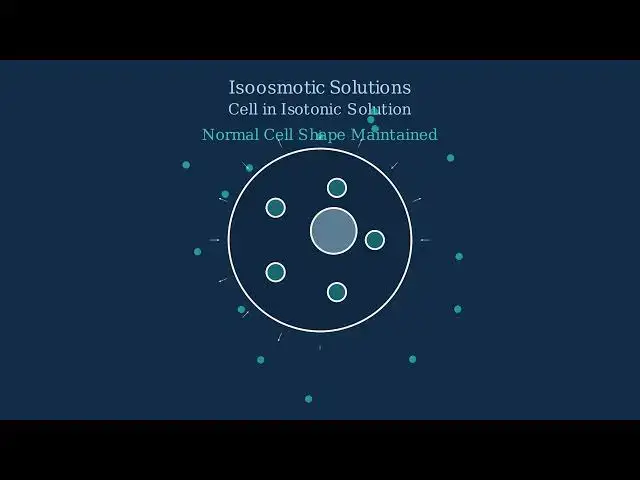
isotonic solution it maintains its normal shape the concentration of solutes outside the cell is equal to the
8:11
concentration inside resulting in no net osmotic pressure water molecules move in
8:16
and out of the cell at equal rates creating a dynamic equilibrium
8:22
isosmotic solutions have important medical applications a common example is 0.9% sodium chloride solution also known
8:29
as normal saline normal saline is isotonic with human blood meaning it has the same osmotic pressure as blood
8:36
plasma this is relationship is critical for intravenous fluids as it prevents
8:41
damage to blood cells that would occur with solutions of different osmotic pressures
8:48
to understand why 0.9% sodium chloride is isotonic with blood we need to look at its concentration human blood plasma
8:56
has an osmarity of approximately 290 millos moles per liter and normal saline
9:01
is formulated to match this because normal saline is isosmotic with blood it
9:06
can be safely administered intravenously without causing osmotic damage to cells
9:14
hypoic or hypotonic solutions have a lower solute concentration than a reference solution this lower
9:21
concentration results in lower osmotic pressure compared to the reference solution when cells are placed in a
9:27
hypotonic environment the concentration gradient causes water to flow into the
9:33
cells let's compare a reference solution with a hypotonic solution notice how the
9:38
hypotonic solution has fewer solute particles when a cell is placed in a hypotonic
9:44
environment water flows into the cell due to the concentration gradient as
9:49
water enters the cell it begins to swell increasing in volume while the solute concentration inside decreases if too
9:56
much water enters the cell it may eventually burst a process called lis
10:02
this happens because the cell membrane cannot withstand the increasing pressure let's look at some real world
10:08
examples of hypotonic solutions distilled water is hypotonic to blood cells which is why red blood cells burst
10:15
when placed in pure water fresh water is hypotonic to marine organisms this is
10:20
why saltwater fish cannot survive in fresh water their cells would take in too much water and rupture sports drinks
10:28
that are diluted too much with water can become hypotonic to your body's cells in medical settings introvenous fluids
10:35
with salt concentrations less than 0.9% sodium chloride are considered hypotonic
10:40
and must be used carefully hypotonic solutions have important clinical applications they can
10:47
be used therapeutically to hydrate cells when needed however hypotonic conditions
10:53
can be dangerous especially for brain cells potentially leading to cerebral edema or brain swelling they may also
11:00
damage fragile tissues by causing excessive swelling which is why proper osmotic balance is crucial in medical
11:07
treatments hyperosmotic or hypertonic solutions contain a higher concentration
11:12
of solutes than the reference solution in a hyperosmotic environment
11:18
the solute concentration outside the cell is higher than inside the cell this
11:23
creates an osmotic pressure gradient that causes water to flow out of the cell through the semi-permeable membrane
11:30
as water leaves the cell the cell shrinks and may undergo a process called creation where the cell membrane becomes
11:37
irregular and wrinkled the loss of water causes the cell to shrink and in extreme
11:43
cases the cell membrane becomes wrinkled and irregular in a process called creation
11:49
examples of hyperosmotic solutions include concentrated salt solutions seawater 3% sodium chloride solution
11:57
used in laboratories and hypertonic intravenous solutions used in medical
12:02
settings cells exist in fluid environments and must maintain osmotic balance to prevent excessive swelling or
12:09
shrinking that could damage their structure when a cell contains a higher
12:15
concentration of solutes than its surroundings water molecules move into the cell through
12:20
osmosis this inward water movement occurs because water flows from regions of lower solute concentration to regions
12:28
of higher solute concentration to prevent damage from excessive water movement cells engage in
12:35
osmo regulation the active regulation of osmotic pressure to maintain proper cell
12:40
volume and fluid balance cell membranes contain specialized
12:45
transport proteins that help maintain osmotic balance different proteins serve
12:50
different functions ion channels allow specific ions to pass through the membrane passively following their
12:57
concentration gradient the sodium potassium pump uses energy to actively transport sodium ions out of the cell
13:04
and potassium ions into the cell against their concentration gradients aquaporins
13:09
are specialized channels that allow water molecules to move rapidly across the membrane in response to osmotic
13:17
gradients different cell types have evolved specific adaptations to survive in their unique osmotic environments
13:25
plant cells have rigid cell walls that allow them to maintain tur pressure in hypotonic environments animal cells have
13:32
flexible membranes and are more susceptible to osmotic changes bacterial
13:37
cells often have cell walls and special adaptations to survive extreme
13:42
conditions red blood cells provide an excellent example of how cells respond
13:47
to different osmotic environments in an isotonic solution red blood cells maintain their normal by concave shape
13:54
in a hypotonic solution water flows into the cell causing it to swell and potentially rupture in a process called
14:01
hemolysis in a hypertonic solution water leaves the cell causing it to shrink and
14:07
develop a spiky appearance called creation understanding osmotic pressure
14:13
and how cells respond to osmotic environments is fundamental to cell biology and medical applications such as
14:19
IV fluid therapy and dialysis plant cells rely on osmotic pressure to
14:24
maintain their structure and rigidity unlike animal cells plant cells have a rigid cell wall surrounding the cell
14:31
membrane with a large central vacule filled with water and dissolved substances tur pressure occurs when
14:38
water moves into the plant cell through osmosis water molecules flow from areas
14:43
of lower solute concentration to higher solute concentration across the semi-permeable cell membrane as water
14:50
enters it creates pressure that pushes outward against the rigid cell wall this pressure is called turgor pressure turg
14:58
pressure is essential for maintaining plant structure it provides the rigidity plants need to stand upright when plants
15:05
lose water tur pressure decreases and the cells become less rigid this causes
15:10
the plant to wilt and droop let's compare a turgid cell with a plasmalized cell a turgid cell is filled with water
15:17
pressing against the cell wall in a hypertonic environment where the concentration of solutes outside the
15:24
cell is higher water leaves the cell through osmosis this causes the cell membrane to pull away from the cell wall
15:31
a process called plasmolysis let's observe how a plant wilts and recovers
15:36
when a plant loses water the cells lose turgor pressure and the plant begins to droop when water is reintroduced osmosis
15:44
causes water to flow back into the cells restoring turor pressure the plant becomes rigid and upright again to
15:51
summarize the key points about osmotic pressure in plant cells turg pressure results from osmotic water movement into
15:58
the cell the rigid cell wall provides structure to withstand this pressure when plants lose water tur pressure
16:04
decreases causing wilting and in hypertonic environments water leaves the
16:10
cell causing plasmolysis kidneys use osmotic pressure to filter
16:15
blood and regulate water balance in the body the functional unit of the kidney is the nephron which consists of several
16:22
specialized segments the kidney creates and maintains a concentration gradient
16:27
in the medulla with increasing solute concentration toward the inner medulla blood filtration begins in the
16:34
glomemeulus where water and small solutes pass into Bowman's capsule due to pressure gradients in the proximal
16:41
tubule essential nutrients ions and water are reabsorbed into the bloodstream the loop of henlay is
16:47
crucial for creating the concentration gradient through a process called counterurren multiplication as fluid
16:54
flows down the descending loop water leaves via osmosis in the ascending loop
16:59
sodium chloride is actively pumped out but the tubule is impermeable to water in the collecting duct water
17:06
reabsorption occurs via osmosis following the concentration gradient established by the loop of henla the
17:12
hormone ADH regulates water permeability in the collecting duct allowing the body
17:18
to produce either concentrated or dilute urine depending on hydration status when
17:23
ADH levels are low the collecting duct remains relatively impermeable to water resulting in dilute urine when ADH
17:30
levels are high water is reabsorbed producing concentrated urine through these osmotic processes the kidneys
17:37
precisely regulate water and solute balance maintaining homeostasis in the
17:42
body blood plasma is the liquid component of blood making up about 55% of total blood volume it consists of
17:49
about 92% water 7% proteins and 1% other solutes including electrolytes nutrients
17:55
and waste products plasma proteins play a critical role in maintaining osmotic balance among these proteins albumin is
18:03
the most abundant and important enotic pressure is a form of osmotic pressure specifically created by
18:10
plasma proteins it's essential for maintaining proper fluid balance between blood vessels and surrounding tissues
18:17
inside blood vessels we have water proteins primarily albumin and various ions and small molecules these proteins
18:24
cannot easily cross the vessel wall two main forces regulate fluid exchange hydrostatic pressure blood pressure
18:32
pushing fluid out and encotic pressure pulling fluid back in blood plasma maintains a delicate
18:39
osmotic balance when this balance is disrupted it can lead to medical conditions edema occurs when encotic
18:46
pressure is too low often due to reduced albumin levels in conditions like liver disease or malnutrition this causes
18:53
fluid to leak into tissues resulting in swelling conversely dehydration can increase the concentration of proteins
19:00
in plasma raising onotic pressure and pulling more fluid from tissues into the bloodstream further dehydrating the
19:09
tissues let's summarize the key points about blood plasma and osmotic balance
19:14
blood plasma 92 cent water seven proteins one other solutes albamin contributes 60 cent of enotic pressure
19:21
normal cotic pressure is 25 to 30 millimeter hgeman balance between enkotic and hydrostatic pressures
19:27
regulates fluid movement between vessels and tissues low albumin levels lead to edema in tissues dehydration increases
19:34
protein concentration and enotic pressure neurons rely on specific ion
19:41
concentrations and osmotic balance to function properly
19:46
the neuronal membrane separates different ion concentrations inside the cell potassium is high while sodium and
19:53
chloride are low these ion channels regulate the movement of specific ions across the
19:59
membrane these ion concentration differences create the resting membrane potential of 70 m
20:08
when a neuron is stimulated it generates an action potential a rapid change in membrane voltage that propagates along
20:15
the axon osmotic imbalances can severely disrupt neuron function in normal
20:21
conditions ion concentrations are carefully regulated in a hypoic environment water flows into the cell
20:28
causing it to swell and diluting ion concentrations in a hyperosmotic environment water leaves the cell
20:34
causing it to shrink and concentrating ions these osmotic imbalances lead to various
20:41
neurological symptoms hypoic conditions can cause seizures while hyperosmotic
20:46
conditions can lead to confusion and impaired neural function in summary proper osmotic balance is critical for
20:54
maintaining normal neuronal function and preventing neurological disorders
21:01
osmotic pressure plays a crucial role in the digestive system driving water movement and nutrient absorption across
21:07
the intestinal walls let's examine how osmotic gradients function throughout the digestive tract the small intestine
21:15
is where most osmotic absorption occurs with specialized structures called villi
21:20
increasing the surface area let's look at a cross-section of the intestinal wall to see how villi
21:28
increase surface area for absorption let's zoom in on a single villis to understand how osmotic pressure drives
21:34
absorption the intestinal epithelium acts as a semi-permeable membrane nutrients ions and water move across
21:42
this barrier through various mechanisms nutrients and sodium ions create an osotic gradient across the membrane as
21:49
these particles are actively transported from the intestinal lumen into the bloodstream water follows by osmosis to
21:57
balance the concentration difference moving from an area of lower solute concentration to higher solute
22:04
concentration when this balance is disrupted conditions like osmotic diarrhea can occur let's compare normal
22:11
intestinal absorption with osmotic diarrhea in normal digestion nutrients are absorbed across the intestinal wall
22:18
and water follows due to the osmotic gradient in osmotic diarrhea poorly absorbed solutes like lactose in lactose
22:25
intolerance or artificial sweeteners remain in the intestinal lumen these solutes draw water into the intestine
22:32
through osmosis resulting in watery stools and diarrhea several clinical conditions
22:38
involve osmotic imbalances in the digestive tract in lactose intolerance undigested lactose remains in the
22:45
intestine drawing water in by osmosis and causing diarrhea magnesium based laxatives intentionally create an
22:52
osmotic gradient to increase water content in the stool sugar alcohols found in sugar-free foods can also cause
22:59
osmotic diarrhea when consumed in large amounts introvenous fluid therapy is a critical
23:06
medical intervention that relies on understanding osmotic pressure to safely deliver fluids directly into the
23:13
bloodstream when administering IV fluids healthcare providers must carefully consider the osmotic pressure of the
23:19
solution relative to blood plasma the osmotic pressure of blood
23:25
plasma is approximately 290 mills moles per liter this pressure affects how
23:31
fluids move between blood vessels and surrounding tissues ioy solutions are classified
23:36
into three main types based on their osmotic pressure relative to blood plasma isotonic solutions have the same
23:43
osmarity as blood plasma approximately 290 millos moles per liter they cause no
23:49
net fluid shift between blood vessels and cells hypotonic solutions have lower osmalerity than blood plasma when
23:57
administered water moves from the bloodstream into cells causing them to swell hypertonic solutions have higher
24:03
osmalerity than blood plasma they draw water out of cells into the bloodstream
24:08
causing cells to shrink isotonic solutions like 0.9% sodium chloride are
24:14
commonly used for volume expansion treating dehydration and as a medium for blood transfusions hypotonic solutions
24:21
such as 0.45% four or 5% sodium chloride are used to treat cellular dehydration hyperonetriia and hyperosmolar states
24:28
hypertonic solutions like 3% sodium chloride are beneficial in treating cerebral edema hyponetriia and increased
24:35
intraanial pressure administering IV fluids with incorrect osmalerity can lead to serious
24:42
medical complications for example using an isotonic solution when a hypotonic
24:47
solution is needed may fail to correct cellular dehydration allow hyperutriia to persist and potentially cause fluid
24:55
overload similarly administering a hypotonic solution when a hypertonic solution is required can worsen cerebral
25:02
edema exacerbate hyponetriia and even cause hemolysis of red blood
25:07
cells let's examine some common IV solutions used in clinical practice and
25:12
their osmotic properties relative to blood normal saline or per.9% sodium
25:18
chloride is an isotonic solution with an osmalerity of 308 mill moles per liter
25:24
it's commonly used for volume replacement and treating dehydration lactated ringer solution is also
25:29
isotonic with an osmalerity of 273 millos moles per liter it's frequently
25:35
used for fluid resuscitation and in treating burn injuries d5w or 5%
25:40
dextrose in water is hypotonic with an osmalerity of 252 millos moles per liter
25:46
it's used to provide free water and treat hyperetriia hypertonic saline or 3% sodium chloride has a high osmalerity
25:53
of,026 millosm moles per liter it's used in treating severe conditions like cerebral edema and severe hyponetriia
26:01
regardless of which IV solution is used careful monitoring of electrolytes and fluid balance is essential to prevent
26:07
complications and ensure optimal patient outcomes dialysis is a life-saving
26:15
medical procedure used when a patients kidneys fail to adequately filter waste from the blood normally healthy kidneys
26:22
filter blood by removing waste products and maintaining fluid and electrolyte balance in kidney failure waste products
26:29
accumulate in the blood which can be life-threatening without intervention dialysis uses a machine
26:37
that acts as an artificial kidney blood is removed from the patient filtered in
26:42
the machine and then returned to the patient the key component of dialysis is
26:47
the semi-permeable membrane which allows some substances to pass through while blocking others blood contains various
26:54
components including waste molecules essential blood components like cells and proteins and electrolytes and water
27:02
the principle of osmotic pressure drives the dialysis process the membrane is
27:07
designed to allow smaller waste molecules and excess water to pass through while retaining larger essential
27:13
blood components during dialysis waste products move from the blood through the membrane into the dialysate solution due
27:20
to the concentration gradient the dialysate solution is specifically formulated to create the right osmotic
27:28
environment for waste removal dialysis has several important clinical applications in treating kidney
27:34
failure the most common use is treating endstage renal disease but dialysis is
27:40
also used for acute kidney injury toxin removal correcting fluid and electrolyte
27:45
imbalances and as a bridge to kidney transplantation to summarize dialysis relies on several
27:52
key principles a semi-permeable membrane for selective filtration osmotic pressure as the driving force
27:58
concentration gradients to control solute movement and carefully formulated dialysate
28:05
solutions reverse osmosis is an industrial water purification technology that applies pressure to overcome
28:12
natural osmotic pressure to understand reverse osmosis let's
28:17
first look at natural osmosis where water naturally moves from low to high solute concentration in normal osmosis
28:25
water molecules move across the membrane from an area of low solute concentration to high solute concentration in reverse
28:32
osmosis external pressure is applied to overcome the natural osmotic pressure forcing water in the opposite direction
28:41
a typical reverse osmosis system consists of several key components feed water enters a high-press which forces
28:48
it through a semi-permeable membrane the membrane allows water molecules to pass through while blocking contaminants like
28:55
salts bacteria and other impurities the clean water or permeate is collected
29:00
while the concentrate containing rejected contaminants is discharged
29:08
the
29:19
pressurecream reverse osmosis has several major industrial applications the most notable is desalination which
29:27
converts seawater into fresh water by removing salt and other minerals in municipal water treatment reverse
29:33
osmosis removes contaminants bacteria and viruses from drinking water supplies improving water quality taste and odor
29:41
industries use reverse osmosis to recycle processed water treat waste water and concentrate valuable compounds
29:48
reducing both resource consumption and disposal costs to summarize reverse osmosis is a pressurdriven membrane
29:55
process that overcomes natural osmotic pressure to purify water it's a versatile technology with applications
30:02
spanning from desalination to industrial water recycling food preservation through
30:08
osmotic pressure is one of the oldest and most effective methods of extending food shelf
30:15
life when microorganisms encounter a hyperosmotic environment rich in salt or
30:20
sugar water is drawn out of their cells through osmosis this dehydration causes
30:25
the microbial cells to shrink deactivates their enzymes inhibits their growth and ultimately leads to their
30:32
death traditional food preservation methods leverage osmotic pressure to extend shelf
30:39
life many popular preserved foods rely on osmotic principles beef jerky uses
30:45
salt to draw out moisture fruit jams use sugar's osotic properties pickles combine salt and acid in a brining
30:53
process while traditional osmotic preservation methods have been used for millennia modern food technology has
30:59
refined these techniques with precise control of water activity and combined
31:04
preservation approaches in summary osmotic food
31:10
preservation creates environments where water is drawn out of microorganisms preventing their growth and extending
31:16
food shelf life using natural principles osmotic pressure is a fundamental force
31:22
shaping life in natural environments it determines where organisms can live
31:27
drives evolutionary adaptations and influences biodiversity patterns across different
31:33
ecosystems aquatic organisms face distinct osmo challenges depending on
31:38
their environment in freshwater environments fish cells face a hypotonic situation where water tends to flow into
31:45
the cell freshwater fish must constantly pump out excess water and actively retain ions to maintain osmotic balance
31:53
conversely in saltwater environments fish cells are in a hypertonic situation where water tends to flow out of the
32:00
cell marine fish must drink sea water and excrete excess ions through specialized cells in their gills
32:08
many aquatic organisms have evolved specialized adaptations for osmo regulation in their specific
32:15
environments salmon are remarkable for their ability to transition between freshwater and saltwater environments
32:21
during migration they have specialized chloride cells in their gills and hormone
32:26
regulated osmo regulation that can switch modes some organisms have evolved remarkable
32:33
adaptations to survive in environments with extreme osmotic conditions halophilic microbes thrive in extremely
32:40
salty environments like the Great Salt Lake with internal salt concentrations that would kill most organisms desert
32:47
frogs like the Australian water holding frog can store water under their skin and in their bladder allowing them to
32:54
survive extended dry periods osmotic pressure has significant
32:59
ecological implications particularly as environments change changes in salinity
33:05
due to climate change or human activities can stress organisms beyond their adaptive capacity potentially
33:10
reducing biodiversity there are several laboratory methods for measuring osmotic
33:17
pressure each with specific applications and limitations osmotic pressure can be
33:22
measured using both direct and indirect methods
33:28
direct measurement uses osmometers which typically consist of a chamber divided by a semi-permeable membrane the
33:35
pressure required to prevent water flow across the membrane equals the osmotic pressure membrane osmometers directly
33:42
measure the hydrostatic pressure needed to halt osmosis colloid osmometers are
33:48
specifically designed to measure encotic pressure from proteins in biological fluids
33:55
indirect methods utilize collleative properties like freezing point depression and vapor pressure lowering
34:01
to calculate osmotic pressure freezing point osmometers are most commonly used
34:06
in clinical laboratories they measure how much the freezing point of a solution is lowered compared to pure
34:11
water then convert this to osmolality expressed in millios moles per kilogram
34:20
measuring osmolality is crucial in clinical settings for assessing fluid and electrolyte balance the normal serum
34:26
osmolality ranges from 275 to 295 millos moles per kilogram clinical applications
34:33
include assessing hydration status diagnosing electrolyte disorders monitoring conditions like diabetes and
34:39
cipotus evaluating kidney function and detecting toxic ingestions
34:46
modern laboratory equipment for measuring osmotic pressure includes freezing point and vapor pressure
34:52
osmometers these devices offer automated sampling and measurement providing results in just 1 to 2 minutes they
35:00
typically require only a small sample volume usually between 20 and 50
35:07
microL to summarize osmotic pressure can be measured through both direct methods
35:12
using membrane osmometers and indirect methods using freezing point depression or vapor pressure
35:18
lowering these measurements provide critical information for clinical assessment of fluid and electrolyte
35:28
balance osmotic pressure principles have found applications across numerous scientific and technological
35:35
domains in biology osmotic pressure regulates cell volume drives water transport in plants and facilitates
35:42
nutrient absorption across membranes in medicine osmotic pressure
35:48
principles are applied in intravenous fluid therapy dialysis treatments and advanced drug delivery
35:54
systems industrial applications leverage osmotic pressure for water desalination
36:00
through reverse osmosis food preservation and even clean energy generation
36:06
environmental applications include water quality monitoring soil moisture management and maintaining ecosystem
36:13
balance several emerging technologies are leveraging osmotic principles in innovative ways osmotic power generation
36:21
or blue energy harnesses the osmotic pressure difference between fresh and salt water to generate clean electricity
36:29
smart drug delivery systems use osmotic principles to control the release rate of medications improving treatment
36:35
efficacy and reducing side effects future directions in osmotic
36:40
pressure applications include developing nanoosmotic technologies biomimetic membranes that mimic natural systems AI
36:48
optimized osmotic processes and self-regulating implantable medical devices understanding osmotic pressure
36:55
continues to drive innovations that address global challenges in healthcare energy production and environmental
37:02
sustainability let's summarize the key concepts of osmotic pressure osmotic pressure is the
37:09
pressure required to prevent the flow of water across a semi-permeable membrane from a region of lower solute
37:14
concentration to a region of higher solute concentration the van equation I * * r *
37:22
t mathematically describes osmotic pressure here pi represents osmotic pressure i is the vanof factor
37:29
accounting for dissociation c is molar concentration r is the gas constant and
37:34
T is absolute temperature solutions can be classified based on their osmotic pressure relative to a reference
37:41
solution isoesmotic solutions have equal concentrations of solutes resulting in
37:46
no net water movement hypoic solutions have lower concentrations of solutes
37:51
causing water to flow into cells hyperosmotic solutions have higher concentrations of solutes drawing water
37:58
out of cells osmotic pressure plays critical roles in various biological systems it regulates cell volume and
38:05
homeostasis maintains plant cell tur drives kidney filtration balances blood plasma and supports nerve cell function
38:13
the principles of osmotic pressure are applied in numerous practical technologies these include medical
38:19
applications like IV fluids and dialysis industrial processes like reverse osmosis food preservation and
38:26
environmental technologies like desalination all these concepts interconnect in a framework centered
38:32
around osmotic pressure at the center is osmotic pressure itself connected to the mathematical Vanhoff equation different
38:39
solution types biological significance practical applications measurement
38:44
methods and factors affecting osmotic pressure in conclusion osmotic pressure
38:50
is a fundamental physical principle that underlies countless natural processes and technologies
38:56
understanding this concept is essential in fields ranging from cell biology to industrial applications