live_tv
Livestream Starting Soon
00
Hours
:
00
Minutes
:
00
Seconds
Up next in 10


Biosafety Levels Explained - A Simple Guide
Study Note: https://biologynotesonline.com/biosafety-levels-with-their-primary-and-secondary-barriers/
In this informative video, we delve into the world of biosafety levels, providing a comprehensive yet straightforward guide to understanding the various classifications of biological agents. From Biosafety Level 1 (BSL-1) to Biosafety Level 4 (BSL-4), we break down the specific containment measures, laboratory practices, and safety protocols associated with each level. Whether you are a student, researcher, or simply curious about biosafety, this video will equip you with essential knowledge about how these levels protect public health and the environment. Join us as we explore the critical role of biosafety in scientific research and its implications for global health security. #Biosafety #PublicHealth #LaboratorySafety
Website: https://biologynotesonline.com/
Facebook: https://www.facebook.com/biologynotesonline
Instagram: https://www.instagram.com/biologynotesonline/?hl=en
biosafety levels,biosafety level,biosafety,biosafety cabinet,biosafety levels 1 2 3 4,biosafety level 2,biosafety level 3,biosafety level 4,biosafety training,biosafety cabinet explained,cdc biosafety levels,biosafety level 2 lab,types of biosafety levels,biosafety levels 1 2 3 4 movie,biosafety level 3 lab exit,what is biosafety levels?,biosafety level 3 lab entry,biosafety level 4 lab entry,biosafety level services singapore
Show More Show Less View Video Transcript
0:00
biosafety is the application of safety
0:02
precautions that reduce the risk of
0:04
exposure to infectious materials and
0:06
limit contamination in laboratory
0:09
settings biosafety protocols are
0:12
critical in laboratory settings to
0:14
protect three key elements first
0:17
researchers themselves are protected
0:19
from laboratory acquired infections and
0:21
injuries second the surrounding
0:23
community is safeguarded from the
0:25
accidental release of pathogens and
0:28
third the environment is protected from
0:30
contamination that could affect
0:31
ecosystems and
0:35
wildlife biosafety involves three core
0:38
components that work together to create
0:40
safe research environments first
0:43
laboratory practices include standard
0:45
operating procedures proper technique
0:47
and comprehensive training for all
0:49
personnel second safety equipment such
0:52
as biological safety cabinets and
0:54
personal protective equipment provide
0:56
physical barriers against
0:58
exposure finally facility design
1:00
features like specialized room layouts
1:02
air handling systems and containment
1:04
barriers prevent the spread of
1:06
biological
1:09
materials before we explore biosafety
1:12
levels in detail let's review the key
1:14
principles of biosafety first risk
1:17
assessment determines appropriate safety
1:19
measures second multiple layers of
1:22
protection work together third safety is
1:24
everyone's responsibility in the
1:26
laboratory and finally biosafety levels
1:29
guide procedure
1:31
implementation with these foundational
1:33
principles in mind we can now explore
1:35
the different biosafety levels that
1:37
guide laboratory practices biosafety
1:40
levels form a riskbased classification
1:42
system used worldwide for biological
1:44
containment each level builds upon the
1:47
previous one adding increasingly
1:49
stringent safety measures as the
1:51
potential risk
1:53
increases biosafety level one is
1:55
suitable for work with agents of minimal
1:57
potential hazard using standard
2:00
microbiological practices biosafety
2:02
level two addresses moderate hazards
2:05
adding restricted access and biohazard
2:07
warning signs biosafety level 3 is
2:09
designed for high-risk agents
2:11
implementing controlled access and
2:13
specialized ventilation systems
2:15
biosafety level 4 the highest level is
2:18
reserved for life-threatening agents
2:20
requiring airlocks dedicated systems and
2:22
positive pressure
2:25
suits selecting the appropriate
2:27
biosafety level requires a comprehensive
2:30
risk assessment pathogenicity considers
2:33
the severity of disease and the
2:34
infectious dose required transmission
2:37
route examines how the agent spreads
2:40
whether by direct contact airborne
2:42
particles or other means host range
2:44
evaluates the variety of species the
2:46
agent can infect available treatments
2:48
assess whether vaccines therapeutics or
2:51
antibiotics exist environmental
2:53
stability determines how long the agent
2:55
can survive outside its
2:59
host the biosafety levels follow several
3:02
key containment principles protection
3:04
increases with each biosafety level
3:07
building on previous controls risk
3:09
assessment determines the appropriate
3:11
biosafety level for each agent and
3:13
procedure containment measures include
3:16
both facility design elements and
3:18
laboratory work practices both primary
3:21
barriers like equipment and secondary
3:22
barriers like facility features are
3:24
considered
3:27
understanding these biosafety levels and
3:30
principles is essential for safe
3:32
laboratory work with biological
3:34
materials biosafety level one represents
3:36
the most basic level of containment bsl1
3:40
is suitable for well-characterized
3:41
agents that pose minimal hazards to
3:44
laboratory personnel and the environment
3:47
work can be conducted on open laboratory
3:49
benches using standard microbiological
3:52
practices in a BSL1 setting work is
3:56
typically performed on open benchtops
3:58
the laboratory doesn't need to be
4:00
isolated from the general building and
4:02
specialized containment equipment isn't
4:06
required common examples of BSL1
4:09
organisms include escarishia coli K12
4:12
basillus subtilus and various yeasts
4:15
like sacroyces cervisier commonly known
4:17
as baker's yeast these organisms are
4:20
well characterized and unlikely to cause
4:22
disease in healthy
4:24
adults standard safety practices for
4:27
BSL1 include regular handwashing
4:30
prohibiting food and drink in the
4:31
laboratory decontaminating work surfaces
4:34
proper waste disposal and minimal
4:36
personal protective equipment such as
4:38
lab coats and gloves
4:41
although BSL1 is the most basic
4:43
biosafety level proper training and
4:46
strict adherence to protocols remain
4:48
essential this includes initial
4:50
laboratory safety training specific
4:52
protocol training documentation of
4:55
procedures and annual refresher
4:57
courses to summarize BSL1 is the lowest
5:01
biosafety level suitable for
5:03
well-characterized non- pathogenic
5:05
agents it requires standard
5:07
microbiological practices performed on
5:09
open benches while the risk to personnel
5:12
in the environment is minimal training
5:14
and protocol adherence remain crucial
5:16
for safe laboratory
5:20
operations biosafety level 3 facilities
5:23
are designed for work with dangerous
5:25
pathogens that pose significant health
5:27
risks bsl3 is specifically designed for
5:31
work with indigenous or exotic agents
5:33
that may cause serious or potentially
5:36
lethal disease through respiratory
5:37
transmission the key characteristics of
5:40
BSL3 pathogens include their potential
5:42
for respiratory transmission their
5:44
indigenous or exotic origin and their
5:47
ability to cause serious or lethal
5:49
disease bsl3 laboratories require
5:52
specialized engineering controls to
5:54
contain these dangerous pathogens these
5:56
include negative pressure rooms that
5:58
prevent air from flowing outward
6:01
hepoiltration systems that clean the air
6:04
and controlled access with double door
6:06
entry systems several notorious
6:08
pathogens require BSL3 containment for
6:10
safe handling examples include
6:13
mcoacterium tuberculosis SARS corona
6:15
virus types 1 and two MS corona virus
6:18
yellow fever virus and West Nile virus
6:21
these pathogens can cause severe
6:23
respiratory diseases with potentially
6:25
fatal outcomes working in a BSL3
6:27
facility requires rigorous training and
6:30
strict operational protocols personnel
6:32
must have advanced microbiological
6:34
training participate in medical
6:36
surveillance programs strictly adhere to
6:39
entry and exit procedures follow
6:41
comprehensive biosafety manuals and
6:44
ensure the facility underos regular
6:46
inspections and certifications bsl3
6:49
facilities represent a critical
6:51
containment level that balances the need
6:53
to work with serious pathogens while
6:56
maintaining strong protections for
6:58
laboratory workers and the surrounding
7:00
community primary barriers are the first
7:02
line of defense in biosafety they are
7:05
defined as equipment and personal
7:07
protective equipment that create
7:09
separation between laboratory personnel
7:11
and hazardous biological materials
7:14
primary barriers fall into two main
7:17
categories engineering controls and
7:19
personal protective equipment
7:21
engineering controls include biosafety
7:23
cabinets which provide protection for
7:25
the user product and environment through
7:28
hepoiltration chemical fume hoods are
7:31
another type of engineering control
7:33
primarily designed to protect the user
7:35
from chemical vapors not for biological
7:37
containment
7:40
centrifuge safety cups and sealed rotors
7:42
are critical engineering controls that
7:45
prevent aerosolization of biological
7:47
materials during
7:49
centrifugation personal protective
7:51
equipment forms an essential barrier
7:54
between laboratory workers and
7:55
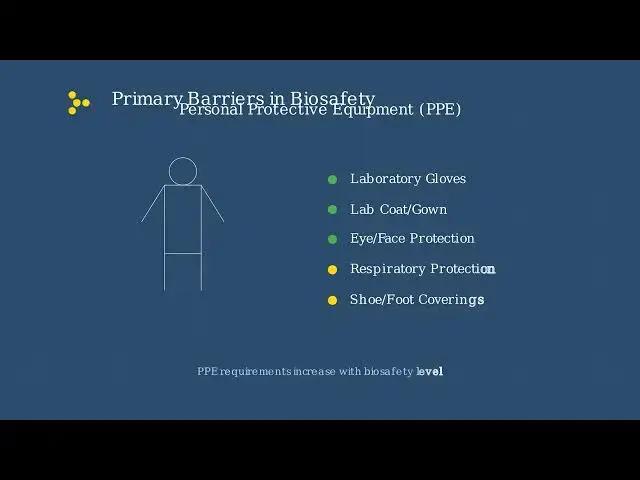
biological hazards basic PPE includes
7:58
laboratory gloves lab coats and eye
8:01
protection higher biosafety levels
8:03
require additional items like
8:05
respiratory protection and dedicated
8:07
footwear
8:09
selecting appropriate primary barriers
8:11
begins with a thorough risk assessment
8:13
the risk assessment considers the
8:15
biological agent characteristics
8:17
procedure hazards laboratory staff
8:19
competency and facility capabilities
8:22
based on these factors appropriate
8:24
primary barriers are selected and
8:26
implemented to ensure safe handling of
8:28
biological
8:30
materials in summary primary barriers
8:33
are essential components of biosafety
8:35
practices they form the first line of
8:37
defense include both engineering
8:39
controls and personal protective
8:41
equipment and must be selected based on
8:44
thorough risk assessment requirements
8:46
increase with biosafety level and they
8:48
must be used alongside proper training
8:50
and
8:53
procedures secondary barriers are the
8:56
facility design features that protect
8:58
people outside the laboratory and the
9:00
environment
9:03
secondary barriers consist of several
9:05
key elements these include specialized
9:07
ventilation systems that filter air
9:10
airlocks and ant rooms that separate lab
9:12
spaces controlled access zones that
9:15
restrict entry decontamination
9:17
facilities for cleaning and waste
9:19
management
9:21
systems secondary barriers become
9:23
increasingly sophisticated as we move
9:26
from lower to higher biosafety levels
9:28
biosafety level one requires only basic
9:31
barriers like handwashing sinks and
9:33
standard laboratory design bsl 2 adds
9:36
self-closing doors eyewash stations and
9:39
access to an autoclave at biosafety
9:41
level 3 secondary barriers become much
9:43
more sophisticated including controlled
9:46
access zones hepailtered ventilation
9:48
systems and airlocks between laboratory
9:51
spaces the highest level BSL4 requires
9:54
completely isolated facilities with
9:56
dedicated air and vacuum systems
9:58
chemical showers for decontamination and
10:01
comprehensive effluent treatment
10:04
systems ventilation systems are critical
10:06
secondary barriers especially in higher
10:09
biosafety levels hepa exhaust systems
10:12
maintain negative air pressure ensuring
10:15
air flows into the lab rather than out
10:17
trapping potentially dangerous particles
10:21
airlocks create transition spaces
10:23
between laboratory zones they prevent
10:25
simultaneous opening of doors maintain
10:27
pressure differentials and may include
10:29
changing areas and decontamination
10:32
showers access control systems restrict
10:34
entry to authorized personnel
10:37
only in summary secondary barriers are
10:41
critical facility design features that
10:43
protect people outside the laboratory
10:45
and the environment they become
10:47
increasingly sophisticated at higher
10:48
biosafety levels ranging from basic
10:51
handwashing sinks at BSL1 to completely
10:54
isolated facilities with dedicated
10:56
systems at
10:59
BSL4 risk assessment is the foundation
11:02
of laboratory biosafety and determines
11:04
which biosafety level is appropriate for
11:06
a given
11:07
situation the risk assessment process
11:10
involves four key steps that form a
11:12
continuous cycle
11:16
when conducting a risk assessment
11:18
several key factors must be considered
11:20
to determine the appropriate biosafety
11:22
level pathogenicity refers to an agent's
11:26
ability to cause disease and the
11:27
severity of that disease the route of
11:30
transmission indicates how the agent
11:32
spreads such as through aerosols direct
11:34
contact or other means the infectious
11:37
dose is the amount of the agent needed
11:39
to cause an infection which varies
11:41
widely between pathogens
11:44
available treatments such as vaccines or
11:46
therapeutics can mitigate risks if
11:48
exposure occurs laboratory procedures
11:51
themselves can increase risks especially
11:53
those generating aerosols or involving
11:56
sharps these factors help determine the
11:58
risk level which corresponds to the
12:01
appropriate biosafety level for handling
12:03
the
12:04
agent remember that risk assessment is
12:06
not a one-time event but an ongoing
12:09
process that must be regularly updated
12:13
proper risk assessment ensures that
12:15
biological materials are handled at the
12:17
appropriate biosafety level protecting
12:20
laboratory workers the community and the
12:22
environment the global importance of
12:24
biosafety continues to grow as our world
12:27
becomes increasingly
12:29
interconnected biosafety is critical for
12:31
global health security it prevents
12:33
crossber spread of dangerous pathogens
12:36
enables safe research on emerging
12:38
threats and facilitates rapid response
12:40
during outbreaks
12:43
laboratory safety measures are designed
12:45
to prevent laboratory acquired
12:47
infections this includes personal
12:49
protection
12:50
protocols pathogen containment
12:52
procedures and comprehensive incident
12:55
reporting
12:56
systems the CO 19 pandemic has
12:59
significantly reshaped biosafety
13:01
practices globally we've seen enhanced
13:03
regulations increased infrastructure
13:06
funding greater public awareness and
13:08
development of new containment
13:10
technologies
13:11
international cooperation is essential
13:13
for effective biosafety organizations
13:16
like the WHO provide global guidelines
13:18
while crossber training programs and
13:21
harmonized certification processes
13:23
ensure consistent standards
13:26
worldwide as research advances biosafety
13:29
protocols must evolve to address new
13:31
challenges these include adapting to
13:34
newly discovered pathogens addressing
13:36
synthetic biology risks developing
13:38
protocols for gene editing technologies
13:41
and balancing safety with scientific
13:44
progress in conclusion biosafety is a
13:47
global responsibility essential for both
13:49
scientific advancement and public health
13:51
protection it requires ongoing
13:54
adaptation to new challenges
13:56
international cooperation and careful
13:58
balancing of security needs with
14:00
scientific progress
#Infectious Diseases
#Public Health
#Occupational Health & Safety
#Home Safety & Security
#Biological Sciences
#Toxic Substances & Poisoning