Up next in 10

Correlation isn’t causation: What headlines often get wrong about health science
Feb 26, 2026


Headlines can confuse correlation for causation: Tylenol causes autism. Ultra-processed foods cause cancer. Social media causes depression.
Show More Show Less View Video Transcript
0:00
The news is full of headlines of officials drawing bold lines between two things happening at once
0:09
Americans are eating more ultra-processed foods while the number of people with obesity and chronic diseases are rising
0:16
More children are being vaccinated while autism and ADHD diagnoses climb. More people are spending time on social media as mental health declines
0:26
The implication is often the same. If two things rise together, then one must be causing the other
0:32
Often these notions are based on data that show timely correlations between two events
0:38
A correlation can be misleading. For example, data from the Department of Agriculture and the Centers for Disease Control and Prevention
0:45
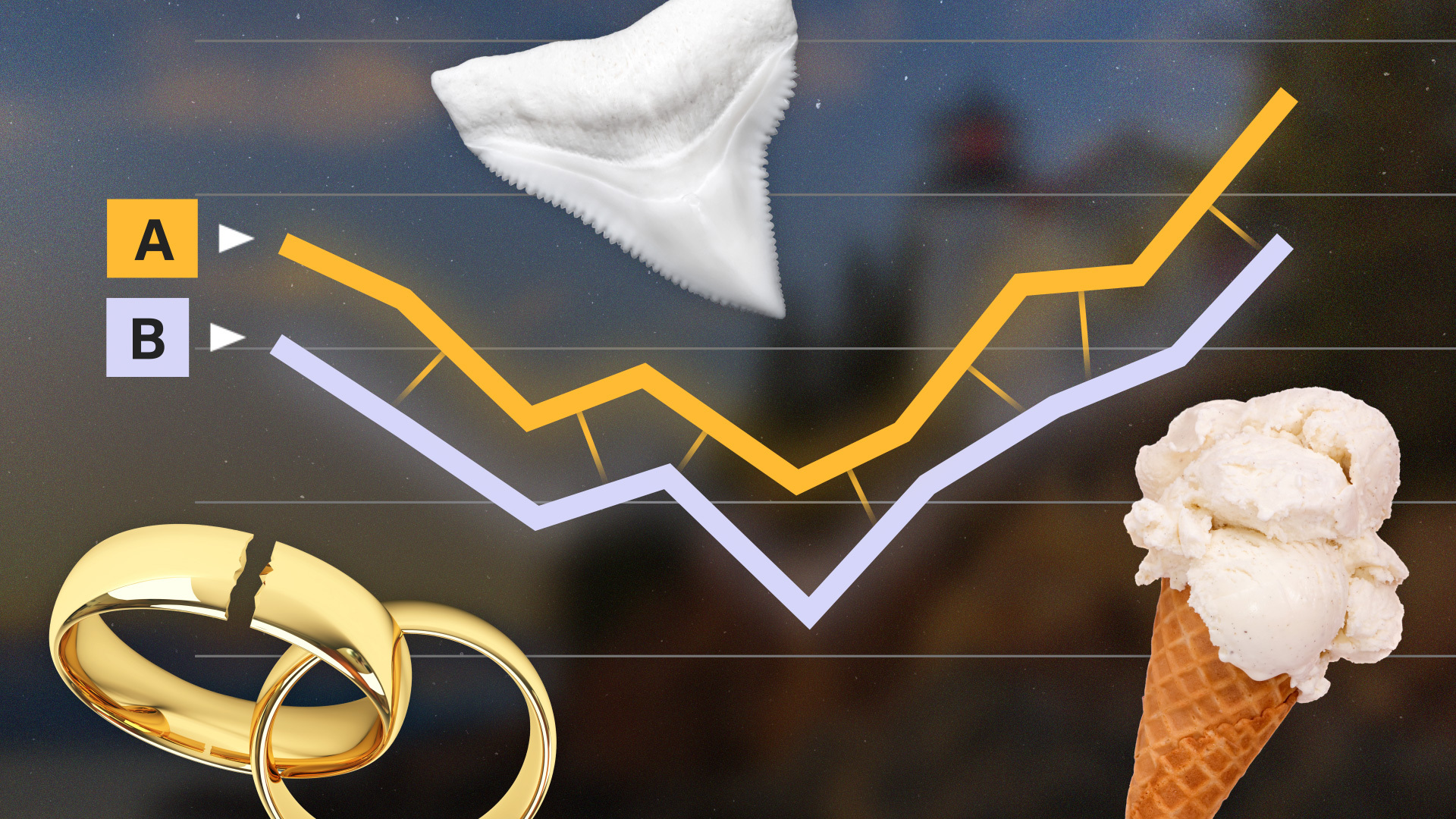
show a strong correlation between national margarine consumption and the divorce rate in Maine
0:51
As margarine consumption steeply declined from 2000 to 2005, divorce rates fell
0:57
From 2005 to 2008, people across the country started to eat more margarine
1:02
And lo and behold, more people in Maine got divorced. As convincing as that graph might be, margarine isn't spreading divorce
1:09
That graph is simply showing a correlation. Two other things that move together, ice cream sales and shark attacks
1:16
both increased seasonally in the summer, peaking around August. They just, they both happened in the summer, you know
1:22
when people are sort of, it's hot and people are swimming more. Um, so the distinction there is like, again, correlation is sort of just things that kind of move together in a sense
1:32
Causation is really this concept or idea that something leads to something else
1:38
While some relationships reflect true biological links, others like ice cream sales and drownings or margarine consumption and divorce rates are mere coincidences
1:47
Confusing correlation and causation is easy to do. Researchers report different, sometimes conflicting findings
1:55
But major health and science decisions, such as the approval of a new drug or the reversal of long-standing health guidelines
2:03
require that scientists and politicians follow careful procedures to sort out correlation from causation
2:09
In the early 1970s doctors blamed stomach ulcers on stress But then in the 1980s Dr Barry Marshall and Dr Robin Warren noticed a certain bacteria called H pylori consistently colonized the stomach lining of stomach ulcer patients
2:26
H. pylori is now known to spread through contaminated food or water or through direct
2:30
contact with a contaminated person's feces. The doctor's observation was a correlation
2:36
Then, in 1984, Marshall, who later won the Nobel Prize, famously drank a culture of H. pylori
2:43
bacteria. A few weeks later, he developed gastritis, an inflammation of the stomach
2:47
lining that can cause a burning pain or ache in the upper belly, vomiting, or a loss of appetite
2:53
This proved causation, albeit in a not-so-ethical or controlled way. Marshall then cured himself
2:59
with antibiotics. So the best case scenario, and this is sort of very common in the medical
3:05
and like food and drug association world is a randomized trial where we might have some
3:11
exposure of interest, some, again, maybe a new program, a new medication
3:15
And we literally enroll people in a study and randomly assign them to get it or not get it
3:22
In many situations, scientists cannot perform the types of controlled experiments needed to
3:27
prove causation. There's a number of approaches that people can use, you know. So basically
3:31
a lot of the time in the absence of randomization, people try to sort of at least find a comparison
3:37
group, like a group of people who didn't get, say, the new medication, but who look as similar
3:43
as possible to those who did. And so the idea is to, again, sort of in some sense, try to have data
3:50
that looks like it could have been randomized. It wasn't, and we have to acknowledge that
3:55
but where we at least say, well, you know, maybe we want to compare what is the effect of eating
4:00
ultra-processed foods. Scientists know that people who eat a lot of ultra-processed foods
4:05
are quite different from those who do not. They live in different environments, they might have
4:10
different exercise strategies, they might have other pre-existing health conditions. What an
4:14
epidemiologist might do is look at their data and find a group of people who are similar to the ones
4:19
who eat a lot of ultra-processed foods but who didn't consume them, perhaps because they lived
4:23
somewhere where they had better access to a grocery store or fresh foods. Statisticians might try to
4:28
group people based on similar health conditions age or other socio factors Whether it ultra foods or autism risk new studies are constantly published around the world
4:40
Some studies agree. Some conflict. At what point do scientists and policymakers determine that we know enough to form a conclusion
4:47
There's sort of a spectrum here, and certainly for, say, a new drug approval by the Food
4:53
and Drug Administration, there's a very formal process, and they require randomized trials
4:58
and sort of a very thorough process to sort of establish that causal link and in some sense
5:05
like statistical proof that some new medication or treatment really does improve outcomes
5:11
In other scenarios where, yeah, it's maybe more recommendations like the ultra processed foods
5:18
And honestly, also, those are often murkier. There's just sort of there's so many factors that relate to health broadly
5:26
I think that's where it really is about a body of evidence
5:29
In the early 2000s, nutritional epidemiologist Carlos Augusto Montiero noticed a shift in Brazil
5:36
As traditional diets of rice and beans were replaced by soda and cookies, obesity rates surged
5:42
While he hypothesized that eating ultra-processed foods might cause the rise of obesity and chronic disease
5:48
so far all he had was a correlation. Since then, studies have found links between consumption of ultra-processed foods and a range of diseases
5:57
from obesity, diabetes, and high blood pressure, to depression, anxiety, inflammatory bowel disease, autoimmune disorders, and even cancer
6:05
Nutrition science is challenging because health is shaped by intertwining factors such as genetics, income, environment, and lifelong eating habits
6:15
That makes controlled experiments difficult. This has become especially important in recent months when science is cited in public debates to support political claims, like what has happened recently with Tylenol and autism
6:28
In late 2025, U.S. researchers reviewed 46 studies examining links between acetaminophen use in pregnancy and autism or ADHD
6:37
Of those 27 studies reported an increased risk 9 found no association and 4 suggested a possible protective effect Several studies also observed a dose relationship where higher use was tied to higher risk Late last year President Donald Trump said pregnant women who take acetaminophen commonly known as Tylenol in the U may increase their child risk of developing autism
7:03
I want to say it like it is. Don't take Tylenol. Don't take it. If you just can't, I mean, it's a fight like hell not to take it
7:14
there may be a point where you have to and that you'll you have to work out with yourself so don't
7:20
take tylenol. Numerous health organizations pushed back. Earlier this year European researchers
7:25
published a separate comprehensive review. They found statistically insignificant increases in the
7:31
odds of autism and intellectual disability, about three and 11 percent higher odds respectively
7:38
The researchers also found a decrease of three percent in the odds of developing ADHD. The
7:43
Researchers also examined sibling comparison studies. These helped control for factors such as shared genetics and family environment
7:51
And those yses found no increased risk of autism, ADHD, or intellectual disability
7:57
associated with acetaminophen use during pregnancy. All of the studies included here were observational studies
8:03
They described a correlation. None of them established causation. Thinking back to the correlation between shark attacks and ice cream sales
8:12
there was a third factor at play. It offered an explanation, and that was temperatures. In the
8:17
summer, as temperatures rise, more Americans go on beach vacations and swim in the water
8:22
They also eat more ice cream. Similarly, other factors might explain sporadic correlations
8:28
between Tylenol use and autism. Fever during pregnancy, especially during the first trimester
8:34
is linked to an increased risk of autism. Because pregnant women might be taking Tylenol to treat
8:39
the fever, the increased risk of autism and ADHD could be from the fever and not from the medicine
8:45
While the correlation between Tylenol and autism has been well researched, there has yet to be a
8:50
single study that proves how acetaminophen causes a range of neurodevelopmental disorders. But this
8:57
might be difficult, if not impossible, because it would be unethical to experiment on pregnant
9:02
women and their fetuses. For Straight Air News, I'm Jess Craig
#news
#Health Policy