Up next in 10


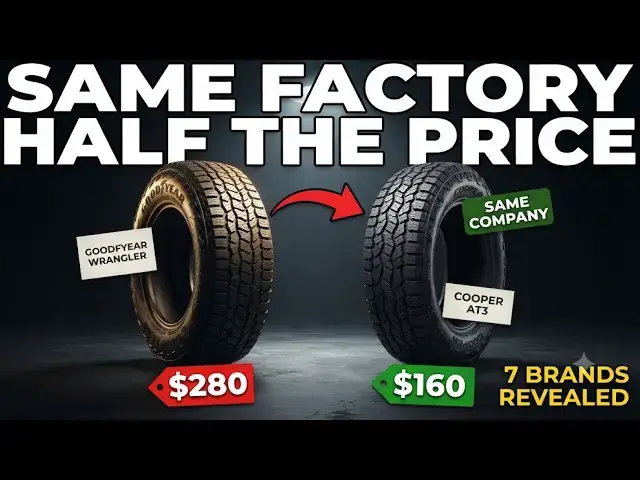
Are expensive truck tires actually better — or are you paying extra for the name on the sidewall?
In this video, we reveal 7 tire brands that many truck and SUV owners overlook, including Cooper, General Tire, Falken, Kumho, Toyo, Nexen, and Sailun. We also break down the 4 critical checks you should make before buying any new tires: treadwear rating, load index, brand ownership, and the DOT date code.
A familiar tire brand does not always mean better engineering. Sometimes, the difference between a premium tire and a cheaper alternative comes down to brand positioning, parent-company ownership, engineering heritage, and what you actually need your tire to do.
We look at how Cooper fits into Goodyear's portfolio, General Tire's connection to Continental, Falken's relationship with Sumitomo Rubber Industries, Kumho and Nexen's OEM presence, Toyo's independent engineering, and where Sailun fits into the value tire market.
You'll learn:
• How to read a tire's UTQG treadwear rating
• Why your tire's load index matters for towing and hauling
• Why the company behind a tire brand can change how you view its value
• How to check the DOT date code before buying a "new" tire
• Why a tire can already be years old before it reaches the shop
• Which affordable all-terrain tire brands deserve a closer look
• The difference between brand reputation and actual tire capability
• What to consider before buying tires for highway driving, gravel, snow, or light off-road use
Whether you're shopping for all-terrain tires, truck tires, SUV tires, or simply trying to find the best tire value for your money, this video will help you look beyond the logo and understand what you're actually buying.
The best tire is not always the most expensive tire.
Sometimes, the smartest purchase is the one you understand.
Which of these tire brands have you personally driven? Cooper, General, Falken, Kumho, Toyo, Nexen, or Sailun? Share your real-world experience in the comments.
Subscribe to YourMotorCare for weekly automotive breakdowns, tire buying advice, car maintenance tips, truck ownership advice, and the information that helps you make smarter decisions before spending money at the shop.
#Tires #TruckTires #AllTerrainTires #TireBuyingGuide #CarMaintenance #YourMotorCare
Show More Show Less View Video Transcript
0:00
The name on the sidewall is not what
0:01
keeps your truck on the road. The rubber
0:03
compound is, the tread design is, the
0:06
engineering behind it is. [music] And
0:08
here is the part the tire industry
0:10
quietly counts on you never finding out.
0:12
The name on the sidewall and the
0:14
engineering behind it are not always
0:16
coming from [music] the same place. Two
0:18
tires can roll off factories using
0:20
nearly identical [music] engineering
0:22
built to nearly identical standards. and
0:24
one can cost over $200 more across a
0:27
full set [music] simply because of the
0:29
badge on the sidewall. That is not an
0:31
accident. That is a business model. A
0:33
Cooper [music] Discoverer AT3 runs
0:35
around $150 to $220 a tire. A comparable
0:39
Goodyear Wrangler sits $50 to $60 higher
0:43
for the same [music] size. Most buyers
0:45
assume the gap exists because the
0:47
Goodyear is a better tire. It is not
0:49
always. And the reason why will
0:51
completely change how you read a tire
0:53
price tag from this point forward. There
0:55
are seven brands on this list. Every
0:57
single one is backed by engineering that
0:58
[music] most buyers never connect to the
1:00
name on the sidewall. But before we get
1:02
to any of them, four checks, because
1:04
none of these brands are worth buying if
1:06
[music] you do not know how to pick the
1:07
right tire from the right shelf on the
1:09
right week. The four checks that
1:10
actually matter. Check one, the tread
1:13
wear rating. Picture the sidewall of a
1:15
tire stamped into the rubber required
1:17
[music] by federal law is a three-digit
1:19
number called the UTQG tread wear
1:22
rating. Around [music] 300 is balanced
1:24
life for an allterrain. 500 and above
1:27
means longlasting [music] tread.
1:29
Anything near 200 will wear fast. No
1:31
matter what the price tag says, [music]
1:33
no matter how aggressive the tread
1:35
looks, no matter how confident the
1:37
salesperson sounds, this number is on
1:39
every tire. Most [music] buyers walk
1:41
past it without looking. Check two. The
1:43
load index. Every vehicle has a load
1:46
rating on the door jam sticker. Your
1:48
replacement tires must match or exceed
1:50
that number, especially if you tow,
1:52
haul, or carry heavy loads regularly. A
1:55
tire with the wrong load index is not a
1:57
bargain. At a certain point, it is a
1:59
safety problem. Two digits on the
2:00
sidewall next to the speed rating. Takes
2:03
5 seconds to check, most people [music]
2:05
never do. Check three. Who actually owns
2:08
the brand? This is the check that makes
2:10
the rest of this video make sense.
2:11
[music] The global tire industry is
2:13
controlled by a small number of parent
2:15
companies. Goodyear, Continental,
2:17
Sumitomo, Michelon. Between them, they
2:20
own or supply technology [music]
2:22
to dozens of brands that most buyers
2:24
treat as completely separate
2:26
competitors. [music] When a smaller
2:27
brand sits inside that engineering
2:29
family, the compound development and
2:31
construction [music] standards flow
2:32
down. You get the engineering without
2:34
the badge premium. This is exactly what
2:36
connects every brand on this list. Check
2:39
[music] four, the dot date code. This is
2:41
the one almost nobody does at the shop
2:43
and it might be the most important check
2:44
of all. Zoom into any tire sidewall and
2:47
you will find a code starting with the
2:49
letters DOT. At the end of that code,
2:51
four digits. [music] The first two are
2:53
the week it was made. The last two are
2:55
the year. A tire stamped 1823 was
2:58
manufactured in the 18th [music] week of
3:00
2023. Here's why that matters. Rubber
3:02
does not age only from use. It ages from
3:05
time. Heat, [music] UV exposure, and
3:07
oxidation harden rubber compounds.
3:10
Whether a tire is mounted on a truck
3:12
doing highway miles or sitting untouched
3:14
in a warehouse, most major tire
3:16
manufacturers recommend replacement
3:19
after 6 to 10 years, regardless of how
3:21
much tread remains. If a tire was built
3:23
2 years before it reached the shop
3:25
shelf, your brand new tire is already 2
3:27
years old the day you buy it. Ask the
3:29
shop to show you the date code. Ask them
3:32
to pull the freshest stock in your size.
3:34
It [music] takes 30 seconds. Most people
3:36
who have bought tires their entire lives
3:38
have never done it once. Now the [music]
3:40
list starting with the brand whose
3:43
parent company paid 2.5 billion to own
3:46
it and then kept quiet about it. Number
3:48
one, Cooper Discoverer at three. Cooper
3:51
was founded in 1914 in Finley, Ohio. For
3:54
over a century, it was an independent
3:55
[music] American tire manufacturer with
3:57
its own reputation. Then in June 2021,
4:00
Goodyear completed an acquisition of
4:02
Cooper in a deal valued at approximately
4:04
$2.5 billion, confirmed in Goodyear's
4:08
own SEC filings. Here is what Goody Year
4:10
did next. They did not absorb the brand.
4:13
They did not rename it. They kept Cooper
4:15
running as a separate label positioned
4:17
as the value tier in the Goodyear
4:18
[music] portfolio. So, when you walk
4:20
into a tire shop today and see a Cooper
4:22
Discoverer AT3 on one shelf and a
4:25
Goodyear Wrangler on the shelf above it,
4:27
you're looking at two products from the
4:28
same parent company. The Cooper runs $50
4:31
to $60 per tire less. The AT3 carries a
4:35
three peak mountain snowflake rating for
4:38
genuine severe snow certification.
4:40
[music]
4:40
It handles daily highway driving, holds
4:43
up on gravel and light trails, and does
4:46
all [music] of it at a price the badge
4:48
above it cannot match. The engineering
4:50
lineage is now the [music] same house.
4:52
Number two, General Tire Grabber. In
4:55
1987, Continental AG acquired General
4:58
Tire for $628 million. That [music]
5:01
single transaction turned a respected
5:03
American independent into Continental's
5:05
value tier brand positioned to carry
5:08
Continental Engineering at a price below
5:11
the Continental name. The way the
5:12
industry describes this is trickle down
5:15
technology compounds proven in
5:17
Continental's flagship tires for years
5:19
eventually appear in General's more
5:21
accessible lines. The buyer gets the
5:23
engineering inheritance without the
5:25
flagship price. Picture standing in a
5:27
tire aisle looking at a general tire
5:29
grabber on one side and a Continental
5:31
Allterrain [music] on the other.
5:33
Different names, same engineering
5:35
parent. The Grabber sits noticeably
5:37
lower in price. For most everyday truck
5:40
and SUV drivers who spend the majority
5:41
[music] of their time on pavement and
5:43
occasional gravel, that gap is the
5:45
entire story. Number three, Falcon Wild
5:48
Peak. Most buyers who have heard of
5:50
Falcon think of it as [music] a
5:51
performance brand. Drift cars, track
5:53
tires, motorsport. What almost nobody
5:56
connects to that name is the company
5:57
behind it. Sumitomo Rubber Industries,
6:00
[music] one of Japan's largest tire
6:02
manufacturers. Founded in Kobe in 1909,
6:05
Falcon launched as a performance
6:07
subbrand [music] in 1983 and was
6:09
formally merged into Sumitomo in 2003.
6:12
The Wild Peak AT3W did not build [music]
6:15
its reputation through advertising. It
6:17
built it through overlanders comparing
6:19
notes on forums after [music] actual
6:21
trail use. The kind of environment that
6:23
exposes a weak tire within the first
6:25
[music] few runs. Three ply sidewall
6:27
construction. Genuine winter
6:29
certification. Highway manners
6:31
noticeably quieter than many allterrain
6:33
competitors at comparable price points.
6:36
When a reputation is built by owners
6:38
talking to each other rather than by a
6:40
marketing budget, that is usually a
6:42
signal worth listening to. Number four,
6:44
Kumho Road Venture. Here's a question
6:46
most people cannot answer honestly.
6:48
Would [music] you trust a tire brand if
6:50
Porsche, BMW, and Mercedes-Benz all
6:53
chose it for factory fitment? Kumho was
6:56
founded in South Korea in 1960. Today,
6:58
it is a verified original equipment
7:00
supplier to Porsche, BMW, [music]
7:02
Mercedes-Benz, Audi, Volkswagen,
7:04
Hyundai, Kia, and Ram across multiple
7:07
vehicle lines confirmed [music] in Nexon
7:09
and Kumho's own press releases and
7:12
automotive trade publications. Those are
7:14
not marketing partnerships. Those are
7:16
engineering evaluations. When a
7:17
manufacturer puts a tire on a Porsche
7:19
Cayenne, [music] that tire passed years
7:21
of internal testing before it ever
7:23
touched a production vehicle. And here
7:25
is the uncomfortable truth about OEM
7:27
tires that applies to every brand on
7:29
this list. Factory fitment tires are
7:32
built to the automaker's cost
7:35
specification, not necessarily to the
7:37
best standard the [music] brand sells in
7:39
the aftermarket. The tire a manufacturer
7:42
puts on the factory floor [music] is not
7:43
always the one to judge the brand by.
7:46
The Road Venture AT line, what Kumho
7:48
sells at retail for everyday truck
7:50
owners, delivers real wet grip, [music]
7:53
solid tread life, and reinforced
7:55
shoulders for light off-road use [music]
7:57
at a price that reflects brand
7:59
recognition more than capability. The
8:01
brand that supplies Porsche is not the
8:04
brand most people reach for in a tire
8:06
shop. That [music] gap is the
8:07
opportunity. The next brand on this list
8:09
does not hide behind any conglomerate at
8:12
all. No Goodyear, no Continental, no
8:14
Sumitomo. [music] stands completely on
8:16
its own and that independence turns out
8:18
to be the reason experienced truck
8:20
owners trust it, [music] not despite it.
8:22
Number five, Toyo Open Country, a T3.
8:25
Every brand so far has been stronger
8:27
because of who owns it. Toyo is stronger
8:30
because of what it built itself. Founded
8:32
in Japan in 1945, Toyo runs its own
8:35
compound research, its own off-road
8:37
racing program, and its [music] own
8:39
testing protocols. No parent company's
8:41
chemistry, no trickle down technology
8:43
from a conglomerate. Decades of
8:45
motorsports funding pushed into
8:47
production tires that get tested in
8:49
conditions washboard gravel, loose rock,
8:52
deep ruts that separate a tire that
8:54
looks capable from one that actually is.
8:57
[music] Independent test data puts the
8:59
Open Country AT3's dry stopping [music]
9:02
distance at 131.5 ft, outperforming the
9:05
BFG Goodrich KO2 in that specific
9:09
measure. It is quieter on the highway
9:11
than the [music] KO2 because its tread
9:13
block layout is tuned for a driver who
9:15
commutes during the week and trails on
9:17
weekends, not for [music] someone
9:19
crawling rock faces every Saturday. It
9:21
runs roughly 10 to 15% less than the
9:25
[music] KO2 in comparable sizes. The
9:28
reputation was built without a
9:30
conglomerate behind it. That is a harder
9:32
thing to fake. Number six, Nexon
9:34
Rodient. Most people have walked [music]
9:35
past a Nexon tire without a second look.
9:38
Here is what they walked past. Nexon was
9:40
founded in South Korea in 1942. As of
9:43
2025, Nexon is a confirmed original
9:46
equipment tire supplier to Porsche,
9:48
MercedesBenz, BMW, [music]
9:50
Audi, Volkswagen, Hyundai, Kia, Ram, and
9:53
Jeep, supplying factory tires across
9:55
more than 80 vehicle models globally.
9:58
That information comes directly from
9:59
Nexon's press releases and automotive
10:02
trade coverage, including the Korea
10:04
Times and Tire Review. Porsche does not
10:06
make careless choices about what goes on
10:08
a Cayenne. The evaluation process for an
10:11
OEM supplier takes years and covers load
10:14
[music] performance, wet grip, noise,
10:16
durability, and failure modes under
10:18
stress. Nexon cleared all of it for the
10:20
Cayenne, [music] the Panamera, and the
10:22
Macan simultaneously. The Roodian ATX
10:25
carries [music] that same engineering
10:27
into a tire that runs around $130 in
10:30
common sizes. [music] Quiet enough for a
10:32
daily commute, capable enough for
10:34
weekend trails. At that price, for
10:36
[music] what the brand has proven in
10:37
front of the most demanding engineering
10:39
teams in the automotive industry, it is
10:41
one of the widest gaps between
10:43
perception and reality on this entire
10:46
list. Number seven, Salin Terramax.
10:48
Every brand so far has had a major
10:50
engineering story behind the name. This
10:52
one does not. And that honesty [music]
10:54
is exactly why it earns its place here.
10:56
Salin is independent, just over two
10:59
decades old. No Goodyear inheritance, no
11:02
Continental Chemistry, no Sumattomo
11:04
manufacturing scale. [music] What it
11:06
does have is a compound it built from
11:08
scratch and a price that runs around
11:11
$100 [music]
11:12
to $120 a tire. Hundreds less across a
11:15
full set compared to the premium names
11:17
above it. What that price buys, real
11:19
[music] traction on gravel, mud, and
11:22
light snow. What it does not always buy
11:24
the highway refinement of Falcon or
11:27
[music] Toyo or the decades of
11:28
engineering pedigree that Kumho and
11:30
Nexon can point to. [music] Some owners
11:32
report increased road noise as the tires
11:35
age past the midpoint of their tread
11:37
life. That [music] is the real trade,
11:39
not a hidden one. For a truck owner
11:41
whose driving is mostly errands, light
11:43
gravel, and occasional trail use, not
11:45
serious off-road conditions, the saleax
11:48
is still a smart decision. As long as
11:50
you go in [music] knowing exactly what
11:52
you are buying and what you are not,
11:54
here is what to take away. The name on
11:56
the sidewall [music] tells you the
11:57
brand. It does not tell you the
11:59
engineering. Cooper is Goodyear's value
12:01
tier. General is Continentals. [music]
12:03
Falcon is Sumitomo. That information
12:06
alone changes how you read every tire
12:08
shelf you will ever stand in front of.
12:11
Run the four checks [music] before any
12:12
purchase. Treadware rating, load index,
12:16
who owns the brand, and the [music] DOT
12:18
date code. Four digits on the sidewall
12:21
that tell you how old that tire actually
12:23
is before it ever touches your truck.
12:25
The gap between what a tire can do and
12:27
what buyers [music] assume it can do
12:29
based on nothing more than a name is
12:31
where the real money is either saved
12:33
[music] or spent. Now you know where to
12:34
look. If this changed how you will buy
12:37
your next set of tires, that is worth a
12:39
like because every truck owner [music]
12:41
who sees this before walking into a tire
12:43
shop saves real money on that visit.
12:46
Subscribe to Your Motor Care for
12:47
breakdowns like this every week. No
12:50
filler, no sponsorships, [music] just
12:52
the information that puts you on the
12:53
same side of the counter as the people
12:55
who actually know how this industry
12:57
[music] works. And drop this in the
12:59
comments. Which of these seven brands
13:01
have you actually mounted and driven?
13:03
And what did [music] you think?
13:03
Realworld notes from real drivers are
13:06
how the rest of us figure out what holds
13:08
up when the road goes
Autos & Vehicles