Up next in 10


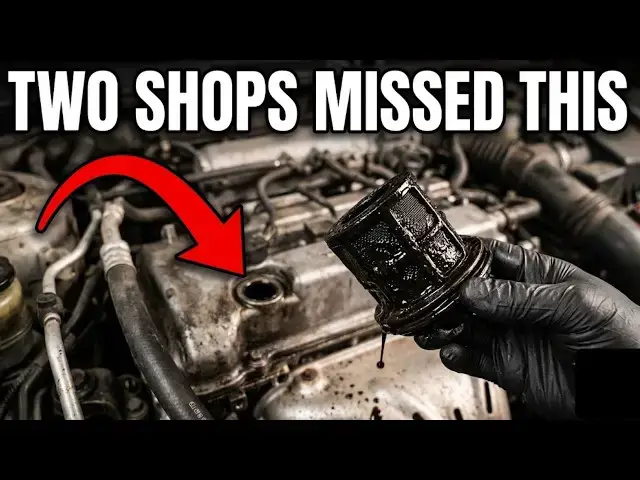
Two shops. Two invoices. $570 spent. The real fix cost $20 — and it took 15 minutes. If your engine has a rough idle, fading power, or a lean code that keeps coming back, this video explains exactly why the diagnosis keeps coming back wrong.
🔍 WHAT THIS VIDEO COVERS
Most drivers know their engine has an air filter. Almost nobody knows it has a second system that works in the opposite direction — and when that system fails, it triggers symptoms that look exactly like a failing sensor, a dirty throttle body, or a blown gasket. Two different shops diagnosed this truck twice. Both were wrong. Both invoices made sense on paper. Here is what they both missed, how to check it yourself in under two minutes, and why your driving habits decide how fast this problem develops.
─────────────────────────────────────
⏱️ CHAPTERS
─────────────────────────────────────
0:00 — Two shops, two wrong diagnoses, one cheap fix
1:45 — Why a correct fault code can still lead to the wrong repair
3:20 — How crankcase pressure builds and what happens when it cannot escape
5:10 — Rough idle, lean codes, and power loss explained by one clogged part
7:00 — Why this misdiagnosis happens across trucks, sedans, and SUVs
8:30 — The smoke alarm analogy — why scan tools read symptoms not causes
10:15 — How to check your crankcase ventilation system at home in 2 minutes
11:00 — When the cheap fix is not enough — signs of deeper engine wear
─────────────────────────────────────
✅ CHECK THIS BEFORE YOUR NEXT REPAIR
─────────────────────────────────────
→ Rough idle that came on gradually over weeks or months
→ Lean code (P0171 or P0172) that returns after sensor replacement
→ Power loss especially when climbing hills or under load
Show More Show Less View Video Transcript
0:00
Two shops looked at the same truck and
0:01
both got it wrong. And the part everyone
0:03
overlooked costs less than an oil
0:05
change. On May 19th, 2026, a Silverado
0:09
came into my bay with a folder. Not a
0:11
print out, a folder. Two estimates
0:13
stapled [music] from two different shops
0:15
6 months apart for the same set of
0:17
symptoms. Rough [music]
0:18
idle fading power on hills. A check
0:21
engine light that wouldn't quit. Shop
0:23
one said mass air flow sensor $310.
0:26
[music] The truck got worse. Shop two
0:29
said throttle body plus an idle relearn.
0:32
$260. [music] The truck got worse again.
0:34
By the time it got to me, the owner
0:36
wasn't looking for a third opinion. He
0:38
was looking for someone to tell him the
0:39
truck was just done. It [music] wasn't
0:41
done. Both shops had been staring at a
0:43
real problem and treating the wrong half
0:45
of it. The strange part wasn't that both
0:47
shops missed it. The strange part was
0:49
that both estimates actually made sense.
0:51
[music] Every symptom pointed toward
0:53
exactly the parts they replaced. A lean
0:56
code really can mean a failing sensor. A
0:58
rough idle really can mean a tired
1:00
throttle body. That's what makes this
1:02
mistake [music] so expensive. Not that
1:04
the technicians were careless, but that
1:06
the computer was telling the truth, just
1:07
not the whole truth. [music] And when
1:09
the data is technically accurate, but
1:11
incomplete. Even experienced [music]
1:13
people end up fixing a component that
1:15
was never broken in the first place.
1:17
Once I show you what they were actually
1:19
[music] missing, you'll understand why
1:21
this exact mistake happens in driveways
1:23
and dealerships. every single day on
1:26
vehicles [music] that have nothing else
1:27
in common. The engine's other job.
1:29
Here's the part nobody walks you
1:31
through. Your engine doesn't have one
1:32
job, [music] it has two. Everyone knows
1:34
the first one. Air goes in, mixes with
1:37
fuel, burns. That's the half with the
1:39
big plastic box, [music] the paper
1:41
filter, the part every quick lube guy
1:43
holds up to the light and says, "Yeah,
1:45
you need this." But for every breath an
1:47
engine takes in, it also has to let
1:49
something out. not through the tailpipe.
1:51
From somewhere most owners have never
1:54
been told to look inside the engine.
1:56
Every time a piston fires, a little bit
1:58
of pressure and unburned gas [music]
2:00
slips past the rings and down into the
2:03
crank case. The lower part of the engine
2:05
where the oil sits. Mechanics call this
2:07
[music] blowby. And here's the thing, it
2:08
happens in every engine ever built. New
2:11
ones, tired ones. [music] It's not
2:12
damage, it's physics. But it means
2:14
pressure is constantly building down
2:16
there. And that pressure has to go
2:18
[music] somewhere or it pushes oil out
2:20
through every gasket and seal it can
2:22
find. [music] So there's a second
2:23
system, one most drivers never hear
2:26
named out loud, the [music] crankcase
2:28
ventilation system. Its job is to bleed
2:30
that pressure off safely and route the
2:33
leftover [music] vapor back into the
2:35
engine to be burned instead of vented
2:37
into the air. [music] Depending on the
2:38
vehicle, that system runs through a
2:40
small valve, a vent filter, or both.
2:43
usually [music] tucked on top of the
2:44
valve cover or buried on a hose. You'd
2:47
never notice unless [music] someone
2:48
pointed a flashlight at it. That's the
2:50
engine's exhale. And it is one of the
2:53
most commonly overlooked maintenance
2:54
items I see in the shop. [music] It's
2:56
not just trucks. I've seen this exact
2:58
chain reaction on halfton trucks that
3:00
tow every weekend with the symptom
3:02
showing up as power loss right when the
3:04
engine is under the most load. I've seen
3:07
it on commuter sedans that never [music]
3:08
leave city traffic where the giveaway
3:10
was a rough idle at every red light and
3:13
nothing else. I've even seen it on SUVs
3:15
that never threw a single warning light,
3:17
no check engine lamp, no code, nothing
3:20
until the owner noticed fuel economy had
3:23
quietly dropped for no reason they could
3:25
explain. Different vehicles, [music]
3:27
different engines, same root cause
3:29
showing up as different symptoms because
3:31
every manufacturer's computer reacts
3:34
[music] to that disrupted air flow a
3:37
little differently depending on how
3:38
aggressively it [music] corrects fuel
3:40
trim and how sensitive its idle control
3:43
strategy is. That's exactly why this
3:45
gets misdiagnosed [music] across so many
3:47
makes and models instead of just one.
3:49
There's no single fingerprint to
3:50
recognize, only [music] a pattern
3:52
underneath several different ones. why
3:55
both shops got it wrong. This is exactly
3:57
where both of those shops went [music]
3:59
wrong on that Silverado. When the
4:00
crankase side starts to clog or fail, it
4:04
doesn't just [music] affect the crank
4:05
case itself. It throws off the air the
4:07
engine's computer is measuring to set
4:09
the fuel mixture because that
4:11
ventilation path isn't sealed away from
4:13
the intake side, [music] it's part of
4:14
it. So, the idle starts to hunt. Power
4:17
fades, especially [music] climbing
4:19
hills. The computer sees the airflow
4:21
numbers go sideways and throws a code.
4:24
Lean condition, idle control fault,
4:27
airflow performance. [music] Every one
4:29
of those codes is real. None of them
4:31
tells you why. Think of a smoke alarm.
4:33
It tells you there's smoke. It doesn't
4:35
tell you whether that smoke came from
4:36
burnt toast, a faulty wire, [music] or a
4:39
real fire starting in the wall. Engine
4:41
codes work exactly the same way. They
4:43
report what the computer can actually
4:45
measure. voltage, [music] air flow, fuel
4:48
trim, not the event that started the
4:50
chain reaction. A lean code [music] is
4:52
the smoke alarm going off. It's
4:54
accurate. It's also not the fire. And
4:56
[music] this is the uncomfortable part,
4:58
the part I wish more shops said out
4:59
loud. A scan tool reads symptoms, not
5:03
causes. When a code says lean, it
5:05
doesn't know if that's a $300 sensor or
5:07
a $20 filter, letting unmetered air
5:10
sneak past it. So, a shop chases the
5:12
part the code is officially attached to,
5:15
replaces the sensor, the throttle body,
5:17
runs the relearn, and sometimes that
5:19
genuinely [music] fixes it. But
5:20
sometimes the real fault is one step
5:23
upstream in a system that's never on the
5:26
maintenance sticker, [music] never on
5:27
the inspection checklist and never gets
5:30
checked first because most diagnostic
5:32
[music] procedures don't direct
5:33
technicians to inspect it before
5:35
anything else. I want to be fair to
5:37
those two shops [music] because I'm not
5:38
telling you this to drag anyone. A lot
5:40
of good technicians have never been
5:42
taught to check the pressure relief
5:43
system before throwing parts at a lean
5:45
code because [music] most training and
5:47
most shop software walk you straight
5:49
from code to part. It's not laziness.
5:52
It's a gap in how the [music] diagnosis
5:53
is structured industrywide. What
5:55
actually fixed it? Here's what actually
5:57
happened on that [music] truck. I pulled
5:59
the crankase vent filter before touching
6:01
anything else. It was black, saturated,
6:03
[music] completely restricted. I checked
6:05
the hoses for cracking, replaced the
6:07
filter, cleared the codes, and let it
6:09
idle through a relearn. The [music] idle
6:11
settled in under five minutes. The lean
6:14
code didn't come back. Total parts cost
6:17
under $25. The honest caveats. But
6:20
here's the honest caveat because I'm not
6:22
going to pretend this is always that
6:24
clean. On some vehicles, certain BMWs
6:27
[music] and German platforms especially,
6:29
the crankcase ventilation system isn't a
6:31
cheap standalone filter. It's built
6:33
directly into the valve cover as one
6:36
sealed unit. And when it fails, you're
6:38
not buying a $20 part. You're buying an
6:40
entire valve cover assembly, sometimes
6:42
with several hours of labor to reach it.
6:45
That's a real $800 to $1,400 [music]
6:48
repair, and no amount of optimism
6:50
changes that. The fix is the same idea.
6:52
The bill is not. Know which kind of
6:54
system you actually have before you
6:56
assume this [music] is a weekend fix.
6:57
There's a second honest caveat, too, and
6:59
it matters just as much. Clearing this
7:02
doesn't always end the story. If a
7:04
crankcase [music] filter is clogging
7:06
fast repeatedly in just a few thousand
7:09
miles, that's not the filter's fault.
7:10
That's [music] a sign the engine is
7:12
producing more blowby than it should,
7:14
which can point to worn piston rings or
7:16
a tired cylinder on a high mileage
7:19
engine. In that case, replacing the
7:21
filter isn't a [music] cure, it's a
7:22
test. If the symptoms disappear and stay
7:25
gone, you're fixed. If they come back
7:27
fast, you've just learned something true
7:29
about the engine that no scan tool would
7:31
have told you. And now you know to look
7:33
deeper instead of guessing again. How to
7:35
check this yourself. So, how do you
7:37
actually check this [music] before you
7:39
let anyone hand you an invoice? With the
7:41
engine warm and idling, slowly crack the
7:44
[music] oil filler cap. A healthy system
7:46
gives you a faint pull or barely
7:48
anything. If pressure visibly puffs
7:50
[music] out, if the cap tries to lift on
7:52
its own, that's a real sign. But treat
7:54
it as a clue, not a verdict. Because
7:56
crankcase [music] pressure pulses
7:58
naturally, and a light hand isn't always
8:00
a reliable gauge on its own. Pair it
8:02
[music] with a look inside the air
8:03
filter housing. Oily residue or a damp
8:06
filter where it should [music] be bone
8:07
dry tells you vapor is finding its way
8:10
back through a system that isn't venting
8:12
properly. [music] Two signs pointing the
8:14
same direction is worth far more than
8:16
either one alone. If your vehicle has a
8:18
serviceable [music] filter, this is one
8:20
of the easiest jobs in the entire engine
8:22
bay. 15 minutes. Basic hand tools, a
8:25
part that costs less [music] than a tank
8:27
of gas. If your system is the sealed
8:29
built-in kind, at least now you're
8:31
walking into a shop already knowing what
8:33
question to ask instead of nodding along
8:35
at whatever part name shows up first on
8:37
the estimate. Why some engines clog
8:40
faster than others. This is also where
8:42
your own driving habits quietly decide
8:44
how often you'll deal with this. Every
8:46
time you start a cold engine, combustion
8:48
produces moisture, and that moisture
8:50
ends up in the crank case right
8:52
alongside the blowby gas. On a drive
8:54
that's long enough to fully warm up,
8:56
generally [music] somewhere past 10 to
8:58
15 minutes of sustained driving, that
9:00
moisture boils off and gets carried
9:02
[music] out through the vent path like
9:04
it's supposed to. On a short trip, the
9:06
engine shuts off before that [music]
9:07
happens, and the moisture just sits
9:09
there. Do that often enough and you get
9:11
a thick, creamy buildup under the oil
9:13
cap, [music] sometimes called milkshake
9:15
sludge. That sludge doesn't stay put. It
9:18
travels through the same passages
9:19
[music] the ventilation system relies
9:21
on, and it clogs the filter or the valve
9:23
faster than dirt ever would [music] on
9:25
its own. This is exactly why a car used
9:28
almost entirely for short errands and
9:30
school runs will choke [music] this
9:32
system far sooner than the same engine
9:34
doing steady highway miles. The highway
9:36
car gets long enough drives to clean
9:38
[music] itself out every single time.
9:40
And the city car never does. Old overdue
9:42
[music] oil makes this worse because oil
9:45
that's broken down produces more vapor
9:47
and contributes more sludge forming
9:50
residue than fresh oil does. And a cheap
9:53
aftermarket filter that flows poorly
9:55
will choke up again within a few
9:57
thousand m even after a proper fix.
10:00
Which means the part you buy actually
10:01
matters here, not just whether you
10:03
replaced it. The fix for all of this
10:05
isn't complicated. [music] Change your
10:06
oil on schedule because clean oil
10:09
produces less of the residue that clogs
10:11
the system. If most of your driving is
10:13
short trips, [music] try to combine
10:15
errands into one longer drive when you
10:17
can, or take the long way home
10:19
occasionally. That one extra stretch of
10:21
[music] sustained driving is what
10:23
actually clears builtup moisture out.
10:25
And when you're already under the hood
10:27
checking your air filter, spend an
10:28
[music] extra 30 seconds checking this
10:30
system, too. since they sit close enough
10:32
together that there's no real excuse
10:34
[music] to skip it. The real lesson and
10:36
that's really the whole lesson here more
10:38
than any single part number. Two shops
10:40
[music] looked at this truck and both
10:42
treated a symptom like it was the
10:43
disease because nobody had ever taught
10:45
them to ask what the engine [music] was
10:47
trying to release on the other side of
10:49
that pressure. The most expensive repair
10:51
isn't always the part with the highest
10:52
price tag. Sometimes it's the first
10:54
wrong diagnosis. And the drivers who
10:56
save the most money usually [music]
10:58
aren't the ones who know every part
11:00
under the hood. They're the ones who
11:01
know where everyone else forgot to
11:03
[music] look. If this is the first time
11:05
anyone's explained the ventilation side
11:06
of your engine to you, that's worth a
11:08
like because that's [music] exactly how
11:10
this stops being a secret. And if you've
11:12
ever paid for a part that turned out to
11:13
be the wrong diagnosis entirely, tell me
11:16
what it was. [music] Those stories are
11:17
how the rest of us learn where the real
11:19
problem was hiding.
#Autos & Vehicles