Up next in 10


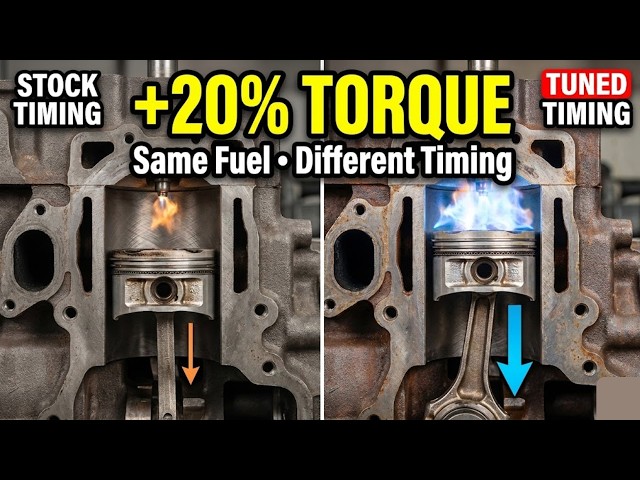
Is there really FREE horsepower hiding in your diesel engine? The answer doesn't come down to a bigger turbo or more fuel—it all comes down to diesel injection timing.
👇 Read more to unlock the science of diesel torque & emissions!
🚜 THE SECRET TO DIESEL HORSEPOWER
In this video from YourMotorCare, we break down exactly how diesel injection timing controls torque production and why modern diesels feel so restricted. Whether you are wrenching on an old mechanical Cummins 12-valve or driving a modern common-rail setup like a Hilux Revo GR, understanding this science is key. You'll learn why advancing timing by just 3-5 degrees can unlock 15-20% more torque, and exactly what EPA NOx emissions regulations did to modern diesel performance.
🔧 KEY DIESEL CONCEPTS EXPLAINED:
✅ Why peak cylinder pressure location matters more than the pressure amount.
✅ How pressure timing moves combustion in the stroke (15-25 degrees after TDC).
✅ The direct relationship between advanced timing, combustion temps (Above 1,400°C), and NOx formation.
✅ Why retarding timing kills low-end torque but satisfies EPA emissions standards.
⚠️ DISCLAIMER: This video is strictly for educational purposes. Modifying or deleting emissions equipment (like DPFs) is illegal for on-road vehicles in most jurisdictions and will void warranties. Always check your local laws.
🌐 READ MORE AUTOMOTIVE ENGINEERING:
Dive deeper into diesel tuning, engine maintenance, and automotive truths at our official website: https://yourmotorcare.com
💬 QUESTION OF THE DAY: Have you experienced the raw torque difference between old mechanical diesels and modern software-limited common-rails? Let me know your thoughts in the comments below!
⚡ If this video helped you understand the truth about diesel timing, hit that LIKE button! Subscribe to yourmotorcare for more heavy-duty diesel deep-dives, and ring the bell so you never miss a video!
Show More Show Less View Video Transcript
0:00
Today we're talking about why modern
0:02
diesel engines don't make the torque
0:03
they used to. And I'm not talking about
0:05
turbo size or fuel quantity. Here's the
0:08
thing. If you compare a mechanically
0:10
injected diesel from the 1990s to a
0:13
modern common rail diesel with the same
0:15
displacement, something weird happened.
0:17
The old engine makes more torque at low
0:20
RPM, runs stronger under load, and feels
0:23
way more responsive. [music] Same fuel,
0:25
same boost pressure. often the newer
0:27
engine actually has more technology. So
0:30
what changed? The answer comes down to
0:32
two words, [music] injection timing. And
0:35
when you understand how injection timing
0:37
actually works, how [music] it controls
0:39
where peak cylinder pressure happens
0:41
inside the stroke, you'll understand why
0:44
emissions regulations completely change
0:46
diesel performance. Not because [music]
0:48
they had to, but because of the
0:50
tradeoffs regulators forced
0:52
manufacturers to make. So, I'm going to
0:54
break down exactly [music] how injection
0:56
timing creates torque, why advancing or
0:59
retarding timing by just a few degrees
1:00
[music]
1:01
makes such a massive difference, what
1:03
emissions regulations did to diesel
1:05
calibration, [music]
1:06
and whether there's any way around it.
1:08
Let's get into it. How injection timing
1:10
[music] actually creates torque. First,
1:13
let's talk about what's actually
1:14
happening inside a diesel [music]
1:16
cylinder when it makes power. Your
1:18
diesel engine doesn't have spark plugs.
1:20
Instead, it compresses air until it's so
1:23
hot that when fuel gets injected, it
1:25
ignites on its own. That's compression
1:27
ignition. But here's the critical part
1:29
most people don't understand. Fuel
1:32
doesn't explode instantly. It takes
1:34
time. When fuel gets injected into that
1:36
super hot [music] compressed air,
1:38
there's a delay before it actually
1:40
ignites. That's called ignition delay.
1:42
Then once it starts [music] burning, the
1:44
flame front has to travel through the
1:46
combustion chamber, burning all the
1:48
fuel. That whole process takes [music]
1:50
time, anywhere from 30 to 50° of
1:53
crankshaft rotation. So if you inject
1:56
fuel at say 10° before top [music] dead
1:59
center, ignition might not start until
2:01
5° before TDC. And [music] peak cylinder
2:04
pressure, the absolute highest pressure
2:06
inside that cylinder might not happen
2:09
until [music] 15 or 20° after top dead
2:12
center. That timing matters a lot.
2:14
Here's [music] why. When the piston is
2:16
at the very top, top dead center, the
2:18
connecting rod is straight up and down.
2:20
There's zero [music] leverage on the
2:22
crankshaft. All that cylinder pressure
2:24
is just pushing straight down on a
2:26
vertical rod. It's not rotating
2:28
anything. But as the crankshaft [music]
2:30
rotates past TDC, the connecting rod
2:33
starts to angle. Now [music] you've got
2:35
leverage. The rod can actually push the
2:37
crankshaft around. Maximum [music]
2:39
torque happens when peak pressure occurs
2:41
around 20 to 30° after top dead center.
2:45
That's when you've got the best
2:46
combination [music] of high cylinder
2:48
pressure and good mechanical leverage.
2:50
If peak pressure [music] happens too
2:52
early, like a TDC or before, you're
2:55
wasting energy fighting the piston on
2:57
its way up. If it happens too late, like
3:00
40° [music]
3:00
after TDC, the piston's already halfway
3:03
down the bore and [music] you've lost
3:05
your leverage window. The sweet spot is
3:07
right around 15 to 25° [music]
3:10
after TDC for most diesel engines. And
3:13
injection timing is how you [music]
3:15
control where peak pressure happens. So,
3:17
how do engineers control pressure
3:19
timing? You adjust when fuel injection
3:22
starts. If you inject fuel earlier,
3:24
combustion starts earlier and peak
3:27
pressure moves earlier in the stroke.
3:29
Inject later, and everything shifts
3:30
[music] later. But it's not just
3:32
injection timing. Engineers have three
3:35
main tools. Injection timing. Start
3:37
[music] spraying fuel earlier or later
3:39
in the cycle. Piston bowl geometry. The
3:42
[music] shape of the bowl in the top of
3:44
the piston controls how the flame
3:46
travels. Swirl and turbulence. Spinning
3:48
the air faster [music] or slower changes
3:51
how quickly fuel mixes and burns. Change
3:54
any of those and you move where peak
3:56
pressure happens. You're not adding more
3:58
fuel. You're choreographing when and how
4:01
it burns. pre-emissions diesel [music]
4:03
engines like the Cumins 12 valve Detroit
4:06
diesel two-strokes mechanical injection
4:08
platforms. These engines ran aggressive
4:11
injection timing. They would inject at
4:13
maybe 12 [music] to 15° before TDC and
4:16
peak pressure would land right in that
4:18
torque zone around 20° after TDC.
4:22
[music] The result, massive low-end
4:24
torque. These engines would pull from
4:26
1,200 RPM like freight [music] trains.
4:28
But there was a problem, a big one. The
4:30
NOx problem. Here's what killed
4:32
aggressive injection timing. NOx,
4:35
nitrogen oxides. [music] NOx is formed
4:37
when combustion temperatures get really
4:39
high above about 1,400°
4:42
C. The hotter you burn, the more NOx you
4:45
create. And here's the connection.
4:46
[music] When you advance injection
4:48
timing to put peak pressure at 15 to 20°
4:52
after TDC, you're creating higher peak
4:55
cylinder pressures. Higher pressure
4:57
means higher temperature. Higher
4:59
temperature means way more NOx. [music]
5:01
It's chemistry. At those extreme
5:03
temperatures, nitrogen and oxygen in the
5:05
air start bonding together. That creates
5:08
NOx, which is invisible but terrible for
5:10
air quality and human health. By the
5:13
early 2000s, EPA and California Air
5:16
Resources Board regulations made high
5:18
NOx [music] combustion illegal.
5:20
Manufacturers had two choices. One, keep
5:23
pressure timing optimized [music]
5:24
for torque and fail emissions. Two,
5:27
timing to lower [music]
5:28
combustion temperatures and meet
5:30
regulations. They timing.
5:32
Modern diesels often have peak pressure
5:35
occurring at 18, 20, even [music] 25°
5:38
after TDC in some calibrations. That's
5:41
further from the optimal torque [music]
5:43
zone. Lower combustion temps, less
5:45
knocks, and less torque. Not because the
5:48
engine can't make it, because
5:49
regulations won't allow it. what the
5:51
regulations actually did. Let me give
5:53
you the actual numbers so you [music]
5:55
understand how drastic this got. In the
5:58
early 2000s, NOx standards were at 2.4
6:01
[music] g per brake horsepower hour. By
6:04
2007, that dropped to 0.2 g. And for
6:07
2027 model year engines, the standard
6:10
drops to [music] 0.035
6:13
g, an 82.5%
6:16
reduction from current levels. That's
6:18
insane. We're talking about cutting NOx
6:20
by over 90% compared to pre-emissions
6:23
engines. To meet [music] those
6:25
standards, manufacturers had to do
6:27
multiple things. injection timing
6:29
to lower combustion [music]
6:31
temperatures. Add exhaust gas
6:33
recirculation EGR to dilute [music] the
6:35
combustion charge. Add selective
6:38
catalytic seduction SCR with DEF [music]
6:41
fluid to clean up NOx in the exhaust.
6:43
Add diesel particulate filters DPF to
6:47
trap soot. But the foundation of all of
6:49
it was retarding injection timing.
6:51
[music] Move peak pressure away from the
6:53
torque zone and you lower combustion
6:55
temps right at [music] the source. The
6:57
trade-off, you can lose 8 to 10 kows at
7:00
the wheels just from timing [music]
7:02
changes with no additional fuel or
7:04
boost. That's real measurable torque
7:06
loss. The durability [music] excuse.
7:08
Now, manufacturers also claimed they
7:11
timing for durability. And
7:13
yeah, there's some truth to that.
7:14
Advancing pressure timing increases peak
7:17
cylinder pressures, rodbearing [music]
7:19
loads, crankshaft stress, and head
7:21
gasket failure risk. Push it too far and
7:24
you'll lift cylinder heads, spin [music]
7:26
bearings, crack pistons. But here's the
7:28
thing. Those pre-emissions heavyduty
7:30
[music] diesel engines ran aggressive
7:32
timing for decades. Cumins 12 valve
7:35
Detroit diesels mechanical injection
7:37
platforms. These engines were designed
7:40
with forged internals, steel pistons,
7:42
and robust bearing surfaces [music]
7:44
specifically to handle high combustion
7:47
pressure. They made massive torque and
7:49
ran a million miles. The difference is
7:51
they were designed for it. Modern
7:53
manufacturers chose to d-tune [music]
7:55
engines through timing rather than
7:57
engineer them to handle optimized
7:59
combustion. Why? Warranty costs. It's
8:02
cheaper [music] to timing and
8:03
lower stress than to build engines that
8:06
can handle [music] peak performance.
8:07
Torque took a backseat to spreadsheets.
8:10
Modern diesels are software limited.
8:13
Here's [music] what really gets me about
8:14
modern diesels. The hardware can handle
8:16
it. Forged cranks, nodular iron blocks,
8:19
[music] advanced high-pressure common
8:21
rail fuel injection systems. The engine
8:24
is physically capable of running
8:26
aggressive pressure timing. The ECU
8:28
won't let it. Modern diesel calibration
8:30
[music] is shaped by NOX limits,
8:32
articulate regulations, warranty
8:35
concerns, and global [music] fuel
8:36
quality compromises. So, engineers
8:39
program the ECU to injection
8:42
timing, [music] push peak pressure later
8:44
in the stroke, and flatten torque curves
8:46
to meet emissions at every single load
8:49
point. The result, a diesel engine that
8:51
could make 15 to 20% [music] more torque
8:54
at 1,800 RPM. But it won't because the
8:57
software says no. Diesel torque [music]
8:59
isn't limited by fuel or turbo size.
9:02
It's limited by timing maps written to
9:04
satisfy regulators. Proof it works. Look
9:07
at [music] deleted diesels. Guys running
9:09
tuned ECUs with emission systems
9:12
removed. They don't add massive turbos
9:14
or double the fuel. They advance
9:16
injection timing by 3 [music] to 5°.
9:19
Peak cylinder pressure shifts from 20°
9:22
after TDC back to 12 [music] to 15°
9:25
after TDC. And the engine makes 15 to
9:29
20% [music] more torque at the same fuel
9:32
quantity. Same air, same boost, [music]
9:35
same engine, different timing. That's
9:38
not magic. That's pressure [music]
9:39
timing working exactly as it should.
9:42
It's the same principle engineers used
9:45
in the 1990s before emissions [music]
9:48
regulations killed it. The engine always
9:50
had the torque potential. It was just
9:53
exploding in the wrong place. Why this
9:56
matters? Diesel engines aren't weak,
9:58
they're muzzled. The hardware is capable
10:01
[music] of making torque that modern
10:03
gasoline engines can't touch. But
10:05
emissions [music] regulations, warranty
10:08
paranoia, and global fuel quality
10:10
compromises [music]
10:11
force manufacturers to d-tune combustion
10:15
timing. Peak pressure [music] gets
10:16
pushed away from the torque zone, not
10:19
because it's better for performance,
10:21
because it's better for NOX numbers.
10:23
[music] And here's the irony. Retarding
10:26
timing actually lowers thermal
10:28
efficiency. You burn more fuel to make
10:31
the same power. Higher [music] fuel
10:33
consumption equals more CO2. They
10:36
reduced one pollutant by increasing
10:39
another, and they killed torque in
10:41
[music] the process. Now, I'm not saying
10:43
we should just ignore emissions. Air
10:45
quality matters. NOX [music] is
10:47
legitimately harmful, but it's worth
10:50
understanding the trade-offs. Modern
10:52
diesel engines are engineering marvels
10:55
that have been deliberately restricted
10:57
to meet regulatory [music] standards.
10:59
The performance potential is there. It's
11:01
just locked behind software. [music]
11:04
What you need to know. So, here's the
11:06
bottom line. Injection timing controls
11:09
where peak cylinder pressure happens in
11:11
the stroke. Get that pressure to land
11:14
around 20 to 30° after TDC, and you
11:18
maximize torque production.
11:20
Pre-emissions diesels ran aggressive
11:22
[music] timing, peak pressure right in
11:24
the torque zone, massive low-end grunt.
11:27
Emissions regulations forced [music]
11:29
manufacturers to timing to reduce
11:32
NOX. Peak pressure moved later in the
11:35
stroke, less torque. Modern diesels have
11:38
the hardware to make more power, but the
11:40
ECU timing [music] maps are written for
11:43
emissions compliance, not for
11:45
performance. If you want that old school
11:48
diesel torque back, [music] you need to
11:50
advance injection timing. But that means
11:52
deleting emissions equipment, which
11:54
[music] is illegal for on-road use and
11:57
will absolutely void your warranty. So,
11:59
you've got to make your own decision
12:01
about what matters more. Staying legal
12:04
and compliant or unlocking the
12:06
performance your engine was physically
12:08
built to deliver. [music] That's the
12:10
reality of modern diesel tuning. There
12:12
you have it. The real reason diesel
12:15
engines lost their legendary torque.
12:17
It's not about fuel quantity. It's not
12:20
about turbo [music] size. It's about
12:22
where combustion happens in the stroke
12:24
and emissions regulations forced [music]
12:27
that to change. If this helped you
12:29
understand diesel tuning better, hit
12:31
that subscribe button. We break down
12:33
complex automotive topics every week.
12:36
[music] Drop a comment. Do you think
12:38
emissions regulations went too far or
12:41
are they necessary for air quality?
12:43
[music] I want to hear your take. Thanks
12:45
for watching. Stay informed and
12:47
remember, understanding the engineering
12:49
makes you a better enthusiast. [music]
12:51
Whether you're staying stock or going
12:53
wild,
#Autos & Vehicles
#Autos & Vehicles
#Custom & Performance Vehicles
#Diesel Vehicles