Up next in 10


UML - OOA unified approach
Show More Show Less View Video Transcript
0:00
object-oriented analysis unified
0:02
approach so in this session we are going
0:05
to discuss and concentrate on this topic
0:07
in the previous video we have discussed
0:09
what is the unified approach and what is
0:12
the layered architecture in the next
0:15
video we'll be discussing
0:16
object-oriented design - unified
0:18
approach so object-oriented design
0:21
unified approach must be coming after
0:23
object-oriented analysis unified
0:25
approach so let us discuss what is the
0:28
object oriented analysis unified
0:30
approach and what are the steps to be
0:33
followed up with the numbers step 1 step
0:36
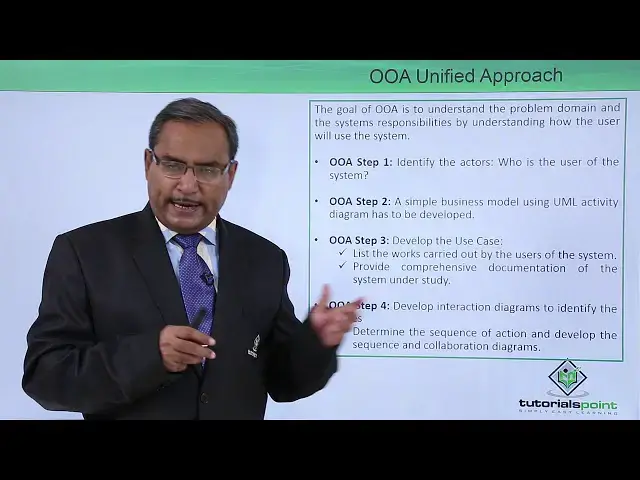
2 step 3 in this way so the goal of
0:40
object-oriented analysis is to
0:42
understand the problem domain and the
0:44
system responsibilities by understanding
0:47
how the user will use the system so
0:51
depending upon the users usage how the
0:53
user will use the system the analysis
0:56
has to be done and all the requirements
0:58
are to be gathered and they are to be
1:01
analyzed in this object-oriented
1:03
analysis phase so OAH step 1 identify
1:07
the actors who is the user of the system
1:11
so at first we are supposed to find out
1:13
all the actors what is the meaning of
1:15
the actors that means who will be the
1:17
user of the systems later we shall show
1:20
you that these actors can be categorized
1:21
as the primary actors and the secondary
1:24
actors next one is the object-oriented
1:26
analysis step number two a simple
1:29
business model using UML activity
1:32
diagram has to be developed so a simple
1:36
business model is to be developed and
1:38
here will be having the list of
1:41
operations or list of processes which
1:45
will be initiated by these actors they
1:48
are to be represented in certain diagram
1:51
next one is object-oriented analysis
1:54
step 3 so develop the use case leaves
1:57
the works carried out by the users of
2:00
the system and provide comprehensive
2:02
documentation of the system under study
2:05
so what is the use case use cases means
2:08
nothing but the functional requirement
2:10
of the system so what are the use
2:12
cases will be initiated by these actors
2:15
they are to be represented in a certain
2:18
diagram and then also we should have to
2:22
write one documentation where this UCS
2:24
detailing will be written step number
2:28
four Oh
2:29
step number four develop interaction
2:32
diagrams to identify the classes so
2:35
determine the sequence of actions and
2:37
develop their sequence and the
2:39
collaboration diagrams so in this
2:41
particular phase we are going to form
2:43
the sequence diagrams and that
2:45
collaboration diagrams and they are
2:47
collectively known as the interaction
2:49
diagrams so as we are not having the
2:52
idea on these particular diagrams we are
2:54
having the separate chapters we will be
2:56
discussing what is the sequence diagram
2:58
and what is the collaboration diagram I
3:00
can tell you this one that this sequence
3:02
diagram and collaboration diagrams they
3:05
are actually denoting that how the
3:07
messages are being passed and received
3:10
between objects in case of sequence
3:12
diagram will be discussing this passing
3:15
of messages and receiving of this
3:17
messages along with the time that at
3:20
what time which message has been
3:22
received by which object and which
3:24
message has been sent by which object
3:27
and their respective serial orders and
3:29
in case of collaboration diagram
3:32
actually it will give us a static or the
3:35
dynamic view rather I should say the
3:36
dynamic view of the system and hear how
3:39
this objects are passing their messages
3:41
and receiving their messages that will
3:44
be depicted so in the case of step four
3:46
we are interested to draw the respective
3:49
interaction diagram so now we are going
3:52
for object oriented analysis step five
3:55
developed static UML class diagrams so
3:58
here will be developing the class
4:00
diagrams identify the classes identify
4:03
relationships identify attributes and
4:06
identify their respective methods a
4:09
class will be consisting of certain
4:11
number of attributes which will be
4:13
holding values and certain number of
4:15
methods which will be denoting that what
4:17
are the permitted operations that we can
4:19
carry out on those attributes and
4:21
identify the classes with the proper
4:23
nomenclature should be there so that
4:25
from the gnome
4:26
richard itself we can get the idea what
4:28
is the purpose of that class and
4:30
identify the respective relationships
4:33
between these classes oh eh oh eh step
4:38
number six that is object-oriented
4:39
analysis step number six iterate and
4:42
define if needed and repeat the
4:44
preceding steps so again we shall go for
4:47
step number one to step number five
4:49
again and again until until the
4:51
refinement has been completed now the
4:54
analysis phase object-oriented analysis
4:57
phase will get completed so here you see
5:00
we're having this actors develop useless
5:02
activity diagrams developed interaction
5:05
diagrams here will be having the
5:06
sequence diagram and collaboration
5:08
diagrams identify the classes and
5:10
relationships and attributes and methods
5:12
so attribute means the respective values
5:14
whatwhat the class can hold and this
5:16
methods are the permitted operations on
5:18
them and refine and reiterate again and
5:22
again until the system has become stable
5:25
and in accordance with our requirement
5:27
so that is our object-oriented analysis
5:30
a unified approach thanks for watching
5:33
this video
#Business Operations
#Business Plans & Presentations
#Programming
#Programming
#Java (Programming Language)
#Software
#Business & Productivity Software