Up next in 10


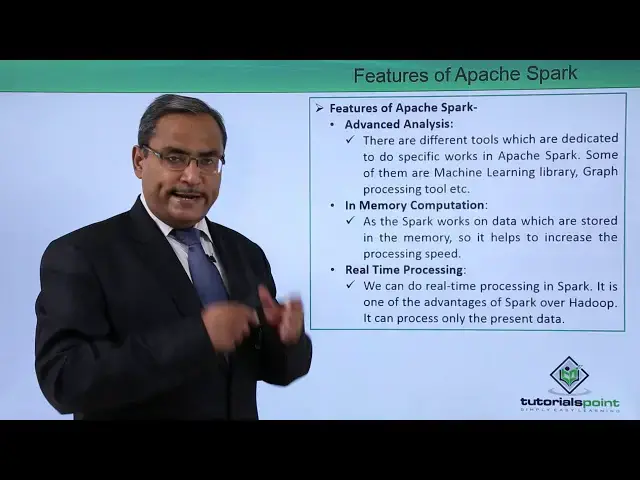
Features of Apache Spark
Show More Show Less View Video Transcript
0:00
in this video we are discussing features
0:02
of Apache spark and there are eight
0:05
different features we are going to
0:06
introduce to you so features of Apache
0:10
spark were having speed reusability
0:12
advanced analytics were having in memory
0:15
computing real-time stream processing
0:18
we're having lazy volition dynamic in
0:21
nature and also fault tolerance so these
0:24
are the eight different features spark
0:26
is having so let us discuss one by one
0:31
at was we are starting with the speed we
0:34
know that this spark is actually
0:37
lightning fast cluster computing
0:40
technology and it supports in-memory
0:42
competition so that's why it's
0:44
competition is hundred times faster than
0:48
the other technologies available so
0:50
Apache spark has a high data processing
0:53
speed by reducing the number of
0:55
read/write operations on disks it can be
0:58
hundred times faster in memory so
1:01
because there were minimized the
1:03
read/write operations on the disk so the
1:06
competitions are getting done in memory
1:08
so that's why it is hundred times faster
1:10
next one is the reusability spark codes
1:14
can be easily converted to batch
1:16
processing or join stream on historical
1:19
data and that's why it is having the
1:21
high reusability next one is the
1:27
advanced analysis advanced analysis
1:30
means there are different tools which
1:32
are dedicated to do specific walks in
1:36
Apache spark so in our in our Apache
1:39
spark components we have shown you that
1:40
in the ecosystem there are six different
1:42
components are there and those
1:44
components were those tools are
1:46
dedicated for different kinds of
1:49
analysis oriented activities so there
1:52
are different tools which are dedicated
1:53
to do specific works in Apache spark and
1:56
some of them are machine learning
1:58
library also known as ml Lib we're
2:01
having the graphics processing tool also
2:04
known as graph X and etc next one is
2:08
in-memory computation very important
2:10
feature at the SPARC works
2:12
on data which are stored in the memory
2:15
we know that memory accessing time will
2:17
be quite less compared to the disk
2:20
accessing time so as the competition is
2:22
getting done in to the memory that means
2:25
that data will be available in the
2:26
memory and during processing when the
2:28
intimated data will be produced
2:30
intermediate results will be produced
2:32
and they'll be also kept in the memory
2:34
so at the spark walks on data and which
2:37
are stored in the memory so it helps to
2:39
increase the processing speed next one
2:43
is the real-time processing we can do
2:45
real-time processing in SPARC it is one
2:48
of the advantages of spark over Hadoop
2:51
and it can process only the present data
2:54
so that means real-time processing means
2:56
depending upon the present input the
2:58
processing will be done the analysis
3:00
will be done and outputs will be
3:02
obtained next one is the Lizzie
3:06
evaluation the SPARC transformation does
3:09
not change the data on the go and only
3:12
when one action is triggered then only
3:14
that changes will be done on the actual
3:17
data so it is not it is not getting done
3:19
before initiation or before triggering
3:22
of any action when the action will be
3:25
triggered then only that respective
3:27
changes will be done on the actual data
3:29
next one is the dynamic in nature
3:32
so there are 80 high-level operations
3:35
are present in SPARC so eight T
3:36
high-level operations are present in
3:38
SPARC so we can build parallel
3:40
applications in it so applications will
3:43
be working in parallel and simultaneous
3:45
next one is about fault tolerance using
3:49
sparks code abstraction rdd's we can
3:52
handle different errors we know that in
3:55
case of a DD it is nothing but one data
3:57
structure where one data set will be
4:00
divided and will be distributed on to
4:02
multiple different servers as a result
4:05
of that the probability of data loss has
4:07
got reduced and that's why the system is
4:09
known as fault tolerance so it is it is
4:12
it reduces the data loss in our spark
4:16
system so these are the different eight
4:18
features of spie patches for which we
4:21
have discussed in this video thanks for
4:23
watching this video
#Programming