Up next in 10

Hey, friends! I assure you that about half of the bills that you pay in your dealership or repair shop come from your bad driving habits. You are literally destroying some of the systems or parts of your vehicle just by not paying attention to these habits.
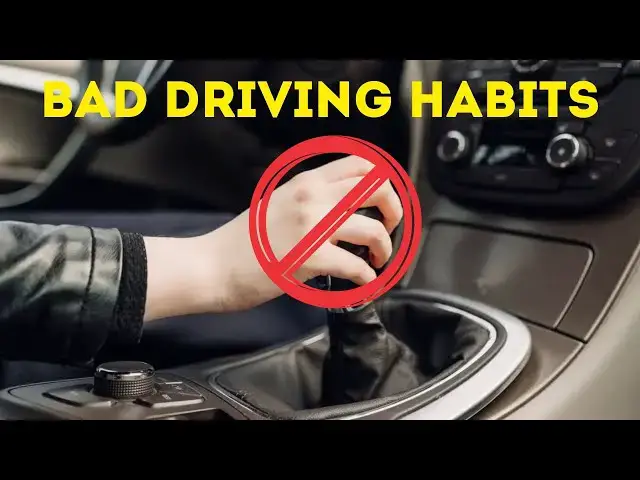
In this video, I will outline the most common bad habits that drivers have. I will tell you why mechanics never recommend keeping your hand on the gear shifter when you drive or what’s affected by overloading your trunk with various unnecessary things.
I will also tell you about other things that you probably do every single day and they affect the health of your vehicle. Some of these things can kill expensive units in your car in just a couple of seconds. Some affect your vehicle day by day and the bad effect accumulates to then pop up with a serious and expensive repair.
If you liked this video, subscribe to my channel and get updated with new videos that I publish. Thanks for your support!
Show More Show Less View Video Transcript
0:00
So, we all have some bad habits that damage our cars, but some of them are really bad,
0:05
and I want to tell you about the most common ones that I see people do.
0:10
The first thing is when you put your hand on the gear shift when you don't actually need this and
0:17
you're driving like this. The problem in a manual car is that you can damage the selector fork in a
0:25
lot of transmissions. Not in all of them, but in a lot of transmissions, you can damage the selector
0:30
fork, and this will be quite expensive repair. In an automatic transmission,
0:35
there is no selector fork. This is an electronic unit that sends information to your transmission,
0:41
but if you keep your hand on this gear shift, there is a slight chance that you
0:47
will press the button on the gear shift and move it unintentionally to some other position. When
0:53
you drive, this may easily kill your transmission in just a second. So, when you drive like this,
1:00
there is a chance of doing this. It's not a high chance, but it can happen, so avoid this.
1:07
Now, the second thing that a lot of us do is putting a lot of things in the trunk. We
1:13
don't actually control what's happening in the trunk. We put a lot of things, a lot of weight,
1:18
and we don't use the things, so we don't need them. And what happens? First of all, your gas
1:24
mileage goes down because every 100 lb of extra weight in your car cut the gas mileage by 2%.
1:34
This is an average thing I read on the internet. I don't know if it's true or not, but sounds like
1:38
true. If you put 200-300 lb of extra things that you don't use in your trunk, it will cut your gas
1:46
mileage by 4 or 6%, and that's a lot. You will be paying every single mile, you will be paying extra
1:53
money. But why? You just take those things out of your car, and you will not be paying that money.
2:00
But there is also another thing that should be considered. When you put a lot of weight
2:04
in your car and you don't center this weight, this weight goes to one side of your vehicle,
2:09
and then it starts swaying on the road. And you get extra wear on the suspension and you get
2:16
problems with steering your car, so obviously avoid putting a lot of weight in your trunk.
2:22
Now, the third thing is bumping the speed bumps. I know they are called speed bumps,
2:27
but it doesn't mean that you should bump them on a high speed. When you go over the speed
2:32
bumps on a high speed, your suspension will suffer. But there are also other things, like
2:39
your tire. Your tire can get a damage when you do this. And there is another thing - your wheel
2:45
alignment will change. It will need adjustment after that. Of course, not from the first time
2:53
when you bump over this speed bump, but if you do this regularly, your adjustment will not be okay.
3:01
Then the fourth thing: revving the engine when it's cold. I don't know,
3:06
this is kind of an old myth. Earlier cars needed to be warmed up like for 5 minutes or 7 minutes
3:15
because the engines were made of iron, and they required warming up to start driving. And a lot
3:23
of people used this trick. They stepped on the gas pedal and revved up their engines,
3:29
and these engines warmed up faster. But today, it's not the thing. First of all,
3:35
engines don't need warming up for 5 minutes or 7 minutes—30 seconds is enough. Also, these engines
3:41
are afraid of revving up when they are cold. Your oil is cold, the engine parts are cold,
3:50
the oil is not lubricating the head parts from the first 30 seconds when you start it. And this may
3:57
cause engine damage. It will not be the severe damage or fatal damage at once, but it will be
4:03
accumulating, so your engine will probably go fewer miles than it can potentially go.
4:08
OK, the fifth thing is ignoring the parking brake. I had a video about this. It told that
4:16
parking brake is important to use whenever you park your car, especially on the hill. Because,
4:22
in automatic transmissions, what holds your car on a hill when you put it in Park, there is the
4:28
system called parking pawl. It's not a very mighty system; it's just a small metal part and a gear
4:36
that hold your car from rolling back. But it will roll back if this small part is broken.
4:43
And if it's broken, there is a high chance that your transmission will require repair because it
4:48
will get directly into the transmission, and in one mile or two miles, it may just destroy your
4:55
automatic transmission. So to avoid breaking this parking pawl, always use your parking brake. Also,
5:02
this is a safety measure, and a lot of car manufacturers now say in driver's manuals,
5:08
they sat "Please apply the parking brake. It's very important". Because, first of all, your
5:13
car may roll back when it's not in parking brake and it can damage something, damage other car,
5:19
or it can even damage you if you are unloading something from your trunk at this moment.
5:24
The sixth thing I often see people doing is keeping their fuel level low, just always. So,
5:31
they buy just a couple of gallons, and that's how they drive. But the problem is that when you buy a
5:37
little fuel and your level is never higher than a half tank, your fuel pump suffers. The fuel
5:46
pumps are made to be submerged in some liquid, and this makes them cool down when they work.
5:53
If they aren't submerged in gas, there is a high chance that they will overheat. And this will not
6:00
kill them immediately, but day after day of driving with the low level of fuel in your tank,
6:08
you will be killing this fuel pump. And fuel pumps are quite expensive today. Also,
6:13
there is one more thing: when the fuel level is low, your fuel pump will take all the debris,
6:19
all the mud from the bottom of the tank and take it directly to the filter. And when the filter is
6:26
not capable of dealing with debris, with the mud, it will all go to injectors. And when injectors
6:31
are clogged, you will have to pay a lot of money to some mechanic to clean these injectors.
6:38
And the last habit that is not really cool is ignoring warning lights. When you ignore
6:45
minor problems, there is 100% chance that these minor problems will grow into huge problems,
6:51
into fatal issues. And the fatal issues will probably make you pay thousands of dollars in
6:58
a dealership or repair shop, or some of them may even lead to the death of your engine,
7:03
or transmission, or whatever. So whenever you see some warning light or error message, or whatever,
7:09
you need to understand why it's happening to your car. The best way is to go to a repair shop and
7:14
ask a mechanic to give you some information, to inspect the car and give you information
7:20
about what's happening. Of course, you may try DIY diagnostics if you know what you're doing.
#Autos & Vehicles