Up next in 10



Professor AJ Kooti explains, What is Equity in Accounting, as part of his financial accounting course series.
https://thebusinessprofessor.com/en_US/accounting-taxation-and-reporting-managerial-amp-financial-accounting-amp-reporting/shareholders-equity-definition
Show More Show Less View Video Transcript
0:00
All right, here's the last one, equity. Equity is a special type of category of accounts
0:07
This is the owner's interest in the business or the owner's claim on the assets. This is what the
0:11
owners put in or what they have at stake in the business. So if they put money into the business
0:16
this is what they have in the business. If they make money with the business, this is what they own of what they made. This equals to the assets minus the liabilities
0:25
So naturally, if you rearrange the accounting equation, that's what it comes up to is equity equals assets minus liabilities
0:32
It's, again, what they own minus what they owe. And whatever's left is what they get to keep, especially if they sell the business
0:41
This is also called net assets or residual equity. It's just another way if you hear it
0:45
That's what it's talking about. Sometimes you'll see it called stockholders' equity or stakeholders' equity as well
0:52
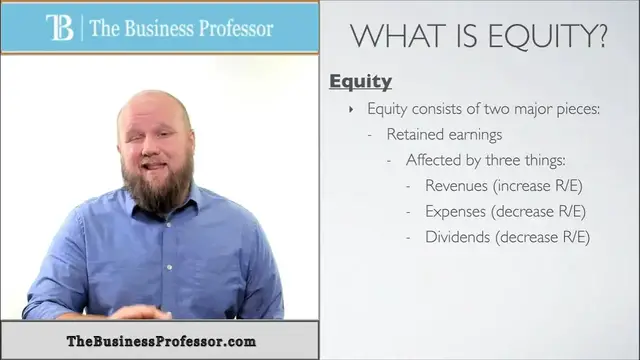
Equity comes really into two major pieces. and I talked about this in the balance sheet video
0:58
is it really comes in two pieces. You could have more things added to it, but these are the two major categories of equity
1:03
And that is one, contributing capital. So what is contributed to the company through capital
1:09
whether it be cash or equipment or whatnot And this reflects inflows of cash and other net assets from the stockholders in exchange for stock So I give you worth of cash in exchange the common stock of the business goes up
1:25
and I get that common stock. The other side of this is the retained earnings side. And again
1:30
more specifically, the ending retained earnings side. And this is affected by three things
1:34
Hopefully by now you know what those three things are that affect retained earnings. But if not
1:38
we'll go over them. The first one being revenue and revenue makes your retained earnings go up
1:43
Then you also have expenses and make sure retained earnings go down. Again, think about it from your
1:48
bank account side. Revenues makes your bank account go up. Expenses makes your bank account go down
1:53
And then we also have dividends, dividends like the birthday present to your buddy that makes
1:56
your bank account go down as well. I tell my students in my class, there's two ways that you
2:01
can go about doing this. You can try to memorize every single account that we talk about and what
2:06
it is and you'll be memorizing for a very long time, a lot of accounts, or you can really
2:11
understand and know how to classify five different things. And those five things are, is it a revenue
2:18
Is it an expense? Is it a asset? Is it a liability or is it an equity
2:22
If you can classify that, that's five things you have to learn versus the potentially hundred
2:26
that you'll have to learn in the individual accounts. So these are five great things that you need to know very much like the back of your hand
2:32
but that's equity
#Business Finance
#Venture Capital
#Finance
#Accounting & Auditing
#Bookkeeping
#Asset & Portfolio Management