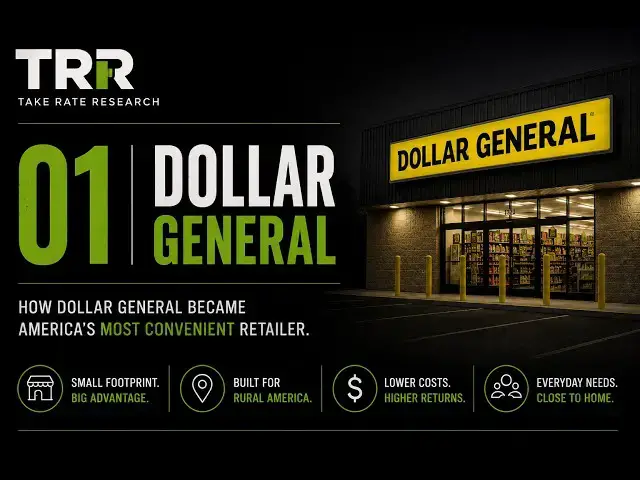

Why Dollar General Built an Empire in America's Poorest Towns
Jul 24, 2026

There's a retailer that only builds stores in the towns everyone else gave up on — too small for a Walmart, too poor for a Target, some with fewer than a thousand people. On paper, that's the worst real estate in American retail. It's also one of the most profitable expansion strategies in the country. This is Dollar General, and the towns nobody else wanted are the entire reason it wins.
Big-box retail runs on density — a Walmart Supercenter can be 180,000+ square feet, a Target over 100,000, and stores that size need thousands of nearby customers just to break even. That math falls apart in rural America, which is why whole counties became what researchers call retail deserts. The obvious guess is that Dollar General just wins on price. It doesn't — with far more buying power, Walmart could out-cheap it any day. Dollar General's edge was never that it's cheap. It's where it's cheap.
A typical Dollar General runs about 7,500–10,000 square feet — a fraction of a supercenter's footprint. That's cheap to build, cheap to lease, and it drops the break-even point low enough to turn a profit in towns a big box would go bankrupt trying to serve. About 80% of its stores sit in communities of 20,000 people or fewer, and in a lot of them, it isn't the cheapest option nearby — it's the only one. No competitor builds a second discount store where there aren't enough customers to split, so the moment Dollar General plants a flag, it effectively owns the town. Run that playbook ~21,000 times across 48 states and it adds up to over $40B a year — small, unremarkable wins, stacked at massive scale, in markets the rest of the industry wrote off.
The honest part: this dominance is genuinely contested. In many towns, Dollar General's arrival has been blamed for pushing out the last independent grocer, and a store built around shelf-stable packaged goods can deepen the food-access problems these communities already face. The strategy is ruthlessly effective — whether it's good for the towns is a real, open question.
CHAPTERS
00:00 The retailer that builds where nobody else will
00:20 Why big-box math fails in rural America
02:00 The small footprint that changes everything
05:00 The numbers: 21,000 stores, $40.6B in sales
06:00 The finding — and where the moat breaks
New Take Rate Research case study every week. Subscribe so you don't miss the next one.
Figures are based on Dollar General's reported FY2024 results and public reporting through early 2026; store counts and sales figures update quarterly and were accurate at time of research. This video is for educational and analytical purposes only and is not investment advice.
#DollarGeneral #Retail #BusinessBreakdown #TakeRateResearch
Show More Show Less #Jobs & Education