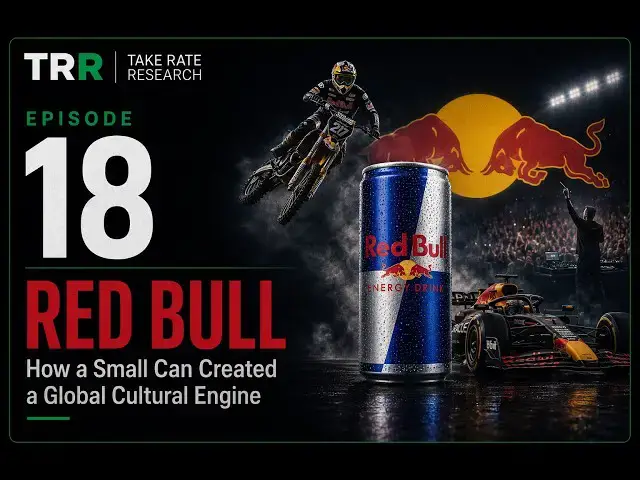

Red Bull Sells You Less for More — On Purpose
Sep 2, 2026

A can of Red Bull holds 8.4 ounces. A can of Coke holds 12. Red Bull gives you about 30% less liquid, charges 2–3x more per ounce, and sold roughly 13 billion cans last year anyway. It also owns no bottling plants — every can is made by someone else. Here's why less product, at a higher price, made from nothing it manufactures itself, turned into one of the most valuable drink brands on earth.
Soft drinks are a volume business: the liquid is nearly free, so everyone competes by selling bigger containers for less per ounce. Red Bull does the opposite on purpose. A small, premium 8-ounce can doesn't read as a drink you compare on price — it reads as a dose of something functional, which escapes the shelf where it would lose and lands in a category Red Bull invented and controls.
That reframe is only half the machine. Because Red Bull outsources production entirely, nearly every dollar it makes is free to spend on meaning instead of factories — an estimated $3B+ a year on Formula One teams, football clubs, a media studio, and 800+ sponsored athletes, rather than traditional advertising. Most companies make a product and buy attention to sell it. Red Bull manufactures the attention and attaches a product to it. The can is the souvenir.
The result: ~43% of the global energy drink market, ~$11B in net sales, and a brand valued around $10B — built by a company that makes none of its own product. But the model has real exposure: in late 2025 EU regulators opened a formal antitrust investigation into whether Red Bull worked to keep bigger, cheaper energy drinks off shelves — an allegation that lands directly on the small can's pricing power. (This is an open investigation; it does not establish wrongdoing.)
CHAPTERS
00:00 The smallest, most expensive can in the aisle
00:25 How the beverage industry normally competes
02:10 Why 8 ounces reads as a "dose," not a drink
06:20 The numbers: 13B cans, 43% market share
07:50 The finding — and the EU antitrust case
New Take Rate Research case study every week. Subscribe so you don't miss the next one.
Red Bull is privately held and discloses selectively; marketing-spend and brand-value figures here are third-party estimates, not company-confirmed. The EU antitrust matter is an open investigation, and no finding of wrongdoing has been made. This video is for educational and analytical purposes only.
#RedBull #Marketing #Business #Branding #TakeRateResearch
Show More Show Less #Jobs & Education