
Why Chick-fil-A Beats McDonald's Despite Closing Every Sunday
Jul 26, 2026

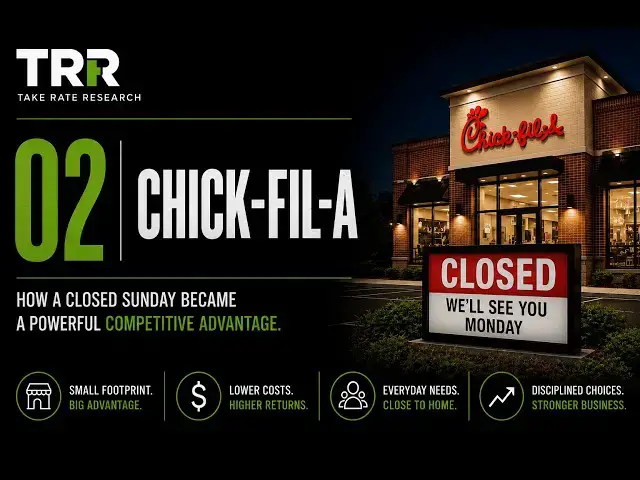
Every Sunday, one of the most profitable restaurant chains in America locks its doors — no drive-thru, no delivery, roughly 52 days a year, on one of fast food's busiest days of the week. And yet the average Chick-fil-A brings in more than double what the average McDonald's does. The day it stays closed is quietly doing work its rivals can't buy.
Fast food is a volume game — more hours open, more cars through the line, more transactions. By that logic, closing your single busiest day is close to economic malpractice. The easy explanation is that it's just a founder's tradition the company tolerates. It isn't. The Sunday closure isn't a cost Chick-fil-A absorbs — it's a lever it pulls, and neither of the two things that actually make a Chick-fil-A location print money is the chicken.
The franchise structure barely resembles a normal one. The fee to become an operator is $10,000 — the lowest in the industry — but you own nothing: Chick-fil-A owns the land, the building, the equipment, and you run exactly one restaurant, full-time, in person, with no side businesses allowed. Out of tens of thousands of applicants a year, only around 80 get in — an acceptance rate under 1%, harder than getting into Harvard. That structure manufactures owner-level obsession at every single location, because an operator's entire livelihood rides on one store they don't even own.
Sunday closure compounds it. Fast food's most expensive problem is labor turnover, and a guaranteed day off every week — free — is one of the most valuable recruiting and retention tools in the industry, one competitors would have to spend millions to match. Better-rested, longer-tenured staff means faster lines and warmer service, which in a throughput business means more sales. On top of that, squeezing a full week of demand into six days forces genuinely obsessive speed — Chick-fil-A runs some of the highest-volume drive-thrus in the country — and the closure markets the brand for free.
The result: ~$7.5M average annual sales per location (freestanding drive-thrus closer to $9M) against McDonald's ~$4M, the third-largest U.S. chain by sales at $22B+, on roughly a quarter of McDonald's store count, holding ~45% of the fast-food chicken market.
The honest part: this machine is extraordinary for the company and far more complicated for the operators, who hold no equity, can't sell or pass down the business, and work 60-hour weeks for a share of the profits — genuinely good money, but not the ownership most people imagine. Chick-fil-A's values have also drawn real controversy and boycotts over the years.
CHAPTERS
00:00 The chain that closes on its busiest day
00:20 Why that should be economic malpractice
02:00 The franchise model that isn't really a franchise
05:30 The numbers: 2x McDonald's, on a quarter of the stores
06:30 The finding: the product isn't chicken
New Take Rate Research case study every week. Subscribe so you don't miss the next one.
Show More Show Less #Jobs & Education