
Valve Has No Bosses. That's Probably Not Why It's Worth Billions.
Aug 26, 2026

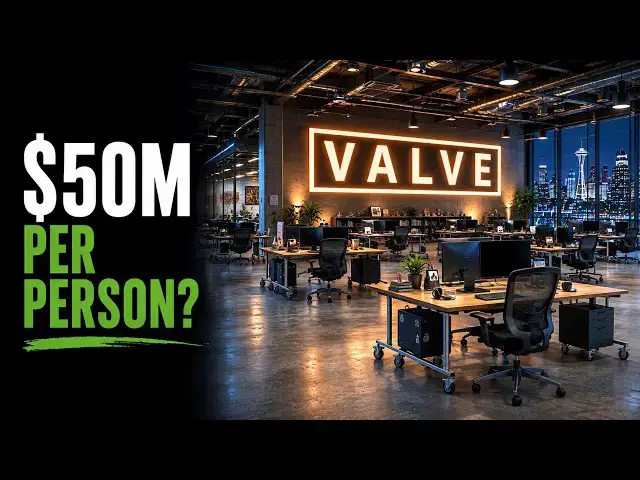
Valve has no managers, no job titles, no assigned work — employees roll their desks to whatever project interests them. It's the most celebrated management experiment in tech, and it's often credited for the company's staggering economics: roughly $50M in estimated revenue per employee, versus about $2.4M at Apple. This video makes the less comfortable argument: the flat structure almost certainly isn't why.
Hierarchy exists to solve a real problem — getting hundreds of people to coordinate on something with thousands of moving parts. Valve threw that out entirely, and "voting with your feet" is genuinely clever: a bad project can't attract believers and quietly dies, a good one staffs itself, and nobody can force a doomed initiative forward for years the way a normal executive can.
But look at what Valve actually sells. The overwhelming majority of its money doesn't come from making games — it comes from Steam, the dominant PC game marketplace, taking a 30% cut (falling to 25% and 20% at higher sales tiers) on transactions between other people. That's a take rate, and a dominant marketplace with network effects produces enormous revenue almost regardless of how the company that owns it is organized. The flat structure didn't create Valve's economics. Steam's platform position did — and it's what makes the flat structure affordable.
The evidence for the reversal is the thing gamers already know: a studio built on beloved games became famous for barely shipping any for years. A structure where nobody can assign the boring, unglamorous, decade-long work is bad at exactly that kind of work. And reporting on Valve's internal culture describes a harsher reality than the management-book version — informal power with no way to appeal it, and compensation decided by peer ranking that can become a popularity contest.
The finding: before copying a famous company's culture, work out what's actually generating the money. Very often the celebrated practice is a consequence of an advantage, not its cause.
CHAPTERS
00:00 The company where nobody has a manager
00:25 Why hierarchy exists in the first place
02:15 What Valve actually sells (it's not games)
06:20 The numbers — and the honest costs of no structure
07:50 The finding: don't imitate a symptom
New Take Rate Research case study every week. Subscribe so you don't miss the next one.
Valve is privately held and discloses no financials; revenue, headcount, and compensation figures here are third-party estimates and reported leaks, not company-confirmed. Valve faces ongoing antitrust litigation regarding its market position; these are unresolved allegations, and Valve disputes them. This video is for educational and analytical purposes only.
Show More Show Less #Jobs & Education