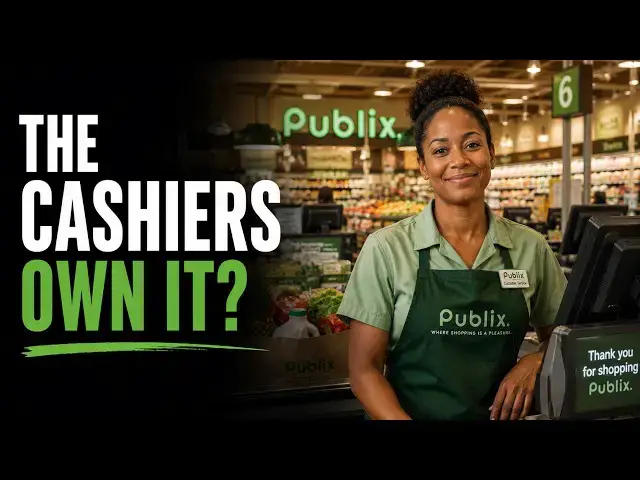

Publix's Cashiers Own the Company — and It Triples Kroger's Margin
Aug 28, 2026

Publix charges more than Walmart, gets beaten on price by Aldi in the same neighborhoods, has never done a mass layoff in 90+ years, and hands company stock — for free — to the people bagging your groceries. It's also the most profitable grocer in America, earning several times Kroger's margin. Those facts aren't a contradiction. The reason is that the cashiers own it.
Grocery is one of the worst businesses there is — a typical supermarket keeps 1–2 cents of every dollar. The standard survival playbook is to get huge, squeeze suppliers, and cut the biggest controllable cost: labor. So the industry runs on minimal hours, cheap hiring, and turnover so high most hourly staff leave within a year — churn treated not as a failure but as the cost structure.
Publix did the opposite, and it's not sentiment — it's a machine. The company is roughly 80% owned by current and former employees and the founding family, and its stock has never traded publicly. Employees don't buy in: Publix grants them stock (recently around 8% of pay) at no cost, and about 247,000 of them are shareholders. That ownership does three things. It changes behavior — when the company's value rises, so does the stock in your account, so service becomes something you have a personal stake in. It drives retention — the stock accumulates the longer you stay, so people don't leave, which eliminates the enormous hidden tax of churn and builds an experienced workforce competitors can't cheaply replicate (the current CEO started bagging groceries in 1984). And it buys patience — with no outside shareholders, there's no analyst demanding layoffs to lift a quarter, which is why the no-layoff record can even exist.
That experienced, invested staff lets Publix compete on the one thing a commodity business can't commoditize — service — and charge a premium for it. The premium funds the wages and the stock, and the loop closes. The result: about $60B in sales, 1,350+ stores, ~250,000 employees, essentially no debt, and net margins above 7% against Kroger's ~1–2% — despite Kroger being more than twice its size.
The honest limits are in the video too: the higher prices are a real cost to budget-conscious shoppers, employee ownership isn't the same as employee power (Publix is non-union, and that debate is genuine on both sides), and tying both your paycheck and your retirement to one company whose shares aren't openly traded is a real concentration risk.
CHAPTERS
00:00 The most expensive grocer is the most profitable
00:25 Why grocery treats labor as the cost to cut
02:15 What "employee-owned" actually means at Publix
06:20 The numbers: 7%+ margin vs Kroger's 1–2%
07:45 The finding: it turned its biggest cost into the product
New Take Rate Research case study every week. Subscribe so you don't miss the next one.
Publix is privately held but files with the SEC, so these figures come from its public filings; margins and financials vary year to year. This video is for educational and analytical purposes only and is not investment advice.
Show More Show Less #Jobs & Education