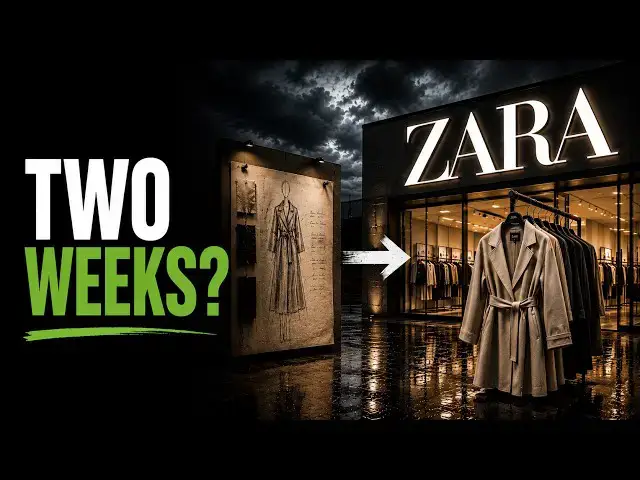

How Zara Turns a Sketch Into a Store in 2 Weeks
Aug 21, 2026

While every rival chased the cheapest labor on earth, Zara kept making a huge share of its clothes in Spain, Portugal, Turkey, and Morocco — paying far more per garment. It's also more profitable than almost all of them. Here's the counterintuitive reason why.
In fashion, the expensive part isn't making the garment — it's making the wrong one. A cheap supplier might save $3 on a $30 top, but if you guessed the trend wrong eight months ago, that top sells for $15 on the clearance rack. Markdowns, not labor, are the single biggest destroyer of profit in apparel.
Zara made the opposite trade: pay more per item to produce close to home — about two weeks from sketch to store versus the industry's ~6 months — so it can decide late, watch what actually sells, and restock winners before the trend cools. The result: parent company Inditex turns its inventory ~12 times a year (industry norm: 3–4), sells far more at full price, runs a ~58% gross margin, and earns ~€5.9B on ~€38.6B in sales — while spending famously little on advertising.
The catch: this is the machine that helped invent fast fashion, its environmental and labor costs are real, and Shein is now out-speeding the speed strategy.
CHAPTERS
00:00 The most expensive place to be wrong
00:22 Why cheap labor has a hidden cost
02:00 The markdown math: save $3, lose $15
05:45 The payoff — 12 inventory turns and 58% margins
06:50 The finding, and the Shein problem
New Take Rate Research case study every Tuesday and Friday. Subscribe so you don't miss the next one.
Figures are based on Inditex's reported FY2024 results (fiscal year ended 31 January 2025) and were accurate at time of research; company financials change. This video is for educational and analytical purposes only and is not investment advice.
#Zara #Inditex #FastFashion #BusinessBreakdown #TakeRateResearch
Show More Show Less #Jobs & Education