
How Costco Makes Billions Selling Everything at Cost
Jul 28, 2026
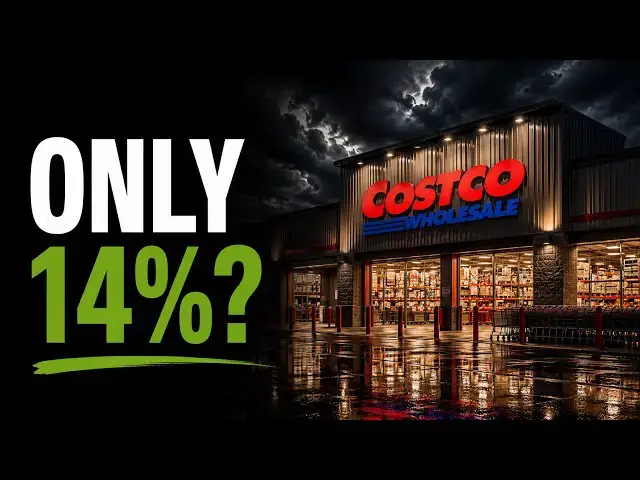
Costco caps its markup at roughly 14% on branded goods — a fraction of what a normal retailer charges. It barely turns a profit on anything it sells. And it still earns billions of dollars a year. Because Costco isn't really selling you products. It's selling you the right to buy them.
Retail is a margin business: buy low, sell higher, keep the spread. Every grocery store and big-box chain runs on widening that gap. Costco does the opposite — capping markups so hard that after warehouses, staff, and trucks, there's almost nothing left from the merchandise itself. The obvious read is "an extreme low-margin Walmart." It isn't. Where Costco's profit actually comes from barely involves the products at all.
Here's the number that reframes the whole company: membership fees bring in roughly $5B a year — only about 2% of total revenue, but by some estimates around two-thirds of operating profit. The fee costs almost nothing to collect, so the merchandise side basically exists to cover its own costs, while the real profit comes from renewals. Costco is a subscription business wearing a retailer's uniform — and the reason members renew above a 90% rate, year after year, is that the near-cost prices make the fee obviously worth paying. Cheap prices bring members in and keep them; the fees are the profit; and because the profit comes from fees, not markups, Costco has every incentive to keep prices low rather than raise them. Every other retailer profits by charging you more. Costco profits when you trust that it isn't.
That trust only works if costs stay brutally low, so everything is engineered around cheapness: ~4,000 products instead of a typical supermarket's 30,000+, bought in massive volume; bare-bones warehouses; a Kirkland private label that undercuts national brands; and — counterintuitively — above-average retail wages, because lower turnover means a more efficient workforce. Even the famous $1.50 hot dog, unchanged for decades and sold at a loss, isn't charity. It's the cheapest, stickiest loyalty program in America.
The result: $250B+ in annual sales, ~905 warehouses worldwide, ~81 million paid member households, and a renewal rate north of 90%. The honest limit: this only works at massive scale and with total discipline — it quietly excludes people who can't afford the fee or bulk buying, and Costco is permanently trapped by its own promise, since marking things up even slightly would break the trust the whole model runs on.
CHAPTERS
00:00 The retailer that refuses to make money on you
00:20 Why capping your own markup should be bad business
02:00 The number that reframes the whole company
05:30 The results: $250B+ in sales, 90%+ renewal
06:30 The finding: a membership that happens to run a store
New Take Rate Research case study every week. Subscribe so you don't miss the next one.
Costco is publicly traded (NASDAQ: COST); figures are from its 10-K and quarterly earnings reports and were accurate at time of research. Financials update quarterly. This video is for educational and analytical purposes only and is not investment advice.
Show More Show Less #Jobs & Education