0:00
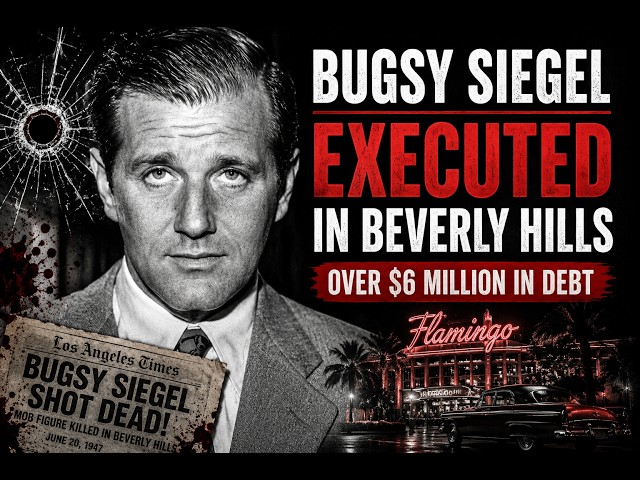
June twentieth, nineteen forty-seven. 810 North Linden Drive, Beverly Hills.
0:07
Benjamin Siegel sat on a chintz sofa in Virginia Hill's living room, reading the Los Angeles
0:16
The evening was warm. The windows were open.
0:19
At approximately nine forty-five p.m., nine rounds from a .30 caliber military carbine came
0:27
through the front window.
0:30
Four struck him in the head and torso. He died instantly.
0:35
The newspaper was still in his hands.
0:43
When police arrived, they found no signs of forced entry. No struggle.
0:49
No witnesses who would speak. The shooter had fired from the rose garden.
0:54
Distance: approximately fifteen feet. Then vanished into the night.
1:00
Beverly Hills detectives cataloged the scene with methodical precision.
1:05
Blood spatter patterns. Bullet trajectory. Shell casings in the garden soil.
1:12
But the forensic detail only confirmed what everyone already knew. This was not a robbery.
1:19
Not a crime of passion. This was an execution.
1:23
Within twenty minutes of the shooting—before the body was even removed—three men walked into
1:30
the Flamingo Hotel in Las Vegas.
1:33
They carried no weapons. No court orders.
1:36
They simply informed the management that ownership had changed. The transfer was immediate.
1:44
Undisputed. Institutional. The timing was not coincidental.
1:49
This documentary uses court records, FBI files, witness testimony, and archival sources to
1:57
reconstruct Bugsy Siegel's rise and fall.
2:00
Some dialogue is based on documented accounts. Where evidence is incomplete, we say so.
2:08
The newspapers called him "Bugsy"—a nickname he despised.
2:13
They described him as a gangster, a ladies' man, a Hollywood hanger-on who got in over his
2:21
But that version—colorful, cinematic, convenient—misses the architecture beneath.
2:27
Benjamin Siegel was not a reckless dreamer. He was a founding member of Murder Incorporated.
2:34
A Syndicate board member.
2:36
A man trusted to carry out the organization's most irreversible decisions.
2:42
And for nearly twenty years, he had been untouchable.
2:46
So what changed? Why did the Syndicate—an organization he helped build—decide he had to die?
2:54
The answer lies not in Hollywood myth, but in accounting.
2:58
Not in personality, but in power structure. And it begins long before Las Vegas...
3:10
Benjamin Siegel was born February twenty-eighth, nineteen oh-six, in the Williamsburg
3:19
His parents, Max and Jennie, were Jewish immigrants from the Austro-Hungarian Empire.
3:25
They ran a small shop. The family lived above it.
3:29
The neighborhood was dense, poor, and divided along ethnic lines. Italian. Irish. Jewish.
3:36
Each block had its own economy. Its own rules.
3:40
And young Benjamin learned early that respect was not given. It was taken.
3:46
Sometime around nineteen eighteen, he met Meyer Lansky.
3:50
Lansky was small, bookish, physically unimposing.
3:54
Siegel was the opposite—athletic, volatile, handsome.
3:58
But they recognized in each other something rare: ambition married to discipline.
4:04
According to FBI records, by age sixteen they were running a protection racket targeting
4:12
By eighteen, they controlled gambling operations across three boroughs. It was not a gang.
4:21
A federal prosecutor once asked Meyer Lansky to describe his relationship with Siegel.
4:28
Lansky's answer was precise. Ben and I understood each other. We came from the same streets.
4:35
We knew what it meant to be hungry.
4:38
And we agreed on one thing—we would never be hungry again.
4:43
By the late nineteen twenties, Prohibition had transformed American organized crime.
4:49
What had been neighborhood operations became interstate supply chains. Liquor importation.
4:56
Distribution networks. Enforcement.
4:59
Lansky and Siegel became essential to what would later be called the National Crime
5:06
Syndicate—a coalition of Jewish and Italian mobsters who agreed to replace ethnic warfare
5:13
with coordinated profit.
5:15
The architects included Lansky, Siegel, Charles "Lucky" Luciano, and Frank Costello.
5:21
And they needed an enforcement mechanism.
5:25
Murder Incorporated was not a formal name. It was a press invention.
5:31
But the organization it described was real.
5:34
A group of contract killers—based in Brownsville, Brooklyn—available to Syndicate leadership
5:41
for disciplinary actions.
5:43
Benjamin Siegel was not just a client. He was one of its operators.
5:49
FBI files document his involvement in multiple contract killings between nineteen thirty and
5:56
nineteen thirty-seven.
5:58
The targets were not civilians. They were Syndicate members who had violated internal rules.
6:05
Skimmed money. Spoke to authorities. Betrayed trust.
6:10
This is where the myth and the man begin to separate.
6:14
Hollywood would later frame Siegel as a charming rogue. A dreamer.
6:19
A visionary who just wanted to build something.
6:23
But the documentary record—wiretaps, witness testimony, forensic evidence—shows something
6:31
He was an enforcer. A killer.
6:33
A man who understood that the Syndicate's entire economy rested on the credible threat of
6:40
irreversible violence.
6:42
And for years, he delivered that threat without hesitation.
6:49
By nineteen thirty-seven, law enforcement pressure in New York was intensifying.
6:56
District Attorney Thomas Dewey had begun dismantling Syndicate operations. Wiretaps. Raids.
7:03
Grand jury subpoenas. The organization needed new geography.
7:07
California—with its gambling ships, racetracks, and Hollywood money—offered opportunity.
7:14
And Benjamin Siegel, with his looks and charm, was the logical choice to open the territory.
7:22
A retired FBI agent who tracked Siegel's movements described the transition.
7:27
Siegel wasn't sent to Los Angeles to hide. He was sent to build.
7:32
To establish the Syndicate's presence on the West Coast.
7:36
To make connections with local politicians, union leaders, and entertainment figures.
7:41
He wasn't running. He was expanding.
7:49
In nineteen thirty-seven, Benjamin Siegel arrived in Los Angeles and did something unusual
7:58
He rented a mansion in Beverly Hills. He joined a country club. He had his teeth fixed.
8:04
He cultivated friendships with actors, studio executives, and directors.
8:10
He was seen at Ciro's nightclub, at Santa Anita racetrack, at private parties in the
8:18
And the Hollywood community—accustomed to reinvention, to people with invented
8:26
Publicly, Siegel presented himself as a businessman. A sportsman. A man of refinement.
8:33
Privately, he was building the Syndicate's West Coast infrastructure.
8:39
Offshore gambling ships. Wire services for bookmakers. Narcotics importation routes.
8:48
FBI surveillance logs from this period show a man living two lives simultaneously—and
8:55
maintaining both with discipline.
8:58
He became genuinely close with actors like George Raft and Cary Grant.
9:03
They were not mob associates. They were friends.
9:07
Raft, himself from a rough New York background, saw Siegel as authentic. Charismatic.
9:14
Someone who had "made it" on his own terms.
9:17
What Raft didn't see—or chose not to—was the violence that funded the lifestyle.
9:24
A studio executive who knew Siegel socially later gave testimony. Ben was charming.
9:30
Impeccably dressed. He could talk about horses, about film production, about politics.
9:37
You'd never know what he really was. And maybe that was the point.
9:42
Maybe he was trying to become something else.
9:46
In nineteen forty-one, Siegel met Virginia Hill.
9:50
She was a former Alabama beauty queen who had become a courier and associate for the Chicago
9:58
She understood the world he came from. She asked no questions about his business.
10:04
And she became both his lover and, according to FBI reports, a financial intermediary for
10:12
Their relationship was volatile. Public. Glamorous.
10:16
And it would later place her at the center of the investigation into his death.
10:22
Here was the central tension of Siegel's Hollywood years.
10:26
He wanted the legitimacy, the social acceptance, the glamour of high society.
10:32
But he funded it with Syndicate rackets. With violence.
10:37
With the same structures he'd built in Brooklyn.
10:40
He believed he could inhabit both worlds indefinitely. The Syndicate believed otherwise.
10:51
By nineteen forty-five, the Syndicate was looking for new revenue streams.
10:56
Wartime prosperity had created a gambling boom.
11:00
But East Coast operations faced constant legal pressure.
11:04
Nevada had legalized casino gambling in nineteen thirty-one.
11:09
But outside of Reno, the infrastructure was minimal. Las Vegas was a desert railroad town.
11:16
Population: eight thousand. Meyer Lansky saw potential. A city where gambling was legal.
11:23
Where casinos could operate openly, without police raids or payoffs.
11:28
And he asked Benjamin Siegel to explore it.
11:32
Years later, Lansky described the initial vision.
11:36
We weren't thinking about what Las Vegas became. We were thinking about a legal operation.
11:43
A place where we could run a clean casino and not worry about the cops shutting us down.
11:50
Ben understood the assignment.
11:52
But somewhere along the way, he lost sight of whose money he was spending.
12:03
In nineteen forty-five, Siegel took over a stalled casino project on the Los Angeles
12:09
Highway, south of downtown Las Vegas.
12:12
The original developer had run out of money.
12:16
The Syndicate bought the site and asked Siegel to finish it. The plan was modest.
12:22
A small casino. A hotel. A restaurant. Budget: one million dollars.
12:27
But Siegel had a different vision.
12:31
He renamed the project the Flamingo—reportedly after Virginia Hill's nickname.
12:37
And he began expanding the design. He wanted luxury suites. A showroom. A swimming pool.
12:44
Air conditioning in every room. Imported fixtures. The finest materials available.
12:51
He was not building a desert casino. He was building a monument.
12:57
Construction costs spiraled immediately. Wartime material shortages drove up prices.
13:04
Contractors inflated invoices.
13:07
Some materials disappeared from the site and were sold on the black market.
13:13
According to FBI financial analysis, Siegel was either unable or unwilling to control the
13:21
By mid-nineteen forty-six, the budget had doubled. Then tripled.
13:26
The Syndicate demanded explanations.
13:29
A contractor who worked on the Flamingo later testified before a Nevada gaming commission.
13:35
Ben wanted everything perfect. If a tile wasn't right, rip it out and start over.
13:41
If the wood grain didn't match, replace it. He didn't care what it cost.
13:46
And some of us—I'll be honest—we took advantage of that.
13:50
By late nineteen forty-six, the Flamingo had consumed over five million dollars in Syndicate
13:59
Meyer Lansky flew to Las Vegas to inspect the site personally.
14:04
What he found was a construction zone. Incomplete rooms. Unfinished infrastructure.
14:11
No clear timeline for opening. And Siegel, according to witnesses, defensive. Dismissive.
14:18
Insistent that the vision required patience.
14:22
The Syndicate ordered Siegel to open the casino by the end of the year—finished or not.
14:29
He chose December twenty-sixth, nineteen forty-six. It was a catastrophic decision.
14:36
The Flamingo's opening night was designed to be a spectacle. Jimmy Durante performed.
14:42
Xavier Cugat's orchestra played. Hollywood celebrities were flown in.
14:47
But the hotel rooms weren't finished. Guests had to stay elsewhere.
14:52
The showroom wasn't complete. The restaurant was barely functional.
14:57
And worst of all—the casino lost money. High rollers won heavily at the tables.
15:03
Some suspected the games were rigged in the players' favor—either through incompetence or
15:11
A casino manager present that night later described the atmosphere. It was chaos.
15:16
The dealers weren't trained. The cashiers didn't know the procedures.
15:20
And Ben was walking around like everything was perfect, while the money was flying out the
15:27
You could feel it in the room—this wasn't a grand opening. This was a disaster.
15:32
Two weeks later, Siegel shut the Flamingo down. Officially, it was for renovations.
15:38
Unofficially, it was because the Syndicate refused to provide more operating capital until
15:45
he could prove the casino was viable.
15:48
He had built a palace in the desert. But he had not built a profitable business.
16:01
The Syndicate operated on cold arithmetic. Money invested. Money returned. Profit margin.
16:08
Timeline. Siegel had consumed over six million dollars.
16:13
He had produced a closed casino and a trail of debts.
16:17
And there were whispers—never proven—that he had skimmed funds.
16:22
That Virginia Hill had deposited Syndicate money in Swiss bank accounts.
16:28
Whether true or not, the suspicion was enough.
16:33
In early nineteen forty-seven, Syndicate leadership convened in Havana, Cuba. Meyer Lansky.
16:40
Frank Costello. Charles Luciano. And others. The subject: Benjamin Siegel.
16:46
According to multiple accounts, Lansky defended him. Argued for patience.
16:52
Pointed out that Siegel had been loyal for twenty years. But the consensus was clear.
16:59
Siegel had mismanaged Syndicate funds. He had ignored warnings. He had become a liability.
17:06
And in the Syndicate's internal logic, there was only one remedy.
17:17
Between March and June nineteen forty-seven, Benjamin Siegel reopened the Flamingo.
17:24
He fired staff. He tightened procedures.
17:27
He spent fourteen-hour days on the casino floor, watching every table, every transaction.
17:34
And slowly, the numbers began to improve. By May, the casino was turning a small profit.
17:41
Siegel believed he could save himself with accounting.
17:46
If he could demonstrate profitability—if he could show that the Flamingo would eventually
17:52
recoup the Syndicate's investment—he would be safe.
17:56
He sent financial reports to Lansky. He requested more time. He promised returns.
18:02
He did not understand that the decision had already been made.
18:08
An FBI wiretap from May nineteen forty-seven captured a conversation between two Syndicate
18:17
The transcript, declassified decades later, is chilling. Ben thinks numbers will save him.
18:24
He doesn't get it. This isn't about the money anymore. It's about respect.
18:31
It's about what happens when you stop listening.
18:36
In mid-June nineteen forty-seven, Siegel flew to Los Angeles.
18:40
Virginia Hill left for Europe the same week—a trip FBI agents later believed was
18:47
orchestrated to remove her from the scene.
18:50
Siegel stayed at her Beverly Hills mansion. He met with attorneys.
18:56
He reviewed financial documents. He made phone calls to Las Vegas.
19:01
He behaved, according to surveillance logs, like a man who believed he still had a future.
19:09
On the evening of June twentieth, Siegel had dinner with an associate at a nearby
19:16
He returned to the Linden Drive house around nine-thirty p.m. He sat on the sofa.
19:23
He picked up the newspaper. And at nine forty-five, the shooting began.
19:29
The Los Angeles Police Department launched a homicide investigation.
19:34
They interviewed neighbors. They processed the crime scene. They followed leads.
19:40
But no witnesses came forward. No physical evidence pointed to a specific shooter.
19:46
The case was never solved.
19:48
A detective assigned to the case later admitted the obvious. We knew it was a mob hit.
19:55
We knew it was ordered from the top. But knowing and proving are different things.
20:01
Nobody talked. Nobody saw anything.
20:04
And frankly, nobody in the organization cared if we solved it or not.
20:10
The message had been sent.
20:12
Within an hour of the shooting, the Flamingo was under new management.
20:18
The transition was seamless. No violence. No confusion.
20:22
The Syndicate had planned the succession before the trigger was pulled.
20:28
And the casino—now free from Siegel's expensive vision—began generating consistent profit.
20:38
The Syndicate's decision to kill Benjamin Siegel was not emotional. It was structural.
20:45
He had violated the organization's core principle: money flows up, accountability flows
20:53
He had spent the Syndicate's capital as if it were his own. He had ignored warnings.
20:59
He had prioritized his vision over their profit.
21:03
And in an organization built on enforcement, there could be no exceptions.
21:09
Not even for a founding member.
21:16
Three years after Siegel's death, the Las Vegas Strip was unrecognizable.
21:22
The Desert Inn opened. The Sands. The Sahara.
21:25
Each casino followed the blueprint Siegel had sketched—luxury, entertainment, spectacle.
21:32
But each was built with better management. Tighter accounting. Syndicate oversight.
21:39
The vision had been correct. The execution had been fatal.
21:44
By nineteen fifty, the Flamingo was one of the most profitable casinos in Nevada.
21:51
The debts were repaid. The Syndicate earned back its investment many times over.
21:57
The palace Siegel built became exactly what he promised—just not under his name.
22:04
A historian specializing in Las Vegas development explained the irony.
22:09
Bugsy Siegel is credited with inventing modern Las Vegas. And in a sense, he did.
22:15
He saw what the city could be. But he didn't live long enough to see it happen.
22:21
The men who killed him became the ones who profited from his vision.
22:26
Over the decades, Benjamin Siegel became a mythological figure. Books. Films.
22:32
Television shows. Each iteration smoothing the edges. Romanticizing the violence.
22:39
Framing him as a tragic visionary.
22:42
The real man—a killer, an enforcer, a Syndicate operator—disappeared beneath the Hollywood
22:50
But the documentary record tells a different story.
22:54
A man who helped build Murder Incorporated. Who carried out contract killings.
23:00
Who enforced Syndicate discipline without hesitation.
23:04
A man who believed his charm and vision made him indispensable.
23:09
And who learned, too late, that in the Syndicate's arithmetic, no one is indispensable.
23:17
Some questions remain unresolved. Did Siegel skim Syndicate funds?
23:22
FBI investigations suggested it, but never proved it.
23:27
Did Virginia Hill know the killing was coming?
23:30
Her sudden departure suggests awareness, but she never testified. Who pulled the trigger?
23:38
Multiple names have been suggested. None confirmed. The uncertainties are part of the story.
23:49
The Syndicate continued for decades after Siegel's death.
23:54
Las Vegas became the most profitable illegal enterprise in American history.
24:00
The Flamingo, the Sands, the Stardust—each generated millions in revenue.
24:06
Much of it skimmed, laundered, distributed to Syndicate families across the country.
24:13
The system Siegel helped build outlived him by generations.
24:18
In the end, Benjamin Siegel's story is not about glamour or vision.
24:23
It is about the price of ambition within a system that valued loyalty over innovation.
24:30
Profit over personality. Discipline over dreams. He built an empire in the desert.
24:37
But he built it with other people's money.
24:40
And when he could not deliver their return, the system did what it was designed to do.
24:49
June twentieth, nineteen forty-seven. A chintz sofa. A newspaper.
24:54
Shattered glass catching the late afternoon sun.
24:58
Benjamin Siegel died the way he had lived—violently, suddenly, and on someone else's terms.
25:06
The Flamingo's neon sign still stands in Las Vegas. His name does not appear on it.