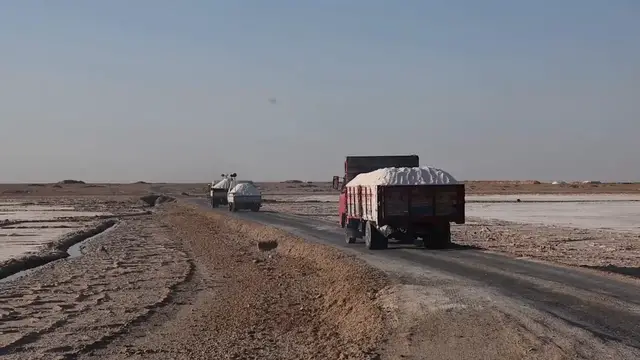

Syria: Salt workers toil under scorching sun in Syria's Deir ez-Zor Desert.
Sep 15, 2026
SHOTLIST DEIR EZ-ZOR, SYRIA (SEPT. 10, 2026) 1. VARIOUS DRONE SHOTS OF TRUCK CARRYING SALT AND DRIVING THROUGH SALT FIELDS (MUTED) 2. VARIOUS OF SALT WORKERS SHOVELING SALT INTO WHEELBARROWS AND DUMPING IT ONTO PILE 3. CLOSE OF SALT IN WORKER'S HANDS 4. (SOUNDBITE) (Arabic) SALT WORKER BILAL MUSTAFA, SAYING: “We work in the salt fields as laborers. When we arrive, we start by shoveling the salt. The work is somewhat difficult and physically demanding. We remain under the sun for about two or three hours until we manage to produce one quintal (100 kg)” 5. WHITE FLASH 6. (SOUNDBITE) (Arabic) SALT WORKER BILAL MUSTAFA, SAYING: “The second quintal can keep you working until noon. Sometimes, you cannot finish it without exhausting yourself completely. The work is extremely hard. There are no other jobs. We were told that factories would open there, and factories for [unclear] were eventually opened.” 7. WHITE FLASH 8. (SOUNDBITE) (Arabic) SALT WORKER BILAL MUSTAFA, SAYING: “We went back to working in the salt fields. The difficulty of the work is beyond description. It is extremely hard. On a day like today, we spend the entire day working with salt. We may manage to produce a quintal, or we may not.” 9. WHITE FLASH 10. (SOUNDBITE) (Arabic) SALT WORKER BILAL MUSTAFA, SAYING: “After producing one quintal (100 kg), we move on to the water and irrigate it. The next morning, we return and do the same work again. We spend the whole day scooping salt from the basin with a shovel. Salt work is extremely difficult; its hardship is beyond description. It is exhausting labor.” 11. WHITE FLASH 12. (SOUNDBITE) (Arabic) SALT WORKER BILAL MUSTAFA, SAYING: “The daily wage ranges from 50 to 75. You are paid by the quintal. For example, if you produce one quintal that day, you receive 50. If you do not complete it, you receive 25. This is what salt work is like.” 13. VARIOUS OF TRUCKS CARRYING SALT 14. (SOUNDBITE) (Arabic) SALT WORKER USAMA SAMER, SAYING: “First, we dig a pit. Then we turn on the pump, bring up water and irrigate it. After that, we leave it for two or three days until the water turns into salt. Then we collect the salt using shovels and wheelbarrows, move it onto the raised path and load it into the vehicle.” 15. WHITE FLASH 16. (SOUNDBITE) (Arabic) SALT WORKER USAMA SAMER, SAYING: “The season lasts roughly from the end of winter until the beginning of the next winter, meaning we only work during the summer. As soon as it starts raining, the work stops completely. From the time we arrive, we work for about five hours and earn 50,000 for the entire day’s work.” 17. SALT TRADER MOHAMMED ALI SHOVELING SALT ONTO TRUCK (2 SHOTS) 18. MEDIUM OF SALT ON TRUCK 19. WATER FLOWING FROM HOSE ONTO SALTY GROUND 20. TOP SHOT OF SALT PIT 21. (SOUNDBITE) (Arabic) SALT TRADER MOHAMMED ALI, SAYING: “Yes, the hardship we face here in the salt fields is severe. We transport about seven tons of salt, and each ton sells for 10 dollars, making a total of 70 dollars. From that amount, we have to pay for 30 liters of diesel, which costs around 375,000. We also need about 1.2 million just for the fuel used by the salt-lifting machine. In addition, we pay the workers 150,000 each week.” 22. WHITE FLASH 23. (SOUNDBITE) (Arabic) SALT TRADER MOHAMMED ALI, SAYING: “Yes, and the road from here is also quite difficult. It takes about three and a half hours to get from here to the boats.” 24. REPORTER: “Three hours, seventy kilometers?” 25. (SOUNDBITE) (Arabic) SALT TRADER MOHAMMED ALI, SAYING: “Seventy kilometers, yes.” 26. VARIOUS OF WORKERS SHOVELING SALT DEIR EZ-ZOR, SYRIA - SEPT. 10: Workers in the Deir ez-Zor Desert along the Syria-Iraq border are enduring extreme heat, dust and physically demanding conditions to extract salt and earn a living for their families. Starting work at first light, laborers dig into the hard ground using hand tools to reach salt deposits beneath the surface. The process requires considerable physical effort, with workers spending hours digging, collecting and transporting the salt under the scorching sun. Salt production remains an important source of income for residents in the area, where workers say employment opportunities in other sectors are limited. On Sept. 10, Bilal Mustafa, one of the workers, told Anadolu that producing even a small amount of salt can require hours of strenuous labor. "The work is difficult and physically demanding. We remain under the sun for about two or three hours until we manage to produce one quintal (100 kg.) The second quintal can keep you working until noon," Mustafa said. "Sometimes you cannot finish it without exhausting yourself completely. The difficulty of the work is beyond description," he added. Mustafa said workers are generally paid according to the amount of salt they produce, meaning their daily income can vary depending on productivity. Another worker, Usam
Show More Show Less