
China: Rose farming in west China's Qinghai-Xizang Plateau paves path to prosperity for women.
Jun 11, 2026
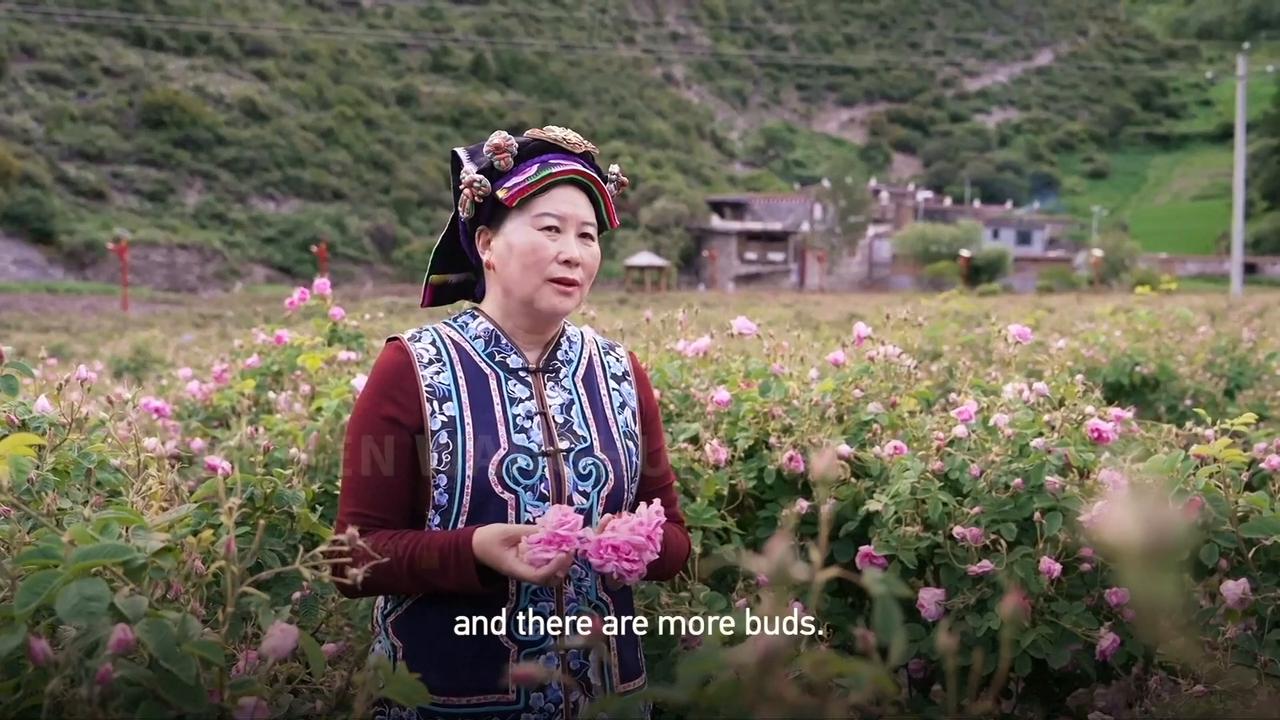
Shotlist Xiaojin County, Aba Tibetan and Qiang Autonomous Prefecture, Sichuan Province, southwest China - Recent (CGTN - No access Chinese mainland) 1. Aerial shot of rural scenery 2. Various of rose field, roses, growers picking roses 3. SOUNDBITE (Chinese) Li Deqin, flower farmer (starting with shot 2/partially overlaid with shot 4): "Life used to be really hard. Women stayed home with the kids, relying on the men to earn money. Now, with roses, we women can earn our own income, and no longer have to ask the men for it." ++SHOT OVERLAYING SOUNDBITE++ 4. Various of local residents picking roses in half dark of early morning ++SHOT OVERLAYING SOUNDBITE++ 5. Various of local residents picking roses 6. Roses 7. SOUNDBITE (Chinese) Chen Wanghui, village Communist Party official; entrepreneur (starting with shot 6): "Forget gold. As long as it does better than our potatoes and beans, I'm happy." 8. Various of local residents packaging rose petals 9. SOUNDBITE (Chinese) Chen Wanghui, village Communist Party official; entrepreneur (starting with shot 8/ending with shots 10-12): "Our rose petals are thicker, the blooms are bigger, and there are more buds. We irrigate with snowmelt water and use farmyard manure." 10. Roses 11. Snowmelt water 12. Aerial shot of rose field, roses 13. Various of workers, facilities, roses being processed in factory 14. SOUNDBITE (Chinese) Chen Wanghui, village Communist Party official; entrepreneur (starting with shot 13): "It takes about 300 roses to produce a single drop of essential oil. This is the legendary 'liquid gold' that inspired me to plant them." 15. Various of rose field, roses 16. Workers processing rose in factory 17. SOUNDBITE (Chinese) Chen Wanghui, village Party official; entrepreneur (starting with shots 15-16): "We've become stricter about planting and processing. Only by setting high standards can we reach the market and open a broader path." 18. Various of rose field, roses 19. SOUNDBITE (Chinese) Chen Wanghui, village Party official; entrepreneur (partially overlaid with shot 20): "This is nature's gift. When I see so many villagers smiling because of these roses, I want to give everything I have and hold nothing back." ++SHOT OVERLAYING SOUNDBITE++ 20. Aerial shots of rose field, roses, villagers, tourists ++SHOT OVERLAYING SOUNDBITE++ 21. Various of rose products on display Storyline Rose farming in a remote west Chinese village on the Qinghai-Xizang Plateau, the world's highest plateau, has paved a path to prosperity for local women. In China's western regions like Sichuan, Yunnan, and Xizang, women have become a growing force in agriculture-based industries. It’s not just about growing the economy. It’s about bringing opportunity, and a sense of dignity, to people once left behind. Xiaojin County of southwest China's Sichuan Province locates at the foot of the Jiajin Mountain, with an average altitude of nearly 3,000 meters. Most villagers here used to scrape a living with the traditional crops, like potatoes and peas, which were often ruined by wild boars. However, the villagers have turned to rose planting as a means of sustenance in Xiaojin County today. There are very few vast fields of roses stretching as far as the eyes can see. But here, what dominates are these small, family-run rose plots. That means these farmers, mostly women and the elderly, can work right outside their home, tend to their fields, and look after their family at the same time. "Life used to be really hard. Women stayed home with the kids, relying on the men to earn money. Now, with roses, we women can earn our own income," said Li Deqin, a flower farmer in Xiaojin County. It all started with a woman some 15 years ago, Chen Wanghui, a village Communist Party official, an entrepreneur, known simply as the "Rose Sister". She was informed that planting roses would be much more profitable as the rose essence oil was considered as precious as gold. But she wasn't dreaming so big. "Forget gold. As long as it does better than our potatoes and beans, I'm happy," Chen said. Chen decided to change the situation at the time. She bought rose saplings herself and invited experts to teach the villagers how to grow roses. Subsequently, she set up a cooperative and promised to purchase the roses at above-market prices. Confident in the quality of these blooms, Chen pays about 30 percent above China's average market price. "Our rose petals are thicker, the blooms are bigger, and there are more buds. We irrigate with snowmelt water and use farmyard manure," Chen said. At a local factory, the roses take on new lives. The freshest blooms are hand-selected for flower tea, while the rest are distilled into essential oil and rose water -- bound for cosmetics and food. "It takes about 300 roses to produce a single drop of essential oil. This is the legendary 
Show More Show Less