
China: China-U.S. researchers rebuild extinct ancient horse in 3D.
Sep 14, 2026
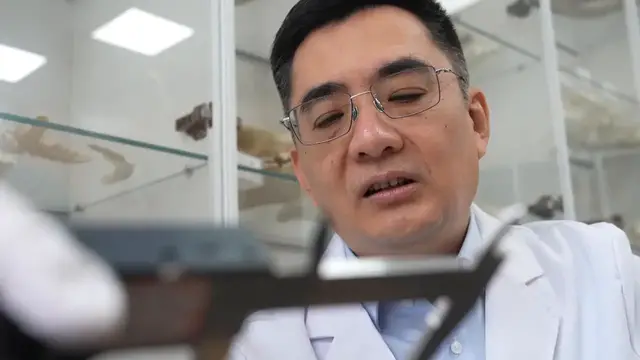
Shotlist Changchun City, Jilin Province, northeast China - Recent 1. Digital model of fur, coat color reconstruction of extinct ancient horse 2. 3D fossil scanning in progress 3. Skeleton of extinct ancient horse reconstructed by computer 4. Sign of School of Archaeology, Jilin University 5. Sign of Bioarchaeology Laboratory 6. Various of Cai Dawei, professor of Bioarchaeology Laboratory, working with fellow researcher 7. SOUNDBITE (Chinese) Cai Dawei, professor, Bioarchaeology Laboratory, Jilin University (ending with shot 8): "We are the first to take the process from the study of extinct animals — starting with genetic identification, moving to the analysis of skeletal morphology, and culminating in 3D reconstruction. Many obscure extinct species cannot be distinguished based on morphology alone; they can only be identified through ancient DNA technology (extracting DNA from ancient biological remains). Once identified, these species will enrich our understanding of ecological diversity." 8. Various of Cai working with others; checking fossils Storyline A China-U.S. research team has, for the first time, reconstructed the full appearance of an extinct ancient horse, known as Equus ovodovi, giving a face to a species that had puzzled scientists for over a century. Jilin University in northeast China on Sept 10 unveiled a 3D image of the animal, a brown-furred creature about the size of a donkey. According to the university, using ancient DNA data and comparative anatomy, its bioarchaeology laboratory carried out the reconstruction in collaboration with U.S. company Evolutio LLC. This joint work fills a gap in terms of what this animal looked like, and establishes a complete research chain from ancient DNA to visual reconstruction, the university said. The horse fossils, dating back roughly 40,000 years, were first found in a cave in southwestern Siberia in Russia. Initially, only broken jawbones and teeth were discovered, without a complete skull. Over the years, related fossils have also been unearthed in North America, Africa, Siberia and northeast China. However, because the bones were scattered fragments, the animal's true appearance had remained a mystery for more than 100 years. In 2022, Chinese researchers at Jilin University and Northwest Agriculture and Forestry University in northwest China's Shaanxi Province successfully extracted high-quality gene data from the fossils. Building on that work, they worked with American researchers in 2026, comparing the fossil data with living species, such as the Asian wild donkey and domestic horse. They reconstructed the skeleton, built up muscle structure, and eventually recreated the animal's full appearance. "We are the first to take the process from the study of extinct animals — starting with genetic identification, moving to the analysis of skeletal morphology, and culminating in 3D reconstruction. Many obscure extinct species cannot be distinguished based on morphology alone; they can only be identified through ancient DNA technology (extracting DNA from ancient biological remains). Once identified, these species will enrich our understanding of ecological diversity," said Cai Dawei, a professor of Bioarchaeology Laboratory, Jilin University. [Restrictions: No access Chinese mainland]
Show More Show Less